Consultation Paper on UAS Projects for 2022 30Th July 2021
Total Page:16
File Type:pdf, Size:1020Kb
Load more
Recommended publications
-
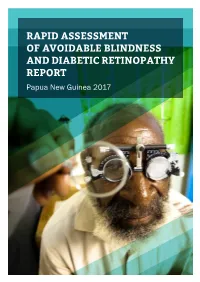
RAPID ASSESSMENT of AVOIDABLE BLINDNESS and DIABETIC RETINOPATHY REPORT Papua New Guinea 2017
RAPID ASSESSMENT OF AVOIDABLE BLINDNESS AND DIABETIC RETINOPATHY REPORT Papua New Guinea 2017 RAPID ASSESSMENT OF AVOIDABLE BLINDNESS AND DIABETIC RETINOPATHY PAPUA NEW GUINEA, 2017 1 Acknowledgements The Rapid Assessment of Avoidable Blindness (RAAB) + Diabetic Retinopathy (DR) was a Brien Holden Vision Institute (the Institute) project, conducted in cooperation with the Institute’s partner in Papua New Guinea (PNG) – PNG Eye Care. We would like to sincerely thank the Fred Hollows Foundation, Australia for providing project funding, PNG Eye Care for managing the field work logistics, Fred Hollows New Zealand for providing expertise to the steering committee, Dr Hans Limburg and Dr Ana Cama for providing the RAAB training. We also wish to acknowledge the National Prevention of Blindness Committee in PNG and the following individuals for their tremendous contributions: Dr Jambi Garap – President of National Prevention of Blindness Committee PNG, Board President of PNG Eye Care Dr Simon Melengas – Chief Ophthalmologist PNG Dr Geoffrey Wabulembo - Paediatric ophthalmologist, University of PNG and CBM Mr Samuel Koim – General Manager, PNG Eye Care Dr Georgia Guldan – Professor of Public Health, Acting Head of Division of Public Health, School of Medical and Health Services, University of PNG Dr Apisai Kerek – Ophthalmologist, Port Moresby General Hospital Dr Robert Ko – Ophthalmologist, Port Moresby General Hospital Dr David Pahau – Ophthalmologist, Boram General Hospital Dr Waimbe Wahamu – Ophthalmologist, Mt Hagen Hospital Ms Theresa Gende -
Social Mapping Survey Report
ACN 140 709 360 SHAREHOLDER Level 8 65 York Street UPDATE SYDNEY NSW 2000 Australia 11 April 2011 Telephone: + 61 2 8215 1519 Facsimile: + 61 2 8215 1600 Web: www.newportenergylimited.com SOCIAL MAPPING SURVEY REPORT We have now uploaded the Report prepared by Firewall Logistics in relation to the Preliminary Social Mapping and Landholder Identification Study for PPL 326. The Report can be found under the Publications tab. It is an excellent Report and will give you a very good insight to the area we are operating in. We would like to thank Firewall Logistics for the work they have undertaken. Firewall Logistics Limited P.O. Box 319, Port Moresby N.C.D. Tel: 320 0815 M: 720 80003 email: craig@firewalllogistics.com www.firewalllogistics.com Page 2 of 2 Preliminary Social Mapping and Land Owner Identification Study Petroleum Prospecting Licence 326 Central and Milne Bay Provinces A Report for Newport Energy (PNG) Limited Philip Fitzpatrick Firewall Logistics Limited Port Moresby February 2011 2 Contents Executive Summary 3 Introduction 6 The Exploration Company 7 The Exploration Program 7 Purpose &Principles of Social Mapping 11 Indigenous Land Groups 12 The Region 14 Colonial History 16 Petroleum Exploration History 18 Language Groups 20 Cultural Groups 23 Land Tenure 34 Villages and Population 36 Government 36 Road and Airstrips 39 Education 40 Health 40 Economic Activity and Major Towns 42 Sources and Acknowledgements 44 Bibliography 46 Appendix 1: Patrol Reports 50 Appendix 2: Schools within the PPL Area 77 Cover: Lagatoiu at Mailu in June 1921 by Frank Hurley 3 Executive Summary Social mapping studies are required to help the Minister for Mining and Petroleum decide which customary land owners should be consulted in regard to the distribution of royalties and benefits from oil and gas projects. -

46495-003: Building Resilience to Climate
Social Safeguards Due Diligence Report April 2018 PNG: Building Resilience to Climate Change in Papua New Guinea Project (Additional Financing) Climate Proofing and Connectivity Improvement of Alotau Provincial Wharf Prepared by Milne Bay Provincial Government and Climate Change and Development Authority for the Asian Development Bank. CONTENTS Page EXECUTIVE SUMMARY ............................................................................................................ I I. INTRODUCTION ............................................................................................................ 1 1.1 Project Background .................................................................................................................... 1 1.2 Objectives of the Due Diligence Report ................................................................................... 1 1.3 Methodology ................................................................................................................................ 1 II. LINK TO NATIONAL POVERTY REDUCTION AND INCLUSIVE GROWTH STRATEGY AND COUNTRY PARTNERSHIP STRATEGY ............................................................... 3 III. MILNE BAY PROVINCE SOCIOECONOMIC PROFILE ................................................. 4 3.1 Geography ................................................................................................................................... 4 3.2 Demography ............................................................................................................................... -

Papua New Guinea Highlights Surveillance and Points of Entry
Papua New Guinea Coronavirus Disease 2019 (COVID-19) Health Situation Report #24 07 June 2020 This Situation Report is jointly issued by PNG National Department of Health and World Health Organization once weekly. This Report is not comprehensive and covers information received as of reporting date. Highlights Papua New Guinea has eight cases of COVID-19, to date: six cases were mild and have fully recovered; two were moderate cases, admitted to hospital and recovered, one of which was repatriated. It’s been 44 days since the last case has been reported, despite ongoing sample collection and testing. With the National Parliament’s 80-2 decision, the State of Emergency (SOE) is extended for two weeks (up to 16 June). The purpose of the extension is to draft and pass Public Health Emergency Act of 2020. The proposed act is aimed at providing a legal framework to prepare for, detect and rapidly respond to COVID-19 and other public health threats with the whole-of- Government approach. With the recognition of global risk for COVD-19, the Prime Minister acknowledged the importance of continuing working with the provinces to prepare for and respond to COVID-19 while considering a transition strategy for ‘new normal’ in the country. Following the SOE extension, the Emergency Controller revoked previous SOE orders and issued 13 new orders related to public health and social measures and for strengthening the efforts for COVID-19 response and mitigating the social and economic impact to the people of PNG (See Annex A). The extended SOE will also allow time to transition to Niupela Pasin (New Normal). -

(COVID-19) Papua New Guinea Situation Report 23
Coronavirus disease 2019 (COVID-19) Papua New Guinea Situation Report 23 31 May 2020 ThisThis Situation Health Situation Report is Reportissued twiceon coronavirus a week (Tuesday disease and2019 Friday) (COVID by-19) the is National issued by Emergency the PNG National Operations Department Center (NEOC) of Health for the(NDoH) coronavirus ONCE a disease WEEK. This2019 (COVID-19). The Report is not comprehensiveReport is not andcomprehensive covers information and covers that information we have as thatof reporting we have date. as of reporting date. HIGHLIGHTS GLOBAL SITUATION IN NUMBERS ❑ Papua New Guinea has eight cases of COVID-19, to date: six cases were mild and have fully The numbers are based on WHO Situation recovered; two were moderate cases, admitted Report as of 31 May 2020. to hospital and recovered, one of which was repatriated. Globally: 5 934 936 confirmed cases 367 166 deaths ❑ On 27 May, the PNG Defence Force (PNGDF) launched an aerial system of drones to be used Western Pacific Region: for surveillance in border and maritime 181 665 confirmed cases provinces. The Australian Defence Force (ADF) 7 028 deaths has supported and enhanced the work of PNG military with modern technology offered Countries/territories/areas affected: 216 together with training. Papua New Guinea: 8 confirmed cases ❑ On 28 May, NDoH led by A/Health Secretary Dr (all recovered) Paison Dakulala and WHO convened the 2nd East New Britain: 2 confirmed cases weekly virtual meeting with the CEOs of the Morobe: 1 confirmed case (repatriated) Provincial Health Authorities, to discuss the NCD: 1 confirmed case ongoing health sector preparedness and Western Province: 3 confirmed case response for COVID-19 and discuss ways forward. -

Notable Events Book All Regions
NATIONAL STATISTICAL OFFICE 2009 HOUSEHOLD INCOME EXPENDITURE SURVEY NOTABLE EVENTS BOOK ALL REGIONS Population and Social Statistics Division National Statistical Office Waigani, February 2009 TABLE OF CONTENTS PAGE NO. 1. WHAT IS A NOTABLE EVENTS BOOK? 1 2. WHY DO WE USE A NOTABLE EVENTS BOOK? 1 3. HOW DO YOU USE THE NOTABLE EVENTS BOOK? 1 4. WHEN DO YOU USE THE NOTABLE EVENTS BOOK? 2 5. NOTIONAL EVENTS – SUMMARY 4 6. NOTABLE EVENTS – SOUTHERN REGION 5 7. NOTABLE EVENTS – WESTERN PROVINCE 6 South Fly District 6 Middle Fly District 8 North Fly District 10 8. NOTABLE EVENTS – GULF PROVINCE 11 Kerema District 11 Kikori District 14 9. NOTABLE EVENTS – CENTRAL PROVINCE 17 Abau District 17 Rigo District 19 Kairuku/Hiri District 22 Goilala District 23 10. NOTABLE EVENTS – NATIONAL CAPITAL DISTRICT 25 National Capital District 26 11. NOTABLE EVENTS – MILNE BAY PROVINCE 27 Alotau District 27 Samarai/Murua District 28 Esa’ala District 30 12. NOTABLE EVENTS – ORO (NORTHERN) PROVINCE 31 Sohe District 31 Ijivitari District 33 13. NOTABLE EVENTS – HIGHLANDS REGION 36 14. NOTABLE EVENTS – SOUTHERN HIGHLANDS 37 Ialibu/Pangia District 37 Imbongu District 39 Kagua/Erave District 39 Komo/Magarima District 41 Koroba/Kopiago 41 Mendi District 42 Nipa/Kutubu 43 Tari District 43 15. NOTABLE EVENTS – ENGA PROVINCE 44 Kandep District 44 i Lagaip/Porgera District 44 Wabag District 45 Wapenamanda District 45 16. NOTABLE EVENTS – WESTERN HIGHLANDS PROVINCE 46 Anglimp/South Wahgi District 46 Dei District 47 Hagen Central District 47 Jimi District 48 Mul/Baiyer District 49 North Wahgi District 51 Tambu/Nebilyer District 51 17. -

Pre-Installation Assessment Checklist Had Been Prepared to Cover the Minimum Requirements Provided in the Environmental Assessment and Review Framework (EARF)
Initial Environmental Examination February 2018 Maritime and Waterways and Safety Project Pre-Installation Assessment Report for Navaids package 3 Prepared by National Maritime Safety Authority for the Asian Development Bank (ADB). This Initial Environmental Examination (or Pre-Installation Assessment) is a document of the Borrower. The views expressed herein do not necessarily represent those of ADB’ Board of Directors, Management, or staff, and may be preliminary in nature. In preparing any country program or strategy, financing any project, or by making any designation of or reference to a particular territory or geographic area in this document, the Asian Development Bank does not intend to make any judgements as to the legal or other status of any territory or area. Project Number: 44375-13 Loan Number: 2978-PNG February 2018 Papua New Guinea: Maritime and Waterways Safety Project Pre-Installation Assessment Report for Contract Package No.3 (West Sepik, East Sepik, Madang, Morobe, Oro and Milne Bay Provinces). 1 EXECUTIVE SUMMARY 1. The Government of Papua New Guinea (the Government) has requested the Asian Development Bank (ADB) to provide further assistance in the maritime sector through replacement of existing or previously evident coastal navigational aids (navaids) as well as the installation of new navaids. The project was initially scoped to include 132 navaids including replacement (99) and new navaids (33), and for which site surveys and assessments are being undertaken to refine requirements and suitability. The Maritime and Waterways Safety Project was prepared in 2012 with the project executing agency and implementing agency being the PNG National Maritime Safety Authority (NMSA). -
Pcab Exit Strategy Draft
DRAFT DEPARTMENT OF FINANCE Financial Management Improvement Programme Provincial Capacity Building Programme Phase II ( PCaB ) Exit Strategy December 2011 PCaB Exit Strategy 2012 INDICE Executive summary ...................................................................................................................... 3 1. Introduction .......................................................................................................................... 12 2. Background ......................................................................................................................... 13 3. PCaB Project ........................................................................................................................ 14 3.1 PCaB project objectives ................................................................................................ 14 3.2 Methodology ................................................................................................................... 15 4. Results and impact to date............................................................................................... 19 5. Need of an exit strategy.................................................................................................... 30 5.1 Why do we need an Exit Strategy? ............................................................................. 31 5.2 Key issues to consider .................................................................................................... 32 6. Strategic Analysis .............................................................................................................. -

Papua New Guinea Road Maintenance and Rehabilitation Project Ii Additional Financing
E4327 V1 REV PAPUA NEW GUINEA ROAD MAINTENANCE AND REHABILITATION PROJECT II ADDITIONAL FINANCING Public Disclosure Authorized ENVIRONMENTAL AND SOCIAL MANAGEMENT PLAN for ALOTAU – EAST CAPE ROAD (MILNE BAY PROVINCE) For GOVERNMENT OF PAPUA NEW GUINEA Public Disclosure Authorized AND THE WORLD BANK Public Disclosure Authorized Public Disclosure Authorized October 2013 ii Contents 1: Executive Summary ............................................................................................................................... 1 2. Statutory Requirements, Standards and Guidelines ............................................................................... 2 3. Project Description ................................................................................................................................. 2 4. Socio – Economic Environment of Year 1 East Cape Road – Milne Bay Province .............................. 6 4.1 Goilanai Bridge – Bubuleta Agricultural Station 22.3 km ............................................................... 7 4.2. Bubuleta village - Wailalou – 20.5 km............................................................................................ 9 4.3 Wailalou – East Cape – 11.2 km ..................................................................................................... 9 5. Environmental and Social Impact Assessment .................................................................................... 10 6. Social Impact Assessment ................................................................................................................... -

Service Delivery Performance in the Provinces of New Ireland and Milne Bay - 1 January 2013 to 31 December 2014
Service Delivery Performance in the Provinces of New Ireland and Milne Bay - 1 January 2013 to 31 December 2014 Auditor-General’s Office of Papua New Guinea Service Delivery Performance in the Provinces of New Ireland and Milne Bay - 1 January 2013 to 31 December 2014 Audit review to determine if the Provincial and District Administrations expended PSIP and DSIP funding and Function Grants in compliance with the PF(M)A and Finance Instructions and to improve service delivery within the province and district. Specifically, the assessment of the PSIP and DSIP on: The total amount of PSIP and DSIP funds received by the Province and District and the total amount spent during the period under review; Whether expenditure incurred was on items permitted by relevant Finance Instructions and was within the respective key sectors; and Compliance with the requirements of the Finance Instructions and the PF(M)A. Auditor-General’s Office of Papua New Guinea 1 Telephone: 301 2203 Fax: 325 8295 Website: www.ago.gov.pg Email: agopng@ago.gov.pg OFFICE OF THE AUDITOR-GENERAL 30 June 2015 The Honourable Theodore Zurenuoc, MP Speaker of the National Parliament Parliament House WAIGANI National Capital District Dear Mr Speaker, In accordance with the provisions of Section 214 of the Constitution of the Independent State of Papua New Guinea, and the Audit Act 1989 (as amended), I have undertaken an audit review to determine if the Provincial and District Administrations expended PSIP and DSIP funding and Function Grants in compliance with the PF(M)A and Finance Instructions and to improve service delivery within the province and district, specifically, the assessment of the PSIP and DSIP. -

Teachers' Perceptions of Teacher Appointments in the Milne Bay
THE NATIONAL RESEARCH INSTITUTE PAPUA NEW GUINEA DISCUSSION PAPER NO. 137 TEACHERS’ PERCEPTIONS OF TEACHER APPOINTMENTS IN THE MILNE BAY PROVINCE NRI The National Research Institute The National Research Institute Discussion Paper No.137 TEACHERS’ PERCEPTIONS OF TEACHER APPOINTMENTS IN THE MILNE BAY PROVINCE by Arnold Kukari, Patricia Paraide, Kapa Kelep-Malpo, Sebastian Mugup, and Wilson Pes NRI The National Research Institute ii First published in November 2012 Copyright © 2012 The National Research Institute. NRI Discussion Paper No. 137 The NRI is an independent statutory authority established by an Act of Parliament in 1988 and confirmed by the IASER (Amendment) Act 1993. NRI’s main aims are to undertake research into the social, political, economic, educational, legal, environmental, and cultural issues and problems of Papua New Guinea and to formulate practical solutions to these problems. Research results are published in the following NRI publication series: Monographs Spotlight with NRI Discussion Papers Post-Courier Index Special Publications Bibliographies Occasional Papers Additional Publications Direct any inquiries regarding these publications to: The Publications Sales Coordinator National Research Institute P.O. Box 5854 BOROKO. NCD. 111 Papua New Guinea Tel: (675) 326 0300/326 0061 Fax: (675) 326 0213 E-mail: nri@nri.org.pg Website: www.nri.org.pg ISBN 9980 75 226 2 National Library Service of Papua New Guinea ABCDE 20165432 The opinions expressed in this report are those of the authors and not necessarily those of the -

Assessing Village Food Needs Following a Natural Disaster In
View metadata, citation and similar papers at core.ac.uk brought to you by CORE Assessing villageprovided by The Australian National University food needs following a natural disaster in Papua New Guinea M.B. Kanua, R.M. Bourke, B. Jinks and M. Lowe Front cover image: Dry cracked soil in a banana garden, Mougulu area, Western Province, October 2015. Villagers in the Nomad-Mougulu area suffered from severe food shortages in both the 1997–98 and 2015–16 droughts. Photo by Sally Lloyd. Back cover image: At Panduaga Elementary School, Margarima area, Hela Province, March 2016, James Komengi (United Church, Tari) listens to a schoolboy who shows his lunch for the day, a small amount of green leafy vegetable. Half of the children who normally would have been at school were absent due to hunger and sickness, and children were fending for themselves and searching for food in the bush, because their parents had left the area in search of food or could not provide food for them. Photo by Brendan Jinks. Assessing village food needs following a natural disaster in Papua New Guinea M.B. Kanua, R.M. Bourke, B. Jinks and M. Lowe Published October 2016 by Church Partnership Program, Port Moresby Funded by Australian Government Department of Foreign Affairs and Trade (DFAT) The views and opinions expressed in this document are those of the authors and do not necessarily reflect the views of DFAT or the Australian Government. Parental and community consent has been received for use of photographs in accordance with the child protection policies of Adventist Development and Relief Agency Australia and DFAT.