Chairpersons of Wto Bodies
Total Page:16
File Type:pdf, Size:1020Kb
Load more
Recommended publications
-

Exposure-Adjusted Road Fatality Rates for Cycling and Walking In
CPB Corporate Partnership Board Exposure-Adjusted Road Fatality Rates for Cycling and Walking 168 Roundtable Alberto Castro in European Countries University of Zurich Sonja Kahlmeier Discussion Paper University of Zurich Thomas Gotschi University of Zurich CPB Corporate Partnership Board Exposure-Adjusted Road Fatality Rates for Cycling and Walking 168 Roundtable Alberto Castro in European Countries University of Zurich Sonja Kahlmeier Discussion Paper University of Zurich Thomas Gotschi University of Zurich The International Transport Forum The International Transport Forum is an intergovernmental organisation with 59 member countries. It acts as a think tank for transport policy and organises the Annual Summit of transport ministers. ITF is the only global body that covers all transport modes. The ITF is politically autonomous and administratively integrated with the OECD. The ITF works for transport policies that improve peoples’ lives. Our mission is to foster a deeper understanding of the role of transport in economic growth, environmental sustainability and social inclusion and to raise the public profile of transport policy. The ITF organises global dialogue for better transport. We act as a platform for discussion and pre‐ negotiation of policy issues across all transport modes. We analyse trends, share knowledge and promote exchange among transport decision‐makers and civil society. The ITF’s Annual Summit is the world’s largest gathering of transport ministers and the leading global platform for dialogue on transport policy. -
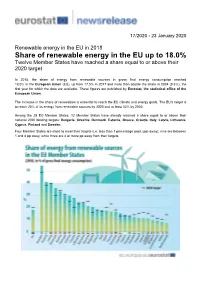
Share of Renewable Energy in the EU up to 18.0% Twelve Member States Have Reached a Share Equal to Or Above Their 2020 Target
17/2020 - 23 January 2020 Renewable energy in the EU in 2018 Share of renewable energy in the EU up to 18.0% Twelve Member States have reached a share equal to or above their 2020 target In 2018, the share of energy from renewable sources in gross final energy consumption reached 18.0% in the European Union (EU), up from 17.5% in 2017 and more than double the share in 2004 (8.5%), the first year for which the data are available. These figures are published by Eurostat, the statistical office of the European Union. The increase in the share of renewables is essential to reach the EU climate and energy goals. The EU's target is to reach 20% of its energy from renewable sources by 2020 and at least 32% by 2030. Among the 28 EU Member States, 12 Member States have already reached a share equal to or above their national 2020 binding targets: Bulgaria, Czechia, Denmark, Estonia, Greece, Croatia, Italy, Latvia, Lithuania, Cyprus, Finland and Sweden. Four Member States are close to meet their targets (i.e. less than 1 percentage point (pp) away), nine are between 1 and 4 pp away, while three are 4 or more pp away from their targets. Sweden had by far the highest share, lowest share in the Netherlands In 2018, the share of renewable sources in gross final energy consumption increased in 21 of the 28 Member States compared with 2017, while remaining stable in one Member State and decreasing in six. Since 2004, it has significantly grown in all Member States. -
Regn Lst 1948 to 2020.Xls
AMERICAN FUCHSIA SOCIETY REGISTERED FUCHSIAS, 1948 - 2020 CULTIVAR REG NO HYBRIDIZER YEAR FORM GROWTH Jardins de France 4439 Massé 2000 sgl up All Square 2335 Adams 1988 sgl up Beatrice Ellen 2336 Adams 1988 sgl up Cardiff Rose 2337 Adams 1988 sgl up/tr Glas Lyn 2338 Adams 1988 sgl up Purple Laddie 2339 Adams 1988 dbl up Velma 1522 Adams 1979 sgl up Windmill 4556 Adams 2001 dbl up Bo Bo 1587 Adkins 1980 dbl up Bonnie Sue 1550 Adkins 1980 dbl tr Dariway 1551 Adkins 1980 sgl up Delta Rae 1552 Adkins 1980 sgl tr Grinnell Bay 1553 Adkins 1980 sgl tr Joanne Lynn 1554 Adkins 1980 sdbl up Grandma Ellen 3066 Ainsworth 1993 sgl up Percy Ainsworth 3065 Ainsworth 1993 sgl tr Tufty Joe 3063 Ainsworth 1993 dbl tr Heidi Joy 2246 Akers/Laburnum 1987 dbl up Elaine Allen 1214 Allen 1974 sdbl up Susan Allen 1215 Allen 1974 sgl up Grandpa Jack 3789 Allso 1997 dbl up/tr Amazing Maisie 4632 Allsop 2001 s-dbl up/tr Amelia Rose 8018 Allsop 2012 sgl tr Arthur C. Boggis 4629 Allsop 2001 s-dbl up Beautiful Bobbie 3781 Allsop 1997 dbl tr Beloved Brian 5689 Allsop 2005 sgl up/tr Betty’s Buddies 8610 Allsop 2015 sgl up Captivating Kelly 3782 Allsop 1997 dbl tr Cheeky Chantelle 3783 Allsop 1997 dbl tr Cinque Port Liberty 4626 Allsop 2001 dbl up/tr Clara Agnes 5572 Allsop 2004 sgl up/tr Conner's Cascade 8019 Allsop 2012 sgl tr CutieKaren 4040 Allsop 1998 dbl tr Danielle’s Dream 4630 Allsop 2001 dbl tr Darling Danielle 3784 Allsop 1997 dbl tr Doodie Dane 3785 Allsop 1997 dbl gtr Dorothy Ann 4627 Allsop 2001 sgl tr Elaine's Gem 8020 Allsop 2012 sgl up Generous Jean 4813 -
The Many Faces of Exclusion: 2018 End of Childhood Report
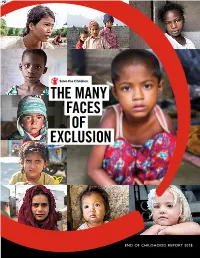
THE MANY FACES OF EXCLUSION END OF CHILDHOOD REPORT 2018 Six-year-old Arwa* and her family were displaced from their home by armed conflict in Iraq. CONTENTS 1 Introduction 3 End of Childhood Index Results 2017 vs. 2018 7 THREAT #1: Poverty 15 THREAT #2: Armed Conflict 21 THREAT #3: Discrimination Against Girls 27 Recommendations 31 End of Childhood Index Rankings 32 Complete End of Childhood Index 2018 36 Methodology and Research Notes 41 Endnotes 45 Acknowledgements * after a name indicates the name has been changed to protect identity. Published by Save the Children 501 Kings Highway East, Suite 400 Fairfield, Connecticut 06825 United States (800) 728-3843 www.SavetheChildren.org © Save the Children Federation, Inc. ISBN: 1-888393-34-3 Photo:## SAVE CJ ClarkeTHE CHILDREN / Save the Children INTRODUCTION The Many Faces of Exclusion Poverty, conflict and discrimination against girls are putting more than 1.2 billion children – over half of children worldwide – at risk for an early end to their childhood. Many of these at-risk children live in countries facing two or three of these grave threats at the same time. In fact, 153 million children are at extreme risk of missing out on childhood because they live in countries characterized by all three threats.1 In commemoration of International Children’s Day, Save the Children releases its second annual End of Childhood Index, taking a hard look at the events that rob children of their childhoods and prevent them from reaching their full potential. WHO ARE THE 1.2 BILLION Compared to last year, the index finds the overall situation CHILDREN AT RISK? for children appears more favorable in 95 of 175 countries. -
Sea Level Rise and Implications for Low-Lying Islands, Coasts and Communities
Sea Level Rise and Implications for Low-Lying Islands, SPM4 Coasts and Communities Coordinating Lead Authors: Michael Oppenheimer (USA), Bruce C. Glavovic (New Zealand/South Africa) Lead Authors: Jochen Hinkel (Germany), Roderik van de Wal (Netherlands), Alexandre K. Magnan (France), Amro Abd-Elgawad (Egypt), Rongshuo Cai (China), Miguel Cifuentes-Jara (Costa Rica), Robert M. DeConto (USA), Tuhin Ghosh (India), John Hay (Cook Islands), Federico Isla (Argentina), Ben Marzeion (Germany), Benoit Meyssignac (France), Zita Sebesvari (Hungary/Germany) Contributing Authors: Robbert Biesbroek (Netherlands), Maya K. Buchanan (USA), Ricardo Safra de Campos (UK), Gonéri Le Cozannet (France), Catia Domingues (Australia), Sönke Dangendorf (Germany), Petra Döll (Germany), Virginie K.E. Duvat (France), Tamsin Edwards (UK), Alexey Ekaykin (Russian Federation), Donald Forbes (Canada), James Ford (UK), Miguel D. Fortes (Philippines), Thomas Frederikse (Netherlands), Jean-Pierre Gattuso (France), Robert Kopp (USA), Erwin Lambert (Netherlands), Judy Lawrence (New Zealand), Andrew Mackintosh (New Zealand), Angélique Melet (France), Elizabeth McLeod (USA), Mark Merrifield (USA), Siddharth Narayan (US), Robert J. Nicholls (UK), Fabrice Renaud (UK), Jonathan Simm (UK), AJ Smit (South Africa), Catherine Sutherland (South Africa), Nguyen Minh Tu (Vietnam), Jon Woodruff (USA), Poh Poh Wong (Singapore), Siyuan Xian (USA) Review Editors: Ayako Abe-Ouchi (Japan), Kapil Gupta (India), Joy Pereira (Malaysia) Chapter Scientist: Maya K. Buchanan (USA) This chapter should be cited as: Oppenheimer, M., B.C. Glavovic , J. Hinkel, R. van de Wal, A.K. Magnan, A. Abd-Elgawad, R. Cai, M. Cifuentes-Jara, R.M. DeConto, T. Ghosh, J. Hay, F. Isla, B. Marzeion, B. Meyssignac, and Z. Sebesvari, 2019: Sea Level Rise and Implications for Low-Lying Islands, Coasts and Communities. -

2018 Comprehensive Annual Report on Public Diplomacy & International Broadcasting Focus on Fy 2017 Budget Data
N ON IO PU SS B I L M I C UNITED STATES M O D C I P L Y ADVISORY COMMISSION O R M O A S I C V Y D A ON PUBLIC DIPLOMACY 2018 COMPREHENSIVE ANNUAL REPORT ON PUBLIC DIPLOMACY & INTERNATIONAL BROADCASTING FOCUS ON FY 2017 BUDGET DATA 1 TRANSMITTAL LETTER To the President, Congress, Secretary of State, and the American people: The United States Advisory Commission on Public Diplomacy (ACPD), authorized pursuant to Public Law 112-239 [Sec.] 1280(a)-(c), hereby submits the 2018 Comprehensive Annual Report on Public Diplomacy and International Broadcasting Activities. The ACPD is a bipartisan panel created by Congress in 1948 to formulate and recommend policies and programs to carry out the Public Diplomacy (PD) functions vested in U.S. government entities and to appraise the effectiveness of those activities across the globe. The ACPD was reauthorized in December 2016 to complete the Comprehensive Annual Report on Public Diplomacy and International Broadcasting Activities, as well as to produce other reports that support more effective efforts to understand, inform, and influence foreign audiences. This document details all reported major PD and international broadcasting activities conducted by the State De- partment and the U.S. Agency for Global Media (USAGM, also referred to in this report by its former name, the Broadcasting Board of Governors or the BBG). It is based on data collected from all State Department PD bureaus and offices, the Public Affairs Sections of U.S. missions worldwide, and from all USAGM entities. The 2018 report was researched, verified, and written by ACPD members and staff with continuous input and collaboration from State Department Public Diplomacy and USAGM officials. -

World Health Statistics 2018: Monitoring Health for the Sdgs, Sustainable Development Goals
2018 2018 ISBN 978 92 4 156558 5 2018 World health statistics 2018: monitoring health for the SDGs, sustainable development goals ISBN 978-92-4-156558-5 © World Health Organization 2018 Some rights reserved. This work is available under the Creative Commons Attribution-NonCommercial-ShareAlike 3.0 IGO licence (CC BY-NC-SA 3.0 IGO; https://creativecommons.org/licenses/by-nc-sa/3.0/igo). Under the terms of this licence, you may copy, redistribute and adapt the work for non-commercial purposes, provided the work is appropriately cited, as indicated below. In any use of this work, there should be no suggestion that WHO endorses any specific organization, products or services. The use of the WHO logo is not permitted. If you adapt the work, then you must license your work under the same or equivalent Creative Commons licence. If you create a translation of this work, you should add the following disclaimer along with the suggested citation: “This translation was not created by the World Health Organization (WHO). WHO is not responsible for the content or accuracy of this translation. The original English edition shall be the binding and authentic edition”. Any mediation relating to disputes arising under the licence shall be conducted in accordance with the mediation rules of the World Intellectual Property Organization. Suggested citation. World health statistics 2018: monitoring health for the SDGs, sustainable development goals. Geneva: World Health Organization; 2018. Licence: CC BY-NC-SA 3.0 IGO. Cataloguing-in-Publication (CIP) data. CIP data are available at http://apps.who.int/iris. -

Diplomatic List – Fall 2018
United States Department of State Diplomatic List Fall 2018 Preface This publication contains the names of the members of the diplomatic staffs of all bilateral missions and delegations (herein after “missions”) and their spouses. Members of the diplomatic staff are the members of the staff of the mission having diplomatic rank. These persons, with the exception of those identified by asterisks, enjoy full immunity under provisions of the Vienna Convention on Diplomatic Relations. Pertinent provisions of the Convention include the following: Article 29 The person of a diplomatic agent shall be inviolable. He shall not be liable to any form of arrest or detention. The receiving State shall treat him with due respect and shall take all appropriate steps to prevent any attack on his person, freedom, or dignity. Article 31 A diplomatic agent shall enjoy immunity from the criminal jurisdiction of the receiving State. He shall also enjoy immunity from its civil and administrative jurisdiction, except in the case of: (a) a real action relating to private immovable property situated in the territory of the receiving State, unless he holds it on behalf of the sending State for the purposes of the mission; (b) an action relating to succession in which the diplomatic agent is involved as an executor, administrator, heir or legatee as a private person and not on behalf of the sending State; (c) an action relating to any professional or commercial activity exercised by the diplomatic agent in the receiving State outside of his official functions. -- A diplomatic agent’s family members are entitled to the same immunities unless they are United States Nationals. -

Cigarette Tax Scorecard Suggested Citation: Chaloupka, F., Drope, J., Siu, E., Vulovic, V., Stoklosa, M., Mirza, M., Rodriguez- Iglesias, G., & Lee, H
Tobacconomics Cigarette Tax Scorecard Suggested Citation: Chaloupka, F., Drope, J., Siu, E., Vulovic, V., Stoklosa, M., Mirza, M., Rodriguez- Iglesias, G., & Lee, H. Tobacconomics cigarette tax scorecard. Chicago, IL: Health Policy Center, Institute for Health Research and Policy, University of Illinois Chicago, 2020. www.tobacconomics.org Authors: This report was written by the Tobacconomics team: Frank Chaloupka, PhD; Jeff Drope, PhD; Erika Siu, JD LLM; Violeta Vulovic, PhD; Michal Stoklosa, PhD; Maryam Mirza, PhD; Germán Rodriguez-Iglesias, MSc; and Hye Myung Lee, MPH. Peer Reviewers: The report was peer reviewed by Evan Blecher, Economist, Fiscal Policies for Health (TAX), Health Promotion Department, World Health Organization; Alan Fuchs Tarlovsky, Senior Economist, Poverty and Equity Global Practice, The World Bank, Maria Fernanda Gonzalez Icaza, Consultant, Poverty and Equity Global Practice, The World Bank; Rijo M. John, Adjunct Professor, Rajagiri College of Social Sciences, Kochi; Nigar Nargis, Scientific Director, Tobacco Control Policy Research, American Cancer Society; Guillermo Paraje, Professor of Economics, Universidad Adolfo Ibáñez; Anne-Marie Perucic, Economist, Fiscal Policies for Health (TAX), Health Promotion Department, World Health Organization; Maxime Roche, International Consultant, Pan American Health Organization; Rosa Carolina Sandoval, Regional Advisor, Tobacco Control, Pan American Health Organization; Francis Thompson, Tobacco Control Advisor, HealthBridge Foundation of Canada; and Professor Corné van Walbeek, Director of the Research Unit on the Economics of Excisable Products, School of Economics, University of Cape Town. About Tobacconomics: Tobacconomics is a collaboration of leading researchers who have been studying the economics of tobacco control policy for nearly 30 years. The team is dedicated to helping researchers, advocates, and policy makers access the latest and best research about what’s working— or not working—to curb tobacco consumption and its economic impacts. -

International Standards on Drug Use Prevention
PRE-PUBLICATION PRE-EDITNG VERSION International Standards on Drug Use Prevention Second Updated Edition PRE-EDITING and PRE-PUBLICATION VERSION Acknowledgements UNODC and WHO would like to acknowledge the following for their invaluable contribution to the process of publication of these standards: The Government of Norway for believing in and supporting the project, as well as the Government of South Korea for providing supplementary resources. Ms. Nandi Siegfried, UNODC and WHO Consultant; Chief Specialist Scientist, Medical Research Council of South Africa; Associate Professor, Faculty of Health Sciences, University of Cape Town Cape Town, South Africa for advising on the methodology guiding and providing continuous methodological advice and much encouragement throughout the process of development. Ms. Hannah Heikkila, firstly as UNODC Programme Officer for coordinating the process of development, including the June 2017 meeting of the Experts, and subsequently as UNODC Consultant, for assessing the literature and conducting the data extraction. Ms. Elena Gomes de Matos, and Mr. Ludwig Kraus, UNODC Consultant for searching and screening the scientific evidence. Ms. Shima Shakory-Bakhtiar, UNODC intern, for searching and screening the scientific evidence. The WHO staff and consultants, including members of the UNODC-WHO Steering Group to review the international standards on drug use prevention, for assistance with developing methodology of the second edition, ongoing process of the revision and finalising the document: Ms. Valentina Baltag, Ms. Faten Ben Abdel Aziz, Dr Dzmitry Krupchanka, Ms. Susan Norris, Dr. Vladimir Poznyak. The members of the Group of Experts on the Prevention Standards, for providing the relevant scientific evidence and technical advice, including (in alphabetical order): Ms. -

Reciprocity Agreements
Reciprocity Agreements Africa Private Bag X54001, Durban 4000, South Africa; email: mmaharaj@pixie.udw.ac.za. Egyptian Mathematical Society Apply to: Prof. N. T. Bishop, Mathematics, Applied Apply to: Prof. Dr. B. I. Bayoumi (Honorary Secretary of Mathematics and Astronomy, P. O. Box 392, Unisa 0003, ETMS), c/o Prof. Dr. A.-S. F. Obada, Al-Azhar Univ., Fac. South Africa. of Sci., Dept. of Math., Nasr City 11884, Cairo, Egypt. Dues: R180.00 (One hundred eighty rands), payable to Dues: U.S. $15, payable to Egyptian Mathematical Society, the South African Mathematical Society (SAMS), c/o Prof. Al-Azhar Univ., Fac. of Sci., Dept. of Math., Nasr City N. T. Bishop (Treasurer) at the above address. 11884, Cairo, Egypt. Privileges: The right to present papers at meetings of Privileges: Receive a 60% discount on the prices of ETMS the Society; the right to receive at no additional cost: the publications, a 50% discount on the publication charge Notices of the SAMS; reduced fees at all SAMS meetings. per printed page in ETMS Journal, and reduced charge Officers: E. A. K. Bruning¨ (President), J. Baniasek (Vice- for participating at ETMS conferences. President),N.T.Bishop(Treasurer),M.S.Maharaj Officers: A.-S. F. Obada (President), M. Asaad (Vice- (Secretary). President),F.F.Ghaleb(Treasurer),B.I.Bayoumi(Secre- tary). Nigerian Mathematical Society* The Americas Apply to: Jerome A. Adepoju (Secretary), Nigerian Math- ematical Society, Department of Mathematics, University Canadian Mathematical Society of Lagos, Akoka-Yaba, Lagos, Nigeria; email: matdeplg@ Apply to: Membership and Publications Agent, infoweb.abs.net. Canadian Mathematical Society, 577 King Edward Ave., Dues: U.S. -
PISA 2018 Insights and Interpretations
2 018 Insights and Interpretations Andreas Schleicher PISA 2018: Insights and Interpretations Equipping citizens with the knowledge and skills necessary to achieve their full potential, to contribute to an increasingly interconnected world, and to convert better skills into better lives “needs to become a more central preoccupation of policy makers around the world. Fairness, integrity and inclusiveness in public policy thus all hinge on the skills of citizens. In working to About PISA achieve these goals, more and more countries are Up to the end of the 1990s, the OECD’s comparisons might remember enough to follow in our footsteps; of education outcomes were mainly based on but if they learn how to learn, and are able to think looking beyond their own borders for evidence measures of years of schooling, which are not reliable for themselves, and work with others, they can go indicators of what people actually know and can do. anywhere they want. of the most successful and efficient education The Programme for International Student Assessment (PISA) changed this. The idea behind PISA lay in Some people argued that the PISA tests are unfair, policies and practices. testing the knowledge and skills of students directly, because they may confront students with problems they through a metric that was internationally agreed upon; have not encountered in school. But then life is unfair, linking that with data from students, teachers, schools because the real test in life is not whether we can PISA is not only the world’s most comprehensive and systems to understand performance differences; remember what we learned at school, but whether we and then harnessing the power of collaboration to will be able to solve problems that we can’t possibly anticipate today.