DOS NUEVAS ESPECIES DE Risoella (MOLLUSCA: RISSOELLIDAE) DE LAS ISLAS CANARIAS Y SENEGAL
Total Page:16
File Type:pdf, Size:1020Kb
Load more
Recommended publications
-

BULLETIN (Mailed to Financial Members of the Society Within Victoria) Price 50¢ EDITOR Val Cram
THE MALACOLOGICAL SOCIETY OF AUSTRALASIA Inc. VICTORIAN BRANCH BULLETIN (Mailed to financial members of the Society within Victoria) Price 50¢ EDITOR Val Cram. Tel. No. 9792 9163 ADDRESS: 6 Southdean Street, Dandenong, Vic. 3175 Conus marmoreus Linne EMAIL: donald.cram@bigpond.com VIC. BR. BULL. NO. 269 JUNE/JULY 2013 NOTICE OF MEETING The next meeting of the Branch will be held on the 17th June at the Melbourne Camera Club Building, cnr. Dorcas & Ferrars Sts South Melbourne at 8pm. This will be a Member’s night. Raffles & Supper as usual. There will be no meeting in July. A Bulletin will be issued prior to the August meeting which will be held on the 19th. At the April meeting we welcomed Caitlin Woods, PR Officer for the Malacological Society of Australasia. We discussed with her our role in the society and she offered any assistance she could to promote our branch to further the study of molluscs in Victoria. Jack Austin advises, with considerable regret, that he must dispose of his shell collection as his intended successor-grandson has opted for a volunteer career overseas and will not have a house in Australia for some years. Jack is a part-sponsor of this venture and will sell-off what he can of the collection to raise funds for his grandson. The collection is fairly extensive world-wide, about 7,000 lots, emphasising GBR, SE Australia, NT, Pacific lslands. All lots are registered - lists of families or places can be supplied. Contact details" 11 Station St., Hastings, Vic. (03) 59797242 Secretary/Treasurer Michael Lyons Tel. -

OREGON ESTUARINE INVERTEBRATES an Illustrated Guide to the Common and Important Invertebrate Animals
OREGON ESTUARINE INVERTEBRATES An Illustrated Guide to the Common and Important Invertebrate Animals By Paul Rudy, Jr. Lynn Hay Rudy Oregon Institute of Marine Biology University of Oregon Charleston, Oregon 97420 Contract No. 79-111 Project Officer Jay F. Watson U.S. Fish and Wildlife Service 500 N.E. Multnomah Street Portland, Oregon 97232 Performed for National Coastal Ecosystems Team Office of Biological Services Fish and Wildlife Service U.S. Department of Interior Washington, D.C. 20240 Table of Contents Introduction CNIDARIA Hydrozoa Aequorea aequorea ................................................................ 6 Obelia longissima .................................................................. 8 Polyorchis penicillatus 10 Tubularia crocea ................................................................. 12 Anthozoa Anthopleura artemisia ................................. 14 Anthopleura elegantissima .................................................. 16 Haliplanella luciae .................................................................. 18 Nematostella vectensis ......................................................... 20 Metridium senile .................................................................... 22 NEMERTEA Amphiporus imparispinosus ................................................ 24 Carinoma mutabilis ................................................................ 26 Cerebratulus californiensis .................................................. 28 Lineus ruber ......................................................................... -

Nueva Especie De Rissoella JE Gray, 1847 (Gastropoda: Heterobranchia )
Rev. Acad. Canar. Cienc, XX (Num. 4), 15-17 (2008) (publicado en septiembre de 2009) NUEVA ESPECIE DE Rissoella J. E. GRAY, 1847 (GASTROPODA: HETEROBRANCHIA) DE LA PENINSULA DE GUANAHACABIBES, PINAR DEL RIO, CUBA J. Espinosa & J. Ortea Institute de Oceanologia, Avda. V n° 18406, E. 184 y 186, Playa La Habana. Cuba RESUMEN Descripcion de una nueva especie del genero Rissoella J. E. Gray, 1847, recolectada en el sistema arrecifal de Cabo de San Antonio, peninsula de Guanahacabibes, con datos sobre la coloracion del animal y la estructura de su concha. Palabras clave: MoUusca, Gastropoda, Heterobranchia, Rissoella, especie nueva, Cuba. ABSTRACT A new species of the genus Rissoella J. E. Gray, 1847 collected in the arrecifal sys- tem of San Antonio Cape, peninsula of Guanahacabibes, Cuba is described, with dates of the living animal and shell structure. Key words: MoUusca, Gastropoda, Heterobranchia, Rissoella, new species, Cuba. 1. INTRODUCCION La aportacion mas reciente sobre el genero Rissoella en Cuba y en el Caribe, es la realizada en un trabajo anterior (ORTEA & ESPINOSA [1]) en el que revisamos la taxo- nomia del genero en el Atlantico americano y describimos siete especies nuevas de estos microcaracoles, todas en las costas de Cuba. En dicho trabajo, establecimos dos grupos de especies, siendo el primero de ellos el que reune conchas con el ombligo abierto, sin cordo- nes ni aristas anteriores a el, cuyos animales pueden presentar o no una pigmentacion dife- rencial de la gonada y del digestivo, apreciable en las primeras vueltas de espira por trans- parencia de la concha; a este ultimo grupo es al que pertenece la especie que describimos a continuacion recolectada en el curso de una de las campafias de colecta realizadas en la peninsula de Guanahacabibes. -
In Compliance with Paragraph 20 of the Action Plan, a Directory of Specialists, Laboratories and Organisations Concerned By
EP United Nations Environment Programme UNEP(DEC)/MED WG.268/6 25 Mai 2005 ANGLAIS ORIGINAL: FRANCAIS MEDITERRANEAN ACTION PLAN Seventh Meeting of the Focal Points for SPAs Seville, 31 May to 3rd of June 2005 EVALUATION REPORT ON IMPLEMENTING THE ACTION PLAN FOR THE CONSERVATION OF MARINE VEGETATION IN THE MEDITERRANEAN SEA UNEP RAC/SPA - Tunis, 2005 UNEP(DEC)/MED WG.268/6 Page 1 EVALUATION REPORT ON IMPLEMENTING THE ACTION PLAN FOR THE CONSERVATION OF MARINE VEGETATION IN THE MEDITERRANEAN SEA Introduction In the context of the Mediterranean Action Plan (MAP), the Contracting Parties to the Barcelona Convention adopted at their Eleventh Ordinary Meeting held in Malta in October 1999 an ‘Action Plan for the conservation of marine vegetation in the Mediterranean Sea’ with an accompanying implementation schedule that ended in 2006. The programme of this Action Plan was as follows: it contained 12 actions ordered in response to both the aims articulated in Article 7, and the priorities stated in Article 8. Programme and schedule for implementing the Action Plan for the conservation of marine vegetation in the Mediterranean Sea Action Deadline 1. Ratifying the new SPA Protocol As quickly as possible First symposium before 2. Mediterranean symposium November 2000, then every four years 3. Guidelines for impact studies October 2000 4. First version of the Mediterranean data bank October 2000 5. First issue of the Directory of specialists, laboratories and organisations concerned by October 2000 marine vegetation in the Mediterranean 6. Launching procedures for the legal protection of Some time in 2001 species at national level 7. -

Guide to the Systematic Distribution of Mollusca in the British Museum
PRESENTED ^l)c trustee*. THE BRITISH MUSEUM. California Swcademu 01 \scienceb RECEIVED BY GIFT FROM -fitoZa£du^4S*&22& fo<?as7u> #yjy GUIDE TO THK SYSTEMATIC DISTRIBUTION OK MOLLUSCA IN III K BRITISH MUSEUM PART I HY JOHN EDWARD GRAY, PHD., F.R.S., P.L.S., P.Z.S. Ac. LONDON: PRINTED BY ORDER OF THE TRUSTEES 1857. PRINTED BY TAYLOR AND FRANCIS, RED LION COURT, FLEET STREET. PREFACE The object of the present Work is to explain the manner in which the Collection of Mollusca and their shells is arranged in the British Museum, and especially to give a short account of the chief characters, derived from the animals, by which they are dis- tributed, and which it is impossible to exhibit in the Collection. The figures referred to after the names of the species, under the genera, are those given in " The Figures of Molluscous Animals, for the Use of Students, by Maria Emma Gray, 3 vols. 8vo, 1850 to 1854 ;" or when the species has been figured since the appear- ance of that work, in the original authority quoted. The concluding Part is in hand, and it is hoped will shortly appear. JOHN EDWARD GRAY. Dec. 10, 1856. ERRATA AND CORRIGENDA. Page 43. Verenad.e.—This family is to be erased, as the animal is like Tricho- tropis. I was misled by the incorrectness of the description and figure. Page 63. Tylodinad^e.— This family is to be removed to PleurobrancMata at page 203 ; a specimen of the animal and shell having since come into my possession. -
An Annotated Checklist of the Marine Macroinvertebrates of Alaska David T
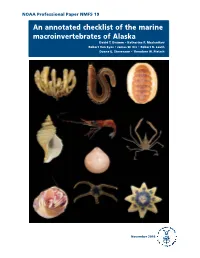
NOAA Professional Paper NMFS 19 An annotated checklist of the marine macroinvertebrates of Alaska David T. Drumm • Katherine P. Maslenikov Robert Van Syoc • James W. Orr • Robert R. Lauth Duane E. Stevenson • Theodore W. Pietsch November 2016 U.S. Department of Commerce NOAA Professional Penny Pritzker Secretary of Commerce National Oceanic Papers NMFS and Atmospheric Administration Kathryn D. Sullivan Scientific Editor* Administrator Richard Langton National Marine National Marine Fisheries Service Fisheries Service Northeast Fisheries Science Center Maine Field Station Eileen Sobeck 17 Godfrey Drive, Suite 1 Assistant Administrator Orono, Maine 04473 for Fisheries Associate Editor Kathryn Dennis National Marine Fisheries Service Office of Science and Technology Economics and Social Analysis Division 1845 Wasp Blvd., Bldg. 178 Honolulu, Hawaii 96818 Managing Editor Shelley Arenas National Marine Fisheries Service Scientific Publications Office 7600 Sand Point Way NE Seattle, Washington 98115 Editorial Committee Ann C. Matarese National Marine Fisheries Service James W. Orr National Marine Fisheries Service The NOAA Professional Paper NMFS (ISSN 1931-4590) series is pub- lished by the Scientific Publications Of- *Bruce Mundy (PIFSC) was Scientific Editor during the fice, National Marine Fisheries Service, scientific editing and preparation of this report. NOAA, 7600 Sand Point Way NE, Seattle, WA 98115. The Secretary of Commerce has The NOAA Professional Paper NMFS series carries peer-reviewed, lengthy original determined that the publication of research reports, taxonomic keys, species synopses, flora and fauna studies, and data- this series is necessary in the transac- intensive reports on investigations in fishery science, engineering, and economics. tion of the public business required by law of this Department. -

Assessment of Mitochondrial Genomes for Heterobranch Gastropod Phylogenetics
Assessment of mitochondrial genomes for heterobranch gastropod phylogenetics Rebecca M Varney University of Alabama Bastian Brenzinger Staatliche Naturwissenschaftliche Sammlungen Bayerns Manuel António E. Malaquias Universitetsmuseet i Bergen Christopher P. Meyer Smithsonian Institution Michael Schrödl Staatliche Naturwissenschaftliche Sammlungen Bayerns Kevin Kocot ( kmkocot@ua.edu ) The University of Alabama https://orcid.org/0000-0002-8673-2688 Research article Keywords: Heterobranchia, Gastropoda, mitochondrial genome, mitogenomic Posted Date: December 10th, 2020 DOI: https://doi.org/10.21203/rs.3.rs-30542/v3 License: This work is licensed under a Creative Commons Attribution 4.0 International License. Read Full License Version of Record: A version of this preprint was published on January 21st, 2021. See the published version at https://doi.org/10.1186/s12862-020-01728-y. Page 1/19 Abstract Background Heterobranchia is a diverse clade of marine, freshwater, and terrestrial gastropod molluscs. It includes such disparate taxa as nudibranchs, sea hares, bubble snails, pulmonate land snails and slugs, and a number of (mostly small-bodied) poorly known snails and slugs collectively referred to as the “lower heterobranchs.” Evolutionary relationships within Heterobranchia have been challenging to resolve and the group has been subject to frequent and signicant taxonomic revision. Mitochondrial (mt) genomes can be a useful molecular marker for phylogenetics but, to date, sequences have been available for only a relatively small subset of Heterobranchia. Results To assess the utility of mitochondrial genomes for resolving evolutionary relationships within this clade, eleven new mt genomes were sequenced including representatives of several groups of “lower heterobranchs.” Maximum likelihood analyses of concatenated matrices of the thirteen protein coding genes found weak support for most higher-level relationships even after several taxa with extremely high rates of evolution were excluded. -

Caenogastropoda
13 Caenogastropoda Winston F. Ponder, Donald J. Colgan, John M. Healy, Alexander Nützel, Luiz R. L. Simone, and Ellen E. Strong Caenogastropods comprise about 60% of living Many caenogastropods are well-known gastropod species and include a large number marine snails and include the Littorinidae (peri- of ecologically and commercially important winkles), Cypraeidae (cowries), Cerithiidae (creep- marine families. They have undergone an ers), Calyptraeidae (slipper limpets), Tonnidae extraordinary adaptive radiation, resulting in (tuns), Cassidae (helmet shells), Ranellidae (tri- considerable morphological, ecological, physi- tons), Strombidae (strombs), Naticidae (moon ological, and behavioral diversity. There is a snails), Muricidae (rock shells, oyster drills, etc.), wide array of often convergent shell morpholo- Volutidae (balers, etc.), Mitridae (miters), Buccin- gies (Figure 13.1), with the typically coiled shell idae (whelks), Terebridae (augers), and Conidae being tall-spired to globose or fl attened, with (cones). There are also well-known freshwater some uncoiled or limpet-like and others with families such as the Viviparidae, Thiaridae, and the shells reduced or, rarely, lost. There are Hydrobiidae and a few terrestrial groups, nota- also considerable modifi cations to the head- bly the Cyclophoroidea. foot and mantle through the group (Figure 13.2) Although there are no reliable estimates and major dietary specializations. It is our aim of named species, living caenogastropods are in this chapter to review the phylogeny of this one of the most diverse metazoan clades. Most group, with emphasis on the areas of expertise families are marine, and many (e.g., Strombidae, of the authors. Cypraeidae, Ovulidae, Cerithiopsidae, Triphori- The fi rst records of undisputed caenogastro- dae, Olividae, Mitridae, Costellariidae, Tereb- pods are from the middle and upper Paleozoic, ridae, Turridae, Conidae) have large numbers and there were signifi cant radiations during the of tropical taxa. -

(Gastropoda) with a Rhipidoglossate Radula
Org Divers Evol (2011) 11:201–236 DOI 10.1007/s13127-011-0048-0 ORIGINAL ARTICLE Interactive 3D anatomy and affinities of the Hyalogyrinidae, basal Heterobranchia (Gastropoda) with a rhipidoglossate radula Gerhard Haszprunar & Erika Speimann & Andreas Hawe & Martin Heß Received: 25 January 2011 /Accepted: 26 May 2011 /Published online: 19 June 2011 # Gesellschaft für Biologische Systematik 2011 Abstract Whereas Hyalogyrina Marshall, 1988 was already on the rhipidoglossate, i.e. the ‘archaeogastropod’, originally considered a skeneid vetigastropod, the family level of evolution. Ectobranchia are considered the first Hyalogyrinidae Warén & Bouchet, 1993 has later been extant offshoot of the Heterobranchia; implications for the classified as basal Heterobranchia despite their rhipidoglossate stem species of the latter are outlined. radula. In order to evaluate this placement and to shed more light on the origin of all higher Gastropoda, we investigated Keywords Gastropoda . Ectobranchia . Hyalogyrinidae . five representatives of all three nominal hyalogyrinid genera Interactive 3D anatomy. Systematics . Phylogeny. by means of semithin serial sectioning and computer-aided Heterobranchia 3D reconstruction of the respective anatomy, which we present in an interactive way. In general the morphological features (shell, external morphology, anatomy) fully confirm Introduction the placement of Hyalogyrinidae in the Heterobranchia, but in particular the conditions of the genital system vary During the last 25 years major progress has been made in substantially within the family. The ectobranch gill of our understanding of the origin of the higher gastropods, Hyalogyrinidae is shared with Valvatidae, Cornirostridae, i.e. the allogastropod, opisthobranch and pulmonate taxa, the and Xylodisculidae; consequently all these families are latter two of which are commonly united as Euthyneura. -

Australian Tropical Marine Micromolluscs: an Overwhelming Bias
diversity Review Australian Tropical Marine Micromolluscs: An Overwhelming Bias Peter U. Middelfart 1, Lisa A. Kirkendale 1,2,* and Nerida G. Wilson 1,3 1 Department of Aquatic Zoology, Western Australian Museum, Locked Bag 49, Welshpool DC, WA 6986, Australia; peter.middelfart@museum.wa.gov.au (P.U.M.); nerida.wilson@museum.wa.gov.au (N.G.W.) 2 School of Veterinary and Life Sciences, Murdoch University, Murdoch, WA 6150, Australia 3 School of Animal Biology, University of Western Australia, Crawley, WA 6009, Australia * Correspondence: lisa.kirkendale@museum.wa.gov.au; Tel.: +61-08-9212-3747 Academic Editor: Michael Wink Received: 26 April 2016; Accepted: 26 July 2016; Published: 2 August 2016 Abstract: Assessing the marine biodiversity of the tropics can be overwhelming, especially for the Mollusca, one of the largest marine phyla in the sea. With a diversity that can exceed macrofaunal richness in many groups, the micro/meiofaunal component is one of most overlooked biotas in surveys due to the time-consuming nature of collecting, sorting, and identifying this assemblage. We review trends in micromollusc research highlighting the Australian perspective that reveals a dwindling taxonomic effort through time and discuss pervasive obstacles of relevance to the taxonomy of micromolluscs globally. Since a high during the 1970s, followed by a smaller peak in 2000, in 2010 we observe a low in micromolluscan collection activity in Australia not seen since the 1930s. Although challenging, considered planning at each step of the species identification pathway can reduce barriers to micromolluscan research (e.g., role of types, dedicated sampling, integration of microscopy and genetic methods). -

Johannes Thiele and His Contributions to Zoology. Part 2. Genus-Group Names (Mollusca)
NEMOURIA Occasional Papers of the Delaware Museum of Natural History NUMBER 39 SEPTEMBER 30, 1991 JOHANNES THIELE AND HIS CONTRIBUTIONS TO ZOOLOGY. PART 2. GENUS-GROUP NAMES (MOLLUSCA) Kenneth J. Boss 1 and Rudiger Bieler2 ABSTRACT. This is the second part of a series on the German zoologist Johannes Thiele (1860-1935) and comprises a critical listing of the genus-group taxa which he described as new to malacology. Each of these names is accompanied by author and bibliographic references, original status, type-species with its original binominal spelling and bibliographic source and some data on subsequent taxonomic placements. Thiele introduced a total of 291 such names in the Phylum Mollusca, distributed as follows: 11 Aplacophora; 39 Polyplacophora; 200 Gastropoda (138 Prosobranchia; 20 Opisthobranchia and 42 Pulmonata); 31 Bivalvia; 10 Cephalopoda; there were no new scaphopod or monoplacophoran names. Of these, later authors recognized as valid 85 at the generic level, 110 at the subgeneric level; 71 are considered to be synonyms, and the remaining 25 are unjustified emendations or errors. INTRODUCTION As part of a series on the scientific contributions of Johannes Thiele, the eminent German zoologist, we provide here an alphabetical listing and analysis of all the genus-group taxa introduced by him in his publications on mollusks as delineated by Bieler & Boss (1989). A total of 291 names is included in the following format: (1) genus-group name; (2) author(s); (3) year of publication; (4) condensed bibliographic reference; (5) original status as given by Thiele; (6) subsequent status 1Museum of Comparative Zoology, Harvard University, Serial Publication Cambridge, Massachussetts 02138, U.S.A. -

View of Morphological and Molecular Evidence Is Consistent with an Origin of Rhodopemorpha Slugs Among Shelled ‘Lower Heterobranchia’
At the limits of a successful body plan – 3D microanatomy, histology and evolution of Helminthope (Mollusca: Heterobranchia: Rhodopemorpha), the most worm-like gastropod Brenzinger et al. Brenzinger et al. Frontiers in Zoology 2013, 10:37 http://www.frontiersinzoology.com/content/10/1/37 Brenzinger et al. Frontiers in Zoology 2013, 10:37 http://www.frontiersinzoology.com/content/10/1/37 RESEARCH Open Access At the limits of a successful body plan – 3D microanatomy, histology and evolution of Helminthope (Mollusca: Heterobranchia: Rhodopemorpha), the most worm-like gastropod Bastian Brenzinger1,2*, Gerhard Haszprunar1,2 and Michael Schrödl1,2 Abstract Background: Gastropods are among the most diverse animal clades, and have successfully colonized special habitats such as the marine sand interstitial. Specialized meiofaunal snails and slugs are tiny and worm-shaped. They combine regressive features – argued to be due to progenetic tendencies – with convergent adaptations. Microscopic size and concerted convergences make morphological examination non-trivial and hamper phylogenetic reconstructions. The enigmatic turbellarian-like Rhodopemorpha are a small group that has puzzled systematists for over a century. A preliminary molecular framework places the group far closer to the root of Heterobranchia – one of the major gastropod groups – than previously suggested. The poorly known meiofaunal Helminthope psammobionta Salvini-Plawen, 1991 from Bermuda is the most worm-shaped free-living gastropod and shows apparently aberrant aspects of anatomy. Its study may give important clues to understand the evolution of rhodopemorphs among basal heterobranchs versus their previously thought origin among ‘higher’ euthyneuran taxa. Results: We describe the 3D-microanatomy of H. psammobionta using three-dimensional digital reconstruction based on serial semithin histological sections.