Systematic and Evolutionary Studies of Rissoellid Microgastropods
Total Page:16
File Type:pdf, Size:1020Kb
Load more
Recommended publications
-

OREGON ESTUARINE INVERTEBRATES an Illustrated Guide to the Common and Important Invertebrate Animals
OREGON ESTUARINE INVERTEBRATES An Illustrated Guide to the Common and Important Invertebrate Animals By Paul Rudy, Jr. Lynn Hay Rudy Oregon Institute of Marine Biology University of Oregon Charleston, Oregon 97420 Contract No. 79-111 Project Officer Jay F. Watson U.S. Fish and Wildlife Service 500 N.E. Multnomah Street Portland, Oregon 97232 Performed for National Coastal Ecosystems Team Office of Biological Services Fish and Wildlife Service U.S. Department of Interior Washington, D.C. 20240 Table of Contents Introduction CNIDARIA Hydrozoa Aequorea aequorea ................................................................ 6 Obelia longissima .................................................................. 8 Polyorchis penicillatus 10 Tubularia crocea ................................................................. 12 Anthozoa Anthopleura artemisia ................................. 14 Anthopleura elegantissima .................................................. 16 Haliplanella luciae .................................................................. 18 Nematostella vectensis ......................................................... 20 Metridium senile .................................................................... 22 NEMERTEA Amphiporus imparispinosus ................................................ 24 Carinoma mutabilis ................................................................ 26 Cerebratulus californiensis .................................................. 28 Lineus ruber ......................................................................... -
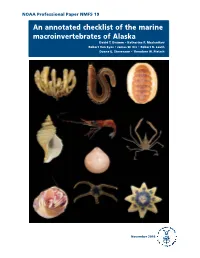
An Annotated Checklist of the Marine Macroinvertebrates of Alaska David T
NOAA Professional Paper NMFS 19 An annotated checklist of the marine macroinvertebrates of Alaska David T. Drumm • Katherine P. Maslenikov Robert Van Syoc • James W. Orr • Robert R. Lauth Duane E. Stevenson • Theodore W. Pietsch November 2016 U.S. Department of Commerce NOAA Professional Penny Pritzker Secretary of Commerce National Oceanic Papers NMFS and Atmospheric Administration Kathryn D. Sullivan Scientific Editor* Administrator Richard Langton National Marine National Marine Fisheries Service Fisheries Service Northeast Fisheries Science Center Maine Field Station Eileen Sobeck 17 Godfrey Drive, Suite 1 Assistant Administrator Orono, Maine 04473 for Fisheries Associate Editor Kathryn Dennis National Marine Fisheries Service Office of Science and Technology Economics and Social Analysis Division 1845 Wasp Blvd., Bldg. 178 Honolulu, Hawaii 96818 Managing Editor Shelley Arenas National Marine Fisheries Service Scientific Publications Office 7600 Sand Point Way NE Seattle, Washington 98115 Editorial Committee Ann C. Matarese National Marine Fisheries Service James W. Orr National Marine Fisheries Service The NOAA Professional Paper NMFS (ISSN 1931-4590) series is pub- lished by the Scientific Publications Of- *Bruce Mundy (PIFSC) was Scientific Editor during the fice, National Marine Fisheries Service, scientific editing and preparation of this report. NOAA, 7600 Sand Point Way NE, Seattle, WA 98115. The Secretary of Commerce has The NOAA Professional Paper NMFS series carries peer-reviewed, lengthy original determined that the publication of research reports, taxonomic keys, species synopses, flora and fauna studies, and data- this series is necessary in the transac- intensive reports on investigations in fishery science, engineering, and economics. tion of the public business required by law of this Department. -

Assessment of Mitochondrial Genomes for Heterobranch Gastropod Phylogenetics
Assessment of mitochondrial genomes for heterobranch gastropod phylogenetics Rebecca M Varney University of Alabama Bastian Brenzinger Staatliche Naturwissenschaftliche Sammlungen Bayerns Manuel António E. Malaquias Universitetsmuseet i Bergen Christopher P. Meyer Smithsonian Institution Michael Schrödl Staatliche Naturwissenschaftliche Sammlungen Bayerns Kevin Kocot ( kmkocot@ua.edu ) The University of Alabama https://orcid.org/0000-0002-8673-2688 Research article Keywords: Heterobranchia, Gastropoda, mitochondrial genome, mitogenomic Posted Date: December 10th, 2020 DOI: https://doi.org/10.21203/rs.3.rs-30542/v3 License: This work is licensed under a Creative Commons Attribution 4.0 International License. Read Full License Version of Record: A version of this preprint was published on January 21st, 2021. See the published version at https://doi.org/10.1186/s12862-020-01728-y. Page 1/19 Abstract Background Heterobranchia is a diverse clade of marine, freshwater, and terrestrial gastropod molluscs. It includes such disparate taxa as nudibranchs, sea hares, bubble snails, pulmonate land snails and slugs, and a number of (mostly small-bodied) poorly known snails and slugs collectively referred to as the “lower heterobranchs.” Evolutionary relationships within Heterobranchia have been challenging to resolve and the group has been subject to frequent and signicant taxonomic revision. Mitochondrial (mt) genomes can be a useful molecular marker for phylogenetics but, to date, sequences have been available for only a relatively small subset of Heterobranchia. Results To assess the utility of mitochondrial genomes for resolving evolutionary relationships within this clade, eleven new mt genomes were sequenced including representatives of several groups of “lower heterobranchs.” Maximum likelihood analyses of concatenated matrices of the thirteen protein coding genes found weak support for most higher-level relationships even after several taxa with extremely high rates of evolution were excluded. -

(Gastropoda) with a Rhipidoglossate Radula
Org Divers Evol (2011) 11:201–236 DOI 10.1007/s13127-011-0048-0 ORIGINAL ARTICLE Interactive 3D anatomy and affinities of the Hyalogyrinidae, basal Heterobranchia (Gastropoda) with a rhipidoglossate radula Gerhard Haszprunar & Erika Speimann & Andreas Hawe & Martin Heß Received: 25 January 2011 /Accepted: 26 May 2011 /Published online: 19 June 2011 # Gesellschaft für Biologische Systematik 2011 Abstract Whereas Hyalogyrina Marshall, 1988 was already on the rhipidoglossate, i.e. the ‘archaeogastropod’, originally considered a skeneid vetigastropod, the family level of evolution. Ectobranchia are considered the first Hyalogyrinidae Warén & Bouchet, 1993 has later been extant offshoot of the Heterobranchia; implications for the classified as basal Heterobranchia despite their rhipidoglossate stem species of the latter are outlined. radula. In order to evaluate this placement and to shed more light on the origin of all higher Gastropoda, we investigated Keywords Gastropoda . Ectobranchia . Hyalogyrinidae . five representatives of all three nominal hyalogyrinid genera Interactive 3D anatomy. Systematics . Phylogeny. by means of semithin serial sectioning and computer-aided Heterobranchia 3D reconstruction of the respective anatomy, which we present in an interactive way. In general the morphological features (shell, external morphology, anatomy) fully confirm Introduction the placement of Hyalogyrinidae in the Heterobranchia, but in particular the conditions of the genital system vary During the last 25 years major progress has been made in substantially within the family. The ectobranch gill of our understanding of the origin of the higher gastropods, Hyalogyrinidae is shared with Valvatidae, Cornirostridae, i.e. the allogastropod, opisthobranch and pulmonate taxa, the and Xylodisculidae; consequently all these families are latter two of which are commonly united as Euthyneura. -

Australian Tropical Marine Micromolluscs: an Overwhelming Bias
diversity Review Australian Tropical Marine Micromolluscs: An Overwhelming Bias Peter U. Middelfart 1, Lisa A. Kirkendale 1,2,* and Nerida G. Wilson 1,3 1 Department of Aquatic Zoology, Western Australian Museum, Locked Bag 49, Welshpool DC, WA 6986, Australia; peter.middelfart@museum.wa.gov.au (P.U.M.); nerida.wilson@museum.wa.gov.au (N.G.W.) 2 School of Veterinary and Life Sciences, Murdoch University, Murdoch, WA 6150, Australia 3 School of Animal Biology, University of Western Australia, Crawley, WA 6009, Australia * Correspondence: lisa.kirkendale@museum.wa.gov.au; Tel.: +61-08-9212-3747 Academic Editor: Michael Wink Received: 26 April 2016; Accepted: 26 July 2016; Published: 2 August 2016 Abstract: Assessing the marine biodiversity of the tropics can be overwhelming, especially for the Mollusca, one of the largest marine phyla in the sea. With a diversity that can exceed macrofaunal richness in many groups, the micro/meiofaunal component is one of most overlooked biotas in surveys due to the time-consuming nature of collecting, sorting, and identifying this assemblage. We review trends in micromollusc research highlighting the Australian perspective that reveals a dwindling taxonomic effort through time and discuss pervasive obstacles of relevance to the taxonomy of micromolluscs globally. Since a high during the 1970s, followed by a smaller peak in 2000, in 2010 we observe a low in micromolluscan collection activity in Australia not seen since the 1930s. Although challenging, considered planning at each step of the species identification pathway can reduce barriers to micromolluscan research (e.g., role of types, dedicated sampling, integration of microscopy and genetic methods). -

View of Morphological and Molecular Evidence Is Consistent with an Origin of Rhodopemorpha Slugs Among Shelled ‘Lower Heterobranchia’
At the limits of a successful body plan – 3D microanatomy, histology and evolution of Helminthope (Mollusca: Heterobranchia: Rhodopemorpha), the most worm-like gastropod Brenzinger et al. Brenzinger et al. Frontiers in Zoology 2013, 10:37 http://www.frontiersinzoology.com/content/10/1/37 Brenzinger et al. Frontiers in Zoology 2013, 10:37 http://www.frontiersinzoology.com/content/10/1/37 RESEARCH Open Access At the limits of a successful body plan – 3D microanatomy, histology and evolution of Helminthope (Mollusca: Heterobranchia: Rhodopemorpha), the most worm-like gastropod Bastian Brenzinger1,2*, Gerhard Haszprunar1,2 and Michael Schrödl1,2 Abstract Background: Gastropods are among the most diverse animal clades, and have successfully colonized special habitats such as the marine sand interstitial. Specialized meiofaunal snails and slugs are tiny and worm-shaped. They combine regressive features – argued to be due to progenetic tendencies – with convergent adaptations. Microscopic size and concerted convergences make morphological examination non-trivial and hamper phylogenetic reconstructions. The enigmatic turbellarian-like Rhodopemorpha are a small group that has puzzled systematists for over a century. A preliminary molecular framework places the group far closer to the root of Heterobranchia – one of the major gastropod groups – than previously suggested. The poorly known meiofaunal Helminthope psammobionta Salvini-Plawen, 1991 from Bermuda is the most worm-shaped free-living gastropod and shows apparently aberrant aspects of anatomy. Its study may give important clues to understand the evolution of rhodopemorphs among basal heterobranchs versus their previously thought origin among ‘higher’ euthyneuran taxa. Results: We describe the 3D-microanatomy of H. psammobionta using three-dimensional digital reconstruction based on serial semithin histological sections. -

DNA Barcoding of Marine Mollusks Associated with Corallina Officinalis
diversity Article DNA Barcoding of Marine Mollusks Associated with Corallina officinalis Turfs in Southern Istria (Adriatic Sea) Moira Burši´c 1, Ljiljana Iveša 2 , Andrej Jaklin 2, Milvana Arko Pijevac 3, Mladen Kuˇcini´c 4, Mauro Štifani´c 1, Lucija Neal 5 and Branka Bruvo Madari´c¯ 6,* 1 Faculty of Natural Sciences, Juraj Dobrila University of Pula, Zagrebaˇcka30, 52100 Pula, Croatia; moira.bursic@unipu.hr (M.B.); mauro.stifanic@unipu.hr (M.Š.) 2 Center for Marine Research, Ruder¯ Boškovi´cInstitute, G. Paliage 5, 52210 Rovinj, Croatia; ivesa@cim.irb.hr (L.I.); jaklin@cim.irb.hr (A.J.) 3 Natural History Museum Rijeka, Lorenzov Prolaz 1, 51000 Rijeka, Croatia; milvana@prirodoslovni.com 4 Department of Biology, Faculty of Science, University of Zagreb, Rooseveltov trg 6, 10000 Zagreb, Croatia; kucinic@biol.pmf.hr 5 Kaplan International College, Moulsecoomb Campus, University of Brighton, Watts Building, Lewes Rd., Brighton BN2 4GJ, UK; lucija.neal@kaplan.com 6 Molecular Biology Division, Ruder¯ Boškovi´cInstitute, Bijeniˇcka54, 10000 Zagreb, Croatia * Correspondence: branka.bruvo.madjaric@irb.hr Abstract: Presence of mollusk assemblages was studied within red coralligenous algae Corallina officinalis L. along the southern Istrian coast. C. officinalis turfs can be considered a biodiversity reservoir, as they shelter numerous invertebrate species. The aim of this study was to identify mollusk species within these settlements using DNA barcoding as a method for detailed identification of mollusks. Nine locations and 18 localities with algal coverage range above 90% were chosen at four research areas. From 54 collected samples of C. officinalis turfs, a total of 46 mollusk species were Citation: Burši´c,M.; Iveša, L.; Jaklin, identified. -

Mollusca, Gastropoda, Heterobranchia)
Title Systematic and evolutionary studies of rissoellid microgastropods (Mollusca, Gastropoda, Heterobranchia) Author(s) CHIRA SIADEN, LUIS EDUARDO Citation 北海道大学. 博士(理学) 甲第13579号 Issue Date 2019-03-25 DOI 10.14943/doctoral.k13579 Doc URL http://hdl.handle.net/2115/74397 Type theses (doctoral) File Information LUIS_EDUARDO_CHIRA_SIADEN.pdf Instructions for use Hokkaido University Collection of Scholarly and Academic Papers : HUSCAP Systematic and evolutionary studies of rissoellid microgastropods (Mollusca, Gastropoda, Heterobranchia) (ガラスツボ科微小巻貝(軟体動物門・腹足綱・異鰓類)の体系学的および進化的研究) A Ph.D. thesis submitted by Luis Eduardo Chira Siadén to Graduate School of Science Hokkaido University Sapporo Japan in March 2019 ii INDEX ACKNOWLEDGEMENTS………………………………………………………….. v LIST OF TABLES…………………………………………………………………… vii LIST OF FIGURES…………………………………………………………………... viii ABSTRACT………………………………………………………………………….. 1 Disclaimer……………………………………………………………………………. 4 GENERAL INTRODUCTION………………………………………………………. 5 CHAPER 1…………………………………………………………………………… 9 ABSTRACT………………………………………………………………………….. 10 INTRODUCTION……………………………………………………………………. 11 MATERIAL AND METHODS……………………………………………………… 12 Collection and processing of samples………………………………………………… 12 DNA extraction, PCR amplification…………………………………………………. 14 Analyses of molecular data and species delimitation………………………………… 15 RESULTS……………………………………………………………………………. 17 Systematics…………………………………………………………………………… 17 Rissoella elatior………………………………………………………………………. 17 Rissoella golikovi…………………………………………………………………….. 21 Rissoella japonica n. sp. ……………………………………..................................... -

3D-Microanatomy and Histology of the Hydrothermal Vent Gastropod
Org Divers Evol (2014) 14:43–55 DOI 10.1007/s13127-013-0155-1 ORIGINAL ARTICLE 3D-microanatomy and histology of the hydrothermal vent gastropod Lurifax vitreus Warén & Bouchet, 2001 (Heterobranchia: Orbitestellidae) and comparisons with Ectobranchia Andreas Hawe & Gerhard Haszprunar Received: 15 March 2013 /Accepted: 4 September 2013 /Published online: 28 September 2013 # Gesellschaft für Biologische Systematik 2013 Abstract Up to now, the internal anatomy of representatives placement of Orbitestellidae as basic Heterobranchia outside of only two of three recent genera of the Orbitestellidae have of Ectobranchia (Valvatoidea). been described. Herein, a species of the third genus, Lurifax vitreus from hydrothermal vent sites of the North Atlantic, is Keywords Heterobranchia . Orbitestellidae . Lurifax . examined on the basis of semi-thin sections. Data on three- 3D-reconstruction dimensional (3D)-anatomy and histology are provided in order to increase knowledge of the family. In addition, the original serial sections of Orbitestella wareni and Microdiscula Introduction cf. subcanaliculata of the original paper by Ponder (Journal of Molluscan Studies 56:515–532, 1990a) were reinvestigated Among basal heterobranch families, the overall marine and compared with Lurifax vitreus. Although Lurifax vitreus Orbitestellidae Iredale, 1917 (= Microdisculidae Iredale & is significantly larger than the two former genera, it is again McMichael, 1962) are still controversial (for an overview of devoid of a gill but shows opponent ciliary stripes and a pallial history and actual genera of these “allogastropod” or tentacle. Most orbitestellid characters reflect plesiomorphic “heterostroph” clades see Hawe et al. 2013a). Iredale (1917) conditions among the Heterobranchia; autapomorphies of the introduced Orbitestella and the Orbitestellidae (type species: family include an orthostrophic protoconch, massive jaws, a Cyclostrema bastowi Gatliff, 1906) and characterised the group. -
Biology and Evolution of the Mollusca Shell, Body, and Muscles
This article was downloaded by: 10.3.98.104 On: 25 Sep 2021 Access details: subscription number Publisher: CRC Press Informa Ltd Registered in England and Wales Registered Number: 1072954 Registered office: 5 Howick Place, London SW1P 1WG, UK Biology and Evolution of the Mollusca Winston F. Ponder, David R. Lindberg, Juliet M. Ponder Shell, Body, and Muscles Publication details https://www.routledgehandbooks.com/doi/10.1201/9781351115667-3 Winston F. Ponder, David R. Lindberg, Juliet M. Ponder Published online on: 01 Nov 2019 How to cite :- Winston F. Ponder, David R. Lindberg, Juliet M. Ponder. 01 Nov 2019, Shell, Body, and Muscles from: Biology and Evolution of the Mollusca CRC Press Accessed on: 25 Sep 2021 https://www.routledgehandbooks.com/doi/10.1201/9781351115667-3 PLEASE SCROLL DOWN FOR DOCUMENT Full terms and conditions of use: https://www.routledgehandbooks.com/legal-notices/terms This Document PDF may be used for research, teaching and private study purposes. Any substantial or systematic reproductions, re-distribution, re-selling, loan or sub-licensing, systematic supply or distribution in any form to anyone is expressly forbidden. The publisher does not give any warranty express or implied or make any representation that the contents will be complete or accurate or up to date. The publisher shall not be liable for an loss, actions, claims, proceedings, demand or costs or damages whatsoever or howsoever caused arising directly or indirectly in connection with or arising out of the use of this material. 3 Shell, Body, and Muscles In this chapter, we provide an overview of the external body on the taxon. -
Irish Biodiversity: a Taxonomic Inventory of Fauna
Irish Biodiversity: a taxonomic inventory of fauna Irish Wildlife Manual No. 38 Irish Biodiversity: a taxonomic inventory of fauna S. E. Ferriss, K. G. Smith, and T. P. Inskipp (editors) Citations: Ferriss, S. E., Smith K. G., & Inskipp T. P. (eds.) Irish Biodiversity: a taxonomic inventory of fauna. Irish Wildlife Manuals, No. 38. National Parks and Wildlife Service, Department of Environment, Heritage and Local Government, Dublin, Ireland. Section author (2009) Section title . In: Ferriss, S. E., Smith K. G., & Inskipp T. P. (eds.) Irish Biodiversity: a taxonomic inventory of fauna. Irish Wildlife Manuals, No. 38. National Parks and Wildlife Service, Department of Environment, Heritage and Local Government, Dublin, Ireland. Cover photos: © Kevin G. Smith and Sarah E. Ferriss Irish Wildlife Manuals Series Editors: N. Kingston and F. Marnell © National Parks and Wildlife Service 2009 ISSN 1393 - 6670 Inventory of Irish fauna ____________________ TABLE OF CONTENTS Executive Summary.............................................................................................................................................1 Acknowledgements.............................................................................................................................................2 Introduction ..........................................................................................................................................................3 Methodology........................................................................................................................................................................3 -

Assessment of Mitochondrial Genomes for Heterobranch Gastropod Phylogenetics Rebecca M
Varney et al. BMC Ecol Evo (2021) 21:6 BMC Ecology and Evolution https://doi.org/10.1186/s12862-020-01728-y RESEARCH ARTICLE Open Access Assessment of mitochondrial genomes for heterobranch gastropod phylogenetics Rebecca M. Varney1, Bastian Brenzinger2, Manuel António E. Malaquias3, Christopher P. Meyer4, Michael Schrödl2,5 and Kevin M. Kocot1,6* Abstract Background: Heterobranchia is a diverse clade of marine, freshwater, and terrestrial gastropod molluscs. It includes such disparate taxa as nudibranchs, sea hares, bubble snails, pulmonate land snails and slugs, and a number of (mostly small-bodied) poorly known snails and slugs collectively referred to as the “lower heterobranchs”. Evolutionary relationships within Heterobranchia have been challenging to resolve and the group has been subject to frequent and signifcant taxonomic revision. Mitochondrial (mt) genomes can be a useful molecular marker for phylogenetics but, to date, sequences have been available for only a relatively small subset of Heterobranchia. Results: To assess the utility of mitochondrial genomes for resolving evolutionary relationships within this clade, eleven new mt genomes were sequenced including representatives of several groups of “lower heterobranchs”. Maximum likelihood analyses of concatenated matrices of the thirteen protein coding genes found weak support for most higher-level relationships even after several taxa with extremely high rates of evolution were excluded. Bayes- ian inference with the CAT GTR model resulted in a reconstruction that is much more consistent with the current understanding of heterobranch+ phylogeny. Notably, this analysis recovered Valvatoidea and Orbitestelloidea in a polytomy with a clade including all other heterobranchs, highlighting these taxa as important to understanding early heterobranch evolution.