Old Days in Nashville, Tenn. Reminiscences
Total Page:16
File Type:pdf, Size:1020Kb
Load more
Recommended publications
-

Queens' College Record 2009
QUEENS’ COLLEGE RECORD • 2009 Queens’ College Record 2009 The Queens’ College Record 2009 Table of Contents 2 The Fellowship (March 2009) The Sporting Record 38 Captains of the Clubs 4 From the President 38 Reports from the Sports Clubs The Society The Student Record 5 The Fellows in 2008 44 The Students 2008 9 Retirement of Professor John Tiley 44 Admissions 9 Book Review 45 Director of Music 10 Thomae Smithi Academia 45 Dancer in Residence 10 Douglas Parmée, Fellow 1947–2008 46 Around the World and Back: A Hawk-Eye View 11 The Very Revd Professor Henry Chadwick 47 On the Hunt for the Cave of Euripides Fellow 1946–59, Honorary Fellow 1959–2008 48 Five Weeks in Japan 13 Richard Hickox, Honorary Fellow 1996–2008 49 Does Anyone Know the Way to Mongolia? 50 South Korea – As Diverse as its Kimchi 14 The Staff 51 Losing the Granola 52 Streetbite 2008 The Buildings 52 Distinctions and Awards 15 The Fabric 2008 54 Reports from the Clubs and Societies 16 The Chapel The Academic Record 62 Learning to Find Our Way Through Economic Turmoil 18 The Libraries 64 War in Academia 19 Newly-Identified Miniatures from the Old Library The Development Record 23 The Gardens 66 Donors to Queens’ 2008 The Historical Record The Alumni Record 24 1209 And All That 69 Alumni Association AGM 26 A Bohemian Mystery 69 News of Members 29 Robert Plumptre – 18th-Century President of Queens’ 80 The 2002 Matriculation Year and Servant of the House of Yorke 81 Deaths 33 Abraham v Abraham 82 Obituaries 37 Head of the River 1968 88 Forthcoming Alumni Events The front cover photograph shows the Martyrdom of St Lucy from a miniature attributed to Pacino di Bonaguida, from the Old Library. -

The Tennessee Magazine
THE TENNESSEE MAGAZINE . THE TENNESSEE GENEALOGICAL SOCIETY 91 14 Davies Plan ration Road on the histon'c Davles Plantarion Mailing Address: P. O. Box 247, Brunswid, 2'3738014-0247 Telphone: (901) 381 - 1447 OFFICERY & SO- President JAMES E. BOBO Vice President PMIE MORGAN Contributions of al1 types of Tennessee-related genealogical Editor DOROTHY M. ROBERSON materiais, iacluding previously unpublished fknily Bibles, Librarian LORE'ITA BAlLEY diaries, joumais, letters, old maps, church minutes or Treasurer FRANK PAESSLER histories, cemetery information, family histories, and other Busiiess h4auager JOHN WOODS documents are welcome. Contributors should send photo- Recording Secretary RUTH REED copies of original documents or dupiicates of photos since Corresponding St~etaryBETTY HUGKES they cawot be returned. Mamscripts are subject to editing Director of Sales DOUG GORDON for @e and space requirements, and the contributor's name Director of Certificates JANE PAESSLER and address will be noted in the published article. Please Director at Large MARY ANN BELL include footnotes in the article submitted and iist any Director at Large SANDRA AUSTM additional sources. Check magazine for style to be used. Manuscripts or other editorial contributions should be typed EDITORIAL STm: Charles and Jane Paessler, Estelie or printed and sent to Editor Dorothy Roberson, 7150 McDaniel, Caro1 Mittag, Jean Alexander Wesf Ruth Reed, BelsGeld Rd., Memphis, TN 38 1 19, dotmarob@belisouth.net Kay Dawson LIBRARY ST- Loraine Trenk, Carolyn Williams, BilEe Arnold, Winnie Caiioway, Billy Can, Kay Dawson, Lena Members can obtain information fiom this file by writing Forrester, Jean Gillespie, Mr. and Mts. Stanley Hams, Amelia TGS. Give your ancestor's ñiii name, at least one date and Hawk, Barbara Hookings, Joan Hoyt, Tburman Jackson, one location, -se a seif-ad-ped #lo Sharon Kelso, Benjamin McDow, Eugene Mathas, PizDe &. -

Cornwall Parish Registers. Marriages. VIII
Co r nwall Par is h ( m arriages. ED ITE D B Y M R E . W . PH I LLI O P W . , M A , R THOMAS TAYLO , M . A . , ’ V ar . t i i c of S t j us n P enwzth . A N D H MR S . J. G LEN C ROSS . VOL . VI I I . 10110011 I S SUE D TO xm: S UB S CRIBERS BY PH I LLI MOR E Co 12 H A C Y A 4 , C N ER L NE , I 90 5 P R E F A C E . Those who have wat ch ed the patient laborious effort by whi c h only it has become possible to issue two volumes of Cornish Registers every year , will appreciate the feeling o fsatisfaction wherewith the editors again commit the results the of the of their labours into hands subscribers . I t was B o c — a rad . o r hoped th t Boconnoc , , and St Winnow som e of e —w e e the th m ould hav b en included in present volume , was e out the but , as point d in a previous issue , contents of a volume are condition ed by the amount of available e e w a e material , and it seemed b tt r to print h t was alr ady in hand than to wait until the entries of the above parishes were transcribed . Not th at subscribers hav e any reason to be disappointed with the contents of the volum e as it ff is here presented . -

"The Rebellion's Rebellious Little Brother" : the Martial, Diplomatic
“THE REBELLION’S REBELLIOUS LITTLE BROTHER”: THE MARTIAL, DIPLOMATIC, POLITICAL, AND PERSONAL STRUGGLES OF JOHN SEVIER, FIRST GOVERNOR OF TENNESSEE A thesis presented to the faculty of the Graduate School of Western Carolina University in partial fulfillment of the requirements for the degree of Masters of Arts in History. By Meghan Nichole Essington Director: Dr. Honor Sachs Assistant Professor of History History Department Committee Members: Dr. Andrew Denson, History Dr. Alex Macaulay, History April 2014 ACKNOWLEDGEMENTS There are many people who have helped me in making this thesis a reality. It is impossible to name every individual who impacted the successful completion of this study. I must mention Dr. Kurt Piehler, who sparked my interest in Tennessee’s first governor during my last year of undergraduate study at the University of Tennessee. Dr. Piehler encouraged me to research what historians have written about John Sevier. What I found was a man whose history had largely been ignored and forgotten. Without this initial inquiry, it is likely that I would have picked a very different topic to study. I am greatly indebted to Dr. Piehler. While an undergraduate in the history program at UTK I met a number of exceptional historians who inspired and encouraged me to go to graduate school. Dr. Bob Hutton, Dr. Stephen Ash, and Dr. Nancy Schurr taught me to work harder, write better, and never give up on my dream. They have remained mentors to me throughout my graduate career, and their professional support and friendship is precious to me. Also, while at UTK, I met a number of people who have continued to be influential and incredible friends. -

The Descendants of John Pease 1
The Descendants of John Pease 1 John Pease John married someone. He had three children: Edward, Richard and John. Edward Pease, son of John Pease, was born in 1515. Basic notes: He lived at Great Stambridge, Essex. From the records of Great Stambridge. 1494/5 Essex Record office, Biography Pease. The Pease Family, Essex, York, Durham, 10 Henry VII - 35 Victoria. 1872. Joseph Forbe and Charles Pease. John Pease. Defendant in a plea touching lands in the County of Essex 10 Henry VII, 1494/5. Issue:- Edward Pease of Fishlake, Yorkshire. Richard Pease of Mash, Stanbridge Essex. John Pease married Juliana, seized of divers lands etc. Essex. Temp Henry VIII & Elizabeth. He lived at Fishlake, Yorkshire. Edward married someone. He had six children: William, Thomas, Richard, Robert, George and Arthur. William Pease was born in 1530 in Fishlake, Yorkshire and died on 10 Mar 1597 in Fishlake, Yorkshire. William married Margaret in 1561. Margaret was buried on 25 Oct 1565 in Fishlake, Yorkshire. They had two children: Sibilla and William. Sibilla Pease was born on 4 Sep 1562 in Fishlake, Yorkshire. Basic notes: She was baptised on 12 Oct 1562. Sibilla married Edward Eccles. William Pease was buried on 25 Apr 1586. Basic notes: He was baptised on 29 May 1565. William next married Alicia Clyff on 25 Nov 1565 in Fishlake, Yorkshire. Alicia was buried on 19 May 1601. They had one daughter: Maria. Maria Pease Thomas Pease Richard Pease Richard married Elizabeth Pearson. Robert Pease George Pease George married Susanna ?. They had six children: Robert, Nicholas, Elizabeth, Alicia, Francis and Thomas. -

Transcripts from Tennessee Civil and Military Commission Book, Volume 1
Transcripts from Tennessee Civil and Military Commission Book, Volume 1 Page 1 State of Tennessee Citizens William Blount and William Cocke Commissioned Senators to represent this State in the Congress of the United States April the 2nd 1796. ============================================================== William Maclin Commissioned Secretary of State for four years, April 9th 1796 John McNairy, esquire of Davidson County Mero District, Archibald Roan Esquire of Hamilton District and Willie Blount esquire of Knox County Hamilton Distrist [sic] were commissioned Judges of the Superior Courts of Law and Equity in and for this State during good behaviour, on the 11th April, 1796. =============================================================== Landon Carter esquire Commissioned Treasurer in and for the Districts of Washington and Hamilton for two years April 11th 1796. Transcripts from Tennessee Civil and Military Commission Book, Volume 1 Page 12 George Smith licensed to practice as an attorney at law, in the several county courts of Pleas and Quarter sessions in this State May 13th 1797. ============================================================= James C. Maclin of the County of Davidson, commissioned Adjutant General of the State, during his good behaviour, May 10th 1797. ============================================================= Pleasant M. Miller, licensed to practice as an attorney at law, in the several County courts of Pleas and quarter sessions, in this state, June, 20th 1797. ============================================================= -

Washington City, 1800-1830 Cynthia Diane Earman Louisiana State University and Agricultural and Mechanical College
Louisiana State University LSU Digital Commons LSU Historical Dissertations and Theses Graduate School Fall 11-12-1992 Boardinghouses, Parties and the Creation of a Political Society: Washington City, 1800-1830 Cynthia Diane Earman Louisiana State University and Agricultural and Mechanical College Follow this and additional works at: https://digitalcommons.lsu.edu/gradschool_disstheses Part of the History Commons Recommended Citation Earman, Cynthia Diane, "Boardinghouses, Parties and the Creation of a Political Society: Washington City, 1800-1830" (1992). LSU Historical Dissertations and Theses. 8222. https://digitalcommons.lsu.edu/gradschool_disstheses/8222 This Thesis is brought to you for free and open access by the Graduate School at LSU Digital Commons. It has been accepted for inclusion in LSU Historical Dissertations and Theses by an authorized administrator of LSU Digital Commons. For more information, please contact gradetd@lsu.edu. BOARDINGHOUSES, PARTIES AND THE CREATION OF A POLITICAL SOCIETY: WASHINGTON CITY, 1800-1830 A Thesis Submitted to the Graduate Faculty of the Louisiana State University and Agricultural and Mechanical College in partial fulfillment of the requirements for the degree of Master of Arts in The Department of History by Cynthia Diane Earman A.B., Goucher College, 1989 December 1992 MANUSCRIPT THESES Unpublished theses submitted for the Master's and Doctor's Degrees and deposited in the Louisiana State University Libraries are available for inspection. Use of any thesis is limited by the rights of the author. Bibliographical references may be noted, but passages may not be copied unless the author has given permission. Credit must be given in subsequent written or published work. A library which borrows this thesis for use by its clientele is expected to make sure that the borrower is aware of the above restrictions. -

Origins of Jacksonian Political Economy in Tennessee, 1768-1830
University of Tennessee, Knoxville TRACE: Tennessee Research and Creative Exchange Doctoral Dissertations Graduate School 12-2019 Origins of Jacksonian Political Economy in Tennessee, 1768-1830 Matthew Joseph Menarchek University of Tennessee, mmenarch@vols.utk.edu Follow this and additional works at: https://trace.tennessee.edu/utk_graddiss Recommended Citation Menarchek, Matthew Joseph, "Origins of Jacksonian Political Economy in Tennessee, 1768-1830. " PhD diss., University of Tennessee, 2019. https://trace.tennessee.edu/utk_graddiss/5737 This Dissertation is brought to you for free and open access by the Graduate School at TRACE: Tennessee Research and Creative Exchange. It has been accepted for inclusion in Doctoral Dissertations by an authorized administrator of TRACE: Tennessee Research and Creative Exchange. For more information, please contact trace@utk.edu. To the Graduate Council: I am submitting herewith a dissertation written by Matthew Joseph Menarchek entitled "Origins of Jacksonian Political Economy in Tennessee, 1768-1830." I have examined the final electronic copy of this dissertation for form and content and recommend that it be accepted in partial fulfillment of the equirr ements for the degree of Doctor of Philosophy, with a major in History. Daniel Feller, Major Professor We have read this dissertation and recommend its acceptance: Robert J. Norrell, Luke E. Harlow, Sharon Ann Murphy Accepted for the Council: Dixie L. Thompson Vice Provost and Dean of the Graduate School (Original signatures are on file with official studentecor r ds.) Origins of Jacksonian Political Economy in Tennessee, 1768-1830 A Dissertation Presented for the Doctor of Philosophy Degree The University of Tennessee, Knoxville Matthew Joseph Menarchek December 2019 Copyright © 2019 by Matthew Joseph Menarchek All rights reserved. -
K:\Fm Andrew\11 to 20\13.Xml
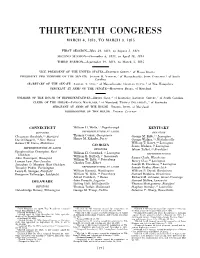
THIRTEENTH CONGRESS MARCH 4, 1813, TO MARCH 3, 1815 FIRST SESSION—May 24, 1813, to August 2, 1813 SECOND SESSION—December 6, 1813, to April 18, 1814 THIRD SESSION—September 19, 1814, to March 3, 1815 VICE PRESIDENT OF THE UNITED STATES—ELBRIDGE GERRY, 1 of Massachusetts PRESIDENT PRO TEMPORE OF THE SENATE—JOSEPH B. VARNUM, 2 of Massachusetts; JOHN GAILLARD, 3 of South Carolina SECRETARY OF THE SENATE—SAMUEL A. OTIS, 4 of Massachusetts; CHARLES CUTTS, 5 of New Hampshire SERGEANT AT ARMS OF THE SENATE—MOUNTJOY BAYLY, of Maryland SPEAKER OF THE HOUSE OF REPRESENTATIVES—HENRY CLAY, 6 of Kentucky; LANGDON CHEVES, 7 of South Carolina CLERK OF THE HOUSE—PATRICK MAGRUDER, 8 of Maryland; THOMAS DOUGHERTY, 9 of Kentucky SERGEANT AT ARMS OF THE HOUSE—THOMAS DUNN, of Maryland DOORKEEPER OF THE HOUSE—THOMAS CLAXTON CONNECTICUT William H. Wells, 12 Dagsborough KENTUCKY REPRESENTATIVES AT LARGE SENATORS SENATORS Chauncey Goodrich, 10 Hartford Thomas Cooper, Georgetown George M. Bibb, 18 Lexington David Daggett, 11 New Haven Henry M. Ridgely, Dover George Walker, 19 Nicholasville Samuel W. Dana, Middlesex William T. Barry, 20 Lexington GEORGIA Jessie Bledsoe, 21 Lexington REPRESENTATIVES AT LARGE SENATORS Isham Talbot, 22 Frankfort Epaphroditus Champion, East 13 William H. Crawford, Lexington REPRESENTATIVES Haddam 14 William B. Bulloch, Savannah James Clark, Winchester John Davenport, Stamford 15 William W. Bibb, Petersburg Henry Clay, 23 Lexington Lyman Law, New London Charles Tait, Elbert Jonathan O. Moseley, East Haddam Joseph H. Hawkins, 24 Lexington Timothy Pitkin, Farmington REPRESENTATIVES AT LARGE Joseph Desha, Mays Lick Lewis B. Sturges, Fairfield William Barnett, Washington William P. -

Williamson Countg Historical Societg
Williamson Countg Historical Societg r Publication number 23 Spring 1992 Pyblished by Uliiliemson County Historical Society Franklin, Tennessee 1992 Williamson Countg Historical Societg Publication number 23 Spring 1992 Published by Ulilliomson County Historicol Society Franklin, Tennessee 1992 Wi l l iamson County Historical Society Publ ication Number 23 Spring 1992 Edi tor Richard Warwick Of f i cers Presi dent M i chae1 Bal l i et First Vice President Rebekah Clark Second Vice President Gerth Uthman Secretary Marjorie Hales Treasurer Herman Major / INTRODUCTION BY EDITOR Wil liamson County has grown in population and changed greatly since 1944. Fortunately, much of its rich history has been preserved by a few biblical "Ebenezers" of our past. Miss Susie Gentry heads the list as Franklin's premier historian and patriot. Through her efforts historical sites were preserved and markers placed to honor our past. So it is that the 1991-92 JOURNAL is dedicated to honor Miss Susie Gentry's good works. The articles presented in this issue had been kept for forty-seven years as Miss Susie left them in two cardboard boxes. After Miss Susie's death in 1944, Mr. Luther McCall , her friend and administrator, gave the material to Dr. Rosalie Carter for safekeeping. Dr. Carter, real izing the importance■of Miss Gentry's writings and the twilight of her own stewardship, offered them to me for publ ication in the Wil l iamson County Historical Society's JOURNAL. ^ I gladly accepted the two boxes and immediately commenced reading and selecting the articles appropriate for our publication. The articles are presented as written by Miss Susie. -
Engineering the American Military Nation, 1814-1821 Dissertation
Importing Napoleon: Engineering the American Military Nation, 1814-1821 Dissertation Presented in Partial Fulfillment of the Requirements for the Degree Doctor of Philosophy in the Graduate School of The Ohio State University By Jonathan M. Romaneski, M.A. Graduate Program in History The Ohio State University 2017 Dissertation Committee: Dr. Mark Grimsley, Advisor Dr. John Brooke Dr. Jennifer Siegel Copyright by Jonathan Romaneski 2017 Abstract As the War of 1812 drew to a close, the American nation was economically exhausted and politically upended. The great crisis of the war loomed over the American shorelines from mid-1814 onward, when British reinforcements under a new and more aggressive British commander threatened offensive thrusts into U.S. territory at multiple points. Americans were completely unprepared to meet the British invasion attempts; the United States parried all British thrusts in 1814 almost in spite of itself. Thus, by the end of 1814, the Madison administration (with strong input from James Monroe) began to seek to reform the American military establishment to ensure a more disciplined and uniform militia system, a better-educated and “professional” officer corps, and a stout system of seacoast fortifications. The reformers looked no further than the Napoleonic military system for all their answers. In order to convince the American people and their congressional representatives that greater investment in a Napoleonic-style army was necessary, the reformers relied on a narrative of the War of 1812 that emphasized the frailty of the militia and the heroism of the regulars. Complicating the reformers’ narrative was, first, the strong antimilitary ideological traditions that Americans had held so closely since the Revolutionary era, and second, a counternarrative of the war that arose from Andrew Jackson’s victory at New Orleans. -

Past Masters: an Exhibition Celebrating Five Centuries of Leadership at Christ’S College, Cambridge
Christ’s College, University of Cambridge Past Masters: An Exhibition Celebrating Five Centuries of Leadership at Christ’s College, Cambridge John Covel, 15th Master John Peile, 26th Master The Lord Todd, 32nd Master (1688-1722) (1887-1910) (1963-1978) 17 June to 15 November 2013 Old Library, Christ’s College Open to the public, 8 October to 15 November 2013 Tuesdays, Wednesdays and Thursdays, 2pm to 4pm, and at other times by appointment Christ’s College Library, St Andrew’s Street, Cambridge, CB2 3BU Email: library@christs.cam.ac.uk Special Collections Blog: http://christstreasures.blogspot.co.uk Introduction In 1505, Christ’s College was refounded by the mother of the Tudor dynasty, Lady Margaret Beaufort. The man she chose to lead her fledgling academic institution into an uncertain future was John Syclyng, who was duly awarded the office of Master of Christ’s College. More than 500 years on, and 37 Masters later, the position endures. The Fellowship has swelled from 12 humble Doctors of Divinity to over 100 academics of wide-ranging learning, and the student body has expanded from 47 poor scholars to several hundred undergraduates and postgraduates. Nevertheless, the community of Christ’s College to this day remains led by one man: the Master. Past Masters is a celebration of this most enduring of positions. From the intriguing process by which Masters assume office, to their varied roles as shepherd of the student flock, magisterial scholar of deep learning, and guardian of the College’s purse, liberties and interests, this exhibition offers an insight into the history of this most fascinating of roles, and of the inspirational men who have filled it.