Legal Brief Bank
Total Page:16
File Type:pdf, Size:1020Kb
Load more
Recommended publications
-

The Official High Times Cannabis Cookbook: More Than 50 Irresistible Recipes That Will Get You High
CONTENTS ACKNOWLEDGMENTS INTRODUCTION TO CANNABIS COOKERY CHAPTER 1: Active Ingredients Basic Recipes THC Oil (Cannabis-Infused Oil) Cannacoconut Oil Cannabis-Infused Mayonnaise Simple Cannabutter Long-Simmering Cannabutter Wamm Marijuana Flour Tinctures Quick Cannabis Glycerite Long-Simmering Ganja Glycerin Green Avenger Cannabis Tincture CHAPTER 2: Irie Appetizers Roasted Ganja Garlic Cannellini Dip Hookah Lounge Hummus Green Leafy Kale Salad in Brown Cannabutter Vinaigrette Obama’S Sativa Samosas Stuffed Stoned JalapeñO Poppers Sativa Shrimp Spring Rolls with Mango Sauce Ganja Guacamole Mini Kind Veggie Burritos Pico de Ganja and Nachos Kind Bud Bruschetta with Pot Pesto Stoner Celebrity Favorite: Lil’ Snoop Hot Doggy Doggs CHAPTER 3: Munchie Meals Reggae Rice and Bean Soup Cream of Sinsemilla Soup Tom Yum Ganja Stoner Celebrity Favorite: Texas Cannabis Chili Shroomin’ Broccoli Casserole Om Circle Stuffed Butternut Squash Chicken and Andouille Ganja Gumbo Time-Warp Tamales Red, Green, and Gold Rasta Pasta Potato Gnocchi with Wild Mushroom Ragu Big Easy Eggplant Alfredo Ganja Granny’s Smoked Mac ‘n’ Cheese Psychedelic Spanakopita Sour Diesel Pot Pie Cheeto Fried Chicken Bacon-Wrapped Pork Tenderloin with Mango Chipotle Glaze Pot-and-Pancetta-Stuffed Beef Tenderloin with Port Mushrooms CHAPTER 4: High Holidays Valentine’s Day, February 14: Sexy Ganja–Dipped Strawberries St. Patrick’s Day, March 17: Green Ganja Garlic Smashed Potatoes 4/20, Cannabis Day, April 20: 420 Farmers’ Market Risotto Independence Day, July 4: Sweet and Tangy Bar–B–Cannabis -

Medical Marijuana the War on Drugs and the Drug Policy Reform Movement
UNIVERSITY OF CALIFORNIA SANTA CRUZ FROM THE FRONTLINES TO THE BOTTOM LINE: MEDICAL MARIJUANA THE WAR ON DRUGS AND THE DRUG POLICY REFORM MOVEMENT A dissertation submitted in partial satisfaction Of the requirements for the degree of DOCTOR OF PHILOSOPHY in SOCIOLOGY by Thomas R. Heddleston June 2012 The Dissertation of Thomas R. Heddleston is approved: ____________________________________ Professor Craig Reinarman, Chair ____________________________________ Professor Andrew Szasz ____________________________________ Professor Barbara Epstein ___________________________________ Tyrus Miller Vice Provost and Dean of Graduate Studies Copyright © by Thomas R. Heddleston 2012 TABLE OF CONTENTS Introduction 1 Chapter I: The History, Discourse, and Practice of Punitive Drug Prohibition 38 Chapter II: Three Branches Of Reform, The Drug Policy Reform Movement From 1964 To 2012 91 Chapter III: Sites of Social Movement Activity 149 Chapter IV: The Birth of Medical Marijuana In California 208 Chapter V: A Tale of 3 Cities Medical Marijuana 1997-2011 245 Chapter VI: From Movement to Industry 303 Conclusion 330 List of Supplementary Materials 339 References 340 iii LIST OF TABLES AND FIGURES Table 2.1: Major Organizations in the Drug Policy Reform Movement by Funding Source and Organizational Form 144 Table 3.1: Characteristics of Hemp Rallies Attended 158 Table 3.2: Drug Policy Organizations and the Internet 197 Figure 4.1: Proposition 215 Vote November 1996 241 Table 5.1: Political Opportunity Structures and Activist Tools 251 Table 5.2: Key Aspects of Political Opportunity Structures at 3 Levels of Government 263 Figure 5.1: Medical Cannabis Dispensaries by Region and State 283 iv ABSTRACT Thomas R. Heddleston From The Frontlines to the Bottom Line: Medical Marijuana the War On Drugs and the Drug Policy Reform Movement The medical marijuana movement began in the San Francisco Bay Area in the early 1990s in a climate of official repression. -

Ethical Cannabis Lawyering in California Francis J
University of the Pacific Scholarly Commons McGeorge School of Law Scholarly Articles McGeorge School of Law Faculty Scholarship 2018 Ethical Cannabis Lawyering in California Francis J. Mootz III University of the Pacific, McGeorge School of Law, jmootz@pacific.edu Follow this and additional works at: https://scholarlycommons.pacific.edu/facultyarticles Part of the Legal Ethics and Professional Responsibility Commons Recommended Citation Mootz, Francis J. III (2018) "Ethical Cannabis Lawyering in California," St. Mary's Journal on Legal Malpractice & Ethics: Vol. 9 : No. 1 , Article 1. This Article is brought to you for free and open access by the McGeorge School of Law Faculty Scholarship at Scholarly Commons. It has been accepted for inclusion in McGeorge School of Law Scholarly Articles by an authorized administrator of Scholarly Commons. For more information, please contact mgibney@pacific.edu. ARTICLE Francis J. Mootz III Ethical Cannabis Lawyering in California Abstract. Cannabis has a long history in the United States. Originally, doctors and pharmacists used cannabis for a variety of purposes. After the Mexican Revolution led to widespread migration from Mexico to the United States, many Americans responded by associating this influx of foreigners with the use of cannabis, and thereby racializing and stigmatizing the drug. After the collapse of prohibition, the federal government repurposed its enormous enforcement bureaucracy to address the perceived problem of cannabis, despite the opposition of the American Medical Association to this new prohibition. Ultimately, both the states and the federal government classified cannabis as a dangerous drug with no therapeutic purpose, treating it the same as cocaine and heroin. Over the past few decades, a number of states have decriminalized cannabis and have permitted residents to purchase cannabis for medical conditions. -

Brownie Mary Collection, 1981-2001,SFH 379
http://oac.cdlib.org/findaid/ark:/13030/c8r49v5q No online items Finding Aid to the Brownie Mary Collection, 1981-2001,SFH 379 Finding aid prepared by Tami J. Suzuki San Francisco History Center, San Francisco Public Library 100 Larkin Street San Francisco, CA, 94102 (415) 557-4567 sfhistory@sfpl.org 2019 Finding Aid to the Brownie Mary SFH 379 1 Collection, 1981-2001,SFH 379 Title: Brownie Mary Collection Date (inclusive): 1981-2001 Collection Identifier: SFH 379 Creator: Rathbun, Mary (Mary Jane), 1922-1999 Physical Description: 3 boxes, 2 oversized flat boxes, 1 framed art piece(2.1 cubic feet) Contributing Institution: San Francisco History Center, San Francisco Public Library 100 Larkin Street San Francisco, CA, 94102 (415) 557-4400 sfhistory@sfpl.org Abstract: Contains news clippings, flyers, and brochures about Rathbun, the cannabis brownies she served to people with AIDS and other serious illnesses, and the medical marijuana legalization movement; awards, some photographs, and items including her signature vest. Physical Location: The collection is stored on site. Language of Materials: Collection materials are in English. Access The collection is available for use during San Francisco History Center hours, with photographs available during Photo Desk hours. Collections that are stored off site should be requested 48 hours in advance. Publication Rights All requests for permission to publish or quote from manuscripts must be submitted in writing to the City Archivist. Permission for publication is given on behalf of the San Francisco Public Library as the owner of the physical items. Preferred Citation [Identification of item], Brownie Mary Collection (SFH 379), San Francisco History Center, San Francisco Public Library. -

Professional School Fee Hike Approved
, H • u c 5 D SACRAMENTO - San Bernardino Valley College student Janice Camerena has named UC President Jack Peltason as one of several defendants in an anti-affirma tive action suit filed on March 16. Camerena, a Caucasian, 7 claims she-was asked to leave UC SAN DIEGO MONDAY, APRIL 3,1995 VOLUME 85, ISSUE 1 an English 101 class because she was told it was intended for black students ouly. The suit opposes the community Professional School Fee Hike Approved colleges' Black Bridge Project, designed to help The widely anticipated fee hikes, for medicine, $7,670 for dentistry, Young pointed out that one-third of African Americans succeed in REGENTS: Medical which were endorsed during a re $7,733 for veterinary medicine, the increases will go toward finan college. Peltason has been school costs set to gents committee meeting the previ $9,157 for law and $8,949 for busi cial aid. named in the suit because the jump $2,000 annually ous day, will only affect new stu ness (except at UC Riverside, which "The cost is going up, but the UC President's Office dents entering UC professional pro will charge $7,949). amount of aid is going up," Young administers a similar program By DCKC Alexander grams beginning in the fall of 1995. Speaking at the March 16 meet said. "It will raise fees, but more geared towards Hispanics, the Senior Staff Writer New law and business students will ing, UCLA Chancellor Charles will be put into financ ial aid, so we Puente Project. In a move which will cost new pay an additional $2,000 per year, Young threw his support behind the will be providing a discount." - California Journal professional-school students as while new medical, dental and vet fee hikes. -

PATIENTSIN the CROSSFIRE Casualties in the War on Medical Marijuana
PATIENTSIN THE CROSSFIRE Casualties in the War on Medical Marijuana Americans for Safe Access © Copyright 2004, Americans for Safe Access, Berkeley, California In loving memory of Cheryl Miller, Asha Davis and Harry McBride, this book is dedicated to all the people who might have been helped by medical marijuana but were denied it. Patients in the Crossfire was largely inspired by the book, Shattered Lives: Portraits From America's Drug War by Mikki Norris, Chris Conrad and Virginia Resner (Creative Xpressions, 2000). Many of the patients' stories and photos included in this publication were adapted from Shattered Lives and their other works -- Human Rights and the US Drug War (2001) and photo exhibit project (see www.hr95.org) that put a human face on the casualties of the Drug War. In addition, Mikki Norris put out a call to solicit new stories of patient harassment at the hands of the government and wrote up many of the stories that responded to this call. She contributed greatly to the making of this project and we appreciate her hard work. Her dedication is an inspiration. PATIENTS IN THE CROSSFIRE TABLE of CONTENTS Preface . 2 Introduction . .3 History of Cannabis as Medicine . .6 Research on Medical Applications . .7 INCARCERATED Jimmy Montgomery . .12 Will Foster . .14 Todd McCormick . .16 James Cox . .18 Marvin Chavez . .20 Bryan Epis . .22 James Burton . .24 Kevin Gage, Tom Kikuchi and Stephanie Landa . .26 Joe Pinson . .29 Michael Teague . .30 Larry Rathbun . .33 PROSECUTED Robert Randall . .34 Barb and Kenny Jenks . .37 Myron Mower . .38 Peter McWilliams . .40 Ed Rosenthal . -
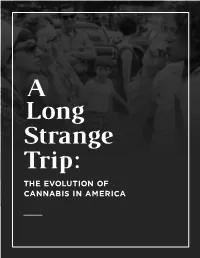
THE EVOLUTION of CANNABIS in AMERICA (Counter-Clockwise) Fig 1
A Long Strange Trip: THE EVOLUTION OF CANNABIS IN AMERICA (counter-clockwise) Fig 1. “Working in a Hemp Field.” The Canna Chronicles, 1905. Fig 2. “Bails of hemp at a warehouse of the Columbian Rope Company.” The National Archives, 6 Aug. 1918. Fig 3. “A farmer standing in front of his hemp crop in Seney, Michigan.” Sudbury.com, circa 1920s. (cover page) Protesters stage smoke-in on the National Mall. David Fenton/Getty Images, 4 July 1970. AMERICA’S DARLING The story of cannabis in the United States is older than the nation itself — and its many plot twists and turns can serve to illuminate the complex web of political, social, and economic influences that have contributed to setting the course of American history. 2 A Long Strange Trip : THE EVOLUTION OF CANNABIS IN AMERICA TIMELINE ( 1619 - 1970 ) HEMP IS LAW 1619 Virginia colony passes a law that requires farmers to grow hemp. HEMP AS CURRENCY Fig 4. “Drawn depiction of villagers farming hemp.” 1631 ~ 1800 The Green Fund. For centuries, Americans can use hemp as money— or to pay taxes. “GROW IT EVERYWHERE ” 1794 Founding father George Washington famously promotes hemp cultivation in a letter to his field manager. MEDICINAL PREPARATIONS 1839 Irish physician-researcher William O’Shaughnessy introduces the thera- peutic use of cannabis to the West. 1860 NEW YORK “POISON LAW” A new kind of law that requires HASHISH-HOUSES 1883 cannabis to carry “POISON” label. Hash-friendly parlors flourish in cities along the East Coast. 1906 PURE FOOD AND DRUG ACT Law that places first federal regula- tions on medically-derived cannabis. -

“We Were Dying and Marijuana Was All We Had.” During the Darkest Days
“We were dying and marijuana was all we had.” During the Darkest Days of AIDS, Cannabis was Often the Only Respite A World AIDS Day Special Feature Article by Betsy Pisik for WM Policy Mention “the 1980s” to most anyone and their recollection might range from the New Right to MTV. The decade introduced us to England’s Lady Diana Spencer and her transformation into a global icon, ET: the Extraterrestrial, Madonna, Roseanne, the Cosby Family, the Carrington Dynasty and yuppies. Marked by consumerism, materialism and conservatism, the decade was epitomized by the presidency of Ronald Reagan. But the 1980s came to be known for something else, too. A mysterious disease was discovered and was raising all sorts of concern. On July 3, 1981, the New York Times reported on a “Rare Cancer Seen in 41 Homosexuals” (The New York Native, an LGBTQ weekly publication reported on this mysterious medical issue in May, making it the first news media outlet to cover AIDS). Around the same time in California, post-hippie interest in cannabis as medicine was emerging in earnest, laying the groundwork for the Golden State to become, decades later, the capital of the legal cannabis industry. San Francisco became Ground Zero for both. The City on the Bay, particularly the Castro, a formerly working class neighborhood in Eureka Valley, had became a haven for Gay men. And the city’s eclectic counter culture vibe--reflected in neighborhoods like Haight-Asburry, the Mission and North Beach--were known to be more than “cannabis friendly.” A “Gay Cancer” and a Plant In “gayborhoods” like the Castro, as well as Christopher Street in New York City, Chicago’s BoysTown and DuPont Circle in the nation’s capital among others, panic set in. -

During the Darkest Days of AIDS, Cannabis Was Often the Only Respite a World AIDS Day Special Feature Article by Betsy Pisik for WM Policy
“We were dying and marijuana was all we had.” During the Darkest Days of AIDS, Cannabis was Often the Only Respite A World AIDS Day Special Feature Article by Betsy Pisik for WM Policy Mention “the 1980s” to most anyone and their recollection might range from the New Right to MTV. The decade introduced us to England’s Lady Diana Spencer and her transformation into a global icon, ET, Madonna, Roseanne, the Cosby Family, the Carrington Dynasty and yuppies. Marked by consumerism, materialism and conservatism, the decade was epitomized by the presidency of Ronald Reagan. The 1980s also came to be known for the mysterious disease targetting healthy gay men with surgical precision. The AIDS epidemic officially began on July 3, 1981, when the New York Times reported on a “Rare Cancer Seen in 41 Homosexuals.” (The New York Native, an oLGBTQ weekly publication reported on this mysterious medical issue in May, making it the first news media outlet to cover AIDS.) Around the same time in California, post-hippie interest in cannabis as medicine was emerging in earnest, laying the groundwork for the Golden State to become, decades later, the capital of the legal cannabis industry. San Francisco became Ground Zero for both. The City on the Bay, particularly the Castro, a formerly working class neighborhood in Eureka Valley, had became a haven for Gay men. And the city’s eclectic counter culture vibe--reflected in neighborhoods like Haight-Ashbury, the Mission and North Beach--were known to be more than “cannabis friendly.” A “Gay Cancer” and a Plant In “gayborhoods” like the Castro, as well as Christopher Street in New York City, Chicago’s BoysTown and DuPont Circle in the nation’s capital among others, panic set in. -
Glossary of Cannabis Terms
Glossary of cannabis terms A cannabis plant Terms related to cannabis include: 0–9 2 long Slang name for a cannabis cigarette.[1] [See joint.] 420 A code-term that refers to the consumption of cannabis. 710 A slang name for hash oil, the word OIL flipped upside-down.[2] [See cannabis edibles and extracts.] A April 20 in Vancouver, British Columbia, in 2012 Acapulco Gold An heirloom variety of cannabis originally grown in the mountains of western Mexico. [See cannabis strains.] adult use Any use of cannabis by adults, whether for medicine, pleasure, religious purposes, or otherwise. Incorporated in some legislation such as the California Adult Use of Marijuana Act. agent provocateur A person who, out of their own sense of duty or employed by the police, commits or provokes others to commit illegal or inappropriate activity, or falsely implicates them in a criminal act. [See informant.] alcohol prohibition Laws in some jurisdictions banning the production or sales of beverage alcohol in an attempt to prevent its use. These bans have been criticized because they create a black market, leading to corruption and violence. Nationwide, constitutional prohibition in the United States, established by the 18th Amendment in 1920, ended in 1933, repealed by the 21st Amendment. Alice B. Toklas 1. Alice B. Toklas (1877–1967) was author of an autobiographical book, The Alice B. Toklas Cookbook, first published in 1954, which includes a recipe for "Hashish Fudge." 2. A slang name for a cannabis edible.[3] amotivational syndrome A supposed medical syndrome of lack of motivation in cannabis consumers, which has been challenged. -
RESOLUTION 18-07.34L Resolving the Pending Property Insurance Crises and Protecting Californians and Our State and Local Econom
1 RESOLUTION 18-07.34L 2 Resolving the Pending Property Insurance Crises and Protecting Californians and Our State and Local Economies 3 WHEREAS the California Democratic Party Platform’s vision of an economically strong state that respects and protects all 4 California residents is threatened by the increasing risk of extreme wildfires linked to climate change that can strike nearly 5 anywhere; and 10 of the 20 most destructive wildfires in California’s history have occurred in the last four years, with more 6 than 150 people killed and more than $25 billion in insured losses reported; and 7 WHEREAS according to the California Department of Insurance, consumer complaints on non-renewals have increased 600 8 percent since 2010 and more than 100 rate increases have been filed with California Department of Insurance in 2017-2018 9 with more to come; and insurance availability is threatened due to the decline in the number of admitted carriers, and 10 WHEREAS non-admitted insurance plans deny Californians the protection of the California Insurance Commissioner and many 11 of the requirements intended by the voters with the passage of Proposition 103; and the inability of homeowners and 12 businesses to afford insurance premiums may damage local government through a reduced property tax base and a possible 13 default crisis as owners become “upside down” on the mortgage-to-market-value, further exacerbating rural unemployment 14 and harming the California economy; 15 THEREFORE BE IT RESOLVED that the California Democratic Party strongly supports the establishment of home and 16 community wildfire defense and adaptation standards, and 17 BE IT FURTHER RESOLVED that the California Democratic Party supports requiring private home insurers to provide home 18 insurance to homeowners and communities that meet that standard, at standard uninflected rates, and supports creating a 19 publicly owned NON PROFIT STATE fire and casualty insurance company AS A COST CONTROLLING ALTERNATIVE TO THE 20 PRIVATE MARKETS. -

UC Santa Cruz UC Santa Cruz Electronic Theses and Dissertations
UC Santa Cruz UC Santa Cruz Electronic Theses and Dissertations Title From the Frontlines to the Bottom Line: Medical Marijuana, the War on Drugs, and the Drug Policy Reform Movement Permalink https://escholarship.org/uc/item/1t7220hj Author Heddleston, Thomas Reed Publication Date 2012 Supplemental Material https://escholarship.org/uc/item/1t7220hj#supplemental Peer reviewed|Thesis/dissertation eScholarship.org Powered by the California Digital Library University of California UNIVERSITY OF CALIFORNIA SANTA CRUZ FROM THE FRONTLINES TO THE BOTTOM LINE: MEDICAL MARIJUANA THE WAR ON DRUGS AND THE DRUG POLICY REFORM MOVEMENT A dissertation submitted in partial satisfaction Of the requirements for the degree of DOCTOR OF PHILOSOPHY in SOCIOLOGY by Thomas R. Heddleston June 2012 The Dissertation of Thomas R. Heddleston is approved: ____________________________________ Professor Craig Reinarman, Chair ____________________________________ Professor Andrew Szasz ____________________________________ Professor Barbara Epstein ___________________________________ Tyrus Miller Vice Provost and Dean of Graduate Studies Copyright © by Thomas R. Heddleston 2012 TABLE OF CONTENTS Introduction 1 Chapter I: The History, Discourse, and Practice of Punitive Drug Prohibition 38 Chapter II: Three Branches Of Reform, The Drug Policy Reform Movement From 1964 To 2012 91 Chapter III: Sites of Social Movement Activity 149 Chapter IV: The Birth of Medical Marijuana In California 208 Chapter V: A Tale of 3 Cities Medical Marijuana 1997-2011 245 Chapter VI: From Movement