Cinema As Translation
Total Page:16
File Type:pdf, Size:1020Kb
Load more
Recommended publications
-

Wilt on Testa, 'Poet of Civic Courage: the Films of Francesco Rosi'
H-Film Wilt on Testa, 'Poet of Civic Courage: the Films of Francesco Rosi' Review published on Monday, June 1, 1998 Carlo Testa, ed. Poet of Civic Courage: the Films of Francesco Rosi. Westport, Conn.: Greenwood Press, 1996. 202 pp. $59.95 (cloth), ISBN 978-0-313-30278-7. Reviewed by David Wilt (University of Maryland-College Park) Published on H-Film (June, 1998) Shedding Light on Franceso Rosi Despite the critical and popular success of his films, Francesco Rosi is hardly a household name, even in cinema circles. Those who have seen Christ Stopped at Eboli (1979) and Three Brothers (1980) may not recognize Rosi as the director of these works, and a deeper appreciation of his talent is hampered by the fact that most of his films are unavailable or are at the least difficult to find in the United States, a point made several times in this book. Francesco Rosi was born in 1922. Although interested in cinema since childhood, he enrolled in law school to please his father, who wanted him to have a stable profession. However, military service in WWII interrupted Rosi's studies, and after the war he abandoned law to work in radio, theater, and eventually in the film industry. After many years as an assistant, Rosi directed his first feature,The Challenge, in 1957. Since then, he has made fifteen additional features (and contributed an episode to a multistory film), including the Academy Award-nominatedThree Brothers. His most recent feature is La Tregua (1996). Poet of Civic Courage contains six chapters on individual films, a 1994 interview with the Italian director, a short article on "The Future of Italian Cinema" written by Rosi for an Italian newspaper, a filmography and a bibliography. -
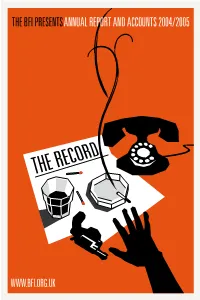
Annual Report and Accounts 2004/2005
THE BFI PRESENTSANNUAL REPORT AND ACCOUNTS 2004/2005 WWW.BFI.ORG.UK The bfi annual report 2004-2005 2 The British Film Institute at a glance 4 Director’s foreword 9 The bfi’s cultural commitment 13 Governors’ report 13 – 20 Reaching out (13) What you saw (13) Big screen, little screen (14) bfi online (14) Working with our partners (15) Where you saw it (16) Big, bigger, biggest (16) Accessibility (18) Festivals (19) Looking forward: Aims for 2005–2006 Reaching out 22 – 25 Looking after the past to enrich the future (24) Consciousness raising (25) Looking forward: Aims for 2005–2006 Film and TV heritage 26 – 27 Archive Spectacular The Mitchell & Kenyon Collection 28 – 31 Lifelong learning (30) Best practice (30) bfi National Library (30) Sight & Sound (31) bfi Publishing (31) Looking forward: Aims for 2005–2006 Lifelong learning 32 – 35 About the bfi (33) Summary of legal objectives (33) Partnerships and collaborations 36 – 42 How the bfi is governed (37) Governors (37/38) Methods of appointment (39) Organisational structure (40) Statement of Governors’ responsibilities (41) bfi Executive (42) Risk management statement 43 – 54 Financial review (44) Statement of financial activities (45) Consolidated and charity balance sheets (46) Consolidated cash flow statement (47) Reference details (52) Independent auditors’ report 55 – 74 Appendices The bfi annual report 2004-2005 The bfi annual report 2004-2005 The British Film Institute at a glance What we do How we did: The British Film .4 million Up 46% People saw a film distributed Visits to -
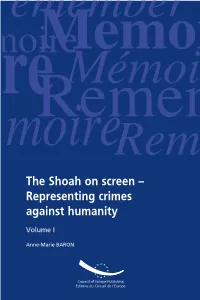
The Shoah on Screen – Representing Crimes Against Humanity Big Screen, Film-Makers Generally Have to Address the Key Question of Realism
Mémoi In attempting to portray the Holocaust and crimes against humanity on the The Shoah on screen – representing crimes against humanity big screen, film-makers generally have to address the key question of realism. This is both an ethical and an artistic issue. The full range of approaches has emember been adopted, covering documentaries and fiction, historical reconstructions such as Steven Spielberg’s Schindler’s List, depicting reality in all its details, and more symbolic films such as Roberto Benigni’s Life is beautiful. Some films have been very controversial, and it is important to understand why. Is cinema the best way of informing the younger generations about what moire took place, or should this perhaps be left, for example, to CD-Roms, videos Memoi or archive collections? What is the difference between these and the cinema as an art form? Is it possible to inform and appeal to the emotions without being explicit? Is emotion itself, though often very intense, not ambivalent? These are the questions addressed by this book which sets out to show that the cinema, a major art form today, cannot merely depict the horrors of concentration camps but must also nurture greater sensitivity among increas- Mémoire ingly younger audiences, inured by the many images of violence conveyed in the media. ireRemem moireRem The Shoah on screen – www.coe.int Representing crimes The Council of Europe has 47 member states, covering virtually the entire continent of Europe. It seeks to develop common democratic and legal princi- against humanity ples based on the European Convention on Human Rights and other reference texts on the protection of individuals. -

The Development of the British Conspiracy Thriller 1980-1990
The Development of the British Conspiracy Thriller 1980-1990 Paul S. Lynch This thesis is submitted to the University of Hertfordshire in partial fulfilment of the requirements of the degree of Doctor of Philosophy. January 2017 Abstract This thesis adopts a cross-disciplinary approach to explore the development of the conspiracy thriller genre in British cinema during the 1980s. There is considerable academic interest in the Hollywood conspiracy cycle that emerged in America during the 1970s. Films such as The Parallax View (Pakula, 1975) and All the President’s Men (Pakula, 1976) are indicative of the genre, and sought to reflect public anxieties about perceived government misdeeds and misconduct within the security services. In Europe during the same period, directors Costa-Gavras and Francesco Rosi were exploring similar themes of state corruption and conspiracy in films such as State of Siege (1972) and Illustrious Corpses (1976). This thesis provides a comprehensive account of how a similar conspiracy cycle emerged in Britain in the following decade. We will examine the ways in which British film-makers used the conspiracy form to reflect public concerns about issues of defence and national security, and questioned the measures adopted by the British government and the intelligence community to combat Soviet subversion during the last decade of the Cold War. Unlike other research exploring espionage in British film and television, this research is concerned exclusively with the development of the conspiracy thriller genre in mainstream cinema. This has been achieved using three case studies: Defence of the Realm (Drury, 1986), The Whistle Blower (Langton, 1987) and The Fourth Protocol (MacKenzie, 1987). -

Crime Wave for Clara CRIME WAVE
Crime Wave For Clara CRIME WAVE The Filmgoers’ Guide to the Great Crime Movies HOWARD HUGHES Disclaimer: Some images in the original version of this book are not available for inclusion in the eBook. Published in 2006 by I.B.Tauris & Co Ltd 6 Salem Road, London W2 4BU 175 Fifth Avenue, New York NY 10010 www.ibtauris.com In the United States and Canada distributed by Palgrave Macmillan, a division of St. Martin’s Press, 175 Fifth Avenue, New York NY 10010 Copyright © Howard Hughes, 2006 The right of Howard Hughes to be identified as the author of this work has been asserted by him in accordance with the Copyright, Designs and Patents Act 1988. All rights reserved. Except for brief quotations in a review, this book, or any part thereof, may not be reproduced, stored in or introduced into a retrieval system, or transmitted, in any form or by any means, electronic, mechanical, photocopying, recording or otherwise, without the prior written permission of the publisher. The TCM logo and trademark and all related elements are trademarks of and © Turner Entertainment Networks International Limited. A Time Warner Company. All rights reserved. © and TM 2006 Turner Entertainment Networks International Limited. ISBN 10: 1 84511 219 9 EAN 13: 978 1 84511 219 6 A full CIP record for this book is available from the British Library A full CIP record for this book is available from the Library of Congress Library of Congress catalog card: available Typeset in Ehrhardt by Dexter Haven Associates Ltd, London Printed and bound in Great Britain by TJ International, -

Mine Vaganti PB
DOMENICO PROCACCI presenta MMIINNEE VVAAGGAANNTTII un film di FERZAN OZPETEK con Riccardo Scamarcio, Nicole Grimaudo, Alessandro Preziosi, Ennio Fantastichini, Lunetta Savino, Ilaria Occhini, con Daniele Pecci, con la partecipazione di Carolina Crescentini e con Elena Sofia Ricci una produzione Fandango in collaborazione con Rai Cinema in collaborazione con Apulia Film Commission una distribuzione Uscita: 12 marzo 2009 Durata: 116’ Ufficio stampa 01 Distribution Studio Nobile Scarafoni Piazza Adriana 12 – 00193 Roma Via della Croce 44 – 00187 Roma 06.684701 - fax 066872141 06.69925096/104 – fax 06.69782905 Ornella Ornato: ornella.ornato@01distribution.it info@studionobilescarafoni.it Cristiana Trotta: c.trotta@01distribution.it Rebecca Roviglioni: r.roviglioni@01distribution.it Materiali stampa disponibili sui siti www.studionobilescarafoni.it - www.01distribution.it - www.fandango.it crediti non contrattuali Mine vaganti CAST ARTISTICO Tommaso Riccardo Scamarcio Alba Nicole Grimaudo Antonio Alessandro Preziosi Vincenzo Ennio Fantastichini Stefania Lunetta Savino Nonna Ilaria Occhini Zia Luciana Elena Sofia Ricci Elena Bianca Nappi Salvatore Massimiliano Gallo Andrea Daniele Pecci Nonna giovane Carolina Crescentini Marco Carmine Recano Teresa Paola Minaccioni Davide Gianluca De Marchi Massimiliano Mauro Bonaffini Patrizia Gea Martire Nicola Giorgio Marchesi Domenico Matteo Taranto Brunetti Giancarlo Montigelli Antonietta Crescenza Guarnieri Giovanna Emanuela Gabrieli crediti non contrattuali 2 Mine vaganti CAST TECNICO Regia Ferzan Ozpetek Soggetto e Sceneggiatura Ivan Cotroneo Ferzan Ozpetek Direttore della Fotografia Maurizio Calvesi Montaggio Patrizio Marone Musiche Pasquale Catalano Scenografia Andrea Crisanti Costumi Alessandro Lai Supervisore alla Produzione Claudio Zampetti Organizzatore generale Gianluca Leurini Direttore di produzione Roberto Leone Suono Marco Grillo Aiuto regista Gianluca Mazzella Prodotto da Domenico Procacci Distribuzione internazionale Fandango Portobello Sales sales@fandangoportobello.com Ufficio stampa Studio NOBILE SCARAFONI tel. -

Roma on the Screen the Roma on Europe’S Cinema Screens - Images of Freedom
ROMA ON THE SCREEN THE ROMA ON EUROPE’S CINEMA SCREENS - IMAGES OF FREEDOM DOMINIQUE CHANSEL 2 CONTENTS Page Introduction 5 1. Big-screen portrayals - from the Romanesque to the fantastic. A general study on a small number of themes 9 1.1. The beautiful rebels of French historical films 10 1.1.1. “The Hunchback of Notre Dame” by J. Delannoy (France / Italy, 1956) 10 1.1.2. “Cartouche” by Ph. de Broca (France / Italy, 1962) 13 1.2. Tales of love and death. From Russia to Spain 16 1.2.1. “Queen of the Gypsies” by E. Loteanu (USSR, 1976) 16 1.2.2. “Carmen” by F. Rosi (France / Italy, 1984) 20 2. Preoccupation with the sordid aspects of Roma life or real empathy? The uncertain paths of recognition 27 2.1. Between grandeur and destitution 27 2.1.1. “Kriss romani” by J. Schmidt (France, 1962) 27 2.1.2. “I Even Met Happy Gypsies” by A. Petrovi (Yugoslavia, 1967) 31 2.2. A lesson in freedom 34 2.2.1. “Devils, Devils” by D. Kdzierzawska (Poland, 1991) 34 2.2.2. “Into the West” by M. Newell (USA / Ireland, 1992) 36 3. An exuberant, baroque vision - the films of Emir Kusturica 41 3.1. Emir Kusturica or the lure of excess 41 3.2. “Time of the Gypsies” (Yugoslavia, 1988) 42 3.3. “Black Cat, White Cat” (France / Germany / Serbia, 1998) 47 4. A view from the inside? - the successes and contradictions of the films of Tony Gatlif 53 4.1. Tony Gatlif, music at heart 53 4.2. -

Andrea Crisanti Viaggio Nella Scenografia
Il Centro Sperimentale di Cinematografia – sede Sicilia è lieto di invitarLa alla presentazione del libro Andrea Crisanti Viaggio nella Scenografia venerdì 13 aprile 2012 ore 18:30 Centro Sperimentale di Cinematografia – Sede Sicilia Cantieri Culturali della Zisa pad. n. 6, Via Paolo Gili 4 - Palermo Il libro, curato da Sergio Toffetti e Antonio Fabio Familari, ripercorre la carriera artistica del Maestro Andrea Crisanti, uno dei massimi scenografi italiani contemporanei. Un viaggio che ripercorre il lavoro di ricerca, di progettazione e di realizzazione degli ambienti e dei luoghi dei film che hanno segnato la storia del cinema. Il libro ricostruisce, attraverso una lunga intervista con lo scenografo Andrea Crisanti, la sua formazione artistica fino ai nostri giorni, raccontando un mestiere fatto di studio e documentazione, ma anche di interpretazione e invenzione. Il viaggio, attraverso le scenografie di Andrea Crisanti, si svolge in molteplici luoghi: dalle montagne balcaniche alla Sicilia, dalla Tunisia alle foreste della Colombia, ed è arricchito da ricordi e aneddoti, di una carriera professionale vissuta a stretto contatto con registi, come Francesco Rosi, Sergio Leone, Andrej Tarkovskij, Marco Bellocchio, Giuseppe Tornatore, Theo Angelopoulos, Ferzan Ozpetek. Uomini contro, Giù la testa, Il caso Mattei, Cadaveri eccellenti, Nostalghia, Il giovane Toscanini, Nuovo Cinema Paradiso, Il ladro di bambini, Mine vaganti, La polvere del tempo sono alcuni dei film più famosi di cui Andrea Crisanti ha firmato le scenografie. SARA’ PRESENTE IL MAESTRO ANDREA CRISANTI interverranno: Prof. Antonino Buttitta – Direttore Scientifico del CSC - sede Sicilia Prof. Sebastiano Gesù – Storico e critico cinematografico Dott. Ivan Scinardo – Direttore del CSC - sede Sicilia Andrea Crisanti. -

Rome Film Fest October 18 | 27 2007 LA STORIA DEL CINEMA
Rome Film Fest October 18 | 27 2007 LA STORIA DEL CINEMA IN CINEMA MON AMOURAMOUR L’INTERMINABILE PASSIONE TRA BNL E IL GRANDE CINEMA cinema.bnl.it BNL MAIN PARTNER di “Cinema. Festa Internazionale di Roma” Roma, 18 - 27 ottobre Founding Members Advisory Board General Manager Comune di Roma Tullio Kezich Francesca Via Camera di Commercio di Roma President Regione Lazio Artistic Direction Provincia di Roma Paolo Bertetto Maria Teresa Cavina Fondazione Musica per Roma Gianni Canova Cinema 2007 Teresa Cavina and New Cinema Network Foundation Committee Giuseppe Cereda Piera Detassis Andrea Mondello Stefano Della Casa Première President Piera Detassis Gianluca Giannelli Giorgio De Vincenti Alice in the City Board of Directors Carlo Freccero Giorgio Gosetti Goffredo Bettini Gianluca Giannelli Cinema 2007 e CINEMA President Giorgio Gosetti The Business Street Franco La Polla Gaia Morrione Counsellors Marie-Pierre Macia Eventi Speciali Andrea Mondello Antonio Monda Mario Sesti MON AMOUR Carlo Fuortes Renato Nicolini Extra Vanni Piccolo Auditors Mario Sesti Daniela Lambardi Giorgio Van Straten President Staff Auditors Gianfranco Piccini Giovanni Sapia Supply Auditors Demetrio Minuto Antonella Greco WWW.AAMS.IT I GIOCHI PUBBLICI FINANZIANO LO SPORT, L'ARTE E LA CULTURA. CON I GIOCHI DI AAMS SI DEVOLVONO FONDI PER LO SPORT, L'ARTE E LA CULTURA. QUEST'ANNO AAMS È PARTNER DI "CINEMA. FESTA INTERNAZIONALE DI ROMA” E ASSEGNA IL PREMIO PER IL MIGLIOR FILM E IL PREMIO DEL PUBBLICO “ALICE NELLA CITTÀ”. VIENI A SCOPRIRE AAMS ALL'AUDITORIUM PARCO DELLA MUSICA. "CINEMA. FESTA INTERNAZIONALE DI ROMA - SOSTIENE LA FAO E LA SUA LOTTA CONTRO LA FAME” / “ROME FILM FEST - SUPPORTS FAO AND ITS FIGHT AGAINST HUNGER”. -

Europe On-Screen Cinema and the Teaching of History
Europe on-screen Cinema and the teaching of history by Dominique Chansel Translated from the French by Carol Kendall, Richard McQuiston, Nicholas Raveney, Christopher Reynolds Project “Learning and teaching about the history of Europe in the 20th century” Council for Cultural Co-operation Council of Europe Publishing French edition: L’Europe à l’écran – Le cinéma et l’enseignement de l’histoire ISBN 92-871-4529-6 The opinions expressed in this work are those of the author and do not all necessarily reflect the official policy of the Council for Cultural Co-operation or that of the Secretariat. Cover design: Graphic Design Workshop, Council of Europe Set of stamps designed for the French National Postal Authorities © Jean Le Gac Council of Europe Publishing F-67075 Strasbourg Cedex ISBN 92-871-4531-8 © Council of Europe, January 2001 Printed in Germany The Council of Europe was founded in 1949 to achieve greater unity between European parliamentary democracies. It is the oldest of the European political institutions and has 41 member states,1 including the 15 members of the European Union. It is the widest intergovernmental and interparliamentary organisation in Europe, and has its headquarters in Strasbourg. With only questions relating to national defence excluded from the Council of Europe’s work, the Organisation has activities in the following areas: democ- racy, human rights and fundamental freedoms; media and communication; social and economic affairs; education, culture, heritage and sport; youth; health; envi- ronment and regional planning; local democracy; and legal co-operation. The European Cultural Convention was opened for signature in 1954. -
Eg Phd, Mphil, Dclinpsychol
This thesis has been submitted in fulfilment of the requirements for a postgraduate degree (e.g. PhD, MPhil, DClinPsychol) at the University of Edinburgh. Please note the following terms and conditions of use: • This work is protected by copyright and other intellectual property rights, which are retained by the thesis author, unless otherwise stated. • A copy can be downloaded for personal non-commercial research or study, without prior permission or charge. • This thesis cannot be reproduced or quoted extensively from without first obtaining permission in writing from the author. • The content must not be changed in any way or sold commercially in any format or medium without the formal permission of the author. • When referring to this work, full bibliographic details including the author, title, awarding institution and date of the thesis must be given. Deleuzean Hybridity in the Films of Leone and Argento Keith Hennessey Brown PhD Film Studies University of Edinburgh 2012 Acknowledgements I would first like to thank my supervisors, Professor Martine Beugnet, Dr Daniel Yacavone, and the late Professor John Orr. I would then like to thank my parents, Alex and Mary Brown; all my friends, but especially Li-hsin Hsu, John Neilson and Tracey Rosenberg; and my cats, Bebert and Lucia. Table of Contents Introduction ..................................................................................................... 5-20 Theory ............................................................................................................. 21-62 -

Vol. II, Issue 1 January/June 2015 ISSN: 2284-3310
Vol. II, Issue 1 January/June 2015 ISSN: 2284-3310 International Journal of Comparative Literature and Arts Trenches/Trincee Mise en Abyme International Journal of Comparative Literature and Arts Vol. II, Issue 1 January-June 2015 General Editors: Armando Rotondi – University of Naples “L’Orientale” Elisa Sartor – University of Verona Editorial Office: Elena Dal Maso – University of Verona Giulia Ferro Milone – University of Verona Anita Paolicchi – University of Pisa Alessandro Valenzisi – University of Strathclyde Advisory Board: Beatrice Alfonzetti – University of Rome “La Sapienza” Raffaella Bertazzoli – University of Verona Joseph Farrell – University of Strathclyde Srecko Jurisic – University of Split José María Micó – Pompeu Fabra University Mariantonietta Picone – University of Naples “Federico II” Pasquale Sabbatino - University of Naples “Federico II” Antonio Saccone – University of Naples “Federico II” Álvaro Salvador – University of Granada Roxana Utale – University of Bucharest Logo and cover: Nicoletta Preziosi Publisher: Bel-Ami Edizioni S.r.l. Roma www.baedizioni.it Contact information: Armando Rotondi: arotondi@unior.it Elisa Sartor: elisa.sartor@univr.it Submission of contributions and material for review purposes: journal.abyme@gmail.com Web address: journalabyme.wordpress.com “Mise en Abyme” is officially recognised as an academic journal by ANVUR and is indexed in DOAJ – Directory of Open Access Journals All work in “Mise en Abyme” is licensed under a Creative Commons 4.0 Non-Commercial International License. ISSN: 2284-3310 January-July 2015 Vol. II, Issue 1 ISSN: 2284-3310 TABLE OF CONTENTS Special Issue. Trenches/Trincee La guerra di trincea: Uomini contro di Francesco Rosi p. 8 Gaetana Marrone Princeton University La traccia delle trincee e la rievocazione della Grande Guerra ne Le stagioni di Giacomo di Mario Rigoni Stern p.