LIBYA CONFLICT: SITUATION UPDATE May 2011
Total Page:16
File Type:pdf, Size:1020Kb
Load more
Recommended publications
-
The Battle for Libya
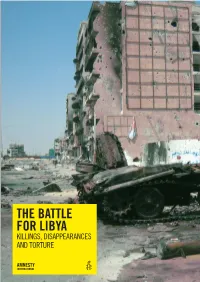
THE BATTLE FOR LIBYA KILLINGS, DISAPPEARANCES AND TORTURE Amnesty International is a global movement of more than 3 million supporters, members and activists in more than 150 countries and territories who campaign to end grave abuses of human rights. Our vision is for every person to enjoy all the rights enshrined in the Universal Declaration of Human Rights and other international human rights standards. We are independent of any government, political ideology, economic interest or religion and are funded mainly by our membership and public donations. First published in 2011 by Amnesty International Ltd Peter Benenson House 1 Easton Street London WC1X 0DW United Kingdom © Amnesty International 2011 Index: MDE 19/025/2011 English Original language: English Printed by Amnesty International, International Secretariat, United Kingdom All rights reserved. This publication is copyright, but may be reproduced by any method without fee for advocacy, campaigning and teaching purposes, but not for resale. The copyright holders request that all such use be registered with them for impact assessment purposes. For copying in any other circumstances, or for reuse in other publications, or for translation or adaptation, prior written permission must be obtained from the publishers, and a fee may be payable. To request permission, or for any other inquiries, please contact copyright@amnesty.org Cover photo : Misratah, Libya, May 2011 © Amnesty International amnesty.org CONTENTS Abbreviations and glossary .............................................................................................5 Introduction .................................................................................................................7 1. From the “El-Fateh Revolution” to the “17 February Revolution”.................................13 2. International law and the situation in Libya ...............................................................23 3. Unlawful killings: From protests to armed conflict ......................................................34 4. -

Militants in Libyan Politics a Militant Leadership Monitor Special Report Recovering from Several Decades of Gaddafi’S Rule
Election Issue: Militants in Libyan Politics A Militant Leadership Monitor Special Report Recovering From Several Decades of Gaddafi’s Rule Quarterly Special Report u July 2012 A Focus on the Role of Militants in Libyan Politics The Libyan PoLiTicaL LandscaPe: beTween LocaL FragmenTaTion and naTionaL democraTic ambiTions by dario cristiani ......................................................................................................................................2 emerging Leaders in Libya: jihadisTs resorTing To PoLiTics To creaTe an isLamic sTaTe by camille Tawil .......................................................................................................................................6 From miLiTia Leader To deFense minisTer: a biograPhicaL skeTch oF osama aL-juwaLi Belhadj: one of many militant leaders by dario cristiani .....................................................................................................................................9 who participated in the Libyan elections The ideoLogicaL inFLuence oF “The bLind sheikh” omar abdeL rahman on Libyan miLiTanTs Militant Leadership Monitor, the by michael w. s. ryan ...........................................................................................................................10 Jamestown Foundation’s premier subscription-based publication, The ZinTan miLiTia and The FragmenTed Libyan StaTe allows subscribers to access by dario cristiani ....................................................................................................................................13 -

Selection the Best Technique for Solid Waste Management at Misurata City, Libya
International Journal of Innovative Technology and Exploring Engineering (IJITEE) ISSN: 2278-3075, Volume-8 Issue-9, July 2019 Selection the Best Technique for Solid Waste Management at Misurata City, Libya Hüseyin Gökçekuş, Youssef Kassem, Qussai Omari The thermal value changes with the economic and social Abstract: The paper presents a proposal for selecting the conditions between 750 kcal and 5000 kcal per kg of waste appropriate waste treatment method for Misurata, reviewing key [1]. In some countries of the ESCWA region, the proportion criteria for such a decision. Many countries use modern methods of waste left without collection may be close to 50 percent, of solid waste treatment, which can be transformed from the source of pollution into an economic commodity. Libya continues especially in remote and rural areas [1]. This waste poses to suffer from solid waste management processes in terms of an environmental hazard because they lead to the production aggregation, transport or treatment. This paper deals with an of methane and to its diffusion into the air when organic approach in the field of solid waste treatment in terms of the matter decomposes. In some countries of the region, nature of these wastes and their methods of management. It also primitive methods are also being used to dispose of these addresses environmental problems related to the subject of solid wastes by burning them in the open air or throwing them into waste using different treatment methods. It also reviews some studies on this subject. The study concluded that the the sea and waterways. The process of waste management is environmental standard criteria are the most important when different from one place to another, some of which depend on making the decision, followed by the technical criteria. -
Stalemate & Siege
October 2011 Anthony Bell & David Witter THE LIBYAN REVOLUTION STALEMATE & SIEGE PART 3 Photo Credit: February 2011—Rebel celebration in Al Bayda, Libya. Courtesy Wikimedia Commons. All rights reserved. Printed in the United States of America. No part of this publication may be reproduced or transmitted in any form or by any means, electronic or mechanical, including photocopy, recording, or any information storage or retrieval system, without permission in writing from the publisher. ©2011 by the Institute for the Study of War. Published in 2011 in the United States of America by the Institute for the Study of War. 1400 16th Street NW, Suite 515 Washington, DC 20036. http://www.understandingwar.org Anthony Bell & David Witter THE LIBYAN REVOLUTION STALEMATE & SIEGE PART 3 ABOUT THE AUTHORS Anthony Bell is a Research Assistant at ISW, where he conducts research on political and security dynamics on Libya. He has previously studied the conflicts in Afghanistan and Iraq, and published the ISW report Reversing the Northeastern Insurgency. Anthony holds a bachelor’s degree from the George Washington University in International Affairs with a concentration in Conflict and Security. He graduated magna cum laude and received special honors for his senior thesis on the history of U.S. policy towards Afghanistan. He is currently a graduate student in the Security Studies Program at Georgetown University. David Witter is a Research Assistant at ISW, where he studies the NATO intervention in Libya as well as security dynamics in Afghanistan. He has previously published the ISW report Reversing the Northeastern Insurgency, the backgrounder Uzbek Militancy in Pakistan’s Tribal Region, as well as briefs on the Islamic Movement of Uzbekistan and the Libyan Islamic Fighting Group. -

Militias Threaten Hopes for New Libya Amnesty International Publications
militias threaten hopes for new libya Amnesty International (ublications )irst published in 2012 by Amnesty International (ublications International *ecretariat (eter +enenson House 1 ,aston *treet -ondon %.1/ 0"% United 0ingdom www.amnesty.org Amnesty International 2012 Inde12 3", 14500252012 Original -anguage2 ,nglish (rinted by Amnesty International, International *ecretariat, United 0ingdom All rights reserved. 6o part of this publication may be reproduced, stored in a retrieval system, or transmitted, in any form or by any means, electronic, mechanical, photocopying, recording or otherwise without the prior permission of the publishers. Amnesty International is a global movement of 2.2 million people in more than 150 countries and territories, who campaign on human rights. Our vision is for every person to enjoy all the rights enshrined in the Universal Declaration of Human Rights and other international human rights instruments. We research, campaign, advocate and mobilize to end abuses of human rights. Amnesty International is independent of any government, political ideology, economic interest or religion. Our wor' is largely financed by contributions from our membership and donations CONT,67* 1. INTRODUCTION ................................................................................................................. 5 About this report ................................................................................................................... 9 2. DETENTIONS OUTSIDE LEGAL FRAMEWORK ............................................................ -

Militias Threaten Hopes for New Libya
MILITIAS THREATEN HOPES FOR NEW LIBYA Amnesty International Publications First published in 2012 by Amnesty International Publications International Secretariat Peter Benenson House 1 Easton Street London WC1X 0DW United Kingdom www.amnesty.org Amnesty International 2012 Index: MDE 19/002/2012 Original Language: English Printed by Amnesty International, International Secretariat, United Kingdom All rights reserved. No part of this publication may be reproduced, stored in a retrieval system, or transmitted, in any form or by any means, electronic, mechanical, photocopying, recording or otherwise without the prior permission o f the publishers. Amnesty International is a global movement of 2.2 million people in more than 150 countries and territories, who campaign on human rights. Our vision is for every person to enjoy all the rights enshrined in the Universal Declaration of Human Rights and other international human rights instruments. We research, campaign, advocate and mobilize to end abuses of human rights. Amnesty International is independent of any government, political ideology, economic interest or religion. Our work is largely financed by contributions from our membership and donations CONTENTS 1. INTRODUCTION ............................................................................................................... 5 About this report ................................................................................................................. 9 2. DETENTIONS OUTSIDE LEGAL FRAMEWORK ........................................................... -
Libya in Conflict: Mapping the Libyan Conflict
Preface The purpose of this legal memo and research project is to identify and analyze the various war crimes, crimes against humanity, and Libyan domestic crimes perpetrated during the Libyan armed conflict between February and October of 2011. This project was conducted by Syracuse University College of Law graduate students, René Moya and Mikala Steenholdt, with the assistance of Professors David M. Crane and Corri Zoli, for the Institute for National Security and Counterterrorism (INSCT), a joint research center at the College of Law and the Maxwell School of Citizenship & Public Affairs, Syracuse University. Readers should view the project in the following sequence: (1) consult, first, the slideshow in the compact disc in Appendix D; (2) then, turn to the legal memorandum; and (3) finally, examine the war crime matrix. In this fashion, readers may visually and conceptually “map” the conflict holistically, become familiar with the detailed documented evidence of violations of international and domestic norms, and finally situate those violations within the context of the unfolding crisis. Although this memorandum reviews all allegations of war crimes and crimes against humanity1 on all sides, including Libyan national forces, Libyan rebels, mercenaries, and NATO forces, it generally focuses on the crimes perpetrated by the Libyan national armed forces as the facts revealed that they were responsible for the majority of alleged violations. Report Review Slideshow Memorandum Crime Matrix 1 We have analyzed the crimes based on the Rome Statute; however, the crime matrix also includes the analysis of crimes under the Libyan Penal Code. i | P a g e CONTENTS I. -

Secretary of the General People's Committee for Justice and Public Security Decree No
Secretary of the General People's Committee for Justice and Public Security Decree No. (94) of 2000 AD on restructuring the cleansing committees The Secretary of the General People's Committee for Justice and Public Security, Upon review of: • Law No. (10) of 1423 FBP on cleansing and the implementing regulations thereof; • General People's Committee Decree No. (108) of 1430 FBP amending certain provisions of Decree No. (189) of 1423 FBP on the implementing regulations of Law No. (10) of 1423 FBP on cleansing; • Secretary of the General People's Committee for Justice and Public Security Decree No. (100) of 1423 FBP on forming the cleansing committees and their working procedures and specifying their headquarters and areas of jurisdiction; • Secretary of the General People's Committee for Justice and Public Security Decree No. (720) of 1423 FBP on establishing a cleansing committee at the Supreme Court; • Secretary of the General People's Committee for Justice and Public Security Decree No. (936) of 1423 FBP on establishing cleansing committees at the Armed People; • Secretary of the General People's Committee for Justice and Public Security Decree No. (1) of 1424 FBP on establishing a Police cleansing committee; • Secretary of the General People's Committee for Justice and Public Security Decree No. (2) of 1424 FBP on establishing an Internal Security cleansing committee; • Secretary of the General People's Committee for Justice and Public Security Decree No. (3) of 1424 FBP on establishing an External Security cleansing committee; • Secretary of the General People's Committee for Justice and Public Security Decree No. -

Misrata Fact Sheet
o o o o o o o o o o o o o o o o o o o o o o Libyan Arab Jamahiriya • Crisis o Last updated: 24 April 2011 Humanitarian Overview - Misrata o o Snapshot: Immediate Needs: goods docked at Misrata seaport. The 16 April: Médecins Sans Frontières ship evacuated 971 migrants, mainly (MSF), evacuated 99 wounded people by • At least 4,700 third-country nationals The evacuation of thousands of TCNs and Ghanaian nationals, women and children. boat from Misrata to Tunisia. (TCNs) and Libyans are waiting to leave Libyans who wish to leave Misrata is one Also, 100 Libyans, 23 of whom were war Misrata (International Organization for 14 April: An IOM-chartered ship of the top priorities for the humanitarian casualties, including a child shot in the Migration, update 24 April 2011). delivered 450 tons of humanitarian aid community. There are critical shortages face and an amputee, were among the (including medicine, food and blankets) • 300 people killed and 1,000 injured in of water and food. The population in rescued. to Misrata. The ship also evacuated nearly Misrata according to hospital records (18 Misrata relies on well water since the April). piped water supply has been cut off in the city. Hospitals are struggling to cope Map of City of Misrata • At least 12 evacuation operations with the influx of civilian casualties. organized by the humanitarian Essential drugs and medical supplies in Tripoli community have transported over 8,500 all health facilities are running low. Al Marqab people mainly TCNs, and some war Mediterranean Sea wounded, from Misrata. -

Militias Threaten Hopes for New Libya
MILITIAS THREATEN HOPES FOR NEW LIBYA Amnesty International Publications First published in 2012 by Amnesty International Publications International Secretariat Peter Benenson House 1 Easton Street London WC1X 0DW United Kingdom www.amnesty.org Amnesty International 2012 Index: MDE 19/002/2012 Original Language: English Printed by Amnesty International, International Secretariat, United Kingdom All rights reserved. No part of this publication may be reproduced, stored in a retrieval system, or transmitted, in any form or by any means, electronic, mechanical, photocopying, recording or otherwise without the prior permission of the publishers. Amnesty International is a global movement of 2.2 million people in more than 150 countries and territories, who campaign on human rights. Our vision is for every person to enjoy all the rights enshrined in the Universal Declaration of Human Rights and other international human rights instruments. We research, campaign, advocate and mobilize to end abuses of human rights. Amnesty International is independent of any government, political ideology, economic interest or religion. Our work is largely financed by contributions from our membership and donations CONTENTS 1. INTRODUCTION .......................................................................................................5 About this report........................................................................................................9 2. DETENTIONS OUTSIDE LEGAL FRAMEWORK...........................................................10 -

The Battle for Libya
THE BATTLE FOR LIBYA KILLINGS, DISAPPEARANCES AND TORTURE Amnesty International is a global movement of more than 3 million supporters, members and activists in more than 150 countries and territories who campaign to end grave abuses of human rights. Our vision is for every person to enjoy all the rights enshrined in the Universal Declaration of Human Rights and other international human rights standards. We are independent of any government, political ideology, economic interest or religion and are funded mainly by our membership and public donations. First published in 2011 by Amnesty International Ltd Peter Benenson House 1 Easton Street London WC1X 0DW United Kingdom © Amnesty International 2011 Index: MDE 19/025/2011 English Original language: English Printed by Amnesty International, International Secretariat, United Kingdom All rights reserved. This publication is copyright, but may be reproduced by any method without fee for advocacy, campaigning and teaching purposes, but not for resale. The copyright holders request that all such use be registered with them for impact assessment purposes. For copying in any other circumstances, or for reuse in other publications, or for translation or adaptation, prior written permission must be obtained from the publishers, and a fee may be payable. To request permission, or for any other inquiries, please contact copyright@amnesty.org Cover photo : Misratah, Libya, May 2011 © Amnesty International amnesty.org CONTENTS Abbreviations and glossary .............................................................................................5 Introduction .................................................................................................................7 1. From the “El-Fateh Revolution” to the “17 February Revolution”.................................13 2. International law and the situation in Libya ...............................................................23 3. Unlawful killings: From protests to armed conflict ......................................................34 4. -

Humanitarian Overview on Misrata
Humanitarian Overview - Misrata 14 April 2011 Overview more than 3,000 Egyptians, awaiting non-Libyan nationals were living in Misrata. evacuation assistance.4 For over seven weeks, Libya has been • Over 50 percent of households in Misrata witnessing continued heavy fighting Several hundred of these TCNs are from are connected with water and sewage between Government and Opposition Sudan, Chad and Iraq who cannot return networks. Forces. Fighting has intensified in recent to their home countries for security fears. • There are six hospitals, a university, a days, particularly in the city of Misrata. The United Nations Secretary-General, Ban seaport and an airport in Misrata. Heavy shelling of the port today (14 April Ki-moon, and Under-Secretary-General 2011) resulted in a number of casualties for Humanitarian Affairs and Emergency and prevented ships from docking. Relief Coordinator, Valerie Amos, called Map of City of Misrata While the exact number of casualties for an immediate temporary cessation of since the begining of violence is hostilities to allow access for humanitarian Tripoli unconfirmed, rights groups have assistance, on 8 April. Mediterranean Sea Al Marqab documented at least 250 deaths since the 1 On 11 April, UNICEF called for an beginning of the hostilities in Misrata. Misratah immediate end to the conflict in Misrata, According to UNICEF, at least 20 children warning that tens of thousands of children Al Jabal Misrata al Gharbi Surt have been killed, including infants as are at risk. young as nine months, and many other City Center children have been injured by bullets and Facts and Figures qÆ shelling over a period of 20 days.