Mayors for a Nuclear Power Free Japan
Total Page:16
File Type:pdf, Size:1020Kb
Load more
Recommended publications
-
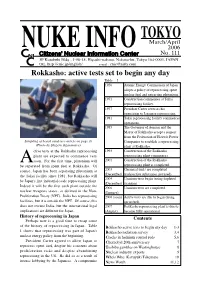
Rokkasho: Active Tests Set to Begin Any Day Table 1 1956 Atomic Energy Commission of Japan Adopts a Policy of Reprocessing Spent Nuclear Fuel and Extracting Plutonium
TOKYOMarch/April 2006 NUKECitizens' Nuclear INFO Information Center No. 111 3F Kotobuki Bldg., 1-58-15, Higashi-nakano, Nakano-ku, Tokyo 164-0003, JAPAN URL: http://cnic.jp/english/ e-mail : cnic@nifty.com Rokkasho: active tests set to begin any day Table 1 1956 Atomic Energy Commission of Japan adopts a policy of reprocessing spent nuclear fuel and extracting plutonium. 1971 Construction commences at Tokai reprocessing facility. 1977 President Carter reverses his opposition to Japanese reprocessing. 1981 Tokai reprocessing facility commences operations. 1985 The Governor of Aomori and the Mayor of Rokkasho accept a request from the Federation of Electric Power Sampling of beach sand (see article on page 3) Companies to establish a reprocessing (Photo by Shigeru Ogasawara) plant at Rokkasho. ctive tests at the Rokkasho reprocessing 1993 Construction of the Rokkasho plant are expected to commence very reprocessing plant commences. soon. For the first time, plutonium will 2001 Construction of the Rokkasho Abe separated from spent fuel at Rokkasho. Of reprocessing plant is completed. course, Japan has been separating plutonium at 2003 Chemical trials are completed (December) (radioactive substances not used). the Tokai facility since 1981, but Rokkasho will 2004 Uranium tests begin (using depleted be Japan's first industrial-scale reprocessing plant. (December) uranium). Indeed it will be the first such plant outside the 2006 Uranium tests are completed. nuclear weapons states, as defined in the Non- (January) Proliferation Treaty (NPT). India has reprocessing 2006 (soon) Active tests are due to begin (using facilities, but it is outside the NPT. Of course, this spent fuel). does not excuse India, but the international legal 2007 Rokkasho reprocessing plant is due to implications are different for Japan. -

Master2018.Kato.Pdf (3.019Mb)
University College of Southeast Norway Faculty of Humanities, Sports and Educational Science Institute of Culture, Religion and Social Studies Master’s Thesis MSc Human Rights and Multiculturalism Spring 2018 Aya Kato Power, politics and debate on the Convention on the Rights of the Child Article 12 in Japan: barriers to implementation in education University College of Southeast Norway Faculty of Humanities, Sports and Educational Science Institute of Culture, Religion and Social Studies PO Box 235 NO-3603 Kongsberg, Norway http://www.usn.no © 2018 <Aya Kato > This thesis is worth 45 study points Abstract This thesis examines tensions between the right of child democratic participation as an ideal encapsulated in the United Nations Convention of the Child Rights (CRC) and how this ideal has been implemented in Japan. Despite ratification of the CRC in 1994, the provision of Article 12 has not been endorsed in the national law of education. The thesis questions are a) Why is the CRC Article 12, ‘the right of the child to be heard’, not endorsed in Japanese education law? b) What are the obstacles preventing the full implementation of the CRC Article 12 in Japanese education? Derrida’s ‘hospitality concept’ is used as a theoretical framework to explore the possibility of including children and youth in the demos. The thesis presents and analyses Parliamentary debate data since 1991 to 2016 and interviews with policymakers and school authorities. Laclau and Mouffe’s discourse theory is applied in the Parliamentary data analysis. This thesis concludes that the Japanese government has prioritized public order at school over students’ individual human rights, and prioritized students’ contribution to the nation state over their democratic participation. -

The Death Penalty in Japan: the Law of Silence Going Against the International Trend
The Death Penalty in Japan: The Law of Silence Going against the International Trend International fact-finding mission Article 1 : All human beings are born free and equal in dignity and rights. They are endowed with reason and conscience and should act towards one another in a spirit of brotherhood. Article 2 : Everyone is entitled to all the rights and freedoms set forth in this Declaration, without distinction of any kind, such as race, colour, sex, language, religion, political or other opinion, national or social origin, property, birth or other status. Furthermore, no distinction shall be made on the basis of the political, jurisdictional or international status of the country or territory to which a person belongs, whether it be independent, trust, non-self-governing or under any other limitation of sovereignty. n°505a October 2008 Tokyo Detention Centre FIDH - The Death Penalty in Japan: The Law of Silence / 2 Contents Introduction 4 I. The Japanese Context 6 Context and history of the application of the death penalty in Japan Actors Authorities Officials at Ministry of Justice Detention Centre Personnel Political Parties Civil society Lawyers victims’ families and detainees’ families NGOs and the movements in favour of abolition Religious representatives The influence of media II. Current debates 18 Secrecy Separation of powers Life imprisonment without parole and a toughening of penalties Fallacious arguments Justification by public opinion The confusion between the rights of victims and the death penalty The cultural argument III. Legal Framework 25 Domestic law and norms International law United Nations Japan ratified the United Nations Convention Against Torture in 1999 The Council of Europe The European Union The International criminal court (ICC) IV. -

Roster of Winners in Single-Seat Constituencies No
Tuesday, October 24, 2017 | The Japan Times | 3 lower house ele ion ⑳ NAGANO ㉘ OSAKA 38KOCHI No. 1 Takashi Shinohara (I) No. 1 Hiroyuki Onishi (L) No. 1 Gen Nakatani (L) Roster of winners in single-seat constituencies No. 2 Mitsu Shimojo (KI) No. 2 Akira Sato (L) No. 2 Hajime Hirota (I) No. 3 Yosei Ide (KI) No. 3 Shigeki Sato (K) No. 4 Shigeyuki Goto (L) No. 4 Yasuhide Nakayama (L) 39EHIME No. 4 Masaaki Taira (L) ⑮ NIIGATA No. 5 Ichiro Miyashita (L) No. 5 Toru Kunishige (K) No. 1 Yasuhisa Shiozaki (L) ( L ) Liberal Democratic Party; ( KI ) Kibo no To; ( K ) Komeito; No. 5 Kenji Wakamiya (L) No. 6 Shinichi Isa (K) No. 1 Chinami Nishimura (CD) No. 2 Seiichiro Murakami (L) ( JC ) Japanese Communist Party; ( CD ) Constitutional Democratic Party; No. 6 Takayuki Ochiai (CD) No. 7 Naomi Tokashiki (L) No. 2 Eiichiro Washio (I) ㉑ GIFU No. 3 Yoichi Shiraishi (KI) ( NI ) Nippon Ishin no Kai; ( SD ) Social Democratic Party; ( I ) Independent No. 7 Akira Nagatsuma (CD) No. 8 Takashi Otsuka (L) No. 3 Takahiro Kuroiwa (I) No. 1 Seiko Noda (L) No. 4 Koichi Yamamoto (L) No. 8 Nobuteru Ishihara (L) No. 9 Kenji Harada (L) No. 4 Makiko Kikuta (I) No. 2 Yasufumi Tanahashi (L) No. 9 Isshu Sugawara (L) No. 10 Kiyomi Tsujimoto (CD) No. 4 Hiroshi Kajiyama (L) No. 3 Yoji Muto (L) 40FUKUOKA ① HOKKAIDO No. 10 Hayato Suzuki (L) No. 11 Hirofumi Hirano (I) No. 5 Akimasa Ishikawa (L) No. 4 Shunpei Kaneko (L) No. 1 Daiki Michishita (CD) No. 11 Hakubun Shimomura (L) No. -

Maires Pour Un Japon Sans Energie Nuclaire
Maires pour un Japon sans Energie Nuclaire Le réseau « Mayors for a Nuclear Power Free Japan » (Maires pour un Japon sans Energie Nuclaire) a été fondé officiellement à Tokyo le 28 avril 2012. Ce réseau a été lancé par les maires et les dirigeants municipaux pendant the « Global Conference for a Nuclear Power Free World » (la Conference Mondiale pour un Monde sans Energie Atomique) tenue à Yokohama en janvier 2012 (pour plus d'informations: npfree.jp), et à ce jour (octobre 2014), 100 maires de 39 préfectures (d'un total de 47) à travers tout le Japon ont déclaré leur soutien au réseau. Un groupe multi-partisans de députés de la Diète de Japon composés de membres originaires de presque tous les principaux parties politiques japonais a été élu comme Conseillers Spéciaux, aux côtés de l©ancien gouverneur de la Préfecture de Fukushima, Sato Eisaku. D©autres partisans du réseau comprennent l©ancien Premier Ministre japonais Kan Naoto, le Maire de Seoul, Park Won-soon ainsi que Suzuki Teisukke, leader du Network of Business Leaders and Entrepreneurs for a Sustainable Business and Energy Future (le Réseau des Chefs d©Entreprises et Entrepreneurs pour un Futur Durable d©Entreprises et Energie). Nos thèmes et objectifs (déclaration complète au verso) Le réseau affirme sa volonté de collaborer pour réaliser les buts suivants: − Pas de construction de nouvelles centrales nucléaires − Un objectif zéro centrale nucléaire dès que possible 1. Comprendre la situation réelle des centrales nucléaires (coût, cycle de combustible nucléaire, sites finals d©évacuation etc.) 2. Clarifier le programme qui permettrait de parvenir à l©objectif zéro centrale nucléaire 3. -

The Issue of Japan's Marine Corps Air
International Journal of East Asian Studies Vol. 3, No. 2, 2013/2014, pp. 1-12 THE ISSUE OF JAPAN’S MARINE CORPS AIR FORCE STATION FUTENMA’S RELOCATION AND THE FALL OF HATOYAMA1 Asmadi Hassan, Rohayati Paidi and Tan Soo Kee In 2009, the opposition party, Democratic Party of Japan (DPJ) won a landslide victory in Japan’s lower house elections, winning 308 seats out of the 480 seats. Through the elections, the Japanese people hoped to see a change in the old bureaucratic-centered politics and the beginning of a two- party system. The reform materialized after more than 50 years of a one-party rule under LDP. The Okinawans, in particular, were strong supporters of the DPJ where the party received 70 percent of votes from the prefecture. One of the key factors behind this support was the promise by the DPJ to relocate the Marine Corps Air Force Station Futenma (MCAS Futenma) to Henoko. However, relocation of the military base out of Okinawa was almost impossible because it required the consent of the United States and various parties such as the Okinawans and the coalition government. This paper aims to analyze how the issue of relocating Futenma during Hatoyama’s administration led seen as an unreliable political party, and Hatoyama was forced to step down, after less than nine Keywords: Democratic Party of Japan, Hatoyama, MCAS Futenma, Okinawa Introduction Although the US occupation of Japan ended in 1952, Japan’s dependence on the US continues, particularly in the area of security, as seen through the Japan-US Security Treaty. -
SURGE Capacity Project Desk Review on Populations at Risk Of
DESK REVIEW ON POPULATIONS AT RISK OF STATELESSNESS CHILDREN OF PHILIPPINE DESCENT IN A MIGRATORY SETTING IN GULF COOPERATION COUNCIL (GCC) COUNTRIES AND PERSONS OF JAPANESE DESCENT By Brian Barbour in his capacity as Researcher SURGE Capacity Project on Statelessness SURGE Capacity Project This initiative aims to support the Philippine Government in improving its quantitative and qualitative data and enhancing its policy and legislative framework. The outputs from this Project—the Desk Review Report and Policy Briefs—were developed through a series of consultations with government and civil society actors and a review of relevant literature. DESK REVIEW ON POPULATIONS AT RISK OF STATELESSNESS CHILDREN OF PHILIPPINE DESCENT IN A MIGRATORY SETTING IN GULF COOPERATION COUNCIL (GCC) COUNTRIES AND PERSONS OF JAPANESE DESCENT SURGE Capacity Project Researcher: Brian Barbour SURGE Capacity Project Coordinator: Aeriel Gonzales (UNHCR) Report Writing: Brian Barbour, Aeriel Gonzales (UNHCR), Meriam Faith Palma (UNHCR), Maria Ermina Valdeavilla-Gallardo (UNHCR), Maria Louella Gamboa (UNHCR) Layout Design: Maria Jorica Pamintuan (UNHCR) Data collection: April to December 2020 Report layout and final editing: January to March 2021 CONTACT US Protection Unit Manila UNHCR Philippines Tel.: +632 8817 2398 Fax: +632 8817 4057 Email: phimapro@unhcr.org COVER PHOTOGRAPH: A woman from Davao, Southern Philippines was previously one of the Persons of Japanese Descent (PJD). She was recognized as a Japanese national in 2013. However, there are other PJD, whose average age is 81 years old, who cannot afford to wait for their citizenship issues to be resolved. © Miyuki Okuyama DESK REVIEW ON POPULATIONS AT RISK OF STATELESSNESS Acknowledgements The outputs from this Project are a result of collaboration with the Philippine Government and civil society organizations. -

The International Community Power Conference 2014 in Fukushima
The International Community Power Conference 2014 in Fukushima プログラム / Program 2014年 主 催 : 認定NPO法人 環境エネルギー政策研究所(ISEP) (金)タウンミー ティング 1/31 共 催 : ふくしま再生可能エネルギー事業ネット 南相馬市民文化会館 一般社団法人 会津自然エネルギー機構 三井物産環境基金「持続可能な風力利用研究プロジェクト (名古屋大学丸山研究室)」 一般社団法人 えこえね南相馬研究機構 2/1(土) 本会議 第1日 協 力 : 一般社団法人 ふくしま会議 コ ミ ュ ニ テ ィ パ ワ ー・イ ニ シ ア チ ブ 福島県文化センター REN21(21世紀のための自然エネルギー政策ネットワーク) EU FP7 CIVIS(EU第7次研究枠組み計画 CIVISプロジェクト) 公益財団法人 自然エネルギー財団 2/2(日) 本会議 第2日 脱原発をめざす首長会議 エネルギーから経済を考える経営者ネットワーク会議 喜多方プラザ文化センター 100%自然エネルギー世界キャンペーン パタゴニア 日本支社 後 援 : 福島県 福島市 喜多方市 南相馬市 ドイツ大使館 デンマーク大使館 スウェーデン大使 館 カナダ大使館 駐日欧州連合代表部 農林水産省 環境省 経済産業省 特 別 協 賛: 新日本有限責任監査法人 地球環境基金 フ リ ー ド リ ヒ・エ ー ベ ル ト 財 団 地域エネルギー革命元年 The Start of Community Power Revolution ■ ご挨拶 / Welcome Address 3・11 福島原発事故後の日本にとっても、また気候変動対策が待ったなしの世界全体にとっても、唯一 とも言える「不幸中の幸い」は、今や自然エネルギーが、世界のさまざまな国で、農耕革命・産業革命・ 情報通信(IT)革命に続く「人類史第4の革命」と呼ばれる急激な変化を実現しつつあることです。 10 年前には、誰も予想し得なかったこの急速なグローバルレベルの変化の原動力は、地域主導のエネ ルギー(コミュニティパワー)です。インターネットの誕生前と後の違いにも似た「大規模・集中・独 占型」から「小規模・分散・ネットワーク型」への社会の枠組みの変化が起きつつあるのです。 デンマークのサムソ島などの北欧やドイツ、北米、豪州、インドなどで多くの地域が「自然エネルギー 100%」を目標に掲げ、現実にそれを実現する地域が次々に増えてきました。 日本でも、3・11 原発事故の後、長野県そして福島県がそれぞれ「自然エネルギー 100%」を新た に目標に掲げました。今後、他の地域コミュニティが次々と続き、日本各地で「ご当地エネルギー」が ほうはい 澎湃と立ち上がりつつあります。 日本で 3 度目となるこのコミュニティパワー国際会議 2014 は、国内外からコミュニティパワーの先駆 者がフクシマに集い、日本の、そして世界の「地域エネルギー革命元年」を誓う場となることでしょう。 ぜひみなさまのご参加と交流をお待ちしております。 コミュニティパワー国際会議 2014 in 福島 大会委員長 飯田哲也 プロフィール: 飯田哲也(環境エネルギー政策研究所 所長) 原子力産業や安全規制に従事後、「原子力ムラ」を脱出 して北欧での研究活動や非営利活動を経て ISEP を設 It is an only blessing in disguise that many countries in the world, including Japan after Fukushima nuclear disaster, 立し現職。持続可能なエネルギー政策の実現を目指し、 have realized drastic renewable energy development that is often called “the 4th Revolution” following agricultural, 提言・活動を行っている。多くの国や地方自治体の審 industrial and information technology revolutions. 議会委員を務め、世界中に幅広いネットワークを持ち、 特に 3.11 以降、世論をリードするエネルギー戦略を The driving force of this rapid and drastic global change, which anyone could hardly imagine 10 years ago, is 打ち出す。 community power. -

The Death Penalty in Japan: the Law of Silence Going Against the International Trend
The Death Penalty in Japan: The Law of Silence Going against the International Trend International fact-finding mission Article 1 : All human beings are born free and equal in dignity and rights. They are endowed with reason and conscience and should act towards one another in a spirit of brotherhood. Article 2 : Everyone is entitled to all the rights and freedoms set forth in this Declaration, without distinction of any kind, such as race, colour, sex, language, religion, political or other opinion, national or social origin, property, birth or other status. Furthermore, no distinction shall be made on the basis of the political, jurisdictional or international status of the country or territory to which a person belongs, whether it be independent, trust, non-self-governing or under any other limitation of sovereignty. n°505a October 2008 Tokyo Detention Centre FIDH - The Death Penalty in Japan: The Law of Silence / 3 Contents Introduction 4 I. The Japanese Context 6 Context and history of the application of the death penalty in Japan Actors Authorities Officials at Ministry of Justice Detention Centre Personnel Political Parties Civil society Lawyers victims’ families and detainees’ families NGOs and the movements in favour of abolition Religious representatives The influence of media II. Current debates 18 Secrecy Separation of powers Life imprisonment without parole and a toughening of penalties Fallacious arguments Justification by public opinion The confusion between the rights of victims and the death penalty The cultural argument III. Legal Framework 25 Domestic law and norms International law United Nations Japan ratified the United Nations Convention Against Torture in 1999 The Council of Europe The European Union The International criminal court (ICC) IV. -

List of Participants Liste Des Participants Lista De Participantes
CBD Distr. CONVENTION ON GENERAL BIOLOGICAL DIVERSITY ENGLISH ONLY Fifth meeting of the Conference of the Parties serving as the Meeting of the Parties to the Cartagena Protocol on Biosafety Nagoya, Aichi Prefecture, Japan, 11 - 15 October 2010 List of Participants Liste des Participants Lista de Participantes Registered Participants Convention on Biological Diversity List of Participants Parties to the Cartagena Protocol on Biosafety Antigua and Barbuda Austria 1. H.E. Mr. Conrod Hunte 5. Dr. Andreas Heissenberger Ambassador / Deputy Permanent Representative Deputy Unit Head Permanent Mission of Antigua and Barbuda to the United Nations Federal Environment Agency 305 Est 47th Street, Suite 6A Spittelauer Lände 5 New York NY 10017 Vienna A-1090 United States of America Austria Tel.: +1 212 541 4117 Tel.: +43 13 1304 3032 Fax: +1 212 757 1607 Fax: +43 13 1304 3700 E-Mail: chunte@abgov.org E-Mail: andreas.heissenberger@umweltbundesamt.at Web: http://www.umweltbundesamt.at 2. Ms. Melesha Banhan Senior Environment Technician 6. Dr. Andrea Nouak Environment Division CBD Focal Point Ministry of Agriculture and the Environment Dept. V/9 St. John's Federal Ministry of Agriculture, Forestry, Environment and Water Antigua and Barbuda Management Tel.: +268 562-2568 Stubenbastei 5 Vienna A-1010 Fax: +268 462-4625 Austria E-Mail: m_banhan@yahoo.com Tel.: +43 1 51522 1616 Austria Fax: +43 1 51522 7626 E-Mail: andrea.nouak@bmlfuw.gv.at 3. Dr. Helmut Gaugitsch Head of Unit Bangladesh Landuse & Biosafety Federal Environment Agency 7. Hasnun Nahar Spittelauer Lände 5 Ministry of Environment and Forests Vienna A-1090 Room 1309 - Building 6 Austria Bangladesh Secretariat Dhaka 1000 Tel.: +43 1 31 304 3133 Bangladesh Fax: +43 1 31 304 3700 Tel.: 01711403995 E-Mail: helmut.gaugitsch@umweltbundesamt.at Web: http://www.umweltbundesamt.at E-Mail: dilahasnun@yahoo.com 4. -

Tokyo, Japan December 4-5, 2006
PARLIAMENTARIANS FOR GLOBAL ACTION PGA 28TH ANNUAL PARLIAMENTARY FORUM ON HUMAN SECURITY & IV CONSULTATIVE ASSEMBLY OF PARLIAMENTARIANS ON THE INTERNATIONAL CRIMINAL COURT TOKYO, JAPAN DECEMBER 4-5, 2006 With the support of the European Commission, European Union, and the Governments of Belgium, The Netherlands and Switzerland. the core support of the Governments of Denmark and Sweden and the cooperation of the Ministry of Foreign Affairs of Japan LIST OF PARTICIPANTS MEMBERS OF PARLIAMENT Afghanistan President, Parliamentarians for Global Action 1. H.E. Prof. Hazrat Sebghatollah Mojaddedi President of Meshrano Jirga, Head of Delegation Bosnia and Herzegovina 13. H.E. Mr. Goran Milojevic MP 2. H.E. Mohammad Arif Noorzai Speaker of the House of Peoples 1st Deputy Speaker of Wolesi Jirga 14. Mr. Velimir Jukic MP 3. Mr. Fazel Karim Aimaq MP Deputy Speaker of the House of Peoples 4. Mr. Assadullah Falah Brazil / Latin American Parliament Secretary-General, Meshrano Jirga 15. Dip. Laura Carneiro MP President of the Brazilian Group of the Latin American 5. Mr. Nader Khan Katwazi MP Parliament 6. Sen. Mohammed Layeq MP 16. Dip. Vanessa Graziottin MP 7. Mr. Haji Serajuddin Safari MP Cambodia 17. Mr. Chhay Son MP 8. Sen. Qurban Ali Urfani MP Chair, Committee on Foreign Affairs, International Cooperation and Information 9. Mr. Abdul Majid MP 18. Mr. Sean Min MP Albania Member, Legislative Committee 10. Mrs. Ermelinda Meksi MP Member, European Integration Committee Cameroon 19. Mr. Martin Bile Bidjang MP Argentina Member, Committee on Petitions and Resolutions 11. Sen. Maria Cristina Perceval President of the Defense Committee Canada 20. Sen. Raynell Andreychuk Belgium Chair, Human Rights Committee; Convenor, PGA 12. -

The World Factbook East & Southeast Asia :: Japan Introduction :: Japan
The World Factbook East & Southeast Asia :: Japan Introduction :: Japan Background: In 1603, after decades of civil warfare, the Tokugawa shogunate (a military-led, dynastic government) ushered in a long period of relative political stability and isolation from foreign influence. For more than two centuries this policy enabled Japan to enjoy a flowering of its indigenous culture. Japan opened its ports after signing the Treaty of Kanagawa with the US in 1854 and began to intensively modernize and industrialize. During the late 19th and early 20th centuries, Japan became a regional power that was able to defeat the forces of both China and Russia. It occupied Korea, Formosa (Taiwan), and southern Sakhalin Island. In 1931-32 Japan occupied Manchuria, and in 1937 it launched a full-scale invasion of China. Japan attacked US forces in 1941 - triggering America's entry into World War II - and soon occupied much of East and Southeast Asia. After its defeat in World War II, Japan recovered to become an economic power and an ally of the US. While the emperor retains his throne as a symbol of national unity, elected politicians hold actual decision-making power. Following three decades of unprecedented growth, Japan's economy experienced a major slowdown starting in the 1990s, but the country remains a major economic power. In March 2011, Japan's strongest-ever earthquake, and an accompanying tsunami, devastated the northeast part of Honshu island, killing thousands and damaging several nuclear power plants. The catastrophe hobbled the country's economy and its energy infrastructure, and tested its ability to deal with humanitarian disasters.