Doctor Honoris Causa - DANIEL CHIROT DOCTOR HONORIS CAUSA -
Total Page:16
File Type:pdf, Size:1020Kb
Load more
Recommended publications
-

Daniel CHIROT
Honoris Causa Reception Address: Why 20th Century Romanian Sociology and History Are Relevant Today Daniel CHIROT Universitatea din Washington University of Washington, Seattle Personal e-mail: chirot@uw.edu Honoris Causa Reception Address: Why 20th Century Romanian Sociology and History Are Relevant Today The present text is the reception speech given by Professor Daniel Chirot at the ceremony for the awarding of the Doctor Honoris Causa degree from the University of Bucharest, which took place on October 10, 2019. Chirot evokes the significance of the scientific and social endeavour of Dimitrie Gusti in the context of the troubled history of interwar Romania. Keywords : Daniel Chirot, Dimitrie Gusti, interwar Romania, interwar history, history of sociology When I arrived in Romania in January 1970 from the partition of Transylvania in which Hitler’s Germany Columbia University in New York to start research for and Mussolini’s Italy had forced Romania to cede the my doctoral dissertation, I knew very little about this northern half of Transylvania to Hungary, Mosely had country except for the basic facts about its history. I had written an influential article in Foreign Affairs showing studied Romanian for a semester, and was greatly helped that in fact the ethnic makeup of the ceded region by the fact that I was fluent in French, but I really had no showed it should have remained Romanian. During idea of what life would be like in Bucharest. World War II he became a top advisor to the American I did have one important advantage. I had gotten to State Department and to America’s intelligence services. -

Daniel Chirot Herbert J
DANIEL CHIROT HERBERT J. ELLISON PROFESSOR OF RUSSIAN AND EURASIAN STUDIES AND PROFESSOR OF SOCIOLOGY CURRICULUM VITAE (2014) Henry M. Jackson School of International Studies University of Washington, Box 353650, Seattle, WA 98195 Phone: (206) 543-4370 FAX: (206) 685-0668 e-mail: chirot@u.washington.edu web site: http://faculty.washington.edu/chirot EDUCATION PhD: Columbia University (New York, NY l0027), Sociology, l973 BA: Harvard University (Cambridge, MA 02138), Magna Cum Laude in Social Studies, l964 EMPLOYMENT 1980 – present: Professor of International Studies and of Sociology, University of Washington, Seattle 1975 – 1980: Assistant Professor to Professor of Sociology, University of Washington, Seattle 1971 – 1974: Instructor to Assistant Professor of Sociology, University of North Carolina, Chapel Hill, NC 275l4 1969: Lecturer in Sociology, Columbia University New York, NY 10027 1964 – 66: Peace Corps Volunteer, Republic of Niger Visiting Appointments 2007: Professor of Government, University of Texas at Austin 2004-2005: Jennings Randolph Senior Fellow, United States Institute of Peace, Washington DC 1997: Professor of Sociology, Bogazici University, Istanbul 1996: Professor of Sociology, University of California at San Diego 1993: Professor of Political Science, Northwestern University 1992: Visiting Fellow, Institut für die Wissenschaften vom Menschen, Vienna, 1992 1989: Professor of Sociology, National Taiwan University Chirot 2 PUBLICATIONS Books --Social Change in a Peripheral Society: The Creation of a Balkan Colony (New York: Academic Press, 1976). [Romanian translation, Bucharest: Corint, 2002.] --Social Change in the Twentieth Century (New York: Harcourt Brace Jovanovich, 1977). [Italian translation, Naples: Liguori Editore, l985. Korean translation, Seoul, 1984.] --translator (with Holley Coulter Chirot) of Henri H. Stahl, Traditional Romanian Village Communities: The Transition from the Communal to the Capitalist Mode of Production in the Danube Region (Cambridge: Cambridge University Press, 1980. -

O Sută De Ani De Cartografie Lingvistică Românească
„Jargonul autenticității”: versiunea românească din anii ’30 Ștefan FIRICĂ Key-words: authenticity, identity, diary, deconstruction Într-o lucrare din 1964 care marca, pentru întâia oară, distanța față de filosofia existențială germană dintr-o perspectivă ideologică, Theodor W. Adorno schițează o listă a cuvintelor-fetiș rulate de anumite cercuri intelectuale din perioada interbelică. Jargon der Eigentlichkeit: Zur deutschen Ideologie notează felul cum elemente lexicale dintre cele folosite în împrejurări relativ curente sunt, deodată, înzestrate în spațiul publicistic cu un strat semantic suprapus, care le adaugă o aură de noblețe. Acest efect de aură se propagă în mod misterios de la un element al „jargonului” la altul, în focarul rețelei aflându-se conceptul heideggerian, dar și pre-heideggerian, al „autenticității” (Eigentlichkeit). E de remarcat, încă de la început, că printre „nobilele substantive” care apar în trena lui se numără și unul dintre termenii invocați cu fervoare de Camil Petrescu, în eseuri ca și în romane, „concretul” (Adorno 1972: 4—6). Critica lui Adorno urmărește modul în care, pe măsură ce se încarcă de aura semnificațiilor abscons-metafizice, cuvintele înseși pierd din înțeles până când se apropie de vidul semantic. Circuitul lor în spațiul public nu se încheie însă aici, fiindcă, imediat ce se descarcă de sensul pedestru din vorbirea cotidiană, volatilizându-se, ele vor putea deveni vehicule ideale ale ideologiei demagogice fasciste. Și în spațiul românesc, în publicistica „tinerei generații” de la începutul anilor ’30, vocabularul „autenticității” ocupă locul central, prin care utilizatorii lui încearcă să se plaseze în opoziție față de „bătrâni”, asimilați cu establishment-ul, și să se legitimeze ca purtători ai unor „noi” valori culturale, sincrone cu cele vehiculate în spațiul european. -
Modernity, Memory and Identity in South-East Europe
Modernity, Memory and Identity in South-East Europe Series Editor Catharina Raudvere Department of Cross-Cultural and Regional Studies University of Copenhagen Copenhagen, Denmark This series explores the relationship between the modern history and pres- ent of South-East Europe and the long imperial past of the region. This approach aspires to offer a more nuanced understanding of the concepts of modernity and change in this region, from the nineteenth century to the present day. Titles focus on changes in identity, self-representation and cultural expressions in light of the huge pressures triggered by the interac- tion between external influences and local and regional practices. The books cover three significant chronological units: the decline of empires and their immediate aftermath, authoritarian governance during the twen- tieth century, and recent uses of history in changing societies in South- East Europe today. More information about this series at http://www.palgrave.com/gp/series/15829 Cristina A. Bejan Intellectuals and Fascism in Interwar Romania The Criterion Association Cristina A. Bejan Duke University Durham, NC, USA ISSN 2523-7985 ISSN 2523-7993 (electronic) Modernity, Memory and Identity in South-East Europe ISBN 978-3-030-20164-7 ISBN 978-3-030-20165-4 (eBook) https://doi.org/10.1007/978-3-030-20165-4 © The Editor(s) (if applicable) and The Author(s), under exclusive licence to Springer Nature Switzerland AG 2019 This work is subject to copyright. All rights are solely and exclusively licensed by the Publisher, whether the whole or part of the material is concerned, specifically the rights of translation, reprinting, reuse of illustrations, recitation, broadcasting, reproduction on microfilms or in any other physical way, and transmission or information storage and retrieval, electronic adaptation, computer software, or by similar or dissimilar methodology now known or hereafter developed. -

Bibliography
BIBLIOGRAPHY 1. Manuscript and Archival Sources Archive at the Center for Advanced Holocaust Studies, United States Holocaust Memorial Museum, USHMM, Washington, DC, USA Inventory Nr. 2247; Ministerul de Interne—Diverse [the Romanian Ministry of the Interior—Diverse] Years 1910–1956 Arhiva Consiliul Nationaļ Pentru Studierea Arhivelor Securitătii,̧ ACNSAS [The National Council for the Study of the Securitate Archives] Bucharest, Romania Arşavir-Nazaret Acterian, R41665 Arşavir Acterian, I203607 Haig Acterian, I21201 2/1 Dosar Nr. 54892/1–2 Mircea Eliade, SiE 167/1 Dosar Nr. 6814 (1–3) Constantin Noica, I4664; Dosar Nr. 85321 (1981–1987) Constantin Noica, I15156/1–3 Dosar Nr. 205407/1–3 Marietta Sadova, I209489/1–4 Zaharia Stancu, I73549/1–2 Arhiva Muzeul Nationaļ al Literaturii Române, AMNLR [National Museum of Romanian Literature] Bucharest, Romania © The Author(s) 2019 281 C. A. Bejan, Intellectuals and Fascism in Interwar Romania, Modernity, Memory and Identity in South-East Europe, https://doi.org/10.1007/978-3-030-20165-4 282 BIBLIOGRAPHY Correspondence of Haig Acterian, Emil Cioran, Petru Comarnescu, Mircea Eliade, Eugen Ionescu, Constantin Noica and Mihail Sebastian Arhivele Statului [State Archives] Bucharest, Romania Sala de studiu fonduri personale şi familie [Room for the study of personal and family files] File #1824: Acterian Family, Years 1904–1973 Biblioteca Academiei Române, BAR [Library of the Romanian Academy] Sala de manuscrise, arhiva personală lui Petru Comarnescu [Manuscripts Room, personal archive of Petru Comarnescu] Ach. 17/2001 APPC The University of Chicago Library Mircea Eliade Papers 1926–1998, unpublished journal 2. Printed Primary Sources1 Acterian, Arşavir. ‘Cîte ceva despre Asociatia̦ Criterion.’ Criterion Seria Nouă, Year 1, Vol. -

Adnotări Asupra Discursului Polemic. Campania Generaționistă
Revista de studii media / nr. 5‐6, 2016‐2017 ADNOTĂRI ASUPRA DISCURSULUI POLEMIC. CAMPANIA GENERAȚIONISTĂ Prof. univ. dr. Cristian Florin POPESCU* Abstract: One of the most important debates between the two World Wars was the so-called generational campaign. The new, the young generation against the old generation. It was a new philosophical doctrine against the rationalism and the universalism. In România Mare, the young leaders of this new generation, Mircea Eliade, Petru Comarnescu, Constantin Noica, Emil Cioran, Eugen Ionescu et cetera, developed an entire rhetoric of irony against the old generation. A very interesting field of investigation from the point of view of the history of the Romanian press. Keywords: generation, polemics, irony, humour, rhetoric. Avertisment. Acest text a mai fost publicat în anul 2000 într-o revistă aparținând unei instituții cu circuit închis. Îl repunem în circulație pentru că problematica pe care o abordăm ni se pare importantă atât din perspectiva istoriei presei române, cât și din perspectiva actualității reînviate în România acestor ani, într-o formă mult degradată: conflictul dintre generații. Aceasta este o primă încălcare a standardelor publicării studiilor în reviste academice. Autorul își asumă și o a doua încălcare a regulilor. Citarea in extenso, pentru că faptele despre care este vorba se petreceau în anii 1928 și următorii, în texte publicate în presa vremii și, considerăm că posibilul cititor nu stă să investigheze colecțiile periodicelor anilor '30 (întreprindere laborioasă), pentru a înțelege în ce termeni a decurs campania generaționistă în România, în anii '30. * Universitatea Hyperion din București, Facultatea de Jurnalism. 187 Revista de studii media / nr. -

Stalinism Revisited Stalinism Revisited
CYAN MAGENTA YELLOW BLACK Stalinism Revisited Stalinism Revisited Stalinism Revisited brings together representatives of multiple generations to create a rich examination The Establishment of Communist Regimes in East-Central Europe of the study and practice of Stalinism. While the articles are uniformly excellent, the book’s signal contribution is to bring recent research from Eastern European scholars to an English-speaking audience. Thus the volume is not just a “state of the discipline” collection, in which articles are collected to reflect that current situation of scholarship in a given field; instead, this one includes cutting edge scholarship that will prompt more of the same from other scholars in other fields/subfields. I would recommend this book highly to anyone interested in understanding the technology of Stalinism in both StalinismStalinism thought and practice. Nick Miller Boise State University The Sovietization of post-1945 East-Central Europe—marked by the forceful imposition of the Soviet- type society in the region—was a process of massive socio-political and cultural transformation. Despite its paramount importance for understanding the nature of the communist regime and its RevisitedRevisited legacy, the communist take-over in East Central European countries has remained largely under- researched. Two decades after the collapse of the communist system,Stalinism Revisited brings together a remarkable international team of established and younger scholars, engaging them in a critical re-evaluation of the institutionalization of communist regimes in East-Central Europe and of the period of “high Stalinism.” Sovietization is approached not as a fully pre-determined, homogeneous, and monolithic transformation, but as a set of trans-national, multifaceted, and inter-related processes of large-scale institutional and ideological transfers, made up of multiple “takeovers” in various fields. -
Symposium, Reception, and Tributes Honoring Professor Charles Hirschman
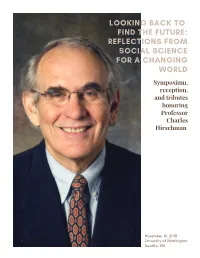
LOOKING BACK TO FIND THE FUTURE: REFLECTIONS FROM SOCIAL SCIENCE FOR A CHANGING WORLD Symposium, reception, and tributes honoring Professor Charles Hirschman November 16, 2018 University of Washington Seattle, WA Compiled by the Center for Studies in Demography & Ecology (CSDE) Contents Symposium and Reception Program ........................................................................................ 1 Symposium Panels ..................................................................................................................... 4 Welcome ......................................................................................................................................................... 5 Robert Stacey ............................................................................................................................................. 6 American Social Science in the Asian Century: What Role for Area Studies? ...................................... 7 Patrick Heuveline ...................................................................................................................................... 8 Maria-Giovanna Merli ............................................................................................................................ 13 Understanding and Responding to Rising Inequality ............................................................................. 17 Marta Tienda........................................................................................................................................... -
Understanding and Misunderstanding in the Historical and Literary Space of the 27S
Cultural and Linguistic Communication UNDERSTANDING AND MISUNDERSTANDING IN THE HISTORICAL AND LITERARY SPACE OF THE 27S. MIHAIL SEBASTIAN’S POSITION Simona STANCU1 1Teaching assistant, PhD Student, Faculty of Communication Sciences, Apollonia University of Iaşi, PhD Student „Al. I. Cuza” University of Iaşi Corresponding author: sim_simonel@yahoo.it Abstract renter, and this happens because he is constantly The structure of a generation is based on a series of aware of the nature of his “placement” or place events, states and facts, common to a particular space and in the social structure, and knows the pressures to a well-defined period of time. Romania’s Young and the possibilities of winning that derive from Generation of the 27s ends up being a representative 1 cultural identity in the development of the inter-war this position . literature. Mihail Sebastian’s position as a key representative of his generation, lucid, rationale and balanced spirit, is 2. THE YOUNG GENERATION IN THE one that is opposed to the outlook which denies the value of rationalism and of the desire to live in adventure. SPACE OF THE LITERARY AND Keywords: generation, narrator, inter-war period, HISTORICAL COMMUNICATION OF Criterion, novel, evolution, autochthon, identity. THE 27S 1. INTRODUCTION In Romania, the Young Generation arises as a result of the indefinite expectations triggered by A generation is structured by its exposure to the violent events that emphasize the anti-Semite the same series of events, moods and facts, at an students’ movements at the beginning of the 20s, age when the conscience is emerging. This movements which have often threatened to get exposure has to take place in a common out of control and against which a series of environment (because between an Indian and a political measures have been taken, the reaction Frenchman the geographical distance being a rational-critical one on behalf of a part of automatically leads to a completely different the intellectual world. -

Autenticitate” Și Identitate În Cultura Română Interbelică 5
sincronizare durabilitate FONDUL SOCIAL EUROPEAN Investeşte în Modele culturale OAMENI EUROPENE Strategii ale (de)construcţiei identitare în proza românească interbelică Autor: Ştefan D. FIRICĂ Lucrare realizată în cadrul proiectului "Cultura română şi modele culturale europene - cercetare, sincronizare, durabilitate", cofinanţat din FONDUL SOCIAL EUROPEAN prin Programul Operaţional Sectorial pentru Dezvoltarea Resurselor Umane 2007 – 2013, Contract nr. POSDRU/159/1.5/S/136077. Titlurile şi drepturile de proprietate intelectuală şi industrial ă asupra rezultatelor obţinute în cadrul stagiului de cercetare postdoctorală aparţinAcademiei Române. * * * Punctele de vedere exprimate în lucrare aparţin autorului şi nu angajează Comisia Europeană şi Academia Română, beneficiara proiectului. DTP, complexul editorial/ redacţional, traducerea şi corectura aparţin autorului. Descărcare gratuită pentru uz personal, în scopuri didactice sau ştiinţifice. Reproducerea publică, fie şi parţială şi pe orice suport, este posibilă numai cu acordul prealabil al Academiei Române. ISBN 978-973-167-311-0 CUPRINS INTRODUCERE. „AUTENTICITATE” ȘI IDENTITATE ÎN CULTURA ROMÂNĂ INTERBELICĂ 5 I. „JARGONUL AUTENTICITĂȚII”: VERSIUNEA ROMÂNEASCĂ DIN ANII ’30 .................. 14 Sensul psihologic / etic .......................................................................................................... 16 Sensul literar ......................................................................................................................... 18 Sensul ontologic / -
The Hero-‐Mirror Mechanism
CULTURAL DISCOURSES IN CEAUŞIST ROMANIA: THE HERO-MIRROR MECHANISM FILIP SEBASTIAN BOICU, BA. MA. Thesis submitted to the University of Nottingham for the degree of Doctor of Philosophy July 2014 1 2 ABSTRACT Cultural discourses in Ceauşist Romania: The Hero-Mirror Mechanism This thesis is concerned with main cultural discourses of the second phase of Communism in Romania (1964-1989), period largely identical with that of Ceauşescu’s rule. A secondary aim of the thesis is to look at the post-1989 continuations of these publicly influential discourses with the aim of understanding how the educational system (HE, in particular) is positioned in relation to the cultural domain. With regard to the Communist period, the main assertion of the thesis is that analysis of these discourses reveals an underlying cultural mechanism equivalent with a central mode of governance employed by the Communist party. According to this assertion, the mission of this cultural mechanism, with origins in Lenin’s drastic distinction between the party and the proletariat and in the idea that the party must bestow consciousness on the proletariat, is to create and regulate positive avatars (heroes imbued with the best of humanity) for each social category so as to fulfill and safeguard the aims of the Party. For this reason, this device has been entitled the hero-mirror mechanism. The device has also been linked with religion and theology. This perspective has found that the mirror-mechanism corresponds to the notion of “imago Dei,” and its axes to the notions of “kenosis” and “imitatio Dei.” The assessment of these cultural discourses via the mirror-mechanism results in three dimensions of research, each with its own universes of investigation, and each with its own findings. -

Elite Intelectuale În România: Tentaţii Ideologice Şi Exerciţiu Critic
ELITE INTELECTUALE ÎN ROMÂNIA: TENTAŢII IDEOLOGICE ŞI EXERCIŢIU CRITIC IDEOLOGIE ŞI POLITICĂ. ♦ SFÂRŞITUL AVENTURII CRITERIONISTE Constantin MIHAI∗ Abstract: This paper tries to explain Criterion’s final adventures, starting from the relationship between ideology and politics during the Romanian interwar period. The relationship between ideology and politics becomes essential for Criterion as long as it reforms inside itself many orientations: towards socialism and communism, the national-Christianism, a trend that becomes major inside the group, the traditional right and the democracy. The unity of Criterion was broken by ideological and political tensions that arase among its members, as much as the events that followed. All of these leaded to the fall of the organic solidarities and to the group’s dissolution. Keywords: ideology, politics, adventure, Criterion, right, left, orientations. Résumé: L’étude présent essai d’expliquer les « aventures » finales du group Criterion, à partir de la relation l’entre idéologie et la politique pendant l’entre deux guerres mondiales. Cette rélation était dévenue essentielle pour Criterion dont les membres partageaient plusieures orientations : vers socialism et communisme, national-chrétien (orientation devenue majoritaire), droit traditionnelle et democratie. L’unité du group a été détruite à la fois à cause des tensions idéologiques et politiques parues parmi ses membre, qu’à cause des événements historiques qui ont marqué la Roumanie. Toutes ces causes ont provoqué la destructuration des solidarités organiques et la dissolution du groupe intellectuel. Mots clés: idéologie, politique, aventure, Criterion. Într-un context în care scena politică internaţională era profund antagonizată în două tabere distincte: comunismul rusesc şi fascismul european, Asociaţia Criterion nu avea cum să evite, la un moment dat, această cădere în spaţiul ideologiilor, în pofida dezideratului său cultural şi spiritual.