INFORM ATION to USERS This Manuscript Has Been Reproduced
Total Page:16
File Type:pdf, Size:1020Kb
Load more
Recommended publications
-

Principal State and Territorial Officers
/ 2 PRINCIPAL STATE AND TERRITORIAL OFFICERS EXECUTIVE OFFICERS Atlorneys .... State Governors Lieulenanl Governors General . Secretaries of State. Alabama. James E. Foisoin J.C.Inzer .A. .A.. Carniichael Sibyl Pool Arizona Dan E. Garvey None Fred O. Wilson Wesley Boiin . Arkansas. Sid McMath Nathan Gordon Ike Marry . C. G. Hall California...... Earl Warren Goodwin J. Knight • Fred N. Howser Frank M. Jordan Colorado........ Lee Knous Walter W. Jolinson John W. Metzger George J. Baker Connecticut... Chester Bowles Wm. T. Carroll William L. Hadden Mrs. Winifred McDonald Delaware...:.. Elbert N. Carvel A. duPont Bayard .Mbert W. James Harris B. McDowell, Jr. Florida.. Fuller Warren None Richard W. Ervin R.A.Gray Georgia Herman Talmadge Marvin Griffin Eugene Cook Ben W. Fortson, Jr. * Idaho ;C. A. Robins D. S. Whitehead Robert E. Sniylie J.D.Price IlUnola. .-\dlai E. Stevenson Sher^vood Dixon Ivan.A. Elliott Edward J. Barrett Indiana Henry F. Schricker John A. Walkins J. Etnmett McManamon Charles F. Fleiiiing Iowa Wm. S.'Beardsley K.A.Evans Robert L. Larson Melvin D. Synhorst Kansas Frank Carlson Frank L. Hagainan Harold R. Fatzer (a) Larry Ryan Kentucky Earle C. Clements Lawrence Wetherby A. E. Funk • George Glenn Hatcher Louisiana Earl K. Long William J. Dodd Bolivar E. Kemp Wade O. Martin. Jr. Maine.. Frederick G. Pgynp None Ralph W. Farris Harold I. Goss Maryland...... Wm. Preston Lane, Jr. None Hall Hammond Vivian V. Simpson Massachusetts. Paul A. Dever C. F. Jeff Sullivan Francis E. Kelly Edward J. Croiiin Michigan G. Mennen Williams John W. Connolly Stephen J. Roth F. M. Alger, Jr.- Minnesota. -

A History of First Presbyterian Church of Lancaster, Pennsylvania
A History of First Presbyterian Church of Lancaster, Pennsylvania By Catherine Courtney and Dr. John D. Long CHAPTER 1 A BRIEF HISTOR Y OF PRESBYTERIANISM in order to understand the establishment of the Presbyterian Church in Lancaster and its relation to the developing colony of Pennsylvania and its people, it is necessary to briefly review the history of Presbyterianism in Europe and the subsequent immigration of Presbyterians to the new world. The following is excerpted from the Columbia Encyclopedia, published 1938: Presbyterian Churches are the direct heirs of CALVINISM in doctrine and polity. They are characterized by belief in the Bible as the sole rule of faith and conduct, by then careful preservation of the sacraments of baptism and the Lord's Supper, by a rigorous opposition to civil interference in ecclesiastical af- fairs, and by thorough education of the ministers. PRESBYTERIANISM is a theory and system of church organization based on administration by a series of representative courts composed of presbyters, clergymen and laymen. It holds a middle ground between the other great types of church polity found among Protestant Christian churches, episcopacy and congregationalism. The one spiritual order of the church is composed of the presbyters (or elders), all of equal status, divided according to function into ministers and rul- 90/1,1986 3 ing elders. The presiding officer of any church court is "first among equals" (primus inter pares). The minister's duties are to teach, to preach, and to ad- minister the sacraments. The elders, chosen by the congregation from among their own membership, are associated with the minister in the conduct of the spiritual life of the church. -

Casanova, Julían, the Spanish Republic and Civil
This page intentionally left blank The Spanish Republic and Civil War The Spanish Civil War has gone down in history for the horrific violence that it generated. The climate of euphoria and hope that greeted the over- throw of the Spanish monarchy was utterly transformed just five years later by a cruel and destructive civil war. Here, Julián Casanova, one of Spain’s leading historians, offers a magisterial new account of this crit- ical period in Spanish history. He exposes the ways in which the Republic brought into the open simmering tensions between Catholics and hard- line anticlericalists, bosses and workers, Church and State, order and revolution. In 1936, these conflicts tipped over into the sacas, paseos and mass killings that are still passionately debated today. The book also explores the decisive role of the international instability of the 1930s in the duration and outcome of the conflict. Franco’s victory was in the end a victory for Hitler and Mussolini, and for dictatorship over democracy. julián casanova is Professor of Contemporary History at the University of Zaragoza, Spain. He is one of the leading experts on the Second Republic and the Spanish Civil War and has published widely in Spanish and in English. The Spanish Republic and Civil War Julián Casanova Translated by Martin Douch CAMBRIDGE UNIVERSITY PRESS Cambridge, New York, Melbourne, Madrid, Cape Town, Singapore, São Paulo, Delhi, Dubai, Tokyo Cambridge University Press The Edinburgh Building, Cambridge CB2 8RU, UK Published in the United States of America by Cambridge University Press, New York www.cambridge.org Information on this title: www.cambridge.org/9780521493888 © Julián Casanova 2010 This publication is in copyright. -

EXTRACTS from a HISTORICAL ENCYCLOPAEDIA of SPANISH ANARCHISM by Miguel Iñiguez (Translated by Paul Sharkey)
EXTRACTS from A HISTORICAL ENCYCLOPAEDIA of SPANISH ANARCHISM by Miguel Iñiguez (Translated by Paul Sharkey) http://www.christiebooks.com 1. CARBÓ CARBÓ, Eusebio. Palamós 1883-Mexico 1958. Coming from a family of federalists and anti-clericals, he was active in the Federalist Youth before going over to anarchism following his reading of Godwin, Proudhon, Kropotkin and Bakunin and observation of the world around him. A bit of a globe-trotter (even in his prison experience, seeing the inside of nearly sixty prisons from the age of 18 onwards) he lived for a long time in Valencia and travelled Europe and the Americas (he was especially familiar with Italy and knew many of the Italian anarchists, like Malatesta, Borghi and Fabbri, being much impressed by Malatesta). Early in the century (1905) he was close to the Avenir group and by the time the First World War came around he was an anarchist of some prestige. In 1915 he attended the congress in El Ferrol (representing Solidaridad Obrera), in 1918 he was at the Anarchist Conference in Barcelona, was present at the International Labour Congress in Geneva and the sixth congress of the F.N.A. in Valencia (where he was outstanding for his vehemence and hard line). His presence at the La Comedia congress in 1919 has been described as crucial: he drafted the anarchist manifesto, was on the working party on propaganda and opposed the line taken by Quintanilla. In the ensuing years he was a leading representative of the most anarchist tendency (and from 1921 stood out on account of his condemnation of the dictatorship of the proletariat). -

Organization of German Divisions, 1916
Organization of German Divisions 1916 Alpine Corps: 1st Bavarian Jäger Brigade: 1st Bavarian Jäger Regiment Leib Infantry Regiment 2nd Jäger Brigade: 2nd Jäger Regiment 3rd Jäger Regiment Artillery: 2nd Mountain Field Artillery Battalion Det/187th Field Artillery Regiment Det/203rd Field Artillery Regiment Det/204th Field Artillery Regiment Engineers: 102nd Pioneer Company 105th Pioneer Company 106th Pioneer Company 175th Mountain Trench Mortar Company Attached: 201st Mountain Machinegun Detachment 202nd Mountain Machinegun Detachment 205th Mountain Machinegun Detachment 209th Mountain Machinegun Detachment Cyclist Battalion (dissolved in June) Bavarian Ersatz Division: 3rd Bavarian Reserve Brigade: 4th Bavarian Reserve Regiment 15th Bavarian Reserve Regiment 59th Landwehr Brigade: 28th Ersatz Regiment 81st Landwehr Regiment Cavalry: Ersatz Cavalry Det/1st Bavarian Cavalry District Engineers: 2nd Landwehr Pioneer Company (2nd Bavarian Cavalry Div) 3rd Landwehr Pioneer Company (3rd Bavarian Cavalry Div) 1st Bavarian Mining Company 1st Bavarian Trench Mortar Detachment 1st Guard Division: 1st Guard Brigade: 1st Guard Foot Regiment 2nd Guard Foot Regiment 4th Guard Foot Regiment Guard Cavalry 1/,2/,3/,4/Guard Cavalry Regiment (Massow) Leibgarde Hussar Regiment 2/6th Dragoon Regiment 1st Guard Artillery Brigade: 1st Guard Artillery Regiment 3rd Guard Artillery Regiment 1st Guard Engineering Battalion: 1st Guard Pioneers Company 1st Guard Trench Mortar Company 1 1st Guard Pontoon Engineers 1st Guard Telephone Detachment 1st Guard Reserve Division: -
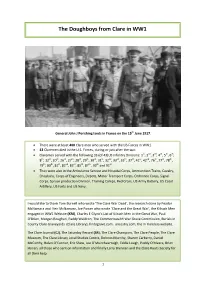
The Doughboys from Clare in WW1
The Doughboys from Clare in WW1 General John J Perishing lands in France on the 15th June 1917. There were at least 400 Clare men who served with the US Forces in WW1. 43 Claremen died in the U.S. Forces, during or just after the war. Claremen served with the following 33 (of 43)US Infantry Divisions: 1st, 2nd, 3rd, 4th, 5th, 6th, 8th, 12th, 20th, 26th, 27th, 28th, 29th, 30th, 31st, 32nd, 33rd, 35th, 37th, 41st, 42nd, 76th, 77th, 78th, 79th, 80th, 81st, 82nd, 83rd, 85th, 87th , 90th and 91st. They were also in the Ambulance Service and Hospital Corps, Ammunition Trains, Cavalry, Chaplains, Corps of Engineers, Depots, Motor Transport Corps, Ordnance Corps, Signal Corps, Spruce production Division, Training Camps, Red Cross, US Army Battery, US Coast Artillery, US Forts and US Navy. I would like to thank Tom Burnell who wrote ‘The Clare War Dead’, the research done by Peadar McNamara and Keir McNamara, Joe Power who wrote ‘Clare and the Great War’, the Kilrush Men engaged in WW1 Website (KM), Charles E Glynn’s List of Kilrush Men in the Great War, Paul O’Brien, Morgan Roughan, Paddy Waldron, The Commonwealth War Grave Commission, Burials in County Clare Graveyards (Clare Library), findagrave.com, ancestry.com, the In Flanders website. The Clare Journal (CJ), The Saturday Record (SR), The Clare Champion, The Clare People, The Clare Museum, The Clare Library Local Studies Centre, Dolores Murrihy, Sharon Carberry, Daniel McCarthy, Helen O’Connor, Eric Shaw, Joe O’Muircheartaigh, Eddie Lough, Paddy O’Meara, Brian Honan, all those who sent on information and finally Larry Brennan and the Clare Roots Society for all their help. -
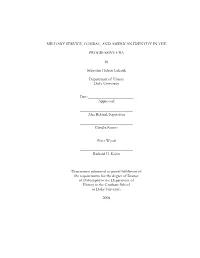
“Remember the Man at the Front”
MILITARY SERVICE, COMBAT, AND AMERICAN IDENTITY IN THE PROGRESSIVE ERA by Sebastian Hubert Lukasik Department of History Duke University Date:_______________________ Approved: ___________________________ Alex Roland, Supervisor ___________________________ Claudia Koonz ___________________________ Peter Wood ___________________________ Richard H. Kohn Dissertation submitted in partial fulfillment of the requirements for the degree of Doctor of Philosophy in the Department of History in the Graduate School of Duke University 2008 ABSTRACT MILITARY SERVICE, COMBAT, AND AMERICAN IDENTITY IN THE PROGRESSIVE ERA by Sebastian Hubert Lukasik Department of History Duke University Date:_______________________ Approved: ___________________________ Alex Roland, Supervisor ___________________________ Claudia Koonz ___________________________ Peter Wood ___________________________ Richard H. Kohn An abstract of a dissertation submitted in partial fulfillment of the requirements for the degree of Doctor of Philosophy in the Department of History in the Graduate School of Duke University 2008 Copyright by Sebastian Hubert Lukasik 2008 Abstract During the First World War, approximately two million troops served with the American Expeditionary Forces (AEF), the army that functioned as the material and symbolic focal point of America’s commitment to the defeat of the Central Powers. This dissertation examines the impact of training, active service and combat on the social identity of the draftees and volunteers who comprised the AEF. Reigning historiography -

28Th Division — General Table of Casualties — Sources
This is a reproduction of a library book that was digitized by Google as part of an ongoing effort to preserve the information in books and make it universally accessible. http://books.google.com , 28 TH DIVISION SUMMARY OF OPERATIONS IN THE WORLD WAR PREPARED BY THE ' J? AMERICAN BATTLE MONUMENTS COMMISSION / *___ UNITED STATES GOVERNMENT PRINTING OFFICE 1944 FOR SALE BY THE SUPERINTENDENT OF DOCUMENTS U. S. GOVERNMENT PRINTING OFFICE WASHINGTON 25, D. C. Foreword THE AMER1CAN BATTLE MONUMENTS COMM1SS1ON was created by Congress in 1923 for the purpose of commemorating the serv ices of American forces in Europe during the World War. In the accomplishment of this mission, the Commission has erected suitable memorials in Europe and improved and beautified the eight American cemeteries there. It has also published a book entitled "American Armies and Battlefields in Europe" which gives a concise account of the vital part played by American forces in the World War and detailed information regarding the memorials and cemeteries. In order that the actions of American troops might be accu rately set forth, detailed studies were made of the operations of each division which had front-line battle service. In certain cases studies of sector service were also prepared. It is felt that the results of this research should now be made available to the public. Therefore, these studies are being published in a series of twenty-eight booklets, each booklet devoted to the operations of one division. In these booklets only the active service of the divisions is treated in detail. The accounts, however, are comprehensive enough to be of general interest and establish a great body of fact concerning the operations. -

PNGMM Newsletter 17
Pennsylvania National Guard Military Museum Building T-8-57, Fort Indiantown Gap Annville, Pennsylvania 17003-5003 (717) 861-2402 PNG MILITARY MUSEUM NEWSLETTER NO.# 17-2013 WWW.PNGMILITARYMUSEUM.ORG CELEBRATING 27 YEARS OF SERVICE TO THE COMMUNITY BOARD OF DIRECTORS INDEX MG Walter F. Pudlowski (USA, Ret.), President Museum Curator Honored 2 Mr. Charles B. Oellig, Museum Director & Curator Boalsburg Ceremony Date Changed 2 Brig. Gen. Stanley J. Jaworski, (USAF, Ret.), Vice- President Ms. Rita Meneses, Treasurer New Minuteman Statue 2 SSgt Ted Nichols II, Secretary 4th PNG Museum Picnic 3 LTC Richard H. Shertzer, (USA, Ret.), Membership BG Walter T. Lord Chapel Begins Major Repairs 4 Col Carl Magagna (USAF, Ret.) Col. David J. Smoker (USAF, Ret) PNGMM Receives Vehicle Barn 4 LTC Robert D. Robinson II 5th Foxhole Golf Invitational 5 LTC Jonathan DeVries WO2 David A. Sakmar Donations 9 SGM Herman W. Clemens (USA, Ret.) M110 Static Display 10 SGT Damian J. M. Smith Ms. Sharon E. Flaig A Day in the Life of the 28th ID 11 Mr. John E. Schreffler Ms. Shannan D. Zerance Museum Tour Groups 12 Chuck Holbrook Museum Membership 13 Advisors (Non-Voting Members) Mr. John Cantwell, Esq., Legal Counsel Financial Donations 13 Maj. Gen. James M. Skiff, (USAF, Ret.), Board Member, Emeritis Museum Wish List 14 NEWSLETTER & MEDIA STAFF Museum Calendar 14 Ms. Rita Meneses, Editor, Cultural Resources Manager Curator‟s Corner 15 SGT Damian J. M. Smith, Articles/Photos/Command Historian Ms. Carolyn O‟Day Malfara, Webmaster Hours and Directions 16 PAGE 2 PENNSYLVANIA NATIONAL GUARD MILITARY MUSEUM 17-2013 MUSEUM CURATOR NEW MINUTEMAN HONORED STATUE DEDICATED Our museum curator, Mr. -

The World War I Survey
THE WORLD WAR I SURVEY Papers Compiled from the United States Army Military History Institute Collection Carlisle Barracks UNIVERSITY PUBLICATIONS OF AMERICA THE WORLD WAR I SURVEY Papers Compiled from the United States Army Military History Institute Collection Carlisle Barracks Edited by R. Dale Grinder, Ph.D. Guide Compiled by Martin Schipper A microfilm project of UNIVERSITY PUBLICATIONS OF AMERICA, INC. 44 North Market Street • Frederick, MD 21701 NOTE ON SOURCES The documents in this publication were microfilmed from the holdings of the U.S. Army Military History Institute, Carlisle Barracks, Carlisle, Pennsylvania. EDITORIAL NOTE The documents in this publication have not been filmed in their entirety. Selections were made in an effort to delete questionnaires that contain no more information than name, rank, serial number, date of birth, and date of discharge. Questionnaires were chosen for inclusion according to the quality and variety of information that they offer. Those documents that contain supplemental infor- mation—particularly those to which letters, diaries, and memoirs were attached—have also been included. Entries appearing within brackets in this guide indicate the frame number and author of those documents that contain significant additions to the standard survey form. These additions range from contemporaneous correspondence, diaries, field notes, lecture notes, and battle orders to memoirs and reminis- cences written after the war. Copyright ® 1985 by University Publications of America, Inc. All rights reserved. ISBN 0-89093-362-6 TABLE OF CONTENTS Introduction ix Reel Index Reels 1-3 Boot Camp and Camp Life 1 Reel 4 Boot Camp and Camp Life cont 3 The War in France American Expeditionary Force Headquarters/General Staff 3 Reels The War in France cont. -

Zirkle Family History
Zirkle Family History -fo-™ HW Compiled by J. William Harpine PREFACE For more than a dozen years the author has been doing research work on the pioneer family, The Zirkies, who came from Germany in 1725 and first locating in Pennsylvania and later making their permanent settlement in Shenandoah County, Virginia, at a place called "The Forest" now Forestville, Virginia. The first Zirkies locating in Virginia were a mother, five brothers and two sisters--namely, Michael, Andrew, Lewis, George Adam, Peter and their mother, Maria Eva. Their one sister, Margaret, had married Michael Nehs prior to coming to Virginia on March 6, 1753. The other children married after arriving in Virginia. The Zirkies were honest, frugal and hard-working people and accu mulated rather large estates. They ail owned and lived on their farms. They were rural people. Farmers, tanners and millers. Also they brought with them their religion, Lutheran faith, and established churches where they located. They were instrumental in building Rader's Church, St. Mary's Church (Pine Church), St. Matthew Church in New Market and Locust Grove Church in Botetourt County. Many of their descendants remained in Virginia where most of them had large families of boys and girls. Some of them moved to other states. Tennessee claims quite a number of them, West Virginia many of them, Ohio received their share, many other states such as Indiana, Illinois, North Dakota, South Dakota, Texas, California and in many other states you will find descendants of the first Zirkies. Many of their descendants remained on farms, some of them are ministers, some of them are teachers, some of them are doctors, some of them are lawyers and some of them have become efficient office holders in the state, in the nation and some in foreign positions. -

Crusaders and Commissars: a Comparative Study of the Motivation of Volunteers in the Popular and National Armies in the Spanish Civil War, 1936-1939
Crusaders and Commissars: A Comparative Study of the Motivation of Volunteers in the Popular and National Armies in the Spanish Civil War, 1936-1939 Christopher Bannister Thesis submitted for assessment with a view to obtaining the degree of Doctor of History and Civilization of the European University Institute Florence, 09 September 2014 European University Institute Department of History and Civilization Crusaders and Commissars: A Comparative Study of the Motivation of Volunteers in the Popular and National Armies in the Spanish Civil War, 1936-1939 Christopher Bannister Thesis submitted for assessment with a view to obtaining the degree of Doctor of History and Civilization of the European University Institute Examining Board Prof. Heinz Gerhard Haupt, EUI (Supervisor) Prof. Xosé-Manoel Núñez Seixas, LMU München (Supervisor) Prof. Lucy Riall, EUI Prof. Mary Vincent, University of Sheffield © Christopher Bannister, 2014 No part of this thesis may be copied, reproduced or transmitted without prior permission of the author i Abstract This thesis is a comparative analysis of the propaganda programmes employed in the motivation of volunteer soldiers in the Spanish Civil War, 1936-1939. It focuses on the successes and failures of each programme in convincing volunteers from various political backgrounds to fight for values that differed from those for which they took up arms. The programme of the Francoist National Army, known as ‘the Crusade’, presented the war as a conflict between the true, Christian Spain and a Muscovite invader, intent of destroying the nation and enslaving its people. The Popular Army’s programme was neither as singular nor as emotive and the message that was presented was a diffuse one.