Nation's Footballpowers Hit Gridiron This Week
Total Page:16
File Type:pdf, Size:1020Kb
Load more
Recommended publications
-
Information to Users
INFORMATION TO USERS This manuscript has been reproduced from the microfilm master. UMI films the text directly from the original or copy submitted. Thus, some thesis and dissertation copies are in typewriter face, while others may be from any type of computer printer. The quality of this reproduction is dependent upon the quality of the copy submitted. Broken or indistinct print, colored or poor quality illustrations and photographs, print bleedthrough, substandard margins, and improper alignment can adversely affect reproduction. In the unlikely event that the author did not send UMI a complete manuscript and there are missing pages, these will be noted. Also, if unauthorized copyright material had to be removed, a note will indicate the deletion. Oversize materials (e.g., maps, drawings, charts) are reproduced by sectioning the original, beginning at the upper left-hand comer and continuing from left to right in equal sections with small overlaps. Each original is also photographed in one exposure and is included in reduced form at the back of the book. Photographs included in the original manuscript have been reproduced xerographically in this copy. IDgher quality 6” x 9” black and white photographic prints are available for any photographs or illustrations appearing in this copy for an additional charge. Contact UMI directly to order. UMI A Bell & HoweU Information Compaiy 300 North Zeeb Road, Ann Arbor MI 48106-1346 USA 313/761-4700 800/521-0600 OUTSIDE THE LINES: THE AFRICAN AMERICAN STRUGGLE TO PARTICIPATE IN PROFESSIONAL FOOTBALL, 1904-1962 DISSERTATION Presented in Partial Fulfillment of the Requirements for the Degree Doctor of Philosophy in the Graduate School of The Ohio State U niversity By Charles Kenyatta Ross, B.A., M.A. -

National Pastime a REVIEW of BASEBALL HISTORY
THE National Pastime A REVIEW OF BASEBALL HISTORY CONTENTS The Chicago Cubs' College of Coaches Richard J. Puerzer ................. 3 Dizzy Dean, Brownie for a Day Ronnie Joyner. .................. .. 18 The '62 Mets Keith Olbermann ................ .. 23 Professional Baseball and Football Brian McKenna. ................ •.. 26 Wallace Goldsmith, Sports Cartoonist '.' . Ed Brackett ..................... .. 33 About the Boston Pilgrims Bill Nowlin. ..................... .. 40 Danny Gardella and the Reserve Clause David Mandell, ,................. .. 41 Bringing Home the Bacon Jacob Pomrenke ................. .. 45 "Why, They'll Bet on a Foul Ball" Warren Corbett. ................. .. 54 Clemente's Entry into Organized Baseball Stew Thornley. ................. 61 The Winning Team Rob Edelman. ................... .. 72 Fascinating Aspects About Detroit Tiger Uniform Numbers Herm Krabbenhoft. .............. .. 77 Crossing Red River: Spring Training in Texas Frank Jackson ................... .. 85 The Windowbreakers: The 1947 Giants Steve Treder. .................... .. 92 Marathon Men: Rube and Cy Go the Distance Dan O'Brien .................... .. 95 I'm a Faster Man Than You Are, Heinie Zim Richard A. Smiley. ............... .. 97 Twilight at Ebbets Field Rory Costello 104 Was Roy Cullenbine a Better Batter than Joe DiMaggio? Walter Dunn Tucker 110 The 1945 All-Star Game Bill Nowlin 111 The First Unknown Soldier Bob Bailey 115 This Is Your Sport on Cocaine Steve Beitler 119 Sound BITES Darryl Brock 123 Death in the Ohio State League Craig -

Black Nfl Draft Prospects' Conceptions of Manhood
DRAFTING INTO MANHOOD: BLACK NFL DRAFT PROSPECTS’ CONCEPTIONS OF MANHOOD AND IDEAS OF PLAYING IN THE NFL A Dissertation Submitted to the Temple University Graduate Board In Partial Fulfillment of the Requirements for the Degree DOCTOR OF PHILOSOPHY by Andrew D. Brown May 2015 Examining Committee Members: Molefi K. Asante, Advisory Chair, African American Studies Heather A. Thompson, African American Studies James Earl Davis, College of Education James L. Conyers, Jr., External Member, University of Houston © Copyright 2015 by Andrew Brown All Rights Reserved ii ABSTRACT This dissertation examines how manhood is conceptualized by Black National Football League (NFL) prospects and explores how their characterizations of manhood are associated with their desire to become NFL players. This mixed-method study uses data collected by interviewing and surveying fifteen Black NFL draft prospects who were or would be eligible for the NFL draft between 2005-2016. The data are supplemented with existing literature and analyzed using the “Utamaduni Bwana” table of African cultural manhood in order to (1) culturally locate participants’ conceptions of manhood, (2) identify the African elements within their conceptions of manhood, and (3) highlight the agency within their responses. In essence, this dissertation explores the significance of the NFL draft and the influence of colonization on Black NFL prospects’ conceptions of manhood. This study found that Black NFL prospects’ desire to reach the NFL is heavily associated with their attempt to reach manhood. The characteristics most commonly found in the participants’ conceptions of manhood are strength, independence, and financial success; and their perceptions of NFL players contain hyper-expressions of these same characteristics. -

Vol. 29, No. 6 2007
Vol. 29, No. 6 2007 PFRA Committees 2 Football’s Best Pennant Races 5 Bob Gain 11 Baseball & Football Close Relationship 12 Right Place – Wrong Time 18 Overtime Opinion 19 Forward Pass Rules 21 Classifieds 24 THE COFFIN CORNER: Vol. 29, No. 6 (2007) 2 Class of 2003: Class of 2004: Gino Cappelletti Gene Brito Carl Eller* John Brodie PFRA Pat Fischer Jack Butler Benny Friedman* Chris Hanburger Gene Hickerson* Bob Hayes COMMITTEES Jerry Kramer Billy Howton By Ken Crippen Johnny Robinson Jim Marshall Mac Speedie Al Nesser Mick Tingelhoff Dave Robinson We are happy to report that another committee has Al Wistert Duke Slater been formed since the last update. Gretchen Atwood is heading up the Football, Culture and Social Class of 2005: Class of 2006: Movements Committee. A description of the committee Maxie Baughan Charlie Conerly can be found below. Jim Benton John Hadl Lavie Dilweg Chuck Howley The Western New York Committee is underway with Pat Harder Alex Karras their newest project, detailing the Buffalo Floyd Little Eugene Lipscomb Bisons/Buffalo Bills of the AAFC. Interviews with Tommy Nobis Kyle Rote surviving players and family members of players are Pete Retzlaff Dick Stanfel underway and will continue over the next few months. Tobin Rote Otis Taylor Lou Rymkus Fuzzy Thurston The Hall of Very Good committee reports the following: Del Shofner Deacon Dan Towler In 2002, Bob Carroll began the Hall of Very Good as a Class of 2007: way for PFRA members to honor outstanding players Frankie Albert and coaches who are not in the Pro Football Hall of Roger Brown Fame and who are not likely to ever make it. -

Bronx, Blacks, and the NFL
THE COFFIN CORNER: Vol. 15, No. 1 (1993) Bronx, Blacks, and the NFL by Victor Mastro and John Hogrogian The Bronx is one of the five boroughs which make up New York City. It is the only borough which is located on the mainland United States, as the other four are on islands in New York Harbor. The Bronx is home for Yankee Stadium and Fordham University. It formerly was home for the uptown campus of New York University, now gone. In the 1920's and 1930's, Fordham and NYU were football powers that sent several players into the pros. Staunchly middle-class in character, the Bronx now is also cursed with a plague of urban blight in its southern neighborhoods. Throughout its history, the Bronx has been ethnically and racially mixed, an incubator for upward mobility for people from everywhere. For the past sixty years, the Bronx has been the setting for many developments in the racial integration of the National Football League, Its fields, schools, and people have all played a role in the progress of the NFL away from its segregated past and into the diverse world of the 1990's. I The New York Brown Bombers Black players were a small but significant presence in the NFL during the 1920's. Players like Fritz Pollard, Duke Slater, and Inky Williams were stars in the league's first decade. By 1933, however, the number of black players in the NFL dwindled to two, halfback Joe Lillard of the Chicago Cardinals and tackle Ray Kemp of the Pittsburgh Pirates. -

THE COFFIN CORNER: Vol. 11, No. 5 (1989)
THE COFFIN CORNER: Vol. 11, No. 5 (1989) Not Only the Ball Was Brown BLACK PLAYERS IN MINOR LEAGUE FOOTBALL, 1933-46 by Bob Gill and Tod Maher As most of you know, between 1933, when Joe Lillard played for the Chicago Cardinals and Ray Kemp for Pittsburgh, and 1946, when Kenny Washington and Woody Strode joined the Los Angeles Rams, the NFL had an unofficial ban on black players. But back in the 1920s, a few blacks had indeed played in the NFL, some of them very well. That raises an interesting question: Where did comparable black players of the '30s go? Among its other virtues, Thomas Smith's fine article in the last Coffin Corner ("Outside the Pale") included short profiles of several blacks who starred on integrated college teams during the period. In passing, he also noted that more than one of them did play professional football (though he sometimes mislabels it "semi-pro") outside the NFL. There were black touring teams, occasional blacks playing on integrated teams, a couple of all-black teams playing in leagues with white clubs, and even one all-black league something like a lower-class version of baseball's Negro Leagues. We're going to take a look at just what was going on "outside the pale" in those days. The following article, by Tod Maher, concerns what Smith calls (correctly) "the most successful" all-black team of the period: the New York Brown Bombers. The Brown Bombers by Tod Maher 1933 was a notable year for the NFL. It was the first in which the league was divided into regional divisions. -
One Dead in Wake of Mixup
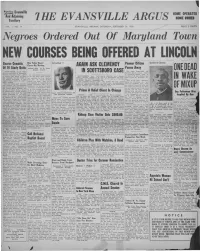
*E£? IHE EVANSVILLE ARGUS HOME OPERATED ritf "3*" VOL. 1—NO. 14 EVANSVILLE, INDIANA, SATURDAY, SEPTEMBER 24, 1938 3r\© PRICE 5 CENTS s ? , u^ . ————^^——————— Negroes Ordered Out Of Maryland Town NEW COURSES BEING OFFERED AT LINCOLN Course Consists Ohio Valley Board Correction ! ! Pioneer Citizen Speaks at Cleaves Closes Big Meeting AGAIN ASK CLEMENCY Of 16 Study Units Sessions Held At St. James Passes Away Baptist Church ONE DEAD WASHINGTON, D. Cv—When IN SCOTTSBORO CASE Mrs. Hattie Dangferfield, 416 the boys and girls of Evansville, Mulberry Street, pioneer citizen Indiana, returned to their desks The Ohio Valley District Board of Evansville, passed away at in Lincoln High School on Mon of the Mt. Olive State Associa MONTGOMERY, Ala., Sept. Norris. However, -Gov. Graves, her home 7:05 a.m. Monday ater day September 12, they found in tion convened its first meeting (ANP)—Attorney General A. A. who is in Washington, will prob seven months of prolonged ill Carmichael was requested Friday ably set the date as is his cus the school's curriculum a new with the St. James , Baptist ness. IN WAKE by Morris Shapiro, Scottsboro tom. supplementary course of study— Church last week, Sept. 15-16 •born to the large Bumphers Defense committee counsel, to set Gov. Graves who may accept family oi Princeton, Ky., she public housing. and expedited its business of the a date for hearing pardon appli or reject board recommendation, spent her childhood days there The new course deals with Lin district Association. Rev. V. L. cations on behalf of Andy Wright, has not acted on the Powell and coln Gardens, the slum-clearance Charlie Weems and Clarence Patterson cases. -

UNIVERSITY of CALIFORNIA Los Angeles Sporting
UNIVERSITY OF CALIFORNIA Los Angeles Sporting Bodies, Displaying History: Black Embodiment and Performance in Contemporary Sports Films A dissertation submitted in partial satisfaction of the requirements for the degree of Doctor of Philosophy in Film and Television by Samantha Noelle Sheppard 2014 © Copyright by Samantha Noelle Sheppard 2014 ABSTRACT OF DISSERTATION Sporting Bodies, Displaying History: Black Embodiment and Performance in Contemporary Sports Films by Samantha Noelle Sheppard Doctor of Philosophy in Film and Television University of California, Los Angeles, 2014 Professor Kathleen McHugh, Co-Chair Professor Allyson Nadia Field, Co-Chair In this dissertation I analyze Black embodiment and performance in contemporary sports films, particularly through their documentary impulse, the gestures and markers through which these films establish their reference to real sporting and non-sporting bodies and histories. I argue that through this impulse, sports films make claims to an historical real, and they can therefore be explored for how they represent the Black sporting body. Though my project focuses primarily on fiction films, I begin by analyzing this impulse in a sports documentary for how it represents the performance and embodiment of the Black sporting body as an historical contestant. I then trace these strategies as they appear in and shape sports in fiction films, ii specifically through narratives of triumph and defeat, dissent, and gendered visibility. Throughout, I focus on and read the Black sporting body as a an individuated multiplicity which, through performance and embodiment, represents, references, and relates to Black sporting and non-sporting embodied histories and experiences. Sports films offer a privileged viewpoint on Black embodiment because of their high concentration of Black actors, one that mirrors representation in contemporary athletics. -

© 2007 University of Oregon Department of Intercollegiate Athletics
© 2007 University of Oregon Department of Intercollegiate Athletics elebrating its 131st anniversary, the University of Oregon has welcomed six generations of C outstanding leaders since opening in 1876. Today’s students, like the nearly 155,000 alumni before them, have access to the most current knowledge in classes, as well as laboratories and seminars conducted by leading researchers. Ranked fifteenth in the country among public universities and sixth among “rising” public universities, the university is regarded as one of the “best buys” in higher education for its high quality and affordability. Two UO graduates are Nobel Prize honorees, ten have received Pulitzer Prizes, and eighteen have been named Today, Rhodes Scholars. the university’s physical plant consists UO students select courses from departments and of 337 structures on and off campus and is valued at programs in the College of Arts and Sciences, six more than $465 million. professional schools and colleges, and the Graduate The 295-acre Eugene campus is the state’s center School. More than 1,650 teaching and research faculty of liberal arts and sciences education, as well as one members and 1,300 graduate teaching and research of the nation’s best teaching and research institutions. assistants serve as mentors, colleagues, Professional schools in architecture, business, and friends to the education, journalism and communication, law, and more than 20,000 music and dance complete the broad range of course undergraduate and offerings, with a total of 268 comprehensive academic graduate students programs available. enrolled at the UO. University science departments are winning national A group of Lane attention in biomechanics, computers, genetics, lasers, County farmers and neuroscience, and nanotechnology. -

The Benching of Willis Ward and the Rise of Northern Racial Liberalism
At the University but Not of the University 35 At the University but Not of the University: The Benching of Willis Ward and the Rise of Northern Racial Liberalism Tyran Kai Steward No Northern state university prohibits the enrollment of Ne- groes, although a few practice minor forms of discrimination once they are enrolled. This is often a matter of individual prejudice rather than of official policy.1 The racial prejudice encountered by the University of Michigan’s black lettermen during the first half of the twentieth century was entwined into the na- tion’s fabric: restaurants and hotels refused service to African Americans, land- lords denied housing to black renters, and employers rebuffed black job seekers when it came to postgraduation professional opportunities. “They [black Amer- icans] were IN America but not OF it,” remarked one writer recalling the racial exclusion that marked the era. Similarly, Dan Kean, a former tennis player at Michigan, reached the same conclusion about his and other African Americans’ sense of social isolation in Ann Arbor that had been drawn about the racial restrictions placed on black life in America. “If you want to know what it is was like then I’d have to say black students were AT the University but not OF it.”2 Kean’s observation exposed the racial marginalization that black stu- dents confronted at the University of Michigan. Although African Americans began enrolling at the University of Michigan in the early 1850s, reflecting the early move toward integration in some areas of the North, discriminatory racial practices prevailed. -

Shooting Stars: the Rise and Fall of Blacks in Professional Football
THE COFFIN CORNER: Vol. 10 Annual (1988) SHOOTING STARS: THE RISE AND FALL OF BLACKS IN PROFESSIONAL FOOTBALL by Gerald R. Gems American culture faced a difficult period of transition during the latter part of the nineteenth century. The Civil War had shredded any figment of national unit and Reconstruction had failed to bring about an assimilation of the emancipated slaves into the mainstream culture. A growing urban-industrial complex continued to transform traditional American values and lifestyles. From the 1880's to 19820 foreigners flocked to American shores in search of opportunity and the promise of a better life. Europeans, as well as black migrants from the American South, filled northern cities and industrial labor forces. Production soared as cheap labor proved a significant contribution to the growth of American commerce and to the United States' emergence as a world power; but the American ascendance was not without problems. The influx of alien cultures and the overwhelming numbers of immigrants challenged American society with new languages, religions and value systems, and with their alternative customs and institutions as well. Progressive reformers confronted a host of social ills emanating from the urban, industrial and foreign elements with programs designed to instill traditional American middle-class values among the disparate groups. Such reforms were intended to bring a consensus to the American culture by educating children in city parks and playgrounds, as well as in the public school systems. Sport figures prominently in the Progressives' strategy to attain physical and moral improvement. Robust physical activity, it was believed, strengthened will power and left little time for the immoral temptations of the city. -
Football in American Art from the Civil War to the Present Football in SCRIMMAGE American Art from the Civil War to the Present
SCRIMMAGE Football in American Art from the Civil War to the Present Football in SCRIMMAGE American Art from the Civil War to the Present Colorado State University Art Museum, Fort Collins August 28 – December 18, 2015 Jordan Schnitzer Museum of Art, University of Oregon, Eugene July 30 – December 31, 2016 2 Table of Contents Foreword by Jill Hartz 5 Preface and Acknowledgments 6 Linny Frickman and Danielle M. Knapp Roosevelt’s “Strenuous Life”: The Masculine Model from Remington to Barney 8 Linny Frickman The Popular Press and the Beginnings of American Football Art 16 Michael Oriard, Ph.D. Patriot Games: Military Displays at Football Games 22 Robert Gudmestad, Ph.D. Black Pioneers: Transformations of the Color Line Across the Line-of-Scrimmage 29 Albert Bimper, Ph.D. Making Landscapes, Building American Identities: Catherine Opie and High School Football 34 Danielle M. Knapp Selected Checklist and Artist Biographies 39 Danielle M. Knapp Stephanie Dunn Christie Hajela Lindsay M. Keast Checklist of the Exhibition 125 Credits 128 University of Oregon vs. St. Mary’s, 1930. Football program, 10 1/2 x 7 3/4 inches. 3 Foreword Football is the most important competitive sport ethnic studies at CSU; Robert Gudmestad, associate played in academia. Winning teams create compel- professor of history at CSU; and Michael Oriard, pro- ling brands for their institutions, which, in turn, drive fessor emeritus of American literature and culture and their admission numbers. Hot schools have hot teams. retired associate dean at Oregon State University— It is also the most controversial of college sports. The contribute to our understanding of college football as pros and cons of financing the game, the dangers of an embodiment of American culture and a locus for physical injury and potential long-term impairment, current debates about American values.