Great Universe.Pdf
Total Page:16
File Type:pdf, Size:1020Kb
Load more
Recommended publications
-

W.B.C.S.(Exe.) Officers of West Bengal Cadre
W.B.C.S.(EXE.) OFFICERS OF WEST BENGAL CADRE Sl Name/Idcode Batch Present Posting Posting Address Mobile/Email No. 1 ARUN KUMAR 1985 COMPULSORY WAITING NABANNA ,SARAT CHATTERJEE 9432877230 SINGH PERSONNEL AND ROAD ,SHIBPUR, (CS1985028 ) ADMINISTRATIVE REFORMS & HOWRAH-711102 Dob- 14-01-1962 E-GOVERNANCE DEPTT. 2 SUVENDU GHOSH 1990 ADDITIONAL DIRECTOR B 18/204, A-B CONNECTOR, +918902267252 (CS1990027 ) B.R.A.I.P.R.D. (TRAINING) KALYANI ,NADIA, WEST suvendughoshsiprd Dob- 21-06-1960 BENGAL 741251 ,PHONE:033 2582 @gmail.com 8161 3 NAMITA ROY 1990 JT. SECY & EX. OFFICIO NABANNA ,14TH FLOOR, 325, +919433746563 MALLICK DIRECTOR SARAT CHATTERJEE (CS1990036 ) INFORMATION & CULTURAL ROAD,HOWRAH-711102 Dob- 28-09-1961 AFFAIRS DEPTT. ,PHONE:2214- 5555,2214-3101 4 MD. ABDUL GANI 1991 SPECIAL SECRETARY MAYUKH BHAVAN, 4TH FLOOR, +919836041082 (CS1991051 ) SUNDARBAN AFFAIRS DEPTT. BIDHANNAGAR, mdabdulgani61@gm Dob- 08-02-1961 KOLKATA-700091 ,PHONE: ail.com 033-2337-3544 5 PARTHA SARATHI 1991 ASSISTANT COMMISSIONER COURT BUILDING, MATHER 9434212636 BANERJEE BURDWAN DIVISION DHAR, GHATAKPARA, (CS1991054 ) CHINSURAH TALUK, HOOGHLY, Dob- 12-01-1964 ,WEST BENGAL 712101 ,PHONE: 033 2680 2170 6 ABHIJIT 1991 EXECUTIVE DIRECTOR SHILPA BHAWAN,28,3, PODDAR 9874047447 MUKHOPADHYAY WBSIDC COURT, TIRETTI, KOLKATA, ontaranga.abhijit@g (CS1991058 ) WEST BENGAL 700012 mail.com Dob- 24-12-1963 7 SUJAY SARKAR 1991 DIRECTOR (HR) BIDYUT UNNAYAN BHAVAN 9434961715 (CS1991059 ) WBSEDCL ,3/C BLOCK -LA SECTOR III sujay_piyal@rediff Dob- 22-12-1968 ,SALT LAKE CITY KOL-98, PH- mail.com 23591917 8 LALITA 1991 SECRETARY KHADYA BHAWAN COMPLEX 9433273656 AGARWALA WEST BENGAL INFORMATION ,11A, MIRZA GHALIB ST. agarwalalalita@gma (CS1991060 ) COMMISSION JANBAZAR, TALTALA, il.com Dob- 10-10-1967 KOLKATA-700135 9 MD. -
Tools to Change the World
TOOLS TO CHANGE THE WORLD Study Guide based on the Progressive Utilization Theory (Prout) Level 1 Dada Maheshvarananda and Mirra Price, M. Ed., Ed.M. Proutist Universal Copenhagen Copyright 2019 by © Proutist Universal: Copenhagen All rights reserved under International and Pan-American Copyright Conventions ISBN: 978-87-89552-00-2 Cover Design: Jagadiish Gorg Azzopardi All rights reserved. This book, or parts thereof, may not be reproduced in any form or by any means, electronic or mechanical, including photocopying, recording, or by any information storage or retrieval system, without permission of the publisher except for brief quotations. Proutist Universal 30 Platanvej, 1810 Fredriksberg Copenhagen, Denmark ACKNOWLEDGEMENTS We would like to express our gratitude to the many people who have contributed to this Prout Study Guide and to its predecessors. We especially want to thank Mark Friedman and Dada Nabhaniilananda, whose work we have reprinted. We are grateful to all who offered suggestions on the modules: Didi Ananda Devapriya (Romania), Ron Baseman, Ole Brekke and Kathrine Sumati Brekke (Denmark), Alex Jackimovicz, Sid Jordan, Kathleen Kesson, John Linkart, Sloan McLain, Mal- colm McDonell (Australia), Matt Oppenheim, Georgia Perry, Charles Paprocki, James Quilligan, and Karl Robins. It has been extremely helpful that a few people—Howard Nemon, Didi Ananda Ruchira, Nina Shapiro, and Bruce Dyer (New Zealand)—have conducted field test study groups and have given feedback. Dada Maheshvarananda would also like to express his gratitude to the staff of the Prama Institute and Wellness Center near Asheville, NC for allowing him to write in peace in their healing environment. Dear readers, we also welcome your critical suggestions about how to improve this project. -

A Survey of Human Rights 2013
Hindus in South Asia and the Diaspora: A Survey of Human Rights 2013 www.HAFsite.org June 5, 2013 © Hindu American Foundation 2013 “All human beings are born free and equal in dignity and rights.” Universal Declaration of Human Rights, 1948, Article 1 “One should never do that to another which one regards as injurious to one’s own self. This, in brief, is the rule of dharma. Yielding to desire and acting differently, one becomes guilty of adharma.” Mahabharata XII: 113, 8 “Thus, trampling on every privilege and everything in us that works for privilege, let us work for that knowledge which will bring the feeling of sameness towards all mankind.” Swami Vivekananda, “The Complete works of Swam Vivekananda,” Vol 1, p. 429 "All men are brothers; no one is big, no one is small. All are equal." Rig Veda, 5:60:5 © Hindu American Foundation 2013 © Hindu American Foundation 2013 Endorsements of Hindu American Foundation's Seventh Annual Report Hindus in South Asia and the Diaspora: A Survey of Human Rights 2010 "As the founder and former co---chair of the Congressional Caucus on India and Indian Americans, I know that the work of the Hindu American Foundation is vital to chronicle the international human rights of Hindus every year. The 2010 report provides important information to members of Congress, and I look forward to continuing to work with HAF to improve the human rights of Hindus around the world." U.S. Congressman Frank Pallone (D-NJ) "As Chairman of the Subcommittee on Terrorism and the co---chair of the Congressional Caucus on India and Indian Americans, I applaud the hard work of the Hindu American Foundation in producing their annual Human Rights Report. -

Details of Visas Granted by India
DETAILS OF VISAS GRANTED BY INDIA I. e-VISA 1 Eligibility e-Visa is granted to a foreigner whose sole objective of visiting India is recreation, sight seeing, casual visit to meet friends or relatives, attending a short term yoga programme, medical treatment including treatment under Indian systems of medicine and business purpose and no other purpose/ activity. This facility shall not be available if the person or either of his / her parents or grand parents (paternal or maternal) was born in, or was permanently resident in Pakistan. e-Visa facility shall not be available to holders of Diplomatic/Official passports, UNLP (UN Passport) holders and international travel document holders e.g. INTERPOL officials. List of countries whose nationals are presently eligible for e-visa is given in Appendix I. 2 Procedure for applying for e-Visa The foreign national may fill in the application online on the website https://indianvisaonline.gov.in/visa/tvoa.html . The applicant can apply 120 days in advance prior to expected date of arrival in India. 3 Sub-categories of e-Visa There are three sub-categories of e-Visa i.e. (a) e-Tourist Visa : For recreation, sightseeing, casual visit to meet friends or relatives, and attending a short term yoga programme, (b)e- Business Visa : For all activities permitted under normal Business Visa and (c) e-Medical Visa : For medical treatment, including treatment under Indian systems of medicine. A foreign national will also be permitted to club these activities provided he/she had clearly indicated the same in the application form along with requisite documents. -

India: "Sensible Everyday Names"
NOT FOR PUBLICATION INSTITUTE OF CURRENT WORLD AFFAIRS GSA-15 25A Nizamuddin West India ttSensible everyday names" New Delhi 30 January 1965 ro Richard H Nolte Executive Director Institute of Current World Affairs 366 adison Avenue New York NeT York Dear Di ck For T. S. Eliot the naming of cats as a difficult matter Nor is the naming of Indians "ust one of your holiday games" BU for the armchair anthropologist Indian names are fun all the same indicating as they often do a person's geographical origins his community (religion) his caste sometimes his group within the com- munity and in general demonstrating the cultural diversity that is India. A look at the telephone directory in Calcutta where I was last week shows that names like Das Das Gupta Dutt De (also spelled Dey) Bose (also rendered Basu) Sen and Sen Gupta are very common names--he Smihs Joneses and Johnsons of Bengal. Sen De Das Ghosh (also spelled Ghose) and others are all Kayastha names The Kayasthas are an ancient caste originally of scribes and can be found in most places in Torth India but particularly in Bihar the United Provinces 0rssa and Bengal A name like Das in Bihar however may not ean that its oner is a Kayastha; he may be of another caste The Kayasthas are an especially interesting caste for their rung on the caste ladder and thus to a large extent their position in society varies greatly from province to province. Kayasthas in Bengal rak close to Brahmins claiming membership as Kshatriyas the second of the four varnas or classes of the Hindu social structure. -

MINUTES of 37TH MEETING of the CULTURAL FUNCTION and PRODUCTION GRANT SCHEME (CFPGS) HELD on 18Th SEPTEMBER - 2017 ATNSD, NEW DELHI
1 F.No. 9-362/2017-S&F Government of India Ministry of Culture **** Puratatav Bhavan, 2nd Floor ‘D’ Block, GPO Complex, INA, New Delhi-110023 Dated: 01.11.2017 MINUTES OF 37TH MEETING OF THE CULTURAL FUNCTION AND PRODUCTION GRANT SCHEME (CFPGS) HELD ON 18th SEPTEMBER - 2017 ATNSD, NEW DELHI. Under CFPGS Scheme financial Assistance is given to ‘Not-for-Profit’ Organisations, NGOs including Societies, Trust, Universities and Individuals for holding Conferences, Seminar, Workshops, Festivals, Exhibitions, Production of Dance, Drama-Theatre, Music and undertaking small research projects etc. on any art forms/important cultural matters relating to different aspects of Indian Culture. The quantum of assistance is restricted to 75% of the project cost subject to maximum of Rs. 5 Lakhs per project as recommend by the Expert Committee. In exceptional circumstances Financial Assistance may be given upto Rs. 20 Lakhs with the approval of Hon’ble Minister of Culture. 2. A meeting of CFPGS was held on 18thSeptember 2017 under the Chairmanship of Ms. Sujata Prasad, Additional Secretary to consider the proposal for financial assistance by the Expert Committee. 3. The Expert Committee meeting was attended by the following:- (i) Ms. Sujata Prasad, Additional Secretary, Chairperson (ii) Shri Pranav Khullar, Joint Secretary (iii) Dr. Sajith E.N., Director, SCZCC, Member (iv) Shri Shantanu Bose, Dean, NSD, Member (v) Smt.Rita Swami Choudhary, Secretary, SNA, Member (vi) Shri Babu Rajan, DS , Sahitya Akademi, Member (vii) Shri Narendra Singh, Director-Incharge, NCZCC (viii) Ms. Deepti Babbar, AS, LKA, Member (ix) Shri Harish Kumar, Director, MOC, Member-Secretary 4. The Expert Committee has considered 401 applications which were complete and supported with all documents as required under the scheme. -
Chapter-2- List of Scheduled Castes 1 the Constitution
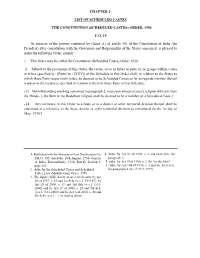
CHAPTER-2- LIST OF SCHEDULED CASTES 1 THE CONSTITUTION (SCHEDULED CASTES) ORDER, 1950 C.O. 19 In exercise of the powers conferred by clause (1) of article 341 of the Constitution of India, the President, after consultation with the Governors and Rajpramukhs of the States concerned, is pleased to make the following Order, namely:— 1. This Order may be called the Constitution (Scheduled Castes) Order, 1950. 2. Subject to the provisions of this Order, the castes, races or tribes or parts of, or groups within, castes or tribes specified in 2 [PartsI to 3 [XXV]] of the Schedule to this Order shall, in relation to the States to which those Parts respectively relate, be deemed to be Scheduled Castes so far as regards member thereof resident in the localities specified in relation to them in those Parts of that Schedule. 4 [3. Notwithstanding anything contained in paragraph 2, no person who professes a religion different from the Hindu 5 [, the Sikh or the Buddhist] religion shall be deemed to be a member of a Scheduled Caste.] 6 [4. Any reference in this Order to a State or to a district or other territorial division thereof shall be construed as a reference to the State, district or other territorial division as constituted on the 1st day of May, 1976.] 1. Published with the Ministry of Law Notification No. 4. Subs. by Act 63 of 1956, s. 3 and First Sch., for S.R.O. 385, dated the 10th August, 1950, Gazette paragraph 3. of India, Extraordinary, 1950, Part II, Section 3, 5. -

18 Baumer.Pdf
ASIAN STUDIES AT HAWAII, NO. 12 Aspects of B~ngali . History and Society Rachel Van M. Baumer Editor ASIAN STUDIES PROGRAM UNIVERSITY OF HAWAII THE UNIVERSITY PRESS OF HAWAII UNIVERSITY OF HAWAII LIBRARY Copyright © 1975 by The University Press of Hawaii All rights reserved Manufactured in the United States of America Library of Congress Cataloging in Publication Data Main entry under title: Aspects of Bengali history and society. (Asian studies at Hawaii; no. 12) "Essays delivered by most of the guest speakers in a seminar on Bengal convened in the spring of 1972 at the University of Hawaii." Includes bibliographical references and index. 1. Bengal-Civilization-Addresses, essays, lectures. 2. Bengal-History-Addresses, essays, lectures. I. Baumer, Rachel Van M., 1928- ed. II. Series. DS3.A2A82 no. 12 [DS485.B44] 915.4'14'03 73-90491 ISBN 0-8248-0318-3 Dedicated to the memory of our colleagues whose lives and fruitful scholar ship were cut off during the independence struggle in Bangladesh. \)j<j 4\31 <j ~\3 ~TbT ~9j$ff<j;ft I - ~D"5' L Contents Introduction vii Hinduism and Islam in Medieval Bengal Edward C. Dimock, Jr. Norms of Family Life and Personal Morality among the Bengali Hindu Elite, 1600-1850 Tapan Raychaudhuri 13 Economic Foundations of the Bengal Renaissance Blair B. Kling 26 The Universal Man and the Yellow Dog: The Orientalist Legacy and the Problem of Brahmo Identity in the Bengal Renaissance David Kopf 43 The Reinterpretation of Dharma in Nineteenth-Century Bengal: Righteous Conduct for Man in the Modern World Rachel Van M. -

A Bengal Village
THE ECONOMIC WEEKLY August 15, 1953 A Bengal Village Shrimati Jyotirmoyee Sarma This is the twelfth in the series of Village Studies, It is based on fast-hand study of a village, the location of which has been indicated though its name has been withheld for obvious reasons. The author belongs to Bengal but was educated in the United Stairs from school onwards and took her PhD in Sociology from the University of Chicago. She worked on tace relations in the States and has published a paper on the Bengali joint household. She did field work in the village about which she writes early this year in the winter months.- Ed. NLY a short distance from the houses and the fields are inter One may have some plots in the Ocity of Calcutta the face of the spersed and houses cluster on the potato fields, some in the paddy land of Bengal changes, and one higher lands. fields, sonic on one side of the village finds oneself in a country dotted with The village has 324 residences. and some on another. Lentils are villages and with a few big towns Of these, only five are brick houses, also grown in quantities sufficient in between. Although the inhabi belonging to families who were tor the villagers' own consumption. tants of these villages maintain con affluent in the past. The remainder Vegetables in season are also culti tact with the city, the contact is of are clay structures thatched with vated. The crops are grown in the a limited type, and village life for straw. -
View of West Bengal
International Journal of Advance Research and Development (Volume3, Issue4) Available online at: www.ijarnd.com Study of Baul Community Family Relation and their Philosophy: An Overview of West Bengal Patit Paban Halder Research Scholar Seacom Skills University, Santiniketan, West Bengal International Journal of Advance Research and Development Contents Page No 1. Title of the RESEARCH 2. Publication of the RESEARCH 3. Dedication 4. Acknowledgement 5. How to Read the Book Chapter-I 6. Abstract 7. Introduction 8. Why Finding of the Work 9. Problem of the Subject 10. Limitation of the Study 11. Objective of the Study 12. Community of Bauls 13. History of the Baul 14. A Social Group 15. Family life and Relation 16. Cause of the Study & Rational Chapter-II 17. Review of Literature Chapter-III 18. Rules and Regulation of Indian Folk Culture 19. The Voice of Bengal Bauls 20. Society depends on our Family Chapter- IV 21. Addresses of some Bauls and Fakirs Chapter –V 22. Research Methodology 23. Table and Categorization of Collected Information 24. Geographical Location & Operational Areas 25. Striking Questions before and after Research 26. Operational Subjects 27. Scope of the study 28. Sample and Sampling System 29. Data Collection Process Chapter- VI 30. Data Presentation and analysis 31. Charts and Diagrams International Journal of Advance Research and Development 32. Most Finding Data 33. Hypothesis Chapter-VII 34. Conclusion Chapter-VIII 35. Research Questionnaire Chapter- IX 36. Author’s Biography 37. Glossary 38. Bibliography 39. Picture’s Credit 40. Index International Journal of Advance Research and Development Research Title: Study of Baul Community Family Relation and their Philosophy: An Overview of West Bengal. -
Partition Or Its Phantasm?: Sixty-Five Years After the Cracking of Bengal
NEW LITERARIA- An International Journal of Interdisciplinary Studies in Humanities Volume 2, No. 1, January-February, 2021, PP. 11-20 ISSN: 2582-7375 DOI: https://dx.doi.org/10.48189/nl.2021.v02i1.002 www.newliteraria.com Partition or its Phantasm?: Sixty-five Years after the Cracking of Bengal Sarbani Banerjee Abstract The article studies two films, Lizard (Tiktiki in Bengali, 2012) directed by Raja Dasgupta, which is a small-screen drama aired as a telefilm in Tara TV Bangla, and Anik Dutta-directed The Ghost’s Future (Bhooter Bhabishyat in Bengali, 2012), which became a big hit on the silver screen. Analyses of these two artworks reveal how and why the phantasm of partition, even more than partition itself, remains a key point of reference in defining the everyday spirit of post-Partition West Bengal. In both these films made sixty-five years after the Bengal Partition, fiction picks on history by means of over-used notions. The article examines why, after several decades of Partition, art is exploited to appeal to the sentimentalist standpoint of ‘The Refugee Experience,’ even as so much scholarship is emerging that examines Partition in all its complexity. Who and what does ‘The Refugee Experience’ represent today? Who is the spokesperson for ‘authentic Bengali-ness’ in the recent socio-cultural context of Kolkata? The article addresses these questions. Keywords: Bhadralok, Bhooter Bhabishyat, Calcutta, Partition of Bengal, Film, Refugee, Tiktiki. Introduction: The Paradoxical Bhadralok1 Immigrant Subject The Bengali Hindus had been culturally and politically dominating India since the colonial period. Following a difference in opinion regarding the formation of the Bengal Union2, it was not unlikely for many East Bengali bhadralok, who worked in Calcutta and simultaneously enjoyed the harvests of East Bengal parish lands, to support the Partition of Bengal. -
Global Indian Diasporas
publication series Edited Volumes 1 Global Indian Diasporas Diasporas Indian Global Global Indian Diasporas Global Indian Diasporas: Exploring Trajectories of Migration and The- ory present new historical and anthropological research on South Asian migrants world-wide. The authors share a strongly ambivalent feeling towards the mainstream issues highlighted in the ‘South Exploring Trajectories of Asians in diaspora’ discourse, such as the emphasis on the migrants’ relation to their homeland and the reproduction of Indian culture abroad. Therefore, this book can be read as a fi rst attempt to focus Migration and Theory on the limits of the diaspora concept, rather than on its possibilities and range. From a comparative perspective – with examples from Edited by Gijsbert Oonk South Asian migrants in Suriname, Mauritius, East Africa, the UK, Canada and the Netherlands – this collection shows that in each of these regions there are South Asian migrants who do not fi t into the › Indian diaspora concept. Thus we attempt to stretch the concept be- yond its current use by highlighting empirical cases, which raise the Oonk (ed.) Gijsbert question about the limits of the effectiveness of the diaspora as an academic historical/sociological concept. Gijsbert Oonk is Associate Professor in Non-Western History at the Erasmus University in Rotterdam. ‘No concept is any good unless it can be questioned. No scholar is any good if he or she follows fashion slavishly. By testing the term “diaspora” almost to destruction the authors in this richly-re- searched