Butoh Dance in the UK: an Ethnographic Performance Investigation
Total Page:16
File Type:pdf, Size:1020Kb
Load more
Recommended publications
-

City Research Online
City Research Online City, University of London Institutional Repository Citation: Liao, P. (2006). An Inquiry into the Creative Process of Butoh: With Reference to the Implications of Eastern and Western Significances. (Unpublished Doctoral thesis, City University London) This is the accepted version of the paper. This version of the publication may differ from the final published version. Permanent repository link: https://openaccess.city.ac.uk/id/eprint/11883/ Link to published version: Copyright: City Research Online aims to make research outputs of City, University of London available to a wider audience. Copyright and Moral Rights remain with the author(s) and/or copyright holders. URLs from City Research Online may be freely distributed and linked to. Reuse: Copies of full items can be used for personal research or study, educational, or not-for-profit purposes without prior permission or charge. Provided that the authors, title and full bibliographic details are credited, a hyperlink and/or URL is given for the original metadata page and the content is not changed in any way. City Research Online: http://openaccess.city.ac.uk/ publications@city.ac.uk An Inquiry into the Creative Process of Butoh: With Reference to the Implications of Eastern and Western Significances PhD Thesis Pao-Yi Liao Jan 2006 Laban City University London, U. K. Table of Contents Page II Table of Contents Acknowledgement IV Declaration IV Abstract V Chapter 1 Introduction 1 1 1.1 The Nature of the Research Inquiry --- ------------------------- -------- 2 -

The Originating Impulses of Ankoku Butoh: Towards an Understanding of the Trans-Cultural Embodiment of Tatsumi Hijikata's Dance of Darkness
The originating impulses of Ankoku Butoh: Towards an understanding of the trans-cultural embodiment of Tatsumi Hijikata's dance of darkness A thesis in partial fulfillment of the requirements of the degree of MASTER OF ARTS of RHODES UNIVERSITY by Orlando Vincent Truter December 2007 1 ;, Contents Page Introduction 3 Chapter 1: Climates and concurrences 13 Chapter 2: The origin of Ankoku Butoh 23 Chapter 3: Trans-cultural embodiment of the Ankoku Butoh body 77 2 l\1akc )- Ol.ll- d""ll nures f'iEVEI~ unoc"Jille 01' ,\-,rue ill a ;ionk Introduction Ankoku Butoh is a performing art devised in Japan in the wake of the Second World War by the dancer and choreographer Tatsumi Hijikata (born Akita, 1928; died Tokyo, 1986). A highly aesthetic and subversive performing art, Butoh often evokes "images of decay, of fear and desperation, images of eroticism, ecstasy and stillness."1 Typically performed with a white layer of paint covering the entire body of the dancer, Butoh is visually characterized by continual transformations between postures, distorted physical and facial expressions, and an emphasis on condensed and visually slow movements. Some of the general characteristics of Butoh performance include "a particular openness to working with the subtle energy in the body; the malleability of time; the power of the grotesque.,,2 While Ankoku Butoh flourished in Japan during the dynamic decades of the 1960s and 1970s, Hijikata's influence has spread with travelling or migrant Japanese performers and teachers, companies and individuals who practise Butoh, or who have been influenced by Ankoku Butoh, or who appropriate elements of its aesthetic for other practices, both within and outside of the performing arts. -
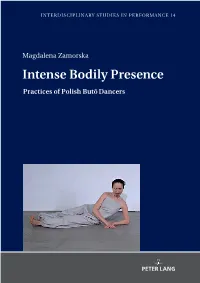
Practices of Polish Butō Dancers
Interdisciplinary Studies in Performance 14 14 Interdisciplinary Studies in Performance 14 Magdalena Zamorska Magdalena Zamorska Intense Bodily Presence The author explores the practices of Polish buto¯ dancers. Underlining the Magdalena Zamorska Magdalena transcultural potential of the genre, she discusses in particular their individual body-mind practices and so-called buto¯ techniques in order to produce a Intense Bodily Presence generalised account of buto¯ training. Her argument is underpinned by complex field research which she carried out as an expert observer and a workshop Practices of Polish Buto¯ Dancers participant. Drawing on a transdisciplinary approach, which combines insights and findings from the fields of cultural and performance studies, cultural anthropology and cognitive sciences, the book depicts the sequence of three phases which make up the processual structure of buto¯ training: intro, following and embodiment. The Author Magdalena Zamorska is a Ph.D. graduate in Humanities (2012) and an assistant professor at the Institute of Cultural Studies at the University of Wroclaw (Poland). Her research interests include movement, social choreography, issues of perception and reception in choreographic performances. She also explores the intersections of humanities and science. Intense Bodily Presence. Practices of Polish Buto¯ Dancers BodilyIntense Presence. Practices Buto¯ Polish of ISPE-14 276512_Zamorska_TL_151-214 A5HC Fusion.indd 1 08.10.18 15:10 Interdisciplinary Studies in Performance 14 14 Interdisciplinary Studies in Performance 14 Magdalena Zamorska Magdalena Zamorska Intense Bodily Presence The author explores the practices of Polish buto¯ dancers. Underlining the Magdalena Zamorska Magdalena transcultural potential of the genre, she discusses in particular their individual body-mind practices and so-called buto¯ techniques in order to produce a Intense Bodily Presence generalised account of buto¯ training. -

The Influence of Traditional Japanese Theater, Culture, and Aesthetics On
STAGE AND SCREAM: THE INFLUENCE OF TRADITIONAL JAPANESE THEATER, CULTURE, AND AESTHETICS ON JAPAN’S CINEMA OF THE FANTASTIC John E. Petty, B.M. Thesis Prepared for the Degree of MASTER OF SCIENCE UNIVERSITY OF NORTH TEXAS May 2011 APPROVED: Harry Benshoff, Major Professor George Larke-Walsh, Committee Member Timothy Wilson, Committee Member William M. Tsutsui, Committee Member C. Melinda Levin, Chair of the Department of Radio, Television and Film James D. Meernik, Acting Dean of the Toulouse Graduate School Petty, John E. Stage and Scream: The Influence of Traditional Japanese Theater, Culture, and Aesthetics on Japan’s Cinema of the Fantastic. Master of Science (Radio, Television and Film), May 2011, 189 pp., 42 illustrations, bibliography, 98 titles. Although widely viewed in the West, Japanese films are often misunderstood, as they are built on cultural, theatrical, and aesthetic traditions entirely foreign to Western audiences. Particularly in regards to Japan’s “fantastic” cinema – including giant monster pictures, ghost stories, and “J-Horror” films – what is often perceived as “cheap” or “cheesy” is merely an expression of these unique cultural roots. By observing and exploring such cultural artifacts as kabuki, noh, and bunraku – the traditional theatrical forms of Japan – long-standing literary traditions, deeply embedded philosophical beliefs, and even more recent developments such as the controversial dance form butoh, these films, including Gojira (1954), Daimajin (1966), Kwaidan (1964), Onibaba (1964), Testuo the Iron Man (1989), and Ju-On (2002), can be placed in their proper perspective, leading to a reevaluation of their worth not merely as commercial products, but as uniquely Japanese expressions of that society’s unique place in world culture.