Alchemy, Ritual, and the Simulacrum“ Text in Alchemic Polyptych Book
Total Page:16
File Type:pdf, Size:1020Kb
Load more
Recommended publications
-

The Word Made Visible in the Painted Image
The Word made Visible in the Painted Image The Word made Visible in the Painted Image: Perspective, Proportion, Witness and Threshold in Italian Renaissance Painting By Stephen Miller The Word made Visible in the Painted Image: Perspective, Proportion, Witness and Threshold in Italian Renaissance Painting By Stephen Miller This book first published 2016 Cambridge Scholars Publishing Lady Stephenson Library, Newcastle upon Tyne, NE6 2PA, UK British Library Cataloguing in Publication Data A catalogue record for this book is available from the British Library Copyright © 2016 by Stephen Miller All rights for this book reserved. No part of this book may be reproduced, stored in a retrieval system, or transmitted, in any form or by any means, electronic, mechanical, photocopying, recording or otherwise, without the prior permission of the copyright owner. ISBN (10): 1-4438-8542-8 ISBN (13): 978-1-4438-8542-3 For Paula, Lucy and Eddie CONTENTS List of Illustrations ..................................................................................... ix Acknowledgements .................................................................................... xi Introduction ................................................................................................. 1 Chapter One ................................................................................................. 3 Setting the Scene The Rise of Humanism and the Italian Renaissance Changing Style and Attitudes of Patronage in a Devotional Context The Emergence of the Altarpiece in -
Observing Protest from a Place
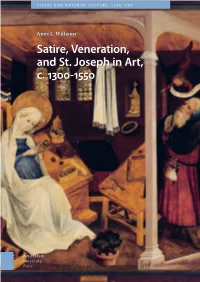
VISUAL AND MATERIAL CULTURE, 1300-1700 Williams Anne L. Williams Satire, Veneration, and St. Joseph in Art, c. 1300-1550 Satire, Veneration, and St. Joseph in Art, in c. 1300-1550 Joseph St. and Veneration, Satire, FOR PRIVATE AND NON-COMMERCIAL USE AMSTERDAM UNIVERSITY PRESS Satire, Veneration, and St. Joseph in Art, c. 1300–1550 FOR PRIVATE AND NON-COMMERCIAL USE AMSTERDAM UNIVERSITY PRESS Visual and Material Culture, 1300–1700 A forum for innovative research on the role of images and objects in the late medieval and early modern periods, Visual and Material Culture, 1300–1700 publishes monographs and essay collections that combine rigorous investigation with critical inquiry to present new narratives on a wide range of topics, from traditional arts to seemingly ordinary things. Recognizing the fluidity of images, objects, and ideas, this series fosters cross-cultural as well as multi-disciplinary exploration. We consider proposals from across the spectrum of analytic approaches and methodologies. Series Editor Dr. Allison Levy, an art historian, has written and/or edited three scholarly books, and she has been the recipient of numerous grants and awards, from the Nation- al Endowment for the Humanities, the American Association of University Wom- en, the Getty Research Institute, the Dumbarton Oaks Research Library of Harvard University, the Whiting Foundation and the Bogliasco Foundation, among others. www.allisonlevy.com. FOR PRIVATE AND NON-COMMERCIAL USE AMSTERDAM UNIVERSITY PRESS Satire, Veneration, and St. Joseph in Art, c. 1300–1550 Anne L. Williams Amsterdam University Press FOR PRIVATE AND NON-COMMERCIAL USE AMSTERDAM UNIVERSITY PRESS This book was published with support from the Kress Foundation and the International Center of Medieval Art, the Historians of Netherlandish Art, and the College of William & Mary. -
EMESE SARKADI Budapest, Hungary Budapest, Dr
Central European University Produced for Transylvania - Local Workshops and Foreign Connections. - Studies of Late Medieval Altarpieces in Transylvania - PhD dissertation in Medieval Studies by EMESE SARKADI Dissertation Supervisors: Dr. Imre Takács Dr. Marcell SebĘk CEU eTD Collection Budapest, Hungary 2008 I, the undersigned Emese Sarkadi, candidate for the PhD degree in Medieval Studies declare herewith that the present dissertation is exclusively my own work, based on my research and relies only on such external information as properly credited in notes and bibliography. I declare that no unidentified and illegitimate use was made of the work of others, and no part of the dissertation infringes on any person’s or institution’s copyright. I also declare that no part of the dissertation has been submitted in this form to any other institution of higher education for an academic degree. Budapest, February 6, 2008 ___________________________ signature CEU eTD Collection TABLE OF CONTENTS FOREWORD.................................................................................................................................................. 4 THE HISTORY OF INTEREST IN TRANSYLVANIAN ALTARPIECES................................................. 6 PREVIOUS SCHOLARSHIP ............................................................................................................................... 6 RESTORATIONS. THE WORKSHOP OF GISELA RICHTER IN KRONSTADT........................................................... 15 HISTORICAL BACKGROUND AND -

Jan Van Scorel's Crucifixion for the Oude Kerk, Amsterdam: the “Finest
Volume 12, Issue 2 (Summer 2020) Jan van Scorel’s Crucifixion for the Oude Kerk, Amsterdam: The “finest painting in all of the regions of Flanders” Molly Faries, Henri Defoer faries@indiana.edu, Henri.Defoer@inter.NL.net Recommended Citation: Molly Faries, Henri Defoer, “Jan van Scorel’s Crucifixion for the Oude Kerk, Amsterdam: The “finest painting in all of the regions of Flanders”,” Journal of Historians of Netherlandish Art 12:2 (Summer 2020) DOI: 10.5092/jhna.12.2.1 Available at https://jhna.org/articles/jan-van-scorels-crucifixion Published by Historians of Netherlandish Art: https://hnanews.org/ Republication Guidelines: https://jhna.org/republication-guidelines/ Notes: This PDF is provided for reference purposes only and may not contain all the functionality or features of the original, online publication. This PDF provides paragraph numbers as well as page numbers for citation purposes. ISSN: 1949-9833 Jan van Scorel’s Crucifixion for the Oude Kerk, Amsterdam: The “finest painting in all of the regions of Flanders” Molly Faries, Henri Defoer This essay identifies one of Jan van Scorel’s most important, lost works—the Crucifixion for the high altar of the Oude Kerk, Amsterdam—by evaluating the evidence provided by workshop replicas, later copies, and other works influenced by the original painting. The questions surrounding the prestigious Oude Kerk commission play out in the context of Scorel’s reestablishment in the northern Netherlands after his return from Italy in 1524 and the responses by Scorel’s contemporaries such as Maarten van Heemskerck to his new Italianate style. 1 Jan van Scorel’s Crucifixion for the high altar of the Oude Kerk in Amsterdam is one of the paintings that Karel van Mander lamented was lost during the Iconoclasm in 1566, along with others in Utrecht, Gouda, and elsewhere.1 The sense of loss is made all the more palpable when one considers how the Oude Kerk painting was appreciated by those who had the chance to see it before it was destroyed. -

Die Ungefaßten Altarwerke Des Ausgehenden Mittelalters Und Der Dürerzeit
DIE UNGEFAßTEN ALTARWERKE DES AUSGEHENDEN MITTELALTERS UND DER DÜRERZEIT vorgelegt von Georg Habenicht aus Göttingen an der Philosophischen Fakultät der Georg-August-Universität Göttingen Erstgutachter: Prof. Dr. Karl Arndt Zweitgutachter: Prof. Dr. Antje Middeldorf Tag der münchlichen Prüfung: 06.12.1999 - 2 - INHALT VORWORT 3 EINLEITUNG 4 DIE HISTORISCH ARGUMENTIERENDE RICHTUNG 9 DIE ÄSTHETISCH ARGUMENTIERENDE RICHTUNG 21 Lasierende Oberflächentönung 21 Lichtführung 27 Exkurs: Der Moosburger Hochaltar 33 Schnitzerische Oberflächendifferenzeirung 41 DENKBARE AUSLÖSER FÜR EINEN GESCHMACKSWANDEL 47 GEFAßTE UND UNGEFAßTE HOLZSKULPTUR IM VERGLEICH 58 Gefaßte und ungefaßte Darstellung der Leiden Christi 70 DIE PRAKTISCHE REALISIERUNG VON ALTARRETABELN 75 DIE BEAUFTRAGUNG EINES GESAMT- BZW. GENERALUNTERNEHMERS 77 DIE SEPARATE BEAUFTRAGUNG VERSCHIEDENER INDIVIDUALUNTERNEHMER 84 Die gemeinsame Abwicklung des Schreiner- und Schnitzauftrags durch einen Bildschnitzer 96 Die gesonderte Fertigung der Retabelarchitektur durch einen Schreiner 114 Die Abwicklung des Faß- und Malauftrags durch einen Maler 116 DIE FINANZIERUNG EINES ALTARRETABELS 129 Das Kefermarkter Hochaltarretabel 139 Das Windsheimer Zwölf-Boten-Retabel 140 Das Windsheimer Hochaltarretabel 141 Die Kollektivstiftung 143 DER LITURGISCHE GEBRAUCH DES FLÜGELRETABELS 150 DIE AUSWIRKUNGEN DER REFORMATION AUF DIE RETABELPRODUKTION 160 Der Kalkarer Hochaltar 175 Der Bordesholmer Altar 177 DIE ENTWICKLUNG HIN ZUM UNGEFAßTEN ALTARRETABEL 183 Das St. Galler Hochaltarretabel 187 Das Ulmer Hochaltarretabel -

OE Med17 3A R20 Film.Indd
THE ALTAR AND ITS DECORATIONS IN MEDIEVAL CHURCHES. A FUNCTIONALIST APPROACH Justin E. A. Kroesen University of Groningen j.e.a.kroesen@rug.nl Abstract It is the aim of this article to problematize the concept of the medieval altarpiece or retable. If handbook defi nitions of a formal nature are followed, many confi g- urations which actually occur in medieval churches remain overlooked. In order to understand the pluriformity of medieval altar decorations, a functional defi ni- tion seems more helpful, such as ‘any object or depiction on top of or behind the altar that forms a backdrop to liturgical activity on and around the altar’. Altars were sometimes equipped with objects which could adopt the function of an al- tarpiece, including reliquaries and saints’ sculptures, while others were provided with painted or sculptured backdrops which often blend in with the architecture of the building. In addition, many medieval altar decorations display a funda- mentally composite character, with clear distinctions between formal categories such as frontals, altar sculptures, panel retables, tabernacles and shrines being diffi cult to maintain. To gain a better insight into the true variety of medieval altar decorations, special attention should be paid to side altars. Re-evaluating these fi xtures as a basic element of the medieval church interior enables us to form a more realistic picture of the variety of medieval altar furnishings and to better understand the original context of the many loose objects we now admire in churches and museums. Keywords Medieval liturgy, retable, altarpiece, tabernacle, sculpture, painting. Resumen El afán de este artículo es problematizar el concepto del retablo medieval.