Schau Lust Niederländische Zeichenkunst Des 18
Total Page:16
File Type:pdf, Size:1020Kb
Load more
Recommended publications
-

The Drawings of Cornelis Visscher (1628/9-1658) John Charleton
The Drawings of Cornelis Visscher (1628/9-1658) John Charleton Hawley III Jamaica Plain, MA M.A., History of Art, Institute of Fine Arts – New York University, 2010 B.A., Art History and History, College of William and Mary, 2008 A Dissertation presented to the Graduate Faculty of the University of Virginia in Candidacy for the Degree of Doctor of Philosophy Department of Art and Architectural History University of Virginia May, 2015 _______________________________________ _______________________________________ _______________________________________ _______________________________________ Table of Contents Abstract ............................................................................................................................................. i Acknowledgements.......................................................................................................................... ii Introduction ..................................................................................................................................... 1 Chapter 1: The Life of Cornelis Visscher .......................................................................................... 3 Early Life and Family .................................................................................................................... 4 Artistic Training and Guild Membership ...................................................................................... 9 Move to Amsterdam ................................................................................................................. -
Open Access Version Via Utrecht University Repository
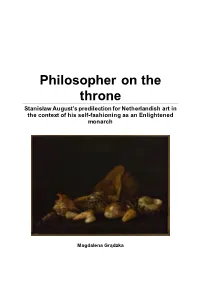
Philosopher on the throne Stanisław August’s predilection for Netherlandish art in the context of his self-fashioning as an Enlightened monarch Magdalena Grądzka Philosopher on the throne Magdalena Grądzka Philosopher on the throne Stanisław August’s predilection for Netherlandish art in the context of his self-fashioning as an Enlightened monarch Magdalena Grądzka 3930424 March 2018 Master Thesis Art History of the Low Countries in its European Context University of Utrecht Prof. dr. M.A. Weststeijn Prof. dr. E. Manikowska 1 Philosopher on the throne Magdalena Grądzka Index Introduction p. 4 Historiography and research motivation p. 4 Theoretical framework p. 12 Research question p. 15 Chapters summary and methodology p. 15 1. The collection of Stanisław August 1.1. Introduction p. 18 1.1.1. Catalogues p. 19 1.1.2. Residences p. 22 1.2. Netherlandish painting in the collection in general p. 26 1.2.1. General remarks p. 26 1.2.2. Genres p. 28 1.2.3. Netherlandish painting in the collection per stylistic schools p. 30 1.2.3.1. The circle of Rubens and Van Dyck p. 30 1.2.3.2. The circle of Rembrandt p. 33 1.2.3.3. Italianate landscapists p. 41 1.2.3.4. Fijnschilders p. 44 1.2.3.5. Other Netherlandish artists p. 47 1.3. Other painting schools in the collection p. 52 1.3.1. Paintings by court painters in Warsaw p. 52 1.3.2. Italian paintings p. 53 1.3.3. French paintings p. 54 1.3.4. German paintings p. -

Mededelingen Van De Stichting Jacob Campo Weyerman. Jaargang 12
Mededelingen van de Stichting Jacob Campo Weyerman. Jaargang 12 bron Mededelingen van de Stichting Jacob Campo Weyerman. Jaargang 12. Uitgeverij Sub Rosa, Deventer 1989 Zie voor verantwoording: http://www.dbnl.org/tekst/_med009198901_01/colofon.php © 2012 dbnl i.s.m. 1 Jacob Campo Weyerman und Johan van Gool* L. de Vries Das literarische Genre der Künstlerviten ist in den Niederlanden nur wenig geübt worden. Bekanntlich war Carel van Mander der erste, der eine chronologisch geordnete Reihe von Biographien nach dem Muster Vasaris publizierte. Der zweite war Cornelis de Bie, dessen mit Biographien erweiterte Porträtsammlung einem anderen Muster folgte. Van Mander fand seinen wirklichen Nachfolger erst nach mehr als hundert Jahre, in dem viel weniger begabten Arnold Houbraken. Houbraken hat den geplanten vierten Band seines Buches nicht mehr vollenden können; seine unmittelbare Zeitgenossen hat er dadurch nicht mehr besprochen. Houbraken hatte sogar zwei Nachfolger; von diesen beiden wird hier weiter die Rede sein. Der erste war Jacob Campo Weyerman. Drei Bände seines Buches erschienen in dem Jahre 1729; der vierte erst 1769. In der Zwischenzeit hatte Johan van Gool sein Buch veröffentlicht; einen ersten Band in 1750 und einen zweiten in '51. Damit wurde er der letzte Vasari-Nachfolger in den Niederlanden. Die gedruckten Quellen zur niederländischen Kunstgeschichte sind nicht unbeachtet geblieben. Dennoch gibt es gute Grunde, Houbraken, Weyerman und Van Gool in Zusammenhang mit neuen Entwicklungen in der niederländischen Kunstgeschichtschreibung zu studieren. Die Entwicklung, die hier gemeint ist, ist die kürzlich stark gesteigerte Aufmerksamkeit für die holländische Malerei des späten 17. Jahrhunderts. Gerade für die Künstler dieser Zeit, die bis jetzt sehr wenig studiert worden sind, besitzen wir drei sich ergänzende Quellen - drei Biographiensammlungen die von Augenzeugen verfaßt worden sind. -
Lorentz – Function Follows Form and Theory Leads to Experiment
Cover Page The handle http://hdl.handle.net/1887/22522 holds various files of this Leiden University dissertation. Author: Weiss, Martin Paul Michael Title: The masses and the muses : a history of Teylers Museum in the Nineteenth Century Issue Date: 2013-11-27 The Masses and the Muses A History of Teylers Museum in the Nineteenth Century Front cover: The Oval Room, drawing by Johan Conrad Greive, 1862 (Teylers Museum, Haarlem, DD042b) Back cover: The First Art Gallery, drawing by Johan Conrad Greive, 1862 (Teylers Museum, Haarlem, DD042d) The Masses and the Muses A History of Teylers Museum in the Nineteenth Century Proefschrift ter verkrijging van de graad van Doctor aan de Universiteit Leiden, op gezag van de Rector Magnificus prof. mr. C.J.J.M. Stolker, volgens besluit van het College voor Promoties te verdedigen op woensdag 27 november 2013 klokke 15.00 uur door Martin Paul Michael Weiss geboren te Hannover in 1985 Promotiecommissie Prof. Dr. F.H. van Lunteren (promotor, Universiteit Leiden) Prof. Dr. D. van Delft (Universiteit Leiden) Prof. Dr. P.J. ter Keurs (Universiteit Leiden) Dr. D.J. Meijers (Universiteit van Amsterdam) Prof. dr. W.W. Mijnhardt (Universiteit Utrecht) Prof. Dr. H.J.A. Röttgering (Universiteit Leiden) Prof. Dr. L.T.G. Theunissen (Universiteit Utrecht) Dr. H.J. Zuidervaart (Huygens Instituut voor Nederlandse Geschiedenis) Prof. Dr. R. Zwijnenberg (Universiteit Leiden) Acknowledgements This PhD was not written in isolation. Throughout the course of this project I received an unquantifiable amount of support – intellectual, financial and moral – from innumerable colleagues and friends. Some of them I hope to be able to acknowledge here. -
Cover Page the Handle
Cover Page The handle http://hdl.handle.net/1887/22522 holds various files of this Leiden University dissertation. Author: Weiss, Martin Paul Michael Title: The masses and the muses : a history of Teylers Museum in the Nineteenth Century Issue Date: 2013-11-27 Chapter II: The Birth of a Musaeum I The Museum’s Pre-History 1. Martinus van Marum & the Beginning of the Age of Museums In a letter to the Dutch minister of the interior Anton Reinhard Falck posted in July 1819, the ornithologist and collector Coenraad Jacob Temminck left no doubt as to what he thought two of his colleagues really wanted to do to him, if the opportunity ever presented itself: “Both”, he wrote, “would stop at nothing to clear me out of the way”.1 He was referring to Sebald Justinus Brugmans, professor of botany and director of the botanical gardens in Leiden, and Martinus van Marum, the director of Teylers Museum and secretary of the Holland Society of Sciences in Haarlem. This was more than just a letter of complaint. Temminck himself was no angel, and at the time was in fact pursuing his own political agenda. He had dined with Falck just a few days earlier, and the two men had discussed the establishment of a national museum of natural history in the Netherlands – of which Temminck was to be handed the directorship. Just 13 months later, Temminck’s highly valuable and widely recognised personal ornithological collection, consisting of more than 4000 stuffed birds, had indeed been merged with both the University of Leiden’s natural history collections and the former Royal Cabinet of Natural History in Amsterdam, to form the new National Museum of Natural History (Rijksmuseum van Natuurlijke Historie) based in Leiden. -

Tischbein Und Die Kunst Des "Goldenen Zeitalters"
Tischbein Zeitalters‘ des ‚Goldenen und die Kunst Tischbein und die Kunst des ‚Goldenen Zeitalters‘ Rezeptionsgeschichte(n) um 1800 Stefanie Rehm Tischbein und die Kunst des ‚Goldenen Zeitalters‘ Stefanie Rehm Tischbein und die Kunst des ‚Goldenen Zeitalters‘ Rezeptionsgeschichte(n) um 1800 Diese Publikation wurde als Dissertation mit dem Titel Bildwissen, Verbreitung und Rezeption der Kunst des Goldenen Zeitalters um 1800 am Beispiel der Niederlande-Reise von J. H. W. Tisch- bein von Stefanie Rehm an der Kunsthochschule Kassel der Universität Kassel zur Erlangung des akademischen Grades der Doktorin der Philosophie (Dr. phil.) eingereicht und am 04.07.2019 verteidigt. Der Text wurde für die Publikation leicht überarbeitet. Bibliografische Information der Deutschen Nationalbibliothek Die Deutsche Nationalbibliothek verzeichnet diese Publikation in der Deutschen National bibliografie; detaillierte bibliografische Daten sind im Internet über http://dnb.dnb.de abrufbar. Dieses Werk ist durch das Urheberrecht und/oder verwandte Schutzrechte geschützt, aber kostenlos zugänglich. Die Nutzung, insbesondere die Vervielfältigung, ist nur innerhalb der gesetzlichen Schranken des Urheber rechts oder mit Zustimmung des Urhebers gestattet. Publiziert bei arthistoricum.net, Universitätsbibliothek Heidelberg 2020. Die OnlineVersion dieser Publikation ist auf https://www.arthistoricum.net dauerhaft frei verfügbar (Open Access). urn: urn:nbn:de:bsz:16ahnartbook6191 doi: https://doi.org/10.11588/arthistoricum.619 Text © 2020, Stefanie Rehm Korrektorat: -

Michael Sweerts (1618-1664) and the Academic Tradition
ABSTRACT Title of Document: MICHAEL SWEERTS (1618-1664) AND THE ACADEMIC TRADITION Lara Rebecca Yeager-Crasselt, Doctor of Philosophy, 2013 Directed By: Professor Arthur K. Wheelock, Jr., Department of Art History and Archaeology This dissertation examines the career of Flemish artist Michael Sweerts (1618-1664) in Brussels and Rome, and his place in the development of an academic tradition in the Netherlands in the seventeenth century. Sweerts demonstrated a deep interest in artistic practice, theory and pedagogy over the course of his career, which found remarkable expression in a number of paintings that represent artists learning and practicing their profession. In studios and local neighborhoods, Sweerts depicts artists drawing or painting after antique sculpture and live models, reflecting the coalescence of Northern and Southern attitudes towards the education of artists and the function and meaning of the early modern academy. By shifting the emphasis on Sweerts away from the Bamboccianti – the contemporary group of Dutch and Flemish genre painters who depicted Rome’s everyday subject matter – to a different set of artistic traditions, this dissertation is able to approach the artist from new contextual and theoretical perspectives. It firmly situates Sweerts within the artistic and intellectual contexts of his native Brussels, examining the classicistic traditions and tapestry industry that he encountered as a young, aspiring artist. It positions him and his work in relation to the Italian academic culture he experienced in Rome, as well as investigating his engagement with the work of the Flemish sculptor François Duquesnoy (1597-1643) and the French painter Nicholas Poussin (1594-1665). The breadth of Sweerts’ artistic and academic pursuits ultimately provide significant insight into the ways in which the Netherlandish artistic traditions of naturalism and working from life coalesced with the theoretical and practical aims of the academy. -

Haarlem Viert Cultuur; Een Gezamenlijk Project Van Gemeente Haarlem, Haarlem Marketing, Teylers Museum, Frans Hals Museum, Stadsschouwburg Haarlem En Toneelschuur
Haarlem, cultuur stad van alle tijden Haarlem, cultuur stad van alle tijden Lieuwe Zoodsma, gemeentearchivaris en directeur Noord-Hollands Archief 2018, Haarlem Marketing Die Patriarchen gaven die vier sterren, Omdat si ghecomen waren van verren, Twie onder ende twie boven. Mit rechte is dese wapen te loven. Dat die van Haerlem dit hebben ghecreghen Opten Heiden mit so groten deghen, Ic dorst wel segghen int openbaere Dat die van Haerlem eendrachtich waren. So en wist ic ghien stat teghen Haerlem te prisen, Want het dunct mij sijn een half paradise. Uit: Lofdicht op Haarlem, Dirc Mathijszen, circa 1483 5 Het Haarlemse stadsbestuur was inventief en bedreef stadspromotie avant la lettre. Haarlem, cultuurstad van alle tijden wapenfeiten en de stad onder de aandacht te brengen. Dit gold Wat is dat toch met Haarlem? Dat deze stad al vanaf de zelfs voor daden en gebeurtenissen waar Haarlemmers part noch middeleeuwen op het gebied van kunst en cultuur voortdurend deel aan hadden, maar wel de eer en roem voor opeisten. Denk een rol van betekenis speelt? Op bepaalde terreinen eist de hierbij aan de inname van Damiate in 1218 en de uitvinding van stad, niet gehinderd door de handels- en cultuurmetropool de boekdrukkunst door Lourens Janszoon Coster in de 15e eeuw, Amsterdam in haar directe omgeving, zelfs een hoofdrol voor onder meer te zien in de Sint-Janskerk in Gouda. zich op. Wat is dat toch met de stad aan het Spaarne? Lieuwe Zoodsma geeft in dit essay antwoord. De gemeentearchivaris Rederijkers promoten Haarlem met betoogt dat - gestaafd door historische feiten, kunst- en bouw- kunst en cultuur werken, proza en poëzie, film en muziek - Haarlem een cultuur- Dat er wat te promoten viel aan Haarlem als culturele Hollandse stad van alle tijden is. -

165 LYCKLE DE VRIES Jan Van Gool Als Geschiedschrijver De Lezer, Die
165 LYCKLE DE VRIES Jan van Gool als geschiedschrijver De lezer, die vertrouwd is met Arnold Houbrakens Groote Schouburgh, zal in de Nieuwe Schouburg van Jan van Gool weini? verrassends vinden. Zo heeft de auteur het ook bcdoeld; zijn werk zet dat van zijn voorganger voort en de latere bundel kunstenaarsbiografieen sluit als met een zwaluwstaartconstructie op de onvoltooid gcblcven eerdere aan. Het in 1750 en ',5 1 verschenen tweedelige boek, dat Van Gool heel wat meer bekendheid heeft gebracht dan zijn werk als vecschilder, bcvat vooral feitelijke informatie. Bovendien geeft de schilder- schrijver soms persoonlijke opinies en laat hij merken, van welke tijd en samen- lcving hij ccn zcgsman is geweest. Wie deze soort van informatie wil opvangen moct met allcen wcl ecus wat tussen de regels kunnen lezen, maar moet ook wctcn hoc en met welk doel de Nieuwe Schouburg is opgezet. Oveizi<.kt Het boek opent met een titelprent van P. Tanje naar L.. F. Dubour?, die in een vers van A. Kuipcrs wordt uitgele?d. Na titelpagina en privilege volgt de opdracht van deel i aan de verzamelaar Johan van der Marck, hoo?d-omcier van Leiden. Twee kunstcnaars-vrienden van de auteur, J. Wandelaar en F. Greenwood, hebben lofdichten op zijn boek bijgedragen. Het portret van Van Gool, door J. Houhraken naar ccn tckening van A. Schouman gegraveerd, sluit het voorwerk af. In de eerste vijftien bladzijden van deel 1 zet Van Gool uiteen wat hij wil gaan docn en hoe zijn relatie is tot Houbraken en Weyerman. Hierna begint de lange reeks levensbeschrijvingen van kunstenaars, geordend naar gcboortejaar en lopend van circa i 58o tot en met 1725. -

Encyklopédia Kresťanského Umenia
Marie Žúborová - Němcová: Encyklopédia kresťanského umenia Holanďan bludný - Bludný Holanďan holandská architektúra - http://nl.wikipedia.org/wiki/Categorie:Architectuur_in_Nederland http://en.wikipedia.org/wiki/Category:Dutch_architecture holandská bieloba - bieloba holandská/bieloba kremžská holandská história - http://nl.wikipedia.org/wiki/Categorie:Geschiedenis_van_Nederland holandská história podľa obdobia - http://en.wikipedia.org/wiki/Category:History_of_the_Netherlands_by_period http://nl.wikipedia.org/wiki/Categorie:Geschiedenis_van_Nederland_naar_periode holandská renesancia - (1500-1584); http://en.wikipedia.org/wiki/Category:Dutch_Renaissance holandská škola (maľby) - maliari v Holandsku od ranej renesancie do baroka; to zahŕňa rané obdobie holandského maliarstva (pozri holandskí maliari raní, flámski primitívi), ktoré spadá do obdobia 1400-1500, a holandskú renesanciu (1500-1584), čo boli umelci činní v severných nížinách, a neskôr do holandskej školy bol zaraďovaný aj holandský zlatý vek maľby (pozri holandskí maliari zlatého veku), čo bola maľba v zjednotených provinciách; mnoho maliarov, sochárov a architektov zo 17.st. je nazývaných „holandskí majstri“, zatiaľ čo skorší umelci sú všeobecne označovaní ako súčasť „holandskej“ tradície; Hieronymus Bosch a Geertgena tot Sint Jans sú dobre známe príklady holandských maliarov 15. a 16.st.; Rembrandt van Rijn, Frans Hals, Johannes Vermeer, Jacob van Ruisdael a Jan Steen zastupujú holandské umenie 17.st.; individuálne diela, ktorých umelca nemožno zistiť, sú označované alebo -

Mededelingen Van De Stichting Jacob Campo Weyerman. Jaargang 2
Mededelingen van de Stichting Jacob Campo Weyerman. Jaargang 2 bron Mededelingen van de Stichting Jacob Campo Weyerman. Jaargang 2. Stichting Jacob Campo Weyerman, Amsterdam 1979 Zie voor verantwoording: http://www.dbnl.org/tekst/_med009197901_01/colofon.php © 2011 dbnl i.s.m. 108 [Nummer 11] Agenda voor de algemene vergadering van 13 januari 1979 te 10.00 uur in de Grote Vergaderzaal van het Instituut voor Neerlandistiek, Herengracht 330-336, Amsterdam 1. Opening 2. Mededelingen 3. Lezing Rotterdamsche Hermes no. 4 4. Verslagen voorzitter sekretaris penningmeester 5. Vaststelling jaarlijkse bijdrage* 6. JCW-literatuur verschenen in 1978 7. JCW-publikaties in 1979 8. Voorstel nieuwe leden 9. Observaties bestuursleden 10. Lezing door B.P.J. Broos: JCW als informant over schilders 11. Wisseling bestuur** 12. Rondvraag 13. Sluiting. * Het bestuur stelt voor de bijdragen ongewijzigd te laten (op het ogenblik: leden f 25, --; vrienden f 20, --; studenten f 10, --). ** Voorgesteld worden als leden voor het nieuwe bestuur: H.M. de Blauw (vz.), A.J. Hanou (sekr.), mevr. B. Sierman (penn.), mevr. A. Nieuweboer (sekr. publ.). Mededelingen van de Stichting Jacob Campo Weyerman. Jaargang 2 109 Geraldine Maréchal (Rode Kruislaan 993, 1111 ZX Diemen) JCW in British Museum British Museum General Catalogue of Printed Books. Photolithographic edition to 1955. Published by the trustees of the British Museum. London 1965. - Volume 256: WEYERMAN (Jacob Campo). - (See Cervantes Saavedra (M. de) [Don Quichot. - Appx. 7]) De voornaamste gevallen van... Don Quichot... Beschreeven door J.C.W., etc. 1746. 4o. 1. Pictorial Illustrations. - (See Democritus, the Philosopher, pseud. Democritus en Heraclitus Brabantsche Voyage. Bezweering van den desperaten Antwerpschen Courantier. -

Proquest Dissertations
NOTE TO USERS This reproduction is the best copy available. ® UMI I "Beschildert met een Glans": Willem van Aelst and Artistic Self-Consciousness in Seventeenth-Century Dutch Still Life Painting Tanya Paul Falmouth, MA B.A. University of Massachusetts, Amherst, 1998 M.A. University of Virginia, 2002 A Dissertation presented to the Graduate Faculty of the University of Virginia in Candidacy for the Degree of Doctor of Philosophy Department of Art History University of Virginia May, 2008 UMI Number: 3312159 Copyright 2008 by Paul, Tanya All rights reserved. INFORMATION TO USERS The quality of this reproduction is dependent upon the quality of the copy submitted. Broken or indistinct print, colored or poor quality illustrations and photographs, print bleed-through, substandard margins, and improper alignment can adversely affect reproduction. In the unlikely event that the author did not send a complete manuscript and there are missing pages, these will be noted. Also, if unauthorized copyright material had to be removed, a note will indicate the deletion. ® UMI UMI Microform 3312159 Copyright 2008 by ProQuest LLC. All rights reserved. This microform edition is protected against unauthorized copying under Title 17, United States Code. ProQuest LLC 789 E. Eisenhower Parkway PO Box 1346 Ann Arbor, Ml 48106-1346 © Copyright by Tanya Paul All Rights Reserved May 2008 Volume I Ill Abstract: In his 1718 biography of the still life painter Willem van Aelst (1627-1683), Arnold Houbraken describes the artist's grand disposition and his great pride. It is this somewhat biased biography which begins to intimate the nature not only of van Aelst's personality, but also of his work.