Wolverhampton City Council OPEN EXECUTIVE DECISION ITEM (AMBER)
Total Page:16
File Type:pdf, Size:1020Kb
Load more
Recommended publications
-

Secondaryschoolspendinganaly
www.tutor2u.net Analysis of Resources Spend by School Total Spending Per Pupil Learning Learning ICT Learning Resources (not ICT Learning Resources (not School Resources ICT) Total Resources ICT) Total Pupils (FTE) £000 £000 £000 £/pupil £/pupil £/pupil 000 Swanlea School 651 482 1,133 £599.2 £443.9 £1,043.1 1,086 Staunton Community Sports College 234 192 426 £478.3 £393.6 £871.9 489 The Skinners' Company's School for Girls 143 324 468 £465.0 £1,053.5 £1,518.6 308 The Charter School 482 462 944 £444.6 £425.6 £870.2 1,085 PEMBEC High School 135 341 476 £441.8 £1,117.6 £1,559.4 305 Cumberland School 578 611 1,189 £430.9 £455.1 £885.9 1,342 St John Bosco Arts College 434 230 664 £420.0 £222.2 £642.2 1,034 Deansfield Community School, Specialists In Media Arts 258 430 688 £395.9 £660.4 £1,056.4 651 South Shields Community School 285 253 538 £361.9 £321.7 £683.6 787 Babington Community Technology College 268 290 558 £350.2 £378.9 £729.1 765 Queensbridge School 225 225 450 £344.3 £343.9 £688.2 654 Pent Valley Technology College 452 285 737 £339.2 £214.1 £553.3 1,332 Kemnal Technology College 366 110 477 £330.4 £99.6 £430.0 1,109 The Maplesden Noakes School 337 173 510 £326.5 £167.8 £494.3 1,032 The Folkestone School for Girls 325 309 635 £310.9 £295.4 £606.3 1,047 Abbot Beyne School 260 134 394 £305.9 £157.6 £463.6 851 South Bromsgrove Community High School 403 245 649 £303.8 £184.9 £488.8 1,327 George Green's School 338 757 1,096 £299.7 £670.7 £970.4 1,129 King Edward VI Camp Hill School for Boys 211 309 520 £297.0 £435.7 £732.7 709 Joseph -

Black Country Secondary Schools, Published in 2008, 2009 and 2010, Were Well Received
Contents Introduction 3 Using the Families of Schools document 7 Black Country in context 11 Family pages 16 Contextual family pages 34 Annex 1 – What it all means: footnotes and explanations 39 Annex 2 – School contact details 45 2 Introduction 1. Families of Schools: the fourth edition The first three editions of Families of Schools for Black Country Secondary schools, published in 2008, 2009 and 2010, were well received. We have been working with schools and education professionals across the Black Country to develop this fourth edition for 2011. As with previous years, this edition includes GCSE results with and without English and maths, a Contextual Value Added (CVA) measure and contextual families focusing on English as an Additional Language (EAL) and mobility. 2. How have families been grouped? Schools are grouped into families based on an average of prior attainment data and context data. Prior attainment data is the Average Key Stage 2 (KS2) Point Score (APS) for all pupils in Year 7 to Year 11 matched to Key Stage 4 data. Context data includes: • Income Deprivation Affecting Children Index (IDACI) data, calculated by linking individual pupil postcodes to IDACI data and compiling an average figure for each school1. • The proportion of pupils eligible to receive Free School Meals (FSM). • The IDACI and FSM school averages are combined to give an overall indicator for the School Environment (SE). • The percentage of pupils whose first language is known or believed to be other than English (EAL). • A mobility measure, defined as the percentage of pupils in Year 10 or Year 11 who have joined the school within the last 2 years (L2Y). -

Impact of Building Schools for the Future Announcement of Monday 5 July 2010
Impact of Building Schools for the Future announcement of Monday 5 July 2010 1. This list sets out the impact on schools of the announcement on Building Schools for the Future (BSF) made by the Secretary of State for Education on Monday 5 July 2010. It has been produced by Partnerships for Schools (PfS) after validation at senior level in Local Authorities and rigorously checked by the Department for Education, including by making telephone contact with every Local Authority listed and with all affected Academy sponsors. 2. This process of checking has been necessary because of the complexity of the BSF process, to ensure the accuracy of this list and, in particular, because, to date, PfS has collected data from Local Authorities about BSF schools as they progressed. Rather than micromanaging individual schools, PfS has relied on Local Authority-level information. 3. All Local Authorities which were participating in BSF are listed, plus those who have had one school pathfinders or academies built or being built through the Partnerships for Schools Academies Framework. That is 102 Local Authorities out of a total of 152. And every school which was included within a Local Authority project is listed and is categorised as either ‘open’, ‘unaffected’, ‘for discussion’ or ‘stopped’. 1592 schools are listed in total. 159 are categorised as ‘open’, 547 as ‘unaffected’, 151 as ‘for discussion’ and 735 as ‘stopped’. 4. For simplicity, and because large numbers of pupils cross constituency boundaries to attend school, this list does not provide a breakdown of schools by constituency. 5. There are many examples of Local Authorities in this list having schools in more than one of these categories. -
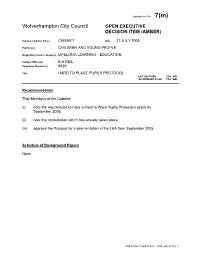
Hard to Place Pupils Protocol Key Decision Yes / No in Forward Plan Yes / No
Agenda Item No: 7(m) Wolverhampton City Council OPEN EXECUTIVE DECISION ITEM (AMBER) Cabinet / Cabinet Panel CABINET Date 27 JULY 2005 Portfolio(s) CHILDREN AND YOUNG PEOPLE Originating Service Group(s) LIFELONG LEARNING - EDUCATION Contact Officer(s) B A KEIL Telephone Number(s) 5925 Title HARD TO PLACE PUPILS PROTOCOL KEY DECISION YES / NO IN FORWARD PLAN YES / NO Recommendation That Members of the Cabinet: (i) note the requirement to have a Hard to Place Pupils Protocol in place by September 2005; (ii) note the consultation which has already taken place; (iii) approve the Protocol for implementation in the LEA from September 2005. Schedule of Background Papers None Hard to Place Pupil Protcol – Draft [July 04 05] 1 HARD TO PLACE PUPIL PROTOCOL (DRAFT) 1.0 Background 1.1 The DfES issued the Circular, Guidance on Hard To Place Pupils (LEA/0316/2004) in November 2004 requiring two areas for action. These were: i) that the local Admissions Forum develop a protocol on the admission of hard to place pupils; ii) that work be undertaken on delegating or devolving funding to groups of schools to enable them to take responsibility for managing difficult pupils and making alternative provision where necessary. 1.2 The first of these elements has been undertaken and the draft Protocol is attached at Appendix 1 for the Cabinet's consideration. 1.3 The second required action is part of a much larger piece of work which is underway and the elements of this are detailed in Appendix 2. 1.4 As the Hard To Place Pupils Protocol is intended to relate to the placement of secondary pupils in the first instance, the deliberations and consultations have been held with secondary colleagues and teacher associations, though when this was presented to the SIP Board and Schools' Forum, primary headteachers expressed an interest in considering this as an option once it had been introduced to the secondary sector. -
Edubase URN UCAS Apply Centre Code Type School Name DFE Code
University of Bristol English Aspiring State Schools for 2018 admissions cycle Schools may be listed more than once where there are multiple UCAS Apply Centre codes for a school. This is often the case with multi-site schools, consortia or mergers. Every care has been taken to link the correct UCAS Apply Centre codes with the correct schools but we cannot guarantee this. Edubase UCAS Apply School URN Centre code Type School name DFE code School address 1 School address 2 School address 3 School address 4 postcode 133226 19149 Aspiring 16-19 Abingdon 9314901 Abingdon Oxfordshire OX14 1RF 137154 16288 Aspiring Abbey School, Faversham 8864242 London Road Faversham Kent ME13 8RZ 131969 16540 Aspiring Abbeyfield School, Chippenham 8654000 Stanley Lane Chippenham Wiltshire SN15 3XB 139067 17701 Aspiring Abbeywood Community School 8034000 New Road Stoke Gifford Bristol BS34 8SF 139067 10868 Aspiring Abbeywood Community School, Stoke Gifford 8034000 Abbeywood Community School New Road Stoke Gifford Bristol BS34 8SF 130793 10028 Aspiring Abingdon And Witney College 9318007 Wootton Road Abingodn Oxfordshire OX14 1GG 130793 12545 Aspiring Abingdon and Witney College 9318007 Abingdon Campus Wotton Road Abingdon Oxfordshire OX14 1GG 135582 17661 Aspiring Abraham Darby Academy 8946906 Ironbridge Road Madeley Telford Shropshire TF7 5HX 135582 23207 Aspiring Abraham Darby Academy 8946906 Ironbridge Road Madeley Telford TF7 5HX 130734 11388 Aspiring Accrington & Rossendale College 8888000 Broad Oak Centre Broad Oak Road Accrington Lancashire BB5 2AW 135649 -
Institution Code Institution Title a and a Co, Nepal
Institution code Institution title 49957 A and A Co, Nepal 37428 A C E R, Manchester 48313 A C Wales Athens, Greece 12126 A M R T C ‐ Vi Form, London Se5 75186 A P V Baker, Peterborough 16538 A School Without Walls, Kensington 75106 A T S Community Employment, Kent 68404 A2z Management Ltd, Salford 48524 Aalborg University 45313 Aalen University of Applied Science 48604 Aalesund College, Norway 15144 Abacus College, Oxford 16106 Abacus Tutors, Brent 89618 Abbey C B S, Eire 14099 Abbey Christian Brothers Grammar Sc 16664 Abbey College, Cambridge 11214 Abbey College, Cambridgeshire 16307 Abbey College, Manchester 11733 Abbey College, Westminster 15779 Abbey College, Worcestershire 89420 Abbey Community College, Eire 89146 Abbey Community College, Ferrybank 89213 Abbey Community College, Rep 10291 Abbey Gate College, Cheshire 13487 Abbey Grange C of E High School Hum 13324 Abbey High School, Worcestershire 16288 Abbey School, Kent 10062 Abbey School, Reading 16425 Abbey Tutorial College, Birmingham 89357 Abbey Vocational School, Eire 12017 Abbey Wood School, Greenwich 13586 Abbeydale Grange School 16540 Abbeyfield School, Chippenham 26348 Abbeylands School, Surrey 12674 Abbot Beyne School, Burton 12694 Abbots Bromley School For Girls, St 25961 Abbot's Hill School, Hertfordshire 12243 Abbotsfield & Swakeleys Sixth Form, 12280 Abbotsfield School, Uxbridge 12732 Abbotsholme School, Staffordshire 10690 Abbs Cross School, Essex 89864 Abc Tuition Centre, Eire 37183 Abercynon Community Educ Centre, Wa 11716 Aberdare Boys School, Rhondda Cynon 10756 Aberdare College of Fe, Rhondda Cyn 10757 Aberdare Girls Comp School, Rhondda 79089 Aberdare Opportunity Shop, Wales 13655 Aberdeen College, Aberdeen 13656 Aberdeen Grammar School, Aberdeen Institution code Institution title 16291 Aberdeen Technical College, Aberdee 79931 Aberdeen Training Centre, Scotland 36576 Abergavenny Careers 26444 Abersychan Comprehensive School, To 26447 Abertillery Comprehensive School, B 95244 Aberystwyth Coll of F. -
Using the Families of Schools Document 7
View metadata, citation and similar papers at core.ac.uk brought to you by CORE provided by Digital Education Resource Archive Contents Introduction 3 Using the Families of Schools document 7 Black Country in context 11 Family pages 16 Contextual family pages 34 Annex 1 – What it all means: footnotes and explanations 39 Annex 2 – School contact details 45 2 Introduction 1. Families of Schools: the fourth edition The first three editions of Families of Schools for Black Country Secondary schools, published in 2008, 2009 and 2010, were well received. We have been working with schools and education professionals across the Black Country to develop this fourth edition for 2011. As with previous years, this edition includes GCSE results with and without English and maths, a Contextual Value Added (CVA) measure and contextual families focusing on English as an Additional Language (EAL) and mobility. 2. How have families been grouped? Schools are grouped into families based on an average of prior attainment data and context data. Prior attainment data is the Average Key Stage 2 (KS2) Point Score (APS) for all pupils in Year 7 to Year 11 matched to Key Stage 4 data. Context data includes: • Income Deprivation Affecting Children Index (IDACI) data, calculated by linking individual pupil postcodes to IDACI data and compiling an average figure for each school 1. • The proportion of pupils eligible to receive Free School Meals (FSM). • The IDACI and FSM school averages are combined to give an overall indicator for the School Environment (SE). • The percentage of pupils whose first language is known or believed to be other than English (EAL). -
School and College (Key Stage 5)
School and College (Key Stage 5) Performance Tables 2010 West lans C FE2 Introduction These tables provide information on the West idands C achievement and attainment of students of sixth-form age in local secondary schools and FE further education sector colleges. They also show how these results compare with other Local Authorities covered: schools and colleges in the area and in England irmingham as a whole. Coventry The tables list, in alphabetical order and sub- divided by the local authority (LA), the further Dudley education sector colleges, state funded Sandwell secondary schools and independent schools in the regional area with students of sixth-form Solihull age. Special schools that have chosen to be Walsall included are also listed, and a inal section lists any sixth-form centres or consortia that operate Warwickshire in the area. Wolverhampton The Performance Tables website www. education.gov.uk/performancetables enables you to sort schools and colleges in ran order under each performance indicator to search for types of schools and download underlying data. Each entry gives information about the attainment of students at the end of study in general and applied A and AS level examinations and equivalent level 3 qualiication (otherwise referred to as the end of ‘Key Stage 5’). The information in these tables only provides part of the picture of the work done in schools and colleges. For example, colleges often provide for a wider range of student needs and include adults as well as young people Local authorities, through their Connexions among their students. The tables should be services, Connexions Direct and Directgov considered alongside other important sources Young People websites will also be an important of information such as Ofsted reports and school source of information and advice for young and college prospectuses. -

Wolverhampton City Council OPEN EXECUTIVE DECISION ITEM (AMBER)
Agenda Item No: 7D Wolverhampton City Council OPEN EXECUTIVE DECISION ITEM (AMBER) Cabinet / Cabinet Panel CABINET Date 17.10.2007 Portfolio(s) SCHOOLS Originating Service Group(s) CHILDREN AND YOUNG PEOPLE Contact Officer(s) ROY LOCKWOOD/DAVE RAWLINSON/TIM WESTWOOD Telephone Number(s) 554100/554110/554225 Title BUILDING SCHOOLS FOR THE FUTURE (BSF) – STRATEGY FOR CHANGE PART 1 KEY DECISION YES IN FORWARD PLAN YES Recommendations Cabinet is requested: 1. To approve the Strategy for Change Part 1 which sets out the Authority’s proposals for BSF. 2. To authorise the Cabinet Member for Schools to approve further minor textual changes prior to the submission of the document to Partnerships for Schools (PfS) and the Department for Children, Schools and Families (DCSF) Executive Summary Wolverhampton is in Wave 5 of BSF. The Remit meeting on 4 September marked the Authority’s formal entry to the BSF Programme. The next stage in the BSF approvals process is the submission of the Strategy for Change Part 1 to Partnerships for Schools for assessment. The Department for Children, Schools and Families will consider the SfC Part 1 alongside the PfS assessment, prior to Ministerial approval. The Building Schools for the Future programme will bring £300 million funding to the City, which will be made available to support a continuous programme of investment. Schedule of Background Papers 1. Building Schools for the Future – Lifelong Learning Cabinet Team 2 October 2003 2. Building Schools for the Future (Secondary) - Cabinet 12 September 2006 3. Building Schools for the Future (Secondary) - Cabinet 4 October 2006 4. Building Schools for the Future – Children and Young People’s Scrutiny Panel 7 June 2007 5.