Households and Families
Total Page:16
File Type:pdf, Size:1020Kb
Load more
Recommended publications
-
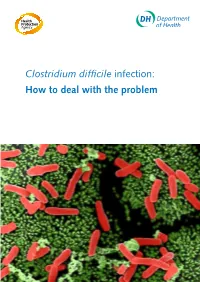
Clostridium Difficile Infection: How to Deal with the Problem DH INFORMATION RE ADER B OX
Clostridium difficile infection: How to deal with the problem DH INFORMATION RE ADER B OX Policy Estates HR / Workforce Commissioning Management IM & T Planning / Finance Clinical Social Care / Partnership Working Document Purpose Best Practice Guidance Gateway Reference 9833 Title Clostridium difficile infection: How to deal with the problem Author DH and HPA Publication Date December 2008 Target Audience PCT CEs, NHS Trust CEs, SHA CEs, Care Trust CEs, Medical Directors, Directors of PH, Directors of Nursing, PCT PEC Chairs, NHS Trust Board Chairs, Special HA CEs, Directors of Infection Prevention and Control, Infection Control Teams, Health Protection Units, Chief Pharmacists Circulation List Description This guidance outlines newer evidence and approaches to delivering good infection control and environmental hygiene. It updates the 1994 guidance and takes into account a national framework for clinical governance which did not exist in 1994. Cross Ref N/A Superseded Docs Clostridium difficile Infection Prevention and Management (1994) Action Required CEs to consider with DIPCs and other colleagues Timing N/A Contact Details Healthcare Associated Infection and Antimicrobial Resistance Department of Health Room 528, Wellington House 133-155 Waterloo Road London SE1 8UG For Recipient's Use Front cover image: Clostridium difficile attached to intestinal cells. Reproduced courtesy of Dr Jan Hobot, Cardiff University School of Medicine. Clostridium difficile infection: How to deal with the problem Contents Foreword 1 Scope and purpose 2 Introduction 3 Why did CDI increase? 4 Approach to compiling the guidance 6 What is new in this guidance? 7 Core Guidance Key recommendations 9 Grading of recommendations 11 Summary of healthcare recommendations 12 1. -

The Four Health Systems of the United Kingdom: How Do They Compare?
The four health systems of the United Kingdom: how do they compare? Gwyn Bevan, Marina Karanikolos, Jo Exley, Ellen Nolte, Sheelah Connolly and Nicholas Mays Source report April 2014 About this research This report is the fourth in a series dating back to 1999 which looks at how the publicly financed health care systems in the four countries of the UK have fared before and after devolution. The report was commissioned jointly by The Health Foundation and the Nuffield Trust. The research team was led by Nicholas Mays at the London School of Hygiene and Tropical Medicine. The research looks at how the four national health systems compare and how they have performed in terms of quality and productivity before and after devolution. The research also examines performance in North East England, which is acknowledged to be the region that is most comparable to Wales, Scotland and Northern Ireland in terms of socioeconomic and other indicators. This report, along with an accompanying summary report, data appendices, digital outputs and a short report on the history of devolution (to be published later in 2014), are available to download free of charge at www.nuffieldtrust.org.uk/compare-uk-health www.health.org.uk/compareUKhealth. Acknowledgements We are grateful: to government statisticians in the four countries for guidance on sources of data, highlighting problems of comparability and for checking the data we have used; for comments on the draft report from anonymous referees and from Vernon Bogdanor, Alec Morton and Laura Schang; and for guidance on national clinical audits from Nick Black and on nursing data from Jim Buchan. -

The Second Annual Report
ISSN 1471-3349 The Renal Association UK Renal Registry The Ninth Annual Report December 2006 This report was prepared by Dr David Ansell, Professor Terry Feest, Dr Alex Hodsman, Dr Raman Rao Dr Charlie Tomson, Dr Uday Udayaraj, Dr Andrew Williams and Dr Graham Warwick in association with F Caskey, K Farrington, R Fluck, J Harper, E Lamb, M Lewis, J Macdonald, R Ravanan, D Richardson, D Thomas Editors Dr D Ansell Prof T Feest Dr C Tomson Dr AJ Williams Dr G Warwick Biostatisticians Prof D van Schalkwyk Mrs M Steenkamp Dr J Gilg Registry Registrars Dr A Hodsman Dr R Rao Dr U Udayaraj Proof reading by Mrs F Benoy-Deeney Ms H Doxford Suggested citation Ansell D, Feest TG, Tomson C, Williams AJ, Warwick G UK Renal Registry Report 2006 UK Renal Registry, Bristol, UK This report will also become available as a supplement to Nephrology Dialysis & Transplantation. The individual chapters should then be referenced by their Medline citation. Publications based on the UK Renal Registry data must include the citation as noted above and the following notice: The data reported here have been supplied by the UK Renal Registry of the Renal Association. The interpretation and reporting of these data are the responsibility of the authors and in no way should be seen as an official policy or interpretation of the UK Renal Registry or the Renal Association. The Renal Association UK Renal Registry Southmead Hospital Southmead Rd Bristol BS10 5NB UK Telephone 0117 959 5665 Fax 0117 959 5664 Email renalreg@renalreg.com Web site www.renalreg.org General Manager -

You Feel Like You're Nothing: the UN Study on Violence Against Children
“YOU FEEL LIKE you’re NOTHING” The UN study on violence against children A contribution to the UN Violence Study from the Children’s Rights Alliance for England and the NSPCC 2 “YOU FEEL LIKE you’re nothing” FOREWORD ‘‘ No violence against children is justifiable; all violence against children is preventable.” These are the first words of the independent study commissioned by the United Nations Secretary-General on violence against children, presented to the General Assembly on 23 August 2006, and they are the principles on which this report is founded. The UN study describes forms of violence that no longer exist in the UK. We do not execute children, we do not beat them in schools, and we do not break children’s bodies under conditions of hazardous labour. Of course these horrors used to exist in this country, quite legally, until brave and energetic people campaigned for their abolition. We must therefore be hopeful that the same rejection of violence against children will continue around the world. There are certainly no grounds for complacency in the UK. Some of the barbarous treatment of children overseas is a direct legacy of the British Empire. This includes corporal punishment in schools, or the maintenance of the age of criminal responsibility at seven years in many ex-colonial states. Where our own country is concerned, we must feel a deep sense of shame at the violence against children revealed in this report. Living in the fifth richest country in the world, in a country that has enjoyed 200 years of social reform, children in the UK are still being killed, tortured, bullied, commercially sexually exploited, and physically and mentally scarred by violence. -

Births and Their Outcomes by Time, Day and Year: a Retrospective Birth Cohort Data Linkage Study
City Research Online City, University of London Institutional Repository Citation: Macfarlane, A. J. ORCID: 0000-0003-0977-7214, Dattani, N., Gibson, R., Harper, G., Martin, P., Scanlon, M., Newburn, M. and Cortina-Borja, M. (2019). Births and their outcomes by time, day and year: a retrospective birth cohort data linkage study. Health Services and Delivery Research, 7(18), doi: 10.3310/hsdr07180 This is the published version of the paper. This version of the publication may differ from the final published version. Permanent repository link: https://openaccess.city.ac.uk/id/eprint/22268/ Link to published version: http://dx.doi.org/10.3310/hsdr07180 Copyright: City Research Online aims to make research outputs of City, University of London available to a wider audience. Copyright and Moral Rights remain with the author(s) and/or copyright holders. URLs from City Research Online may be freely distributed and linked to. Reuse: Copies of full items can be used for personal research or study, educational, or not-for-profit purposes without prior permission or charge. Provided that the authors, title and full bibliographic details are credited, a hyperlink and/or URL is given for the original metadata page and the content is not changed in any way. City Research Online: http://openaccess.city.ac.uk/ publications@city.ac.uk HEALTH SERVICES AND DELIVERY RESEARCH VOLUME 7 ISSUE 18 MAY 2019 ISSN 2050-4349 Births and their outcomes by time, day and year: a retrospective birth cohort data linkage study Alison Macfarlane, Nirupa Dattani, Rod Gibson, -

Birth Statistics: Births and Patterns of Family Building England and Wales (FM1)
15 December 2008 Correction Notice Birth statistics: Births and patterns of family building England and Wales (FM1) FM1 No. 36 – 2007 An error relating to the title of one table has been corrected in this publication, originally released on 9 December 2008. The error in table 10.3 – Estimated average number of first live-born children: age and year of birth of woman, 1920-1992, omitted the word “first” from the table title. ONS apologises for any inconvenience caused. Issued by: National Statistics Government Buildings Cardiff Road Newport NP10 8XG Telephone Media Office 0845 604 1858 Contact Centre 0845 601 3034 Birth statistics Review of the National Statistician on births and patterns of family building in England and Wales, 2007 Laid before Parliament pursuant to Section 19 Registration Service Act 1953 Series FM1 No. 36 ISSN 0140–2587 Copyright and reproduction © Crown copyright 2008 A National Statistics publication Published with the permission of the Office for Public Sector Information (OPSI) National Statistics are produced to high professional standards set out in the National Statistics Code of Practice. They are You may use this publication (excluding logos) free of charge produced free from political influence. in any format for research, private study or internal circulation About us within an organisation providing it is used accurately and not in a misleading context. The material must be acknowledged as Crown copyright and you must give the title of the source The Office for National Statistics (ONS) is the executive office of publication. Where we have identified any third party copyright the UK Statistics Authority, a non-ministerial department which material you will need to obtain permission from the copyright reports directly to Parliament. -

Decriminalising Abortion in the Uk the in Abortion Poli Sally Sheldon and Kaye Wellings Kaye and Sheldon Sally
“Abortion plays a fundamental Available Open Access under Decriminalising Abortion UK the in role in women’s health but is CC-BY-NC licence. often shrouded in myth and hyperbole. This lucid and The public and parliamentary accessible text provides robust debate about UK abortion law and reliable evidence on this reform is often diverted away important issue.” from key moral and political Professor Dame Lesley Regan questions by disputes regarding DBE, MD DSc, Royal College of basic questions of fact. And all Obstetricians and Gynaecologists too often, claims of scientific ‘fact’ are ideologically driven. “This excellent book steps aside from the heat of debate What effect would Edited by Sally Sheldon and Kaye Wellings in order to provide an accurate decriminalisation be likely to account of the evidence about have on women’s health? What clinical safety, public opinion and would be the impact on the legal regulation. It provides an incidence of abortions? Would essential reference point for all decriminalisation equate to those seeking to approach the deregulation, sweeping away reform of abortion law with moral necessary restrictions on integrity.’’ dangerous or malicious conduct? Professor Sir Jonathan Montgomery, University College With each chapter written by London leading experts in the fields of medicine, law, reproductive health and social science, this book offers a concise and Sally Sheldon is Professor of authoritative account of the Law at the University of Kent and University of Technology, Sydney. evidence regarding the likely impact of decriminalisation of POLICY PRESSPOLICY & PRACT ICE Kaye Wellings is Professor of abortion in the UK. Sexual and Reproductive Health Research at the London School of Hygiene and Tropical Medicine. -

Smoking and Drinking Among Adults, 2009
UK Data Archive Study Number SN 6716 - General Lifestyle Survey: Secure Access Smoking and drinking among adults, 2009 A report on the 2009 General Lifestyle Survey Authors: Simon Robinson Helen Harris Editor: Steven Dunstan Office for National Statistics A report on the 2009 General Lifestyle Survey A National Statistics publication Copyright and reproduction National Statistics are produced to high professional © Crown copyright 2011 standards set out in the Code of Practice for Official You may re-use this information (not including logos) Statistics. They are produced free from political free of charge in any format or medium, under the terms influence. of the Open Government Licence. About us To view this licence, go to: The Office for National Statistics www.nationalarchives.gov.uk/doc/open-government- licence/ The Office for National Statistics (ONS) is the executive office of the UK Statistics Authority, a non-ministerial or write to the Information Policy Team, The National department which reports directly to Parliament. ONS Archives, Kew, London TW9 4DU is the UK government’s single largest statistical email: psi@nationalarchives.gsi.gov.uk producer. It compiles information about the UK’s society and economy, and provides the evidence-base Any enquiries regarding this publication should be sent for policy and decision-making, the allocation of to: info@statistics.gsi.gov.uk resources, and public accountability. The Director- General of ONS reports directly to the National This publication is available for download at: Statistician who is the Authority's Chief Executive and www.ons.gov.uk the Head of the Government Statistical Service. The Government Statistical Service The Government Statistical Service (GSS) is a network of professional statisticians and their staff operating both within the Office for National Statistics and across more than 30 other government departments and agencies. -

National Confidential Inquiry Into Suicide and Homicide by People with Mental Illness
INFORMATION The National Confidential Inquiry into Suicide and Homicide by People with Mental Illness THE INQUIRY IS COMMISSIONED BY THE HEALTHCARE QUALITY IMPROVEMENT PARTNERSHIP (HQIP) The Mental Health Clinical Review Outcome Programme, delivered by the Inquiry, is commissioned by the Healthcare Quality Improvement Partnership (HQIP) on behalf of NHS England, NHS Wales, the Scottish Government Health and Social Care Directorate, the Northern Ireland Department of Health, the States of Guernsey and the States of Jersey. Sudden Unexplained Death (SUD) in mental health in-patients Copyright © 2016, re-used with the permission of the Health and Social Care Information Centre. All rights reserved. Please cite this report as: The National Confidential Inquiry into Suicide and Homicide by People with Mental Illness. Making Mental Health Care Safer: Annual Report and 20-year Review. October 2016. University of Manchester. Report authors: Louis Appleby, FRCPsych Director Nav Kapur, FRCPsych Head of Suicide Research Jenny Shaw, FRCPsych Head of Homicide Research Isabelle M Hunt, PhD Research Fellow Sandra Flynn, PhD Research Fellow Saied Ibrahim, PhD Research Associate Pauline Turnbull, PhD Project Manager Myrsini Gianatsi, MSc Research Assistant Su-Gwan Tham, BSc Research Assistant and all staff at the Inquiry: James Burns, Alison Baird, Cathryn Rodway, Rebecca Lowe, Philip Stones, Julie Hall, Nicola Worthington, Thabiso Nyathi, and Huma Daud. 2 Making Mental Health Care Safer Annual Report and 20-year Review, October 2016 CONTENTS Contents -

Excess Mortality Monitoring in England and Wales During the Influenza A(H1N1) 2009 Pandemic
Epidemiol. Infect. (2011), 139, 1431–1439. f Cambridge University Press 2011 doi:10.1017/S0950268811000410 Excess mortality monitoring in England and Wales during the influenza A(H1N1) 2009 pandemic P. HARDELID1*, N. ANDREWS1 AND R. PEBODY2 1 Statistics Unit, Health Protection Agency Centre for Infections, London, UK 2 Immunisation, Hepatitis and Blood Safety and Respiratory Diseases Departments, Health Protection Agency Centre for Infections, London, UK (Accepted 23 February 2011; first published online 25 March 2011) SUMMARY We present the results from a novel surveillance system for detecting excess all-cause mortality by age group in England and Wales developed during the pandemic influenza A(H1N1) 2009 period from April 2009 to March 2010. A Poisson regression model was fitted to age-specific mortality data from 1999 to 2008 and used to predict the expected number of weekly deaths in the absence of extreme health events. The system included adjustment for reporting delays. During the pandemic, excess all-cause mortality was seen in the 5–14 years age group, where mortality was flagged as being in excess for 1 week after the second peak in pandemic influenza activity; and in age groups >45 years during a period of very cold weather. This new system has utility for rapidly estimating excess mortality for other acute public health events such as extreme heat or cold weather. Key words: Influenza A, statistics. INTRODUCTION pneumonia and influenza mortality [5], while others have reported a probable excess in all-cause mortality In April 2009, a novel reassorted pandemic influenza in older children [6]. virus emerged from the Americas, followed by rapid In England and Wales, a long-standing excess mor- global spread [1, 2]. -

Durham Research Online
Durham Research Online Deposited in DRO: 20 October 2014 Version of attached le: Accepted Version Peer-review status of attached le: Peer-reviewed Citation for published item: Lindsey, I. and Adams, A. (2013) 'Sport development and community development.', in Routledge handbook of sport policy. Abingdon, Oxon: Routledge, pp. 264-274. Routledge international handbooks. Further information on publisher's website: http://www.routledge.com/9780415666619 Publisher's copyright statement: This is an Accepted Manuscript of a book chapter published by Routledge in Routledge handbook of sport policy on 23/07/2013, available online at: http://www.routledge.com/9780415666619 Use policy The full-text may be used and/or reproduced, and given to third parties in any format or medium, without prior permission or charge, for personal research or study, educational, or not-for-prot purposes provided that: • a full bibliographic reference is made to the original source • a link is made to the metadata record in DRO • the full-text is not changed in any way The full-text must not be sold in any format or medium without the formal permission of the copyright holders. Please consult the full DRO policy for further details. Durham University Library, Stockton Road, Durham DH1 3LY, United Kingdom Tel : +44 (0)191 334 3042 | Fax : +44 (0)191 334 2971 https://dro.dur.ac.uk Sport Development and Community Development Iain Lindsey & Andrew Adams Introduction The potential of sport to contribute to community development has increasingly gained global prominence in recent years. This alignment of sport with community development can be attributed to the general view of sport as morally benign (Coalter, 2007) and its increasing salience to both international bodies and national governments as a mechanism to achieve particular local policy objectives (Houlihan and Green, 2009). -

Impact of Deprivation, Dementia Prevalence and Regional
University of Birmingham Impact of deprivation, dementia prevalence and regional demography on prescribing of antidementia drugs in England Vohra, Neha; Hadi, Muhammad Abdul; Khanal, Saval; Kurmi, Om P; Paudyal, Vibhu DOI: 10.1111/bcp.14782 License: Creative Commons: Attribution (CC BY) Document Version Publisher's PDF, also known as Version of record Citation for published version (Harvard): Vohra, N, Hadi, MA, Khanal, S, Kurmi, OP & Paudyal, V 2021, 'Impact of deprivation, dementia prevalence and regional demography on prescribing of antidementia drugs in England: A time trend analysis', British Journal of Clinical Pharmacology. https://doi.org/10.1111/bcp.14782 Link to publication on Research at Birmingham portal General rights Unless a licence is specified above, all rights (including copyright and moral rights) in this document are retained by the authors and/or the copyright holders. The express permission of the copyright holder must be obtained for any use of this material other than for purposes permitted by law. •Users may freely distribute the URL that is used to identify this publication. •Users may download and/or print one copy of the publication from the University of Birmingham research portal for the purpose of private study or non-commercial research. •User may use extracts from the document in line with the concept of ‘fair dealing’ under the Copyright, Designs and Patents Act 1988 (?) •Users may not further distribute the material nor use it for the purposes of commercial gain. Where a licence is displayed above, please note the terms and conditions of the licence govern your use of this document. When citing, please reference the published version.