A Journal of African Studies
Total Page:16
File Type:pdf, Size:1020Kb
Load more
Recommended publications
-

Submission to the University of Baltimore School of Law‟S Center on Applied Feminism for Its Fourth Annual Feminist Legal Theory Conference
Submission to the University of Baltimore School of Law‟s Center on Applied Feminism for its Fourth Annual Feminist Legal Theory Conference. “Applying Feminism Globally.” Feminism from an African and Matriarchal Culture Perspective How Ancient Africa’s Gender Sensitive Laws and Institutions Can Inform Modern Africa and the World Fatou Kiné CAMARA, PhD Associate Professor of Law, Faculté des Sciences Juridiques et Politiques, Université Cheikh Anta Diop de Dakar, SENEGAL “The German experience should be regarded as a lesson. Initially, after the codification of German law in 1900, academic lectures were still based on a study of private law with reference to Roman law, the Pandectists and Germanic law as the basis for comparison. Since 1918, education in law focused only on national law while the legal-historical and comparative possibilities that were available to adapt the law were largely ignored. Students were unable to critically analyse the law or to resist the German socialist-nationalism system. They had no value system against which their own legal system could be tested.” Du Plessis W. 1 Paper Abstract What explains that in patriarchal societies it is the father who passes on his name to his child while in matriarchal societies the child bears the surname of his mother? The biological reality is the same in both cases: it is the woman who bears the child and gives birth to it. Thus the answer does not lie in biological differences but in cultural ones. So far in feminist literature the analysis relies on a patriarchal background. Not many attempts have been made to consider the way gender has been used in matriarchal societies. -
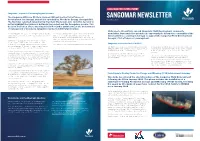
Sangomar Field Development
SANGOMAR FIELD DEVELOPMENT Sangomar – a symbol of intermingling and tolerance The Sangomar Offshore Oil Field (former SNE) will be the first offshore oil SANGOMAR NEWSLETTER development for Senegal, and will be operated by Woodside Energy (Senegal) B.V. November 2020 The field was renamed Sangomar by President Macky Sall, who took this decision to better highlight the symbiosis between the project and the Senegalese people. This decision was taken after a meeting held in November 2019 between the Government of Senegal and a Woodside delegation led by its CEO Peter Coleman. Welcome to Woodside’s second Sangomar Field Development community The name Sangomar, also given to the Senegalese presidential plane, One headed south and became “Aguene”, the mother of the Djolas, newsletter. Our newsletter provides an opportunity to inform the community of the is taken from the Serer language spoken in Senegal by nearly 10% of while the other headed north and became “Diambogne”, the latest activities occurring in Senegal to support the Sangomar Field Development, the population. mother of the Serers. The story represents the sacred cousinhood between the two ethnic groups who consider themselves allies in all Senegal’s first offshore oil development. In Serer mythology, Sangomar means the “village of shadows”, circumstances that nothing must oppose. the gathering place of the visible and the invisible. It is a place of confluence, on an uninhabited island with majestic, mythical, *Short trees with very thick trunks and large edible fruits, living to a great age. Sangomar on track for first oil in 2023 and mystical baobab* off the coast of Djifere. -

Eligible Nursing Officer.Xlsx
LIST OF ELIGIBLE & INELIGIBLE CANDIDATES FOR APPEARING IN WRITTEN EXAMINATION FOR THE POST OF NURSING OFFICER AGAINST ADVERTISEMENT DATED 25.09.2018 & 21.06.2019 PUBLISHED BY THE DIRECTORATE OF HEALTH SERVICES. List of candidates found eligible for appearing in written examination for the post of Nursing Officer Age (as on S No. RD No. Name Father’s name Gender DOB Category Remarks eligible Reason 01.04.2019) 1 29201800009 SUKHSAGAR SINGH SURINDER SINGH KAHLON M UR YES 2 29201800012 MIRALIDHAR SINGIDI SANYASI RAO LATE M OBC YES 3 29201800013 TAPATI MALAKAR MADHU MALAKAR F OBC YES 4 29201800014 JOYDIP MONDAL P K MONDAL M OBC YES 29201800017 PROBIR KUMAR CHAKRABORTHY LATE ASHOK CHAKRABORTHY OBC 5 M YES 6 29201800019 ABDUL WAJID ABDUL MAJEED M OBC YES 7 29201800021 KAMAL ADHIKARY HARIPADA ADHIKARY M GS OBC YES 8 29201800022 SANJOY BALA RAMANIKANTA BALA M UR YES 9 29201800024 BISAKA MISTRY HARE KRISHNA MISTRY F OBC YES 10 29201800025 KIRAN URAON BANDHANA URAON F UR YES 11 29201800026 SIKHA DAS ATUL DAS F OBC YES 12 29201800027 SHAMALI KIRTANIA CHITTA RANJAN KIRTANIA F OBC YES 13 29201800028 BITHIKA MONDAL BHAGIRATH MONDAL F OBC YES 14 29201800029 PORKUDI M RAJAGURU F UR YES 15 29201800030 ESTHER JENEBA SELVAM F UR YES 16 29201800032 JANAAIJA G S GOPAKUMAR K F UR YES 17 29201800033 MEHRAJ BEGUM ABDUL ANSAR F OBC YES 18 29201800034 PRIYANKA BISWAS PARIMAL BISWAS F OBC YES 19 29201800035 ANJALI SANGA SIBU SANGA F UR YES 20 29201800036 EVANGLIN G J GNANARAJ F UR YES 29201800037 SUNANDA MAZUMDER SHANKAR CHANDRA OBC 21 F YES MAZUMDER 22 29201800040 -
The Ambiguity of Religious Teachings Allows People to Craft Narratives That Justify Inherited Local Burial Patterns That They Hold Dear
The ambiguity of religious teachings allows people to craft narratives that justify inherited local burial patterns that they hold dear. Should Christians and Muslims Cohabit after Death? Diverging Views in a Senegalese Commune Ato Kwamena Onoma In Senegal, some people are open to burial in cemeteries used for the departed of all faiths, while others wish to be buried only in cemeteries used exclusively for people of their own religion. Research in Fadiouth, which has a mixed cemetery, and Joal, which has segregated cemeteries, indicates that most people, regardless of their faith, embrace the dominant burial practice in their community. I argue that the ambiguity of religious doctrines through which people look at interment explains the legitimacy of local burial arrangements. Because people consume these teachings through interpretive exer- cises, even exposure to the same doctrines may not always help us understand the choices they make. This article sheds light on interfaith relations and the explanatory potential of religious teachings. Introduction In 2014, Abdou Diouf, the former president of Senegal, came under attack by some people in his hometown of Louga. He was accused of being a bad citizen of his place of origin. Specific offenses included not visiting Louga for ten years, not acquiring land there, and not developing the area during his presidency (Leral.net 2014). Beyond these preoccupations was an other- worldly transgression, which had driven some in Louga over the edge. Abdou Diouf had publicly expressed a wish to be buried in the faraway southern Senegalese city of Ziguinchor instead of Louga. Ziguinchor is one of the few Senegalese cities with a mixed cemetery, where people of all faiths can be buried. -

Exemple De La Lutte Sérère
~~~~~~~~~~~~~~~~~4 ~ REPUBLIQUE DU SENEGAL ~ ~ _.~ ~ MINISTERE DE L'EDUCATION ~ ~ ~ ~ UNIVERSITE CHEIKH ANTA DIOP ~ ~ ~ ~ ~ ~ ~ ~ INSTITUT NATIONAL SUPERIEUR DE ~ ~ L'EDUCATION POPULAIRE ET DU SPORT ~ ~ MEMOIRE DE IAITRII dENCES ET lICHNIUES DE L'AClMTE PHYsIQUE 3 ~ ET DU SPORT .." ~ ~ ~~ ~ ~ THEME: ~ ,~ ~ ~ LE ROLE DE LA FEMME DANS LES PRATIQUES ~ ~ CORPORELLES : ~ sr- EXEMPLE DE LA LUTTE SERERE ~ ~ ~ ~ Présenté et Soutenu par .:. Sous la Direction de .:. ~ Mademoiselle Awa SARR Monsieur Abdoul Wahid KANE ~ -~ Année Universitaire 2001 - 2002 ~~~~~~~~~~~~~~~~ [ @n cU8mtJninn 1 --..-------------- A mes chères grands-mères y Céline Ndokhoye SARR ~ Ramatoulaye SENE };> Tenning Mossane SARR A mes chers frères };> Edouard SARR };> Yamou SARR ~ Cheikh SARR Arrachés très tôt à notre affection. 1_~_'(f._;d._k_'crctJ_~ 1 Je dédie cc travnil •A tOlite ma famille: ma mère, mon père, mes sœurs, mes frères en témoignage de J'affection que je porle en VOLIS; + A la famille SARR, ma seconde famille, je vous seraI toujours reconnaissante; + A mes neveux et nièces; •A mes amis de toujours: Juliette Mendy, Simone Ndong, Da\VT1 &Chance Reynolds, Josh & Fatou Moore, Suzane et Pattick Fine; + A mes deux oncles: Gabriel ct Joseph SARR ~ • 1\ IIIOJl Ol\cl<..: Camille St\RI~, VOliS êtes pour moi (,;0Il 11 Ile 1111 p~n; <.:1 les mols ne saliraient traduire ce qlle j'~prOllvc pour VOII:). [.(ÇjÇ_.em_er..c.ie..m.e..n.t.s .1 Je porte mes remerciements à J'endroit de: .:. Monsieur Abdoul Wahid KANE Professeur à l'INSEPS, qm a bien voulu acceptéAde m'encadrer .:. Monsieur Robert SARR pour sa contribution à la réalisation de ce mémoire .:. Monsieur Djibril SECK pour sa disponibilité dans la confection de ce docwnent .:. -

Gods , Trickster Gods , & Goddesses
Gods , Trickster Gods , & Goddesses Adroa Other Names: "God in the sky", God on Earth", Creator God, River God. Location: The Lugbara of Zaire and Uganda. Description: He is pictured as tall and white with only half of his body visible. Rules Over: Social order, law, death. Akuj Location: The Turkana of Kenya. Rules Over: Divination. Ala Other Names: Ale, Ane. Location: The Ibo of Nigeria. Description: Extremely popular Goddess and Earth Mother. She is a Creator Goddess and Queen of the Dead. Rules Over: Community laws, morality, oaths, harvest. Anayaroli Location: The Temne. Description: River demon. Rules Over: Wealth. Asa Other Names: Father God, "the strong lord." Location: Akamba of Kenya. Rules Over: Mercy, help, surviving the impossible. Asase Other Names: Yaa, Aberewa, Efua, "Old Woman Earth." Location: The Ashanti of West Africa. Description: Goddess of creation of humans and receiver of them at death. Rules Over: Cultivation, harvest. Behanzin Location: West Africa. Description: Fish God. Cagn Location: South Central Africa among the Bushman. Description: Creator God. Rules Over: Sorcery and Shape-Shifting. Chiuta Other Names: Mulengi, Mwenco, Wamtatakuya Tumbuka. Description: Creator God, Rain God. Is self-created and omniscient. Rules Over: Rain, help, plant growth, food. Chuku Other Names: Chineke. Location: The Ibo of East Nigeria. Description: "The first great cause", "Creator", Father of Ale, The Earth Goddess. Offerings and sacrifices were done for him in groves. Rules Over: Help, goodness. Danh Location: Dahomey. Description: Snake God. Rainbow Snake shown with tail in his mouth. Rules Over: Wholeness, unity. En-Kai Other Names: Parsai, Emayian. Location: Masai. Description: Sky God. -

Plaidoyer Pour Le Dialogue Interreligieux
Ambassade d’Israël ENRACINEMENT ET OUVERTURE – Plaidoyer pour le dialogue interreligieux Colloque à la Fondation Konrad Adenauer Dakar 23 et 24 juin 2009 TEXTES ET DOCUMENTS TABLE DES MATIERES PROGRAMME DU COLLOQUE 3 I. ALLOCUTIONS D’OUVERTURE ET DE CLOTURE 5 Dr. Stefan Gehrold 6 Gidéon Behar 9 Sidy Dieng 11 Prof. Saliou Ndiaye 14 II. TEXTES DES PANELS 17 PANEL I : FONDEMENTS DU DIALOGUE INTERRELIGIEUX Abbé Léon Diouf : Bases religieuses et théologiques du dialogue interreligieux 18 Interview avec Rabbin Dov Maimon sur le dialogue interreligieux 24 PANEL II : ARRIERE-PLAN SOCIORELIGIEUX ET DECISIONS DES POUVOIRS PUBLICS Klaus-Jürgen Hedrich : Influences et justifications religieuses de décisions publiques 27 Penda Mbow : Islam, Paix et démocratie 30 PANEL III : RELIGION ET DEVELOPPEMENT HUMAIN Abdoul Aziz Kébé : Religion et droits humains 38 Issa Laye Thiaw : Religions et Arbres à travers les âges 43 III. RAPPORTS DES PANELS 51 IV. RAPPORTS DES ATELIERS 70 Enracinement et Ouverture – Plaidoyer pour le dialogue interreligieux 2 Colloque à la FKA Dakar, 23 et 24 juin 2009 PROGRAMME DU COLLOQUE Enracinement et ouverture – Plaidoyer pour le dialogue interreligieux 23 et 24 juin 2009, Fondation Konrad Adenauer, Dakar Mardi 23 juin 2009 09.00 – 10.00 Cérémonie d’ouverture Dr. Stefan Gehrold, Représentant Résident FKA Dakar Prof. Abdou Salam Sall, Recteur de l’Université Cheikh Anta Diop Autorité religieuse musulmane S.E. Le Nonce apostolique de Dakar S. E. Gidéon Behar, l’Ambassadeur d’Israël au Sénégal S. E. M. Moustapha Sourang, Ministre de l’Enseignement Secondaire, des Centres Universitaires Régionaux et des Universités 10.00 – 10.30 Pause café 10.30 – 13.00 Panel I : Fondements du dialogue interreligieux Modérateur: Prof. -

Furaha Afka Soomaaliga Qore:-Maxamuud Maxamed Ciise, E-Mail: Ufayn1@Gmail.Com
Furaha Afka Soomaaliga Qore:-Maxamuud Maxamed Ciise, E-mail: ufayn1@gmail.com HORDHAC Anigoo ah Maxud Maxed Ciise, kanatirsan Bahda waxkaqodha Afka Soomaaliga waxaan rabaa inaan gogoldhig u sameeyo Buugan loogu magac daray Furaha Afka Soomaaliga, Sababka igubixiyey inaan diyaariyo Qoraalkan waxan arkay Afkii Soomaaliga oo Ciriiri kujira waxana keenay Shacabkii Soomaaliyeed oo kukala firdhay Dunida daafeheeda islamarkaas waxay soo rareen Luqadihii Dalalkii ay kukala noolaayeen, waxaa,kaloo qayb weyn kaqaatay inuu qarsoomo Afka Somaaligu markii Dawladii dhexe burbudhay ayaa waxaa faraha kabaxay Manaahijtii Dalka tiilay oo dhan iyadoo lawaayey meelloo raaco Buugaagtii Daraasaadka Madaarista lagubaran jiray, Sidaas awgeed waxaa iimuuqatay beylah badan oo kusoo wajahan Afkii Soomaaliga taasoo baahi gelisey in ladayactiro silooga nabadgalo inaynu qaadanno Afaf shisheeye ama Luqado kale oo markaas Afkeenii Barax noqdo, FAALLO Hadaan faallo ama tusaale kooban kabixiyo Afka Soomaaligu wuxuu leeyaha Xubno isku rakiban ama israaca markasta oo ladoonayo in Jumlo lageliyo, Weerkasta oo kamida weerahan kuxusan Buuggan waxaa lagasameyn karaa oraah macneheedu dhamays tiranyahay, weeraha qaarkood sidooda Asalkaa ayey macnayaal iyo magacyo buuxa kuyihiin, Hadaan kulaabto ama marlabaad qeexo Xubnaha hadalka waxaa kamida Xubno ama weero dhaadheer iyo kuwa gaagaaban, Hadaan sooqaato kuwa gaagaaban tusaale,(Xira, Fura, Xero) hadaan diburaacno furayaasha shaxdeena kujira waxaad kaheli kadhaa sadexdan kelmedood oo ukala xiran lix meelood ee hadaan laysku rakibin -

Social Learning, Influence
Social learning, influence, and ethnomedicine: individual, neighborhood and social network influences on attachment to an ethnomedical cultural model in rural Senegal Abstract The preference in many parts of the world for ethnomedical therapy over biomedical alternatives has long confounded scholars of medicine and public health. In the anthropological literature cultural and interactional contexts have been identified as fundamental mechanisms shaping adherence to ethnomedical beliefs and health seeking behaviors. In this paper, we examine the association between individual, neighborhood, and social network characteristics and the likelihood of attachment to an ethnomedical cultural model encompassing beliefs about etiology of disease, appropriate therapeutic and preventative measures, and more general beliefs about metaphysics and the efficacy of health systems in a rural population in Eastern Senegal. Using data from a unique social network survey, and supplemented by extensive qualitative research, we model attachment to the ethnomedical model at each of these levels as a function of demographic, economic and ideational characteristics, as well as perceived effectiveness of both biomedical and ethnomedical therapy. Individuals’ attachment to the ethnomedical cultural model is found to be strongly associated with characteristics of their neighborhoods, and network alters. Experiences with ethnomedical care among neighbors, and both ethnomedical and biomedical care among network alters, are independently associated with attachment to the ethnomedical model, suggesting an important mechanism for cultural change. At the same time, we identify an independent association between network alters’ cultural models and those of respondents, indicative of a direct cultural learning or influence mechanism, modified by the degree of global 1 transitivity, or ‘connectedness’ of individuals’ networks. -

Keepers of West-African Humanism and Healing
Keepers of West-African Humanism and Healing: African-Centered Storytelling Praxis by Asè in Chicago BY Elisha Hall B.A., Carleton College, 2007 M.A., Antioch College Midwest, 2011 DISSERTATION Submitted as partial fulfillment of the requirements for the degree of Doctor of Philosophy in Policy Studies in Urban Education in the Graduate College of the University of Illinois at Chicago, 2020 Chicago, Illinois Defense Committee: David Stovall, African-American Studies, Chair and Advisor Nicole Nguyen, Educational Policy Studies Decoteau Irby, Educational Policy Studies Kamau Rashid, National-Louis University Goria Emeagwali, Central Connecticut State University ACKNOWLEDGEMENTS This has not been easy – and for that I am thankful. While I sought to learn knowledge and wisdom from the content, I was indeed humbled and indebted to the lessons learned from the process. I have deep gratitude for the Creator. I am also honored my Ancestors helped me persevere when I did want to move. For guiding me into places and spaces that I did not know existed. And for keeping the line of communication open. For not giving up on me. I extend this same deep gratitude to my family, especially my children and their mother, Sona Smith. Throughout this journey we have seen our relationship end and a friendship begin. I am thankful for the mother that she has always been to our children and the way she continues to model a true African queen. My children, Ayah, Ameen, and Ajani have also shown me so much poise and strength through all of these challenging times and changes and for that I am thankful. -

The Effect of the Language of Test on Students' Academic Achievement In
Succes or failure? The effect of the language of test on students’ academic achievement in rural Senegal Alexandre Martín-Chazeaud Aquesta tesi doctoral està subjecta a la llicència Reconeixement 3.0. Espanya de Creative Commons. Esta tesis doctoral está sujeta a la licencia Reconocimiento 3.0. España de Creative Commons. This doctoral thesis is licensed under the Creative Commons Attribution 3.0. Spain License. SUCCESS OR FAILURE? THE EFFECT OF THE LANGUAGE OF TESTS ON STUDENTS’ ACADEMIC ACHIEVEMENT IN RURAL SENEGAL Tesi doctoral presentada per Alexandre Martín-Chazeaud Com a requeriment per a l’obtenció del títol de Doctor per la Universitat de Barcelona Programa de doctorat: Estudis Lingüístics, Literaris i Culturals Línia de recerca: Lingüística Aplicada Departament de Llengües i Literatures Modernes i d’Estudis Anglesos Directora: M. Luz Celaya Villanueva Universitat de Barcelona 2017 To all African children, with the purpose of breaking up the silence of their voices ACKNOWLEDGEMENTS First of all, I would like to express my most sincere gratitude to my supervisor, Dr Celaya, who guided me and encouraged me throughout the hard process of the present dissertation. All the valuable advice, persistent support and positive encouragement that she could give me were essential in order to carry out research in Sub-Saharan Africa and write this thesis. I am particularly indebted to Dr Jarvis and all the members of the committee of the Language Learning Dissertation Grant Programme at Language Learning from whom I had the pleasure to be granted with support during the collection of data in Senegal. I would like to thank Dr Cummins, Dr Brock-Utne and Dr Skattum for their recommendations on some references which have been of inspiration to the present dissertation. -

Cosaani Sénégambie Resource Centre : Juillet 2014
The Seereer Resource Centre Traduit et transcrit par The Seereer Cosaani Sénégambie Resource Centre : Juillet 2014. « Cosaani Sénégambie » (« L’Histoire de la Sénégambie ») avec Jebal Samba de la Gambie [dans] le programme de Radio Gambie: « Chosaani Senegambia ». Présenté par: Alhaji Mansour Njie de Radio Gambie. Directeur de programme: Alhaji Alieu Ebrima Cham Joof. Enregistré à la fin des années 1970, au début des années 1980 au studio de Radio Gambie, Bakau, en Gambie [dans] onegambia.com [dans] The Seereer Resource Centre (SRC) (« le Centre de Resource Seereer ») : URL: L'histoire www.seereer.com. Traduit et transcrit par The Seereer Resource Centre : Juillet 2014. orale Titre : Cosaani Sénégambie (« l’histoire de la Sénégambie ») : l'Histoire du Saluum, la généalogie de la famille royale du Saluum et l’histoire de Ama Juuf Jaame (2ème partie). Date ou année (ou année approximative de l'enregistrement) : Fin des années 1970 au début des années 80. La date exacte de l'enregistrement est inconnue. Objet: Tradition orale 2ème Partie : C'est la deuxième partie de l'histoire du Saloum (variation : « Saluum » ou « Saalum ») et de Ama Juuf Jaame (en sérère, variation : « Ama Diouf Diamé » ou « Ama Joof Jammeh ») relaté par Jebal Samba. Cette partie parle également sur la généalogie de la famille royale du Saloum, du Baddibu et du Sine (ou « Siin »). Pour la 1ere partie de cette interview, veillez cliquer ici. Lieu : Studio de Radio Gambie, Bakau, en Gambie Durée: 01:00:14 minutes Langue source : cet enregistrement est en Wolof Langue cible : le Français Moyen: dossier audio Présentateur: Alhaji Mansour Njie Station Radio: Radio Gambie Orateurs : 1.