Pachycereus Cactaceae See Sub
Total Page:16
File Type:pdf, Size:1020Kb
Load more
Recommended publications
-

Farinose Alpine Primula Species: Phytochemical and Morphological Investigations
Phytochemistry 98 (2014) 151–159 Contents lists available at ScienceDirect Phytochemistry journal homepage: www.elsevier.com/locate/phytochem Farinose alpine Primula species: Phytochemical and morphological investigations Paola S. Colombo a,e, Guido Flamini b, Michael S. Christodoulou c, Graziella Rodondi d, Sara Vitalini a,e, ⇑ Daniele Passarella c, Gelsomina Fico a,e, a Dipartimento di Scienze Farmaceutiche, Università degli Studi di Milano, via Mangiagalli 25, 20133 Milano, Italy b Dipartimento di Farmacia, Università degli Studi di Pisa, via Bonanno 33, 56126 Pisa, Italy c Dipartimento di Chimica, Università degli Studi di Milano, via Golgi 19, 20133 Milano, Italy d Dipartimento di Bioscienze, Università degli Studi di Milano,via Celoria 26, 20133 Milano, Italy e Orto Botanico G.E. Ghirardi, Dipartimento di Scienze Farmaceutiche, Via Religione 25, Toscolano Maderno, Brescia, Italy article info abstract Article history: This work investigated the epicuticular and tissue flavonoids, the volatiles and the glandular trichome Received 30 July 2013 structure of the leaves of four species of Primula L. that grow in the Italian Eastern Alps. Primula albenensis Received in revised form 20 November 2013 Banfi and Ferlinghetti, P. auricula L., P. farinosa L., P. halleri Gmelin produce farinose exudates that are Available online 14 December 2013 deposited on the leaf surface as filamentous crystalloids. In addition to compounds already known, a new flavone, the 3,5-dihydroxyflavone, was isolated from the Keywords: acetone extract of leaf farinas and three new flavonol glycosides, 30-O-(b-galactopyranosyl)-20-hydroxyf- Primula albenensis, P. auricula, P. farinosa, P. lavone, isorhamnetin 3-O-a-rhamnopyranosyl-(1?3)-O-[a-rhamnopyranosyl-(1?6)]-O-b-galactopyran- halleri oside, quercetin 3-O- -rhamnopyranosyl-(1?3)-O-[ -rhamnopyranosyl-(1?6)]-O-b-galactopyranoside, Primulaceae a a Phytochemistry were isolated from the MeOH extract of the leaves. -

(Dr. Sc. Nat.) Vorgelegt Der Mathematisch-Naturwissenschaftl
Zurich Open Repository and Archive University of Zurich Main Library Strickhofstrasse 39 CH-8057 Zurich www.zora.uzh.ch Year: 2012 Flowers, sex, and diversity: Reproductive-ecological and macro-evolutionary aspects of floral variation in the Primrose family, Primulaceae de Vos, Jurriaan Michiel Posted at the Zurich Open Repository and Archive, University of Zurich ZORA URL: https://doi.org/10.5167/uzh-88785 Dissertation Originally published at: de Vos, Jurriaan Michiel. Flowers, sex, and diversity: Reproductive-ecological and macro-evolutionary aspects of floral variation in the Primrose family, Primulaceae. 2012, University of Zurich, Facultyof Science. FLOWERS, SEX, AND DIVERSITY. REPRODUCTIVE-ECOLOGICAL AND MACRO-EVOLUTIONARY ASPECTS OF FLORAL VARIATION IN THE PRIMROSE FAMILY, PRIMULACEAE Dissertation zur Erlangung der naturwissenschaftlichen Doktorwürde (Dr. sc. nat.) vorgelegt der Mathematisch-naturwissenschaftliche Fakultät der Universität Zürich von Jurriaan Michiel de Vos aus den Niederlanden Promotionskomitee Prof. Dr. Elena Conti (Vorsitz) Prof. Dr. Antony B. Wilson Dr. Colin E. Hughes Zürich, 2013 !!"#$"#%! "#$%&$%'! (! )*'+,,&$-+''*$.! /! '0$#1'2'! 3! "4+1%&5!26!!"#"$%&'(#)$*+,-)(*#! 77! "4+1%&5!226!-*#)$%.)(#!'&*#!/'%#+'.0*$)/)"$1'(12%-).'*3'0")"$*.)4&4'*#' "5*&,)(*#%$4'+(5"$.(3(-%)(*#'$%)".'(#'+%$6(#7.'2$(1$*.".! 89! "4+1%&5!2226!.1%&&'%#+',!&48'%'9,%#)()%)(5":'-*12%$%)(5"'"5%&,%)(*#'*3' )0"';."&3(#!'.4#+$*1"<'(#'0")"$*.)4&*,.'%#+'0*1*.)4&*,.'2$(1$*.".! 93! "4+1%&5!2:6!$"2$*+,-)(5"'(12&(-%)(*#.'*3'0"$=*!%14'(#'0*1*.)4&*,.' 2$(1$*.".>'5%$(%)(*#'+,$(#!'%#)0".(.'%#+'$"2$*+,-)(5"'%..,$%#-"'(#' %&2(#"'"#5($*#1"#).! 7;7! "4+1%&5!:6!204&*!"#")(-'%#%&4.(.'*3'!"#$%&''."-)(*#'!"#$%&''$"5"%&.' $%12%#)'#*#/1*#*204&4'%1*#!'1*2$0*&*!(-%&&4'+(.)(#-)'.2"-(".! 773! "4+1%&5!:26!-*#-&,+(#!'$"1%$=.! 7<(! +"=$#>?&@.&,&$%'! 7<9! "*552"*?*,!:2%+&! 7<3! !!"#$$%&'#""!&(! Es ist ein zentrales Ziel in der Evolutionsbiologie, die Muster der Vielfalt und die Prozesse, die sie erzeugen, zu verstehen. -
Dissertation
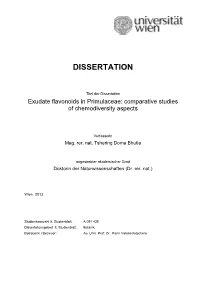
DISSERTATION Titel der Dissertation Exudate flavonoids in Primulaceae: comparative studies of chemodiversity aspects Verfasserin Mag. rer. nat. Tshering Doma Bhutia angestrebter akademischer Grad Doktorin der Naturwissenschaften (Dr. rer. nat.) Wien, 2013 Studienkennzahl lt. Studienblatt: A 091 438 Dissertationsgebiet lt. Studienblatt: Botanik Betreuerin / Betreuer: Ao. Univ. Prof. Dr. Karin Valant-Vetschera Acknowledgements It is my great pleasure to thank all those who, with their help and support, have contributed to the completion of this thesis. First and foremost I would like to express my sincere and heartfelt gratitute to my supervisor Assoc. Prof. Dr. Karin Valant‐Vetschera for giving me the opportunity to join the “Chemodiversity Group”. I thank her for assuming the dual role of supervisor and mentor. During the years of my diploma and doctoral theses she has continuously offered me the best guidance, support and advice I could have asked for. I am very grateful to Dr. Lothar Brecker for the characterization and identification of the isolated compounds. Additionally, I thank him for his constant encouragement, support and valuable suggestions. In the lab I have always received invaluable technical support from Mag. Johann Schinnerl, for which I extend him my earnest thanks and appreciation. Prof. Dr. Harald Greger has been very kind and supportive throughout the years, which I gratefully appreciate. Thanks are also due to Prof. Dr. Irene Lichtscheidl and Dr. Wolfram Adlassnig for providing access to their laboratory equipment and for their excellent guidance. I am deeply indebted to Prof. Eckhard Wollenweber (Institut für Botanik der TU Darmstadt, Germany) for the constant supply of authentic flavonoid samples, which made my lab life a lot easier. -

Pollinator Adaptation and the Evolution of Floral Nectar Sugar
doi: 10.1111/jeb.12991 Pollinator adaptation and the evolution of floral nectar sugar composition S. ABRAHAMCZYK*, M. KESSLER†,D.HANLEY‡,D.N.KARGER†,M.P.J.MULLER€ †, A. C. KNAUER†,F.KELLER§, M. SCHWERDTFEGER¶ &A.M.HUMPHREYS**†† *Nees Institute for Plant Biodiversity, University of Bonn, Bonn, Germany †Institute of Systematic and Evolutionary Botany, University of Zurich, Zurich, Switzerland ‡Department of Biology, Long Island University - Post, Brookville, NY, USA §Institute of Plant Science, University of Zurich, Zurich, Switzerland ¶Albrecht-v.-Haller Institute of Plant Science, University of Goettingen, Goettingen, Germany **Department of Life Sciences, Imperial College London, Berkshire, UK ††Department of Ecology, Environment and Plant Sciences, University of Stockholm, Stockholm, Sweden Keywords: Abstract asterids; A long-standing debate concerns whether nectar sugar composition evolves fructose; as an adaptation to pollinator dietary requirements or whether it is ‘phylo- glucose; genetically constrained’. Here, we use a modelling approach to evaluate the phylogenetic conservatism; hypothesis that nectar sucrose proportion (NSP) is an adaptation to pollina- phylogenetic constraint; tors. We analyse ~ 2100 species of asterids, spanning several plant families pollination syndrome; and pollinator groups (PGs), and show that the hypothesis of adaptation sucrose. cannot be rejected: NSP evolves towards two optimal values, high NSP for specialist-pollinated and low NSP for generalist-pollinated plants. However, the inferred adaptive process is weak, suggesting that adaptation to PG only provides a partial explanation for how nectar evolves. Additional factors are therefore needed to fully explain nectar evolution, and we suggest that future studies might incorporate floral shape and size and the abiotic envi- ronment into the analytical framework. -

Attack Insects on Roses C Flowers NOW!
American Primrose Society Quarterly Winter Issue 1983 Volume 41, Number 1 Published January 24, 1983 President's message Copyright 1948 Entered 2nd Class, Edmonds, Washington Editor's Committee: 1570 9th Avc. North The holidays, joyous reunions and celebrations are over. I hope they were Edmonds, WA 98020 joyous for all concerned. We now look forward to a new year with renewed Larry and Linda Bailey hope and expectations that it will be better than the last. During these Irene Buckles winter months, as gardeners, we make out our seed orders, sort out and Dan and Evelyn Douglas Jerry Flintoff clean any seed of our own we have saved, do our dreaming and planning Cy Happy On the cover for all the things we are going to do with our plants this coming season. Allan and Rosctta Jones If you are the practical person and keep your plans within the limits of Dee Peck Primula nutans - the enchanted your ability to accomplish, you are the exception among gardeners. Most Orpha Salsman Primula from China. Photograph Brian and June Skidmore gardeners plan during the winter months more than they can complete taken by Larry Bailey in his garden. during the rush of activity during the spring; so, some projects have to be See page 10. postponed to another year. That is why we live so long trying to complete ISSN 0162-6671 our projects. As A.P.S. members I would recommend two things to put in your plans. First, grow more species Primula. Second, make some hand pollinated crosses with a purpose. -
Latin for Gardeners: Over 3,000 Plant Names Explained and Explored
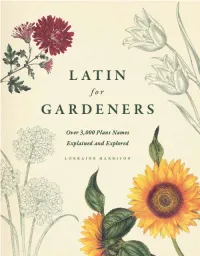
L ATIN for GARDENERS ACANTHUS bear’s breeches Lorraine Harrison is the author of several books, including Inspiring Sussex Gardeners, The Shaker Book of the Garden, How to Read Gardens, and A Potted History of Vegetables: A Kitchen Cornucopia. The University of Chicago Press, Chicago 60637 © 2012 Quid Publishing Conceived, designed and produced by Quid Publishing Level 4, Sheridan House 114 Western Road Hove BN3 1DD England Designed by Lindsey Johns All rights reserved. Published 2012. Printed in China 22 21 20 19 18 17 16 15 14 13 1 2 3 4 5 ISBN-13: 978-0-226-00919-3 (cloth) ISBN-13: 978-0-226-00922-3 (e-book) Library of Congress Cataloging-in-Publication Data Harrison, Lorraine. Latin for gardeners : over 3,000 plant names explained and explored / Lorraine Harrison. pages ; cm ISBN 978-0-226-00919-3 (cloth : alkaline paper) — ISBN (invalid) 978-0-226-00922-3 (e-book) 1. Latin language—Etymology—Names—Dictionaries. 2. Latin language—Technical Latin—Dictionaries. 3. Plants—Nomenclature—Dictionaries—Latin. 4. Plants—History. I. Title. PA2387.H37 2012 580.1’4—dc23 2012020837 ∞ This paper meets the requirements of ANSI/NISO Z39.48-1992 (Permanence of Paper). L ATIN for GARDENERS Over 3,000 Plant Names Explained and Explored LORRAINE HARRISON The University of Chicago Press Contents Preface 6 How to Use This Book 8 A Short History of Botanical Latin 9 Jasminum, Botanical Latin for Beginners 10 jasmine (p. 116) An Introduction to the A–Z Listings 13 THE A-Z LISTINGS OF LatIN PlaNT NAMES A from a- to azureus 14 B from babylonicus to byzantinus 37 C from cacaliifolius to cytisoides 45 D from dactyliferus to dyerianum 69 E from e- to eyriesii 79 F from fabaceus to futilis 85 G from gaditanus to gymnocarpus 94 H from haastii to hystrix 102 I from ibericus to ixocarpus 109 J from jacobaeus to juvenilis 115 K from kamtschaticus to kurdicus 117 L from labiatus to lysimachioides 118 Tropaeolum majus, M from macedonicus to myrtifolius 129 nasturtium (p. -

Plant World Seeds on Facebook and Receive a Free Surprise Packet of Seeds with Your Order
NEW! PLANT WORLD NEW! CYNOGLOSSUM OFFICINALE SEEDS IMPATIENS ‘BLUE DIAMOND’ 2013 NEW! NEW! THALICTRUM SPHAEROSTACHYUM POTENTILLA ‘HELEN JANE’ NEW! NEW! PRIMULA ‘VICTORIAN SILVER LACE’ MECONOPSIS SUPERBA NEW! NEW! SCABIOSA INCISA PRIMULA VERIS ‘HOSE-IN-HOSE’ www.plant-world-seeds.com Probably the world’s only catalogue selling this year’s fresh seeds! Garden pathways became little rivers, wheelbarrows and buckets filled with rain, and that summed up the ‘summer’ of 2012. Frantic volunteers struggled with an ever-encroaching army of fast-growing annual weeds as they exploded with vigour in the unseasonable wet, threatening to engulf whole beds of our valuable new plants in the nursery and gardens…and so continued the wettest summer ever recorded in Devon, and indeed most of the UK. On the positive side, we collected good seed crops of many plants that actually thrived during this bizarre so-called summer. Some of our new discoveries… Impatiens ‘Blue Diamond’ - The annual London Marathon, to be held on Recently discovered in Tibet, the April 22nd 2012 was looming, so after an first ever, deepest true-blue unexpected spell in Torbay Hospital, Tessa impatiens, perennial in a decided that it would be appropriate if we could conservatory! raise some much needed funds for their rather Primula veris hose-in-hose - This bare Oncology Unit waiting room. And in spite amazing ancient cowslip, recently of still recovering from her serious treatment, re-discovered, has one flower she managed to pull the old Flower Pot man tucked neatly inside the other. around the 26 miles again, and more than Meconopsis superba - What an £3,000 was contributed. -

Uarttdy Oftoamerican
uarttdy of TO American Primrose VOLUME XXI WINTER 1963 NUMBER 1 Primula pulverulenta at Hannon Acres OFFICERS—AMERICAN PRIMROSE SOCIETY President—Mr. Herbert H. Dickson 13347 56th Ave. South, Seattle 88, Wn. Quarterly Vice President—Mrs. Rosetta M. Jones .6210 So 286th St., Kent, Wn. Rec. Sec'y.—Mrs. Mary E. Zack. 8825 N.W. Bailey, Portland 9, Ore. Corresponding Sec'y—Mrs. Alice Hills Baylor. Johnson, Vermont of the Treasurer—Mrs. Lawrence G. Tait 14015 84th Ave. N.E., Bothell, Wn. REGIONAL VICE-PRESIDENTS Mrs. L. N. Rindspach, Pres. Wn. St. Primrose Soc 19723 88th Ave. N.E., Bothell, Wn. American Primrose Society Mr. Floyd S. Keller, Pres. Tacoma Primrose Soc 8511 S. Ainsworth, Tacoma, Wn, Dr. Raymond F. Piper, Pres. Onandoga Primrose Society, VOLUME XXT WINTER 1963 NUMBER 1 1310 Comstock Avenue, Syracuse 5, N.Y. Mrs. F. J. Macey—Pres. Canadian Primula & Alpine Society, _ 4020 Marine Dr. West, Vancouver, B.C., Canada A Tribute To Dan Bamford 2 Mrs. Raymond Elmstrom—Pres. Oregon Primrose Society, 8715 S.E. 36th St., Milwaukie 22, Ore. Concerning Primulas. Chupirr 2 Candelabra Section Grace. Dowling 4 Mrs. Francis Rae, Pres. East Side Garden Club 9007 132 Ave. N.E., Kirkland, Wn. Mrs. Marion Hannah—Pres. Emeritus, Friday Harbor Primrose Club, Other Members of the Primulaceae Doretta Klaber 14 _ Friday Harbor, Wn. Mrs. Reuben Stohr, Pres. Lewis Co. Primrose Society, 1963 Spring Primrose Shows 17 1512 Grand Ave., Centralia, Wn. Mr. Robert Saxe... 166 Eleventh Ave., San FrancisC9 18, Calif. Mr. Robert Luscher Thedford P. O., Ontario, Canada Nominations for 1963 A. -

Kilmurry Nursery Plant List 2015
Kilmurry Nursery Plant List 2015 Plant Name - Click here to list plants alphabeticallyDescription Pot Euro Type Pink and white flower spikes on a tall plant, June- Acanthus 'Mornings Candle' October. 3 8.00 Deeply cut spiny leaves.Pure white flowers with Acanthus spinosus purple bracts.1.5m 3 8.00 Soft lilac-pink flowers over fragrant ferny foliage. Achillea 'Apple Blossom' 60cm heigh 3 8.00 Light green leaves,corymbs of deep golden yellow Achillea 'Cloth of Gold' flowerheads 3 8.00 Stout stems rise from basal tufts of feathery pungent foliage. Flowers July/August. Best in sun Achillea mill. 'Walter Funcke' and good drainage 3 8.00 sturdy stems of deep yellow fls, 1m tall. June - Achillea mill. 'Yellowstone' Sept. Need full sun. 3 8.00 Fragrant ferny foliage, with clusters of flowers appearing on upright stems in early summer. This selection has soft-pink flowers. Good for cutting. Achillea millefolium 'Apple Blossom' Height 45-70cm. 3 8.00 Achillea millefolium 'Paprika' Lovely shade of red over grey green foliage.75cm 3 8.00 2015 New Achillea millefolium'Sunny Seduction' Gorgeous creamy yellow flowers.70cm 3 8.00 2015 New Bright yellows flowers over silvery foliage. Blooms Achillea 'Moonshine' in the summer and autumn. 46-60 cm in height. 3 8.00 Creamy flowers over fragrant ferny foliage. 40cm Achillea 'Neilreichii' in height 3 8.00 Flattened clusters of deep wine red flowers in June- Achillea 'Red Velvet' August. Height 60cm. 3 8.00 Achillea 'Salmon Beauty' Salmon flowers Jun-Sept-60cm 3 8.00 Achillea 'Terracotta' Brownish orange flowers 3 8.00 Achillea'Anthea' Cream flowers over tall silver foliage.65cm 3 8.00 Achillea'The Beacon' Red flowers 3 8.00 Tall flower spikes and dark glossy leaves. -

Antioxidant and Anti-Inflamatory Activities of Phenolic Constituents from Primula Elatior L. Aerial Part
Available online on www.ijppr.com International Journal of Pharmacognosy and Phytochemical Research 2014; 6(1); 74-78 ISSN: 0975-4873 Research Article Antioxidant and Anti-Inflamatory Activities of Phenolic Constituents from Primula elatior L. Aerial Part *Fouad A. Mostafa1, Mohamed A. Gamal2, Ibrahim R. M. Sabrin 3, Elkhayat S. Ehab2 1Department of Pharmacognosy, Faculty of Pharmacy, Minia University, Minia, 61519 Egypt. 2Department of Pharmacognosy, Faculty of Pharmacy, Al-Azhar University, Assiut, 71524 Egypt. 3Department of Pharmacognosy, Faculty of Pharmacy, Assiut University, Assiut, 71526 Egypt. Available online: 15th February 2014 ABSTRACT Eight phenolic compounds were isolated from the EtOAc fraction of the aerial parts of Primula elatior L. (Primulaceae) cultivated in Egypt. Their structures were established as kaempferol (1), quercetin (2), 5-hydroxy pyrogallol (3), gallic acid methyl ester (4), gallic acid (5), 4`-methoxy kaempferol-3-O-β-glucuronopyranoside (6), kaempferol-3-O-β- glucuronopyranoside (7), and quercetin-3-O-β-glucuronopyranoside (8). Three of these compounds (6-8) have been isolated for the first time from the genus Primula. Their structures were confirmed by comparison of their chromatographic properties, chemical and spectroscopic data (UV, 1H, and 13C NMR) with those reported in the literature. The isolated flavonoids 1, 2, and 6-8 were found to exhibit significant antioxidant and anti-inflammatory activities. This is the first report about the antioxidant and anti-inflammatory activities of compounds 6-8. Keywords: Primula elatior L., Primulaceae, phenolic, Antioxidant, Anti-inflammatory. INTRODUCTION a Bruker Avance DRX 400 using DMSO-d6 as solvent. Primula elatior L. belongs to family Primulaceae which NMR spectra were referenced to the solvent signals (2.49 comprises about more than 400 species1.