Gunybi Ganambarr
Total Page:16
File Type:pdf, Size:1020Kb
Load more
Recommended publications
-

Art Gallery of New South Wales Annual Report 2012 – 13
ART GALLERY OF NEW SOUTH WALES ANNUAL REPORT 2012 – 13 1 CONTENTS 4 Vision and strategic direction 2010 – 15 5 President’s foreword 9 Director’s statement 13 At a glance 15 Access 15 Exhibitions and audience programs 19 Future exhibitions 21 Publishing 23 Engaging 23 Digital engagement 23 Community 30 Education 35 Outreach Regional NSW 40 Stewarding 40 Building and environmental management 42 Corporate Governance 58 Collecting 58 Major collection acquisitions 67 Other collection activity 70 Appendices 123 General Access Information 131 Financial statements 2 ART GALLERY OF NSW ANNUAL REPORT 12-13 The Hon George Souris MP Minister for Tourism, Major Events, Hospitality and Racing, and Minister for the Arts Parliament House Macquarie Street SYDNEY NSW 2000 Dear Minister It is our pleasure to forward to you for presentation to the NSW Parliament the annual report for the Art Gallery of NSW for the year ended 30 June 2013. This report has been prepared in accordance with the provisions of the Annual Report (Statutory Bodies) Act 1984 and the Annual Reports (Statutory Bodies) Regulations 2010. Yours sincerely Steven Lowy Michael Brand President Director Art Gallery of NSW Trust 21 October 2013 3 VISION AND STRATEGIC DIRECTION 2010 – 2015 Vision The Gallery is dedicated to serving the widest possible audience, both nationally and internationally, as a centre of excellence for the collection, preservation, documentation, . interpretation and display of Australian and international art. The Gallery is also dedicated to providing a forum for scholarship, art education and the exchange of ideas. Strategic Directions Access To continue to improve access to our collection, resources and expertise through exhibitions, publishing, programs, new technologies and partnerships. -

Macassan History and Heritage Journeys, Encounters and Influences
Macassan History and Heritage Journeys, Encounters and Influences Edited by Marshall Clark and Sally K. May Macassan History and Heritage Journeys, Encounters and Influences Edited by Marshall Clark and Sally K. May Published by ANU E Press The Australian National University Canberra ACT 0200, Australia Email: anuepress@anu.edu.au This title is also available online at http://epress.anu.edu.au National Library of Australia Cataloguing-in-Publication entry Author: Clark, Marshall Alexander, author. Title: Macassan history and heritage : journeys, encounters and influences / Marshall Clark and Sally K. May. ISBN: 9781922144966 (paperback) 9781922144973 (ebook) Notes: Includes bibliographical references. Subjects: Makasar (Indonesian people)--Australia. Northern--History. Fishers--Indonesia--History Aboriginal Australians--Australia, Northern--Foreign influences. Aboriginal Australians--History. Australia--Discovery and exploration. Other Authors/Contributors: May, Sally K., author. Dewey Number: 303.482 All rights reserved. No part of this publication may be reproduced, stored in a retrieval system or transmitted in any form or by any means, electronic, mechanical, photocopying or otherwise, without the prior permission of the publisher. Cover images: Fishing praus and cured trepang in the Spermonde Archipelago, South Sulawesi. Source: Marshall Clark. Cover design and layout by ANU E Press Printed by Griffin Press This edition © 2013 ANU E Press Contents 1. Understanding the Macassans: A regional approach .........1 Marshall Clark and Sally K. May 2. Studying trepangers. 19 Campbell Macknight 3. Crossing the great divide: Australia and eastern Indonesia ... 41 Anthony Reid 4. Histories with traction: Macassan contact in the framework of Muslim Australian history ....................... 55 Regina Ganter 5. Interpreting the Macassans: Language exchange in historical encounters .................................. -
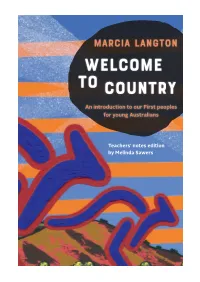
An Introduction to Our First Peoples for Young Australians
An introduction to our First peoples for young Australians Teachers’ notes edition by Melinda Sawers Welcome to Country teachers’ notes About these teachers’ notes These teachers’ notes have been written to align with each chapter of the bookWelcome to Country: Youth Edition and to assist teachers to prepare and present lessons and activities that draw on the main book. To use this material, teachers are advised to read the chapter in the main book, Welcome to Country: Youth Edition and then the associated material in these notes. Each chapter in the teachers’ notes follows the same format, and is designed to give teachers a summary of the chapter, background information helpful for teaching the content and then a list of the relevant Organising Ideas from the Cross-Curriculum Priority of Aboriginal and Torres Strait Islander Histories and Cultures. Following this are suggested teaching activities for a variety of subjects with references to resources, links to the relevant Content Descriptions and Content Elaborations for each subject and, finally, an extensive resource list. The Learning Activities range from short and simple, such as watching a three-minute YouTube video that presents new and interesting information to the students, to research topics that can fill an entire unit, such as understanding Australia’s Constitution. There are a wide variety of suggested student outcomes from singing, dancing, art and media productions, to debates, public presentations, scientific field explorations, conversations with historical figures and students producing their own webpage resources to assist others to learn about these topics. Teachers are encouraged to explore the resources listed at the end of each chapter to enrich their own knowledge and to develop their students’ understanding and enjoyment of learning about Australia’s First peoples. -

Nonggirrnga Marawili: Yathikpa
Art Appreciation Lecture Series 2017 Site Specific: The power of place Nonggirrnga Marawili: Yathikpa Cara Pinchbeck 8/9 February 2017 Lecture summary: Nonggirrnga Marawili is currently one of Australia’s leading artists. She comes from an esteemed artistic family. Her father is the famed Yolngu leader Mundukul Marawili, who completed crayon drawings for the anthropologist Ronald Berndt in 1947. Her husband is Djutjadjutja Mununggurr and for many years Marawili assisted him with the cross hatching on his refined bark paintings. Marawili began her career as a printmaker, but in recent years has further honed her skills in painting and dramatically altered her practice. Marawili paints alongside Nyapanyapa Yunupingu at the art centre in Yirrkala and together these ladies are forging a new identity for bark painting. Like many artists working at Yirrkala today, Marawili is interested in the atmospheric effects created as country is brought to life through the movement of wind, water or unseen forces. She is not just documenting sites in country, as her predecessors did, but capturing the dynamism of a living landscape. Within bark painting traditions, the continual reduction of imagery in Marawili’s work, and indeed the restraint she shows in retaining bold areas of background painting, devoid of decoration, are courageous. While Marawili does not break with tradition, she certainly pushes at its boundaries. This lecture will explore the evolution of Marawilli’s recent practice from her geometric paintings of the Djapu clan designs of Wanduwuy, through to her dramatic works of Yathikpa, which is of importance to the Madarrpa clan. Slide list: 1. -

Revolution Suite
Revolution suite 20 years of printmaking at Yirrkala Print Space New acquisitions to the CDU Art Collection displayed at CDU Art Gallery in conjunction with Balnhdhurr – a lasting impression, 12 May – 15 July 2016 revolution suite / 1 he Revolution suite of prints is a distinctive marker of 20 years of print production at the TYirrkala Print Space (YPS). Produced in 2015 and editioned by the YPS with Basil Hall Editions, these prints celebrate the successful operation of a limited edition print space as part of the Buku- Larraŋgay Mulka Art Centre in the remote North East Arnhem Land community, Yirrkala. The Revolution suite of etchings was initially exhibited at the outdoor Gupun Gallery, suspended from stringy bark trees as part of the Garma Festival in 2015, while simultaneously exhibited at Nomad Art, Darwin under the title Revolution.1 The term ‘revolution’ refers to the beginnings of the YPS back in May 1995 when the initiative to ‘seize the means of production into Yolŋu hands’ was instigated. However, ‘revolution’ can also relate, albeit lyrically, to the continuous turning and rotation of the wheel of the printing press, since the inception of YPS.2 The foundation of this ‘revolution’ was bubbling away long before 1995. Silk screen printing was taught at Dhupuma College as early as 1973 with students from North East Arnhem Land learning Figure. 1 this technique from balanda teachers.3 An Australian National University Artist-in-Residence Program in 1978 resulted in Narritjin Maymuru (1916–1981) producing his first etchings.4 In 1982 Untitled woodblock printing began in Yirrkala. -

Arts Backbone
Arts Backbone Volume 4 Issue 2: July 2004 EMPOWERING INDIGENOUS ART CENTRES Hello every body; to all those art centres in Arnhemland, Kimberley, Northern Territory and the Islands and to all the people in those southern areas. I will give you the background about ANKAAA. ANKAAA has recently got stronger and has sure things are done the right way. They become an industry for all art centres. To should work together and look after each me it is really important. To me it is a big other and spend the money the right way. one, not just a dream. It was really a plan for those people who are putting their input, In Yolngu way we used to make lettersticks not only on their art but also for those old to pass on information to other tribes so the people. They are the ones we are looking other tribes knew that Dreaming stories at and bringing their wishes and dreams were passing through, and sharing names to become a reality for young artists; to and culture to other tribes. Now we are teach them about leadership in their area, doing the same thing, using voice instead following the footsteps of their grandfathers, of letterstick, our voice now, sending it fathers, brothers, sisters, aunties and all interstate so everyone is learning from us. those people. Those people who never went to college, that is really important for those This is a message to those ANKAAA art people who cannot read English. centres. We need to get together with white and black and work together. -
Project Notes
Education Kit - Project Notes Djalkiri is a cross-cultural art project which commemorates the 150th anniversary of the publication of On the Origin of the Species by Charles Darwin. In 2009 Nomad Art Productions in Darwin brought a group of artists, scientists and printmakers together for a cross- cultural collaborative workshop in northern Australia. During the project nine Indigenous and non-Indigenous artists created art about the land, knowledge, history and events of the region. The result is an exhibition that explores the unspoiled environment of remote Blue Mud Bay in Arnhem Land and records knowledge of the natural environment, heritage, traditions and change. The Djalkiri Education Kit provides an introduction to the exhibition from an educational perspective. More information can be found in the Djalkiri exhibition catalogue. We are standing on their names Djalkiri:Blue Mud Bay • Project Notes Contents Message from Blue Mud Bay 3 Traditional Land Owners 4 Monsoon Traders (Macassans) 4 The Place 5 Life and Death in Baniyala 5 The Project 6 The Workshop 7 The Journey - Howard Morphy 7 Sea Rights 8 Collaborative Printmaking 9 The Printmaking Process 9 History of Aboriginal Printmaking 10 The Environment of the Top End 11 Ethno-biology in the Northern Territory 11 Glenn Wightman - Ethno-biologist 11 Laynhapuy Rangers Caring for Country 11 The Northern Territory Herbarium 12 How Plants are Named 12 Aboriginal Knowledge and Plant Use 12 Organising Knowledge Yolngu Way 13 Artwork Plant and Animal Species 14 Artists and Participants 16 Djambawa Marawili AM 17 Liyawaday Wirrpanda 18 Marrirra Marawili 19 Marrnyula Mununggurr 20 Mulkun Wirrpanda 21 Fiona Hall 22 John Wolseley 23 Jörg Schmeisser 24 Judy Watson 25 Basil Hall 26 Glenn Wightman 26 Howard Morphy 26 Peter Eve 26 Angus Cameron 27 Rose Cameron 27 Curriculum Links 27 Web Sites 28 Indigenous Knowledge and Protocols 29 2 We are standing on their names Djalkiri:Blue Mud Bay • Project Notes Message from Blue Mud Bay “Yolngu. -
Djalkiri: We Are Standing on Their Names, Blue Mud Bay Are Words Spoken 46 Acknowlegments by Djambawa Marawili
2 3 Introduction Contents The concept for this project came about in 2009, during the 150th anniversary of the publication of On the Origin of Species by Charles Darwin with its evolutionary 5 Introduction - Angus Cameron focus on relationships between animal species. Charles Darwin demonstrated that all species of life have evolved from common ancestors. His evolutionary theory of 7 Djalkiri - Djambawa Marawili AM natural selection forms the foundation of modern biology and an explanation for Western understandings of the diversity of life. 8 Making Art Work Together on Blue Mud Bay - Howard Morphy TheYithuwa Madarrpa people have a different perception. Yolŋu belief and knowledge is contained within songs, stories, ritual and art. Paintings are conceptual maps 13 Ancestral Figure - Will Stubbs depicting living things and earthly elements. All have meaning and are based on complex structures of knowledge and relationships. This is expressed through the 15 Djalkiri Magic - Glenn Wightman Djalkiri, literally meaning foot or footprints, but when applied to Yolŋu law it takes on a more profound meaning referring to the underlying ‘foundation of the world’. 16 Artist Statements The objective of this project was to bring a group of artists, scientists and print makers together in a cross-cultural, cross-disciplinary, creative exchange. 38 Artist and Participant Biographies To juxtapose Western scientific view points and knowledge with the holistic perspective of Yolŋu people. 40 Works At times, as the project developed, the notion seemed assuming and even presumptuous, and yet in the end it was an experience the participants will 42 Project Images never forget. The title, Djalkiri: We are standing on their names, Blue Mud Bay are words spoken 46 Acknowlegments by Djambawa Marawili. -

The Arts Backbone AUGUST 2002
ANKAAA ASSOCIATION OF THE NORTHERN, KIMBERLEY AND ARNHEM ABORIGINAL ARTISTS VOLUME 2, ISSUE 3 The Arts Backbone AUGUST 2002 INSIDE THIS ISSUE: Art centres working to 2 THE DEFUNDING OF ART CENTRES ... bring out the best in Samantha Togni, Director of Warlayirti Artists discusses the artists impact of defunding art centres on the artists Sotheby’s and 3 Aboriginal Art at Warlayirti Artists’ submission to ATSIC for rising significantly. The success of the organi- Auction operational funding for the 2002/03 was unsuc- sation is the main reason given by ATSIC for Feature Artists: 4 cessful, resulting in no operational grant fund- the cessation of operational funds. However, Marrnyula Mununggurr ing for the Warlayirti Art or Culture Centres in as any organisation grows so does its operating Namiyal Bopirri this current financial year. In the previous costs and to compete in the current art industry financial year (2001/02), the ATSIC funding Warlayirti Artists has to maintain a profes- Feature Art Centre: 5 was cut by more than half compared to the sional approach. While the organisation has Warmun Art Centre previous year. These funding cuts have had a taken more of a commercial management fo- Kiripuranji—Tiwi Art 6 significant impact on Warlayirti Artists and cus, the fact remains that Warlayirti Artists is Network’s First initially caused the closure of the Culture Cen- not a commercial enterprise but a non-profit Touring Exhibition tre, only a few months after it had opened in community organisation. And it is a strong July last year. community organisation whose core focus is Upcoming Exhibition 7 cultural maintenance and sustainability. -

Art Gallery of New South Wales 2015 Year in Review
Art Gallery of New South Wales Art Wales South Gallery New of ART GALLERY OF NEW SOUTH WALES 2015 2015 ART GALLERY OF NEW SOUTH WALES 2015 2 Art Gallery of New South Wales 2015 Art Gallery of New South Wales 2015 3 Our year in review 4 Art Gallery of New South Wales 2015 Art Gallery of New South Wales 2015 5 We dedicate this inaugural Art Gallery of New South Wales annual review publication to the Australian artists represented in the Gallery’s collection who have passed away during the year. 8 OUR VISION 9 FROM THE PRESIDENT Guido Belgiorno-Nettis 10 FROM THE DIRECTOR Michael Brand 12 YEAR AT A GLANCE 14 SYDNEY MODERN PROJECT 23 ART 42 IDEAS 50 AUDIENCE 60 PARTNERSHIPS 74 EXECUTIVE 75 CONTACTS 80 2016 PREVIEW Our vision From its base in Sydney, the Art Gallery of New South Wales is dedicated to serving the widest possible audience as a centre of excellence for the collection, preservation, documentation, interpretation and display of Australian and international art, and a forum for scholarship, art education and the exchange of ideas. Our goal is that by the time of our As Australia’s premier art museum, 150th anniversary in 2021, the Gallery we must reflect the continuing evolution will be recognised, both nationally of the visual arts in the 21st century and internationally, for the quality of alongside the development of new our collection, our facilities, our staff, channels of global communication that our scholarship and the innovative increasingly transcend national ways in which we engage with our boundaries.