Gastropoda Pulmonata) from the Iberian Peninsula
Total Page:16
File Type:pdf, Size:1020Kb
Load more
Recommended publications
-
National Monitoring Program for Biodiversity and Non-Indigenous Species in Egypt
UNITED NATIONS ENVIRONMENT PROGRAM MEDITERRANEAN ACTION PLAN REGIONAL ACTIVITY CENTRE FOR SPECIALLY PROTECTED AREAS National monitoring program for biodiversity and non-indigenous species in Egypt PROF. MOUSTAFA M. FOUDA April 2017 1 Study required and financed by: Regional Activity Centre for Specially Protected Areas Boulevard du Leader Yasser Arafat BP 337 1080 Tunis Cedex – Tunisie Responsible of the study: Mehdi Aissi, EcApMEDII Programme officer In charge of the study: Prof. Moustafa M. Fouda Mr. Mohamed Said Abdelwarith Mr. Mahmoud Fawzy Kamel Ministry of Environment, Egyptian Environmental Affairs Agency (EEAA) With the participation of: Name, qualification and original institution of all the participants in the study (field mission or participation of national institutions) 2 TABLE OF CONTENTS page Acknowledgements 4 Preamble 5 Chapter 1: Introduction 9 Chapter 2: Institutional and regulatory aspects 40 Chapter 3: Scientific Aspects 49 Chapter 4: Development of monitoring program 59 Chapter 5: Existing Monitoring Program in Egypt 91 1. Monitoring program for habitat mapping 103 2. Marine MAMMALS monitoring program 109 3. Marine Turtles Monitoring Program 115 4. Monitoring Program for Seabirds 118 5. Non-Indigenous Species Monitoring Program 123 Chapter 6: Implementation / Operational Plan 131 Selected References 133 Annexes 143 3 AKNOWLEGEMENTS We would like to thank RAC/ SPA and EU for providing financial and technical assistances to prepare this monitoring programme. The preparation of this programme was the result of several contacts and interviews with many stakeholders from Government, research institutions, NGOs and fishermen. The author would like to express thanks to all for their support. In addition; we would like to acknowledge all participants who attended the workshop and represented the following institutions: 1. -
ED45E Rare and Scarce Species Hierarchy.Pdf
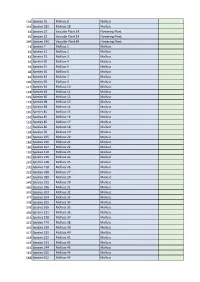
104 Species 55 Mollusc 8 Mollusc 334 Species 181 Mollusc 28 Mollusc 44 Species 23 Vascular Plant 14 Flowering Plant 45 Species 23 Vascular Plant 14 Flowering Plant 269 Species 149 Vascular Plant 84 Flowering Plant 13 Species 7 Mollusc 1 Mollusc 42 Species 21 Mollusc 2 Mollusc 43 Species 22 Mollusc 3 Mollusc 59 Species 30 Mollusc 4 Mollusc 59 Species 31 Mollusc 5 Mollusc 68 Species 36 Mollusc 6 Mollusc 81 Species 43 Mollusc 7 Mollusc 105 Species 56 Mollusc 9 Mollusc 117 Species 63 Mollusc 10 Mollusc 118 Species 64 Mollusc 11 Mollusc 119 Species 65 Mollusc 12 Mollusc 124 Species 68 Mollusc 13 Mollusc 125 Species 69 Mollusc 14 Mollusc 145 Species 81 Mollusc 15 Mollusc 150 Species 84 Mollusc 16 Mollusc 151 Species 85 Mollusc 17 Mollusc 152 Species 86 Mollusc 18 Mollusc 158 Species 90 Mollusc 19 Mollusc 184 Species 105 Mollusc 20 Mollusc 185 Species 106 Mollusc 21 Mollusc 186 Species 107 Mollusc 22 Mollusc 191 Species 110 Mollusc 23 Mollusc 245 Species 136 Mollusc 24 Mollusc 267 Species 148 Mollusc 25 Mollusc 270 Species 150 Mollusc 26 Mollusc 333 Species 180 Mollusc 27 Mollusc 347 Species 189 Mollusc 29 Mollusc 349 Species 191 Mollusc 30 Mollusc 365 Species 196 Mollusc 31 Mollusc 376 Species 203 Mollusc 32 Mollusc 377 Species 204 Mollusc 33 Mollusc 378 Species 205 Mollusc 34 Mollusc 379 Species 206 Mollusc 35 Mollusc 404 Species 221 Mollusc 36 Mollusc 414 Species 228 Mollusc 37 Mollusc 415 Species 229 Mollusc 38 Mollusc 416 Species 230 Mollusc 39 Mollusc 417 Species 231 Mollusc 40 Mollusc 418 Species 232 Mollusc 41 Mollusc 419 Species 233 -
Revision of the Systematic Position of Lindbergia Garganoensis
Revision of the systematic position of Lindbergia garganoensis Gittenberger & Eikenboom, 2006, with reassignment to Vitrea Fitzinger, 1833 (Gastropoda, Eupulmonata, Pristilomatidae) Gianbattista Nardi Via Boschette 8A, 25064 Gussago (Brescia), Italy; gbnardi@libero.it [corresponding author] Antonio Braccia Via Ischia 19, 25100 Brescia, Italy; ant.brac@tin.it Simone Cianfanelli Museum System of University of Florence, Zoological Section “La Specola”, Via Romana 17, 50125 Firenze, Italy; simone.cianfanelli@unifi.it & Marco Bodon c/o Museum System of University of Florence, Zoological Section “La Specola”, Via Romana 17, 50125 Firenze, Italy; bodonm0@gmail.com Nardi, G., Braccia, A., Cianfanelli, S. & Bo- INTRODUCTION don, M., 2019. Revision of the systematic position of Lindbergia garganoensis Gittenberger & Eiken- Lindbergia garganoensis Gittenberger & Eikenboom, 2006 boom, 2006, with reassignment to Vitrea Fitzinger, is the first species of the genus, Lindbergia Riedel, 1959 to 1833 (Gastropoda, Eupulmonata, Pristilomatidae). be discovered in Italy. The genus Lindbergia encompasses – Basteria 83 (1-3): 19-28. Leiden. Published 6 April 2019 about ten different species, endemic to the Greek mainland, Crete, the Cycladic islands, Dodecanese islands, northern Aegean islands, and southern Turkey (Riedel, 1992, 1995, 2000; Welter-Schultes, 2012; Bank & Neubert, 2017). Due to Lindbergia garganoensis Gittenberger & Eikenboom, 2006, lack of anatomical data, some of these species remain ge- a taxon with mainly a south-Balkan distribution, is the only nerically questionable. Up to now, L. garganoensis was only Italian species assigned to the genus Lindbergia Riedel, 1959. known by the presence of very fine spiral striae on the tel- The assignment to this genus, as documented by the pecu- eoconch and by the general shape of its shell. -

Reply to Quintana Et Al
SPIRA 2007 Vol. 2 Núm. 3 Pàg. 191-196 Rebut el 8 d’octubre de 2007; Acceptat el 27 d’octubre de 2007 Reply to Quintana et al. (2007): Darderia bellverica Altaba, 2007 is the correct name for the Mallorcan fossil helicodontid CRISTIAN R. ALTABA Laboratory of Human Systematics, Universitat de les Illes Balears, 07071 Palma de Mallorca, Balearic Islands (Spain) E-mail: cristianr.altaba@uib.es _______________________________________________________________________________________________ For several decades, a very rare, take the occasion to criticize my work. enigmatic land snail found in Quaternary Herewith I present a rebuttal of all their sediments on the island of Mallorca points. (Majorca) was attributed to Oestophora barbula (Rossmässler, 1838), a west- • The original description of Darderia Iberian species never recorded in the bellverica was published in February Balearics (Gasull, 1963; Cuerda, 1989). 2007. Although issue 26.2 of Animal This identification was based on superficial Biodiversity and Conservation belongs similarity and incomplete preparation of the into the volume corresponding to 2006, few specimens available. A re-examination the actual publication date is clearly of the two shells belonging to the Gasull mentioned in both the print and online collection and now deposited at the Museu versions. de Ciències Naturals de la Ciutadella in • The claim by Quintana et al. (2007) that Barcelona (catalog number MZB 84–6550) their former paper was published in allowed the description of a new species 2006 is a factual misrepresentation. within a new endemic genus, Darderia The Bolletí of the SHNB has often been bellverica Altaba, 2007 (Figures 1 and 2). published with great delay relative to the publication date printed in recent Several months after this description issues; volume 49 is no exception. -
Molluscs, by Michael J
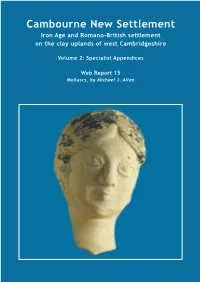
Cambourne New Settlement Iron Age and Romano-British settlement on the clay uplands of west Cambridgeshire Volume 2: Specialist Appendices Web Report 15 Molluscs, by Michael J. Allen Cambourne New Settlement Iron Age and Romano-British Settlement on the Clay Uplands of West Cambridgeshire By James Wright, Matt Leivers, Rachael Seager Smith and Chris J. Stevens with contributions from Michael J. Allen, Phil Andrews, Catherine Barnett, Kayt Brown, Rowena Gale, Sheila Hamilton-Dyer, Kevin Hayward, Grace Perpetua Jones, Jacqueline I. McKinley, Robert Scaife, Nicholas A. Wells and Sarah F. Wyles Illustrations by S.E. James Volume 2: Specialist Appendices Part 1. Artefacts Part 2. Ecofacts Wessex Archaeology Report No. 23 Wessex Archaeology 2009 Published 2009 by Wessex Archaeology Ltd Portway House, Old Sarum Park, Salisbury, SP4 6EB http://www.wessexarch.co.uk Copyright © 2009 Wessex Archaeology Ltd All rights reserved ISBN 978-1-874350-49-1 Project website http://www.wessexarch.co.uk/projects/cambridgeshire/cambourne WA reports web pages http://www.wessexarch.co.uk/projects/cambridgeshire/cambourne/reports ii Contents Web pdf 1 Contents and Concordance of sites and summary details of archive ................................ iii Part 1. Artefacts 2 Prehistoric pottery, by Matt Leivers.....................................................................................1 2 Late Iron Age pottery, by Grace Perpetua Jones................................................................11 2 Romano-British pottery, by Rachael Seager Smith ...........................................................14 -
Ecological Groups of Snails – Use and Perspectives
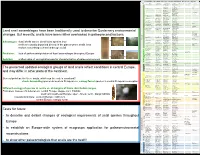
The subdivision of all central European Holocene and Late Glacial land snail species to ecological groups ecological Glacial Early Holocene Middle Holocene Late Holocene (sensu Walker at al 2012) modern immigrants comment group Acanthinula aculeata Acanthinula aculeata Acanthinula aculeata Acanthinula aculeata Acicula parcelineata Acicula parcelineata Aegopinella epipedostoma one sites Aegopinella nitens Aegopinella nitens Aegopinella nitidula Aegopinella nitidula few sites Aegopinella pura Aegopinella pura Aegopinella pura Aegopinella pura Aegopis verticillus Ecological groups of snails Argna bielzi Argna bielzi Bulgarica cana Bulgarica cana Carpathica calophana Carpathica calophana one site; undated Causa holosericea Causa holosericea Clausilia bidentata no fossil data Clausilia cruciata Clausilia cruciata Clausilia cruciata – use and perspectives Cochlodina laminata Cochlodina laminata Cochlodina laminata Cochlodina laminata Cochlodina orthostoma Cochlodina orthostoma Cochlodina orthostoma Cochlodina orthostoma Daudebardia brevipes Daudebardia brevipes Daudebardia rufa Daudebardia rufa Daudebardia rufa Daudebardia rufa Discus perspectivus Discus perspectivus Discus perspectivus 1 2 1 1 ) Lucie Juřičková , Michal Horsák , Jitka Horáčková and Vojen Ložek Discus ruderatus Discus ruderatus Discus ruderatus Discus ruderatus Ena montana Ena montana Ena montana Ena montana forest Eucobresia nivalis Eucobresia nivalis Eucobresia nivalis Faustina faustina Faustina faustina Faustina faustina Faustina faustina Faustina rossmaessleri Faustina -
National Monitoring Program for Biodiversity and Non-Indigenous Species in Egypt
National monitoring program for biodiversity and non-indigenous species in Egypt January 2016 1 TABLE OF CONTENTS page Acknowledgements 3 Preamble 4 Chapter 1: Introduction 8 Overview of Egypt Biodiversity 37 Chapter 2: Institutional and regulatory aspects 39 National Legislations 39 Regional and International conventions and agreements 46 Chapter 3: Scientific Aspects 48 Summary of Egyptian Marine Biodiversity Knowledge 48 The Current Situation in Egypt 56 Present state of Biodiversity knowledge 57 Chapter 4: Development of monitoring program 58 Introduction 58 Conclusions 103 Suggested Monitoring Program Suggested monitoring program for habitat mapping 104 Suggested marine MAMMALS monitoring program 109 Suggested Marine Turtles Monitoring Program 115 Suggested Monitoring Program for Seabirds 117 Suggested Non-Indigenous Species Monitoring Program 121 Chapter 5: Implementation / Operational Plan 128 Selected References 130 Annexes 141 2 AKNOWLEGEMENTS 3 Preamble The Ecosystem Approach (EcAp) is a strategy for the integrated management of land, water and living resources that promotes conservation and sustainable use in an equitable way, as stated by the Convention of Biological Diversity. This process aims to achieve the Good Environmental Status (GES) through the elaborated 11 Ecological Objectives and their respective common indicators. Since 2008, Contracting Parties to the Barcelona Convention have adopted the EcAp and agreed on a roadmap for its implementation. First phases of the EcAp process led to the accomplishment of 5 steps of the scheduled 7-steps process such as: 1) Definition of an Ecological Vision for the Mediterranean; 2) Setting common Mediterranean strategic goals; 3) Identification of an important ecosystem properties and assessment of ecological status and pressures; 4) Development of a set of ecological objectives corresponding to the Vision and strategic goals; and 5) Derivation of operational objectives with indicators and target levels. -

Suboestophora Tarraconensis (Aguilar-Amat, 1935) VU
Suboestophora tarraconensis (Aguilar-Amat, 1935) VU Categoría UICN: Vulnerable Criterio UICN: B1ab(iii)+2ab(iii); D2 Nombre Vulgar: Tipo: Mollusca Clase: Gastropoda Orden: Pulmonata Familia: Trissexodontidae Área de distribución a la reducción poblacional de esta especie en esta Endemismo catalano-valenciano, restringido en provincia (Martínez-Ortí y Robles, 2003). Cataluña al bajo valle del río Foix, en el Alto y Bajo Penedés y el Garraf, en la zona limítrofe entre las Medidas de conservación provincias de Tarragona y Barcelona. Bech (1990) Protección de su hábitat. Elaboración de un Plan cita la presencia de un ejemplar de S. tarraconensis de Conservación. en fase de crecimiento en Cova Balaguer, Monte Caro (Tarragona, Bajo Ebro). Esta localidad, sepa- Bibliografía rada de las áreas geográficas confirmadas para S. Bech, M. 1990. Fauna malacològica de Catalunya. tarraconensis y S. altimirai, queda por confirmar. En Mol.luscs terrestres i d’aigua dolça. Trb. Inst. la Comunidad Valenciana se extiende por las co- Cat. Hist. Nat., 12: 1-229. marcas castellonesas de La Plana Alta, L’Alcalatén, Martínez-Ortí, A. 1995. Characterization of Suboes- El Alto Mijares y La Plana Baixa (Martínez-Ortí y tophora altimirai (Ortiz de Zárate, 1962) (Pulmo- Robles, 2003). nata: Higromiidae). Abst. 12th Intern. Malacol. Congr., Vigo. A. Guerra, E. Rolán y F. Rocha eds.: Hábitat y Biología 389-391. Especie que habita debajo de piedras, entre la ho- Martínez-Ortí, A. 1999. Moluscos terrestres testáceos jarasca y dentro de grietas. Típica también de en- de la Comunidad Valenciana. Tesis doctoral (in- tradas de cuevas en las que se acumula materia or- édita). -

Fauna of New Zealand Website Copy 2010, Fnz.Landcareresearch.Co.Nz
aua o ew eaa Ko te Aiaga eeke o Aoeaoa IEEAE SYSEMAICS AISOY GOU EESEAIES O ACAE ESEAC ema acae eseac ico Agicuue & Sciece Cee P O o 9 ico ew eaa K Cosy a M-C aiièe acae eseac Mou Ae eseac Cee iae ag 917 Aucka ew eaa EESEAIE O UIESIIES M Emeso eame o Eomoogy & Aima Ecoogy PO o ico Uiesiy ew eaa EESEAIE O MUSEUMS M ama aua Eiome eame Museum o ew eaa e aa ogaewa O o 7 Weigo ew eaa EESEAIE O OESEAS ISIUIOS awece CSIO iisio o Eomoogy GO o 17 Caea Ciy AC 1 Ausaia SEIES EIO AUA O EW EAA M C ua (ecease ue 199 acae eseac Mou Ae eseac Cee iae ag 917 Aucka ew eaa Fauna of New Zealand Ko te Aitanga Pepeke o Aotearoa Number / Nama 38 Naturalised terrestrial Stylommatophora (Mousca Gasooa Gay M ake acae eseac iae ag 317 amio ew eaa 4 Maaaki Whenua Ρ Ε S S ico Caeuy ew eaa 1999 Coyig © acae eseac ew eaa 1999 o a o is wok coee y coyig may e eouce o coie i ay om o y ay meas (gaic eecoic o mecaica icuig oocoyig ecoig aig iomaio eiea sysems o oewise wiou e wie emissio o e uise Caaoguig i uicaio AKE G Μ (Gay Micae 195— auase eesia Syommaooa (Mousca Gasooa / G Μ ake — ico Caeuy Maaaki Weua ess 1999 (aua o ew eaa ISS 111-533 ; o 3 IS -7-93-5 I ie 11 Seies UC 593(931 eae o uIicaio y e seies eio (a comee y eo Cosy usig comue-ase e ocessig ayou scaig a iig a acae eseac M Ae eseac Cee iae ag 917 Aucka ew eaa Māoi summay e y aco uaau Cosuas Weigo uise y Maaaki Weua ess acae eseac O o ico Caeuy Wesie //wwwmwessco/ ie y G i Weigo o coe eoceas eicuaum (ue a eigo oaa (owe (IIusao G M ake oucio o e coou Iaes was ue y e ew eaIa oey oa ue oeies eseac -
Guidelines for the Capture and Management of Digital Zoological Names Information Francisco W
Guidelines for the Capture and Management of Digital Zoological Names Information Francisco W. Welter-Schultes Version 1.1 March 2013 Suggested citation: Welter-Schultes, F.W. (2012). Guidelines for the capture and management of digital zoological names information. Version 1.1 released on March 2013. Copenhagen: Global Biodiversity Information Facility, 126 pp, ISBN: 87-92020-44-5, accessible online at http://www.gbif.org/orc/?doc_id=2784. ISBN: 87-92020-44-5 (10 digits), 978-87-92020-44-4 (13 digits). Persistent URI: http://www.gbif.org/orc/?doc_id=2784. Language: English. Copyright © F. W. Welter-Schultes & Global Biodiversity Information Facility, 2012. Disclaimer: The information, ideas, and opinions presented in this publication are those of the author and do not represent those of GBIF. License: This document is licensed under Creative Commons Attribution 3.0. Document Control: Version Description Date of release Author(s) 0.1 First complete draft. January 2012 F. W. Welter- Schultes 0.2 Document re-structured to improve February 2012 F. W. Welter- usability. Available for public Schultes & A. review. González-Talaván 1.0 First public version of the June 2012 F. W. Welter- document. Schultes 1.1 Minor editions March 2013 F. W. Welter- Schultes Cover Credit: GBIF Secretariat, 2012. Image by Levi Szekeres (Romania), obtained by stock.xchng (http://www.sxc.hu/photo/1389360). March 2013 ii Guidelines for the management of digital zoological names information Version 1.1 Table of Contents How to use this book ......................................................................... 1 SECTION I 1. Introduction ................................................................................ 2 1.1. Identifiers and the role of Linnean names ......................................... 2 1.1.1 Identifiers .................................................................................. -

Guía De Los Caracoles Terrestres De Andalucía
El presente trabajo se enmarca en el Programa de Actuaciones para la Conservación y Uso sostenible de los caracoles terrestres de Andalucía, en el que colaboran, desde 2002, la Consejería de Medio Ambiente de la Junta de Andalucía y el Departamento de Fisiología y Zoología de la Universidad de Sevilla. La edición de la obra es fruto de la colaboración entre la Fundación Gypaetus y la Consejería de Medio Ambiente. Edición: Fundación Gypaetus. Dirección facultativa: Fernando Ortega Alegre. Autores: Antonio Ruiz Ruiz, Ángel Cárcaba Pozo, Ana I. Porras Crevillen y José R. Arrébola Burgos. Fotografía: Antonio Ruiz Ruiz, Alberto Martínez Ortí (págs. 211, 241). Diseño gráfico y maquetación: Carlos Manzano Arrondo y Juan A. Martínez Camúñez. I.S.B.N.: 84-935194-2-1. Depósito legal: 4 Sumario Presentación . 6 1. Introducción a la Guía de los caracoles terrestres de Andalucía a. La Guía y su estructura . 12 b. Uso de la guía . 22 c. Morfología de la concha en los caracoles terrestres . 26 d. Biología y ecología de los caracoles terrestres . 36 e. Normativa ambiental . 45 f. Localización, observación, estudio, identificación y conservación de caracoles terrestres . 49 2. Ordenación sistemática y catálogo de especies . 58 3. Glosario de términos . 278 4. Abreviaturas . 283 5. Indice de nombres científicos. 284 6. Bibliografía . 290 7. Agradecimientos . 299 8. Claves de símbolos . 300 5 Presentación de la Consejera de Medio Ambiente. Uno de los términos claves en Conservación es el de Biodiversidad o Diversidad Biológica. Alude a la gran variedad de formas y patrones de vida existente sobre el planeta y a los complejos ecológicos en los que se integran. -

European Red List of Non-Marine Molluscs Annabelle Cuttelod, Mary Seddon and Eike Neubert
European Red List of Non-marine Molluscs Annabelle Cuttelod, Mary Seddon and Eike Neubert European Red List of Non-marine Molluscs Annabelle Cuttelod, Mary Seddon and Eike Neubert IUCN Global Species Programme IUCN Regional Office for Europe IUCN Species Survival Commission Published by the European Commission. This publication has been prepared by IUCN (International Union for Conservation of Nature) and the Natural History of Bern, Switzerland. The designation of geographical entities in this book, and the presentation of the material, do not imply the expression of any opinion whatsoever on the part of IUCN, the Natural History Museum of Bern or the European Union concerning the legal status of any country, territory, or area, or of its authorities, or concerning the delimitation of its frontiers or boundaries. The views expressed in this publication do not necessarily reflect those of IUCN, the Natural History Museum of Bern or the European Commission. Citation: Cuttelod, A., Seddon, M. and Neubert, E. 2011. European Red List of Non-marine Molluscs. Luxembourg: Publications Office of the European Union. Design & Layout by: Tasamim Design - www.tasamim.net Printed by: The Colchester Print Group, United Kingdom Picture credits on cover page: The rare “Hélice catalorzu” Tacheocampylaea acropachia acropachia is endemic to the southern half of Corsica and is considered as Endangered. Its populations are very scattered and poor in individuals. This picture was taken in the Forêt de Muracciole in Central Corsica, an occurrence which was known since the end of the 19th century, but was completely destroyed by a heavy man-made forest fire in 2000.