BAST1993057004017.Pdf
Total Page:16
File Type:pdf, Size:1020Kb
Load more
Recommended publications
-
National Monitoring Program for Biodiversity and Non-Indigenous Species in Egypt
UNITED NATIONS ENVIRONMENT PROGRAM MEDITERRANEAN ACTION PLAN REGIONAL ACTIVITY CENTRE FOR SPECIALLY PROTECTED AREAS National monitoring program for biodiversity and non-indigenous species in Egypt PROF. MOUSTAFA M. FOUDA April 2017 1 Study required and financed by: Regional Activity Centre for Specially Protected Areas Boulevard du Leader Yasser Arafat BP 337 1080 Tunis Cedex – Tunisie Responsible of the study: Mehdi Aissi, EcApMEDII Programme officer In charge of the study: Prof. Moustafa M. Fouda Mr. Mohamed Said Abdelwarith Mr. Mahmoud Fawzy Kamel Ministry of Environment, Egyptian Environmental Affairs Agency (EEAA) With the participation of: Name, qualification and original institution of all the participants in the study (field mission or participation of national institutions) 2 TABLE OF CONTENTS page Acknowledgements 4 Preamble 5 Chapter 1: Introduction 9 Chapter 2: Institutional and regulatory aspects 40 Chapter 3: Scientific Aspects 49 Chapter 4: Development of monitoring program 59 Chapter 5: Existing Monitoring Program in Egypt 91 1. Monitoring program for habitat mapping 103 2. Marine MAMMALS monitoring program 109 3. Marine Turtles Monitoring Program 115 4. Monitoring Program for Seabirds 118 5. Non-Indigenous Species Monitoring Program 123 Chapter 6: Implementation / Operational Plan 131 Selected References 133 Annexes 143 3 AKNOWLEGEMENTS We would like to thank RAC/ SPA and EU for providing financial and technical assistances to prepare this monitoring programme. The preparation of this programme was the result of several contacts and interviews with many stakeholders from Government, research institutions, NGOs and fishermen. The author would like to express thanks to all for their support. In addition; we would like to acknowledge all participants who attended the workshop and represented the following institutions: 1. -
ED45E Rare and Scarce Species Hierarchy.Pdf
104 Species 55 Mollusc 8 Mollusc 334 Species 181 Mollusc 28 Mollusc 44 Species 23 Vascular Plant 14 Flowering Plant 45 Species 23 Vascular Plant 14 Flowering Plant 269 Species 149 Vascular Plant 84 Flowering Plant 13 Species 7 Mollusc 1 Mollusc 42 Species 21 Mollusc 2 Mollusc 43 Species 22 Mollusc 3 Mollusc 59 Species 30 Mollusc 4 Mollusc 59 Species 31 Mollusc 5 Mollusc 68 Species 36 Mollusc 6 Mollusc 81 Species 43 Mollusc 7 Mollusc 105 Species 56 Mollusc 9 Mollusc 117 Species 63 Mollusc 10 Mollusc 118 Species 64 Mollusc 11 Mollusc 119 Species 65 Mollusc 12 Mollusc 124 Species 68 Mollusc 13 Mollusc 125 Species 69 Mollusc 14 Mollusc 145 Species 81 Mollusc 15 Mollusc 150 Species 84 Mollusc 16 Mollusc 151 Species 85 Mollusc 17 Mollusc 152 Species 86 Mollusc 18 Mollusc 158 Species 90 Mollusc 19 Mollusc 184 Species 105 Mollusc 20 Mollusc 185 Species 106 Mollusc 21 Mollusc 186 Species 107 Mollusc 22 Mollusc 191 Species 110 Mollusc 23 Mollusc 245 Species 136 Mollusc 24 Mollusc 267 Species 148 Mollusc 25 Mollusc 270 Species 150 Mollusc 26 Mollusc 333 Species 180 Mollusc 27 Mollusc 347 Species 189 Mollusc 29 Mollusc 349 Species 191 Mollusc 30 Mollusc 365 Species 196 Mollusc 31 Mollusc 376 Species 203 Mollusc 32 Mollusc 377 Species 204 Mollusc 33 Mollusc 378 Species 205 Mollusc 34 Mollusc 379 Species 206 Mollusc 35 Mollusc 404 Species 221 Mollusc 36 Mollusc 414 Species 228 Mollusc 37 Mollusc 415 Species 229 Mollusc 38 Mollusc 416 Species 230 Mollusc 39 Mollusc 417 Species 231 Mollusc 40 Mollusc 418 Species 232 Mollusc 41 Mollusc 419 Species 233 -
Revision of the Systematic Position of Lindbergia Garganoensis
Revision of the systematic position of Lindbergia garganoensis Gittenberger & Eikenboom, 2006, with reassignment to Vitrea Fitzinger, 1833 (Gastropoda, Eupulmonata, Pristilomatidae) Gianbattista Nardi Via Boschette 8A, 25064 Gussago (Brescia), Italy; gbnardi@libero.it [corresponding author] Antonio Braccia Via Ischia 19, 25100 Brescia, Italy; ant.brac@tin.it Simone Cianfanelli Museum System of University of Florence, Zoological Section “La Specola”, Via Romana 17, 50125 Firenze, Italy; simone.cianfanelli@unifi.it & Marco Bodon c/o Museum System of University of Florence, Zoological Section “La Specola”, Via Romana 17, 50125 Firenze, Italy; bodonm0@gmail.com Nardi, G., Braccia, A., Cianfanelli, S. & Bo- INTRODUCTION don, M., 2019. Revision of the systematic position of Lindbergia garganoensis Gittenberger & Eiken- Lindbergia garganoensis Gittenberger & Eikenboom, 2006 boom, 2006, with reassignment to Vitrea Fitzinger, is the first species of the genus, Lindbergia Riedel, 1959 to 1833 (Gastropoda, Eupulmonata, Pristilomatidae). be discovered in Italy. The genus Lindbergia encompasses – Basteria 83 (1-3): 19-28. Leiden. Published 6 April 2019 about ten different species, endemic to the Greek mainland, Crete, the Cycladic islands, Dodecanese islands, northern Aegean islands, and southern Turkey (Riedel, 1992, 1995, 2000; Welter-Schultes, 2012; Bank & Neubert, 2017). Due to Lindbergia garganoensis Gittenberger & Eikenboom, 2006, lack of anatomical data, some of these species remain ge- a taxon with mainly a south-Balkan distribution, is the only nerically questionable. Up to now, L. garganoensis was only Italian species assigned to the genus Lindbergia Riedel, 1959. known by the presence of very fine spiral striae on the tel- The assignment to this genus, as documented by the pecu- eoconch and by the general shape of its shell. -
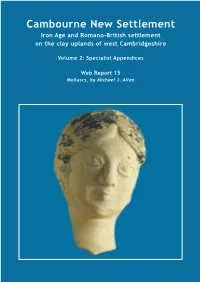
Molluscs, by Michael J
Cambourne New Settlement Iron Age and Romano-British settlement on the clay uplands of west Cambridgeshire Volume 2: Specialist Appendices Web Report 15 Molluscs, by Michael J. Allen Cambourne New Settlement Iron Age and Romano-British Settlement on the Clay Uplands of West Cambridgeshire By James Wright, Matt Leivers, Rachael Seager Smith and Chris J. Stevens with contributions from Michael J. Allen, Phil Andrews, Catherine Barnett, Kayt Brown, Rowena Gale, Sheila Hamilton-Dyer, Kevin Hayward, Grace Perpetua Jones, Jacqueline I. McKinley, Robert Scaife, Nicholas A. Wells and Sarah F. Wyles Illustrations by S.E. James Volume 2: Specialist Appendices Part 1. Artefacts Part 2. Ecofacts Wessex Archaeology Report No. 23 Wessex Archaeology 2009 Published 2009 by Wessex Archaeology Ltd Portway House, Old Sarum Park, Salisbury, SP4 6EB http://www.wessexarch.co.uk Copyright © 2009 Wessex Archaeology Ltd All rights reserved ISBN 978-1-874350-49-1 Project website http://www.wessexarch.co.uk/projects/cambridgeshire/cambourne WA reports web pages http://www.wessexarch.co.uk/projects/cambridgeshire/cambourne/reports ii Contents Web pdf 1 Contents and Concordance of sites and summary details of archive ................................ iii Part 1. Artefacts 2 Prehistoric pottery, by Matt Leivers.....................................................................................1 2 Late Iron Age pottery, by Grace Perpetua Jones................................................................11 2 Romano-British pottery, by Rachael Seager Smith ...........................................................14 -
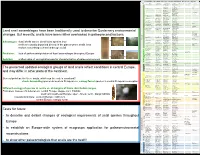
Ecological Groups of Snails – Use and Perspectives
The subdivision of all central European Holocene and Late Glacial land snail species to ecological groups ecological Glacial Early Holocene Middle Holocene Late Holocene (sensu Walker at al 2012) modern immigrants comment group Acanthinula aculeata Acanthinula aculeata Acanthinula aculeata Acanthinula aculeata Acicula parcelineata Acicula parcelineata Aegopinella epipedostoma one sites Aegopinella nitens Aegopinella nitens Aegopinella nitidula Aegopinella nitidula few sites Aegopinella pura Aegopinella pura Aegopinella pura Aegopinella pura Aegopis verticillus Ecological groups of snails Argna bielzi Argna bielzi Bulgarica cana Bulgarica cana Carpathica calophana Carpathica calophana one site; undated Causa holosericea Causa holosericea Clausilia bidentata no fossil data Clausilia cruciata Clausilia cruciata Clausilia cruciata – use and perspectives Cochlodina laminata Cochlodina laminata Cochlodina laminata Cochlodina laminata Cochlodina orthostoma Cochlodina orthostoma Cochlodina orthostoma Cochlodina orthostoma Daudebardia brevipes Daudebardia brevipes Daudebardia rufa Daudebardia rufa Daudebardia rufa Daudebardia rufa Discus perspectivus Discus perspectivus Discus perspectivus 1 2 1 1 ) Lucie Juřičková , Michal Horsák , Jitka Horáčková and Vojen Ložek Discus ruderatus Discus ruderatus Discus ruderatus Discus ruderatus Ena montana Ena montana Ena montana Ena montana forest Eucobresia nivalis Eucobresia nivalis Eucobresia nivalis Faustina faustina Faustina faustina Faustina faustina Faustina faustina Faustina rossmaessleri Faustina -
National Monitoring Program for Biodiversity and Non-Indigenous Species in Egypt
National monitoring program for biodiversity and non-indigenous species in Egypt January 2016 1 TABLE OF CONTENTS page Acknowledgements 3 Preamble 4 Chapter 1: Introduction 8 Overview of Egypt Biodiversity 37 Chapter 2: Institutional and regulatory aspects 39 National Legislations 39 Regional and International conventions and agreements 46 Chapter 3: Scientific Aspects 48 Summary of Egyptian Marine Biodiversity Knowledge 48 The Current Situation in Egypt 56 Present state of Biodiversity knowledge 57 Chapter 4: Development of monitoring program 58 Introduction 58 Conclusions 103 Suggested Monitoring Program Suggested monitoring program for habitat mapping 104 Suggested marine MAMMALS monitoring program 109 Suggested Marine Turtles Monitoring Program 115 Suggested Monitoring Program for Seabirds 117 Suggested Non-Indigenous Species Monitoring Program 121 Chapter 5: Implementation / Operational Plan 128 Selected References 130 Annexes 141 2 AKNOWLEGEMENTS 3 Preamble The Ecosystem Approach (EcAp) is a strategy for the integrated management of land, water and living resources that promotes conservation and sustainable use in an equitable way, as stated by the Convention of Biological Diversity. This process aims to achieve the Good Environmental Status (GES) through the elaborated 11 Ecological Objectives and their respective common indicators. Since 2008, Contracting Parties to the Barcelona Convention have adopted the EcAp and agreed on a roadmap for its implementation. First phases of the EcAp process led to the accomplishment of 5 steps of the scheduled 7-steps process such as: 1) Definition of an Ecological Vision for the Mediterranean; 2) Setting common Mediterranean strategic goals; 3) Identification of an important ecosystem properties and assessment of ecological status and pressures; 4) Development of a set of ecological objectives corresponding to the Vision and strategic goals; and 5) Derivation of operational objectives with indicators and target levels. -

Fauna of New Zealand Website Copy 2010, Fnz.Landcareresearch.Co.Nz
aua o ew eaa Ko te Aiaga eeke o Aoeaoa IEEAE SYSEMAICS AISOY GOU EESEAIES O ACAE ESEAC ema acae eseac ico Agicuue & Sciece Cee P O o 9 ico ew eaa K Cosy a M-C aiièe acae eseac Mou Ae eseac Cee iae ag 917 Aucka ew eaa EESEAIE O UIESIIES M Emeso eame o Eomoogy & Aima Ecoogy PO o ico Uiesiy ew eaa EESEAIE O MUSEUMS M ama aua Eiome eame Museum o ew eaa e aa ogaewa O o 7 Weigo ew eaa EESEAIE O OESEAS ISIUIOS awece CSIO iisio o Eomoogy GO o 17 Caea Ciy AC 1 Ausaia SEIES EIO AUA O EW EAA M C ua (ecease ue 199 acae eseac Mou Ae eseac Cee iae ag 917 Aucka ew eaa Fauna of New Zealand Ko te Aitanga Pepeke o Aotearoa Number / Nama 38 Naturalised terrestrial Stylommatophora (Mousca Gasooa Gay M ake acae eseac iae ag 317 amio ew eaa 4 Maaaki Whenua Ρ Ε S S ico Caeuy ew eaa 1999 Coyig © acae eseac ew eaa 1999 o a o is wok coee y coyig may e eouce o coie i ay om o y ay meas (gaic eecoic o mecaica icuig oocoyig ecoig aig iomaio eiea sysems o oewise wiou e wie emissio o e uise Caaoguig i uicaio AKE G Μ (Gay Micae 195— auase eesia Syommaooa (Mousca Gasooa / G Μ ake — ico Caeuy Maaaki Weua ess 1999 (aua o ew eaa ISS 111-533 ; o 3 IS -7-93-5 I ie 11 Seies UC 593(931 eae o uIicaio y e seies eio (a comee y eo Cosy usig comue-ase e ocessig ayou scaig a iig a acae eseac M Ae eseac Cee iae ag 917 Aucka ew eaa Māoi summay e y aco uaau Cosuas Weigo uise y Maaaki Weua ess acae eseac O o ico Caeuy Wesie //wwwmwessco/ ie y G i Weigo o coe eoceas eicuaum (ue a eigo oaa (owe (IIusao G M ake oucio o e coou Iaes was ue y e ew eaIa oey oa ue oeies eseac -

(Gastropoda, Pulmonata, Gargano in Italy & Joop+CA Eikenboom (In Litt
BASTERIA, 70:161-163, 2006 The genus Lindbergia (Gastropoda, Pulmonata, Zonitidae) in Greece and the Promontorio del Gargano in Italy Edmund Gittenberger National Museum of Natural History Naturalis, P.O. Box 9517, NL 2300 RALeiden, The Netherlands; gittenberger@naturalis.nnm.nl & Joop+C.A. Eikenboom Asmusstraat 7, NL 3221 BA Hellevoetsluis, The Netherlands; jeikenboom@12move.nl Three species with small, narrowly perforate, zonitid shells, are reportedfrom the Promontorio del Two of these is Gargano, Italy. are problematic Vitrea species. Here, the third one provi- described L. because of the sionally as a Lindbergia species, garganoensis spec. nov., general of the shell and the of the teleoconch whorls. That is hitherto shape microsculpture genus known from Greece only. words: Key Gastropoda, Pulmonata, Zonitidae,Lindbergia, new species, Italy, Gargano. INTRODUCTION While studying bottom samples, collected independently by both authors of this in paper the region of the Promontorio del Gargano, Puglia, Italy, many small zonitid shells were sorted These shells could be classified out. easily into two categories on the basis of the relative widthof theirumbilicus. Next to specimens with an umbilicus meas- of the shell shells with much umbilicus uring c. 1/7 width, a narrower were present. The former category is rather homogeneous in size and shape and reminds of species like Vitrea botterii (L. Pfeiffer, 1853) and V. contracta (Westerlund, 1871). Without anatomical data and in the absence of of the Italian a general revision Vitrea Fitzinger, 1833, species, the identity of this species has to remain uncertain. The shells the second belonging to category are equally problematical. They can be subdivided into three species, i.e. -

Abbreviation Kiel S. 2005, New and Little Known Gastropods from the Albian of the Mahajanga Basin, Northwestern Madagaskar
1 Reference (Explanations see mollusca-database.eu) Abbreviation Kiel S. 2005, New and little known gastropods from the Albian of the Mahajanga Basin, Northwestern Madagaskar. AF01 http://www.geowiss.uni-hamburg.de/i-geolo/Palaeontologie/ForschungImadagaskar.htm (11.03.2007, abstract) Bandel K. 2003, Cretaceous volutid Neogastropoda from the Western Desert of Egypt and their place within the noegastropoda AF02 (Mollusca). Mitt. Geol.-Paläont. Inst. Univ. Hamburg, Heft 87, p 73-98, 49 figs., Hamburg (abstract). www.geowiss.uni-hamburg.de/i-geolo/Palaeontologie/Forschung/publications.htm (29.10.2007) Kiel S. & Bandel K. 2003, New taxonomic data for the gastropod fauna of the Uzamba Formation (Santonian-Campanian, South AF03 Africa) based on newly collected material. Cretaceous research 24, p. 449-475, 10 figs., Elsevier (abstract). www.geowiss.uni-hamburg.de/i-geolo/Palaeontologie/Forschung/publications.htm (29.10.2007) Emberton K.C. 2002, Owengriffithsius , a new genus of cyclophorid land snails endemic to northern Madagascar. The Veliger 45 (3) : AF04 203-217. http://www.theveliger.org/index.html Emberton K.C. 2002, Ankoravaratra , a new genus of landsnails endemic to northern Madagascar (Cyclophoroidea: Maizaniidae?). AF05 The Veliger 45 (4) : 278-289. http://www.theveliger.org/volume45(4).html Blaison & Bourquin 1966, Révision des "Collotia sensu lato": un nouveau sous-genre "Tintanticeras". Ann. sci. univ. Besancon, 3ème AF06 série, geologie. fasc.2 :69-77 (Abstract). www.fossile.org/pages-web/bibliographie_consacree_au_ammon.htp (20.7.2005) Bensalah M., Adaci M., Mahboubi M. & Kazi-Tani O., 2005, Les sediments continentaux d'age tertiaire dans les Hautes Plaines AF07 Oranaises et le Tell Tlemcenien (Algerie occidentale). -

Gastropoda Pulmonata) from the Iberian Peninsula
BASTERIA, 55: 3-7, 1991 New land snails (Gastropoda Pulmonata) from the Iberian peninsula A.J. de Winter c/o Nationaal Natuurhistorisch Museum, P.O. Box 9517, 2300 RA Leiden, the Netherlands & Th.E.J. Ripken Houttuinen 16, 2611 AJ Delft, the Netherlands Two new stylommatophoranland snails are described from Spain, viz., Oestophora (O.) ortizi from the of and Vitrea inae nov. spec. province Malaga, nov. spec. from the province of Teruel. Topotypic shells of V. pygmaea (O. Boettger) and shells from the Algerian province of Mostaganem resembling this species are described and figured for comparison. Vitrea cf. pygmaea is an addition to the Algerian faunal list. words: Pulmonata, Zonitidae, Key Gastropoda, Helicidae, Oestophora, Vitrea, taxonomy, faunistics, Spain, Algeria. Below two new species of stylommatophoran snails are described from Spain. The following abbreviations have been used: IZPAN for Instytut Zoologiczny Polska Akademia Nauk, Warsaw (Poland); NNM for Nationaal Natuurhistorisch Museum, Historie Leiden. formerly Rijksmuseum van Natuurlijke (RMNH), ortizi (1) Oestophora (Oestophora) nov. spec. (figs. 1-3) Material. W. of Torremolinos, from rock crevice in Spain, prov. Malaga, just RMNH dry calcareous slope (holotype 56490, paratypes RMNH 56491/5 ad. + 4 juv.), and in humid sites along brook, under stones (paratypes RMNH ale. 9238/5); UTM UF6S; Januari 1, 1983; A.J. de Winter leg. Description. Shell roughly circular in outline. Spire somewhat elevated. Umbilicus Periphery vaguely angulated. round, very deep, cylindrical, taking up one fifth to one sixth of the shell diameter. Aperture without barriers. Outer lip reflexed, but thin, without undulations. Shell colour pale brown. Adult shells measure between 8.3 and 9.2 mm maximum width, with 5.5-5.8 whorls. -

Manuscript Final Foropenaccess
View metadata, citation and similar papers at core.ac.uk brought to you by CORE provided by Repository@Nottingham 1 Molecular phylogeny of the Achatinoidea (Mollusca: Gastropoda) 2 3 4 Ian Kendrich Fontanillaa,c, Fred Naggsb, Christopher Mark Wadea,* 5 aSchool of Life Sciences, University of Nottingham, University Park, Nottingham, United 6 Kingdom 7 b Life Sciences Department, Natural History Museum, London, United Kingdom 8 cInstitute of Biology, College of Science and the Philippine Genome Center, University of the 9 Philippines, Diliman, Quezon City, Philippines1 10 11 *corresponding author (Chris.Wade@nottingham.ac.uk) 12 1Present address of IKF 13 Abstract 14 This study presents a multi-gene phylogenetic analysis of the Achatinoidea and provides an 15 initial basis for a taxonomic re-evaluation of family level groups within the superfamily. A total 16 of 5028 nucleotides from the nuclear rRNA, actin and histone 3 genes and the 1st and 2nd codon 17 positions of the mitochondrial cytochrome c oxidase subunit I gene were sequenced from 24 18 species, representing six currently recognised families. Results from maximum likelihood, 19 neighbour joining, maximum parsimony and Bayesian inference trees revealed that, of currently 20 recognised families, only the Achatinidae are monophyletic. For the Ferussaciidae, Ferussacia 21 folliculus fell separately to Cecilioides gokweanus and formed a sister taxon to the rest of the 22 Achatinoidea. For the Coeliaxidae, Coeliaxis blandii and Pyrgina umbilicata did not group 23 together. The Subulinidae was not resolved, with some subulinids clustering with the 24 Coeliaxidae and Thyrophorellidae. Three subfamilies currently included within the Subulinidae 25 based on current taxonomy likewise did not form monophyletic groups. -

Spatial Structure of a Gastropod Community in the Litter of a Beech Forest of Dentario Glandulosae-Fagetum in the Tatra Mountains
Folia Malacol. 3: 55–72 http://dx.doi.org/10.12657/folmal.003.004 SPATIAL STRUCTURE OF A GASTROPOD COMMUNITY IN THE LITTER OF A BEECH FOREST OF DENTARIO GLANDULOSAE-FAGETUM IN THE TATRA MOUNTAINS †ANNA DYDUCH-FALNIOWSKA, HALINA TOBIS Institute of Nature Conservation, Polish Academy of Sciences, Al. Mickiewicza 33, 31-120 Cracow, Poland ABSTRACT: The grid method was used in the present study of the spatial structure of a gastropod community. 2,474 specimens representing 29 species were collected from an area of 9 sq m. The numbers of species were higher in squares with higher densities of snails (rNS = 0.9). Species diversity varied between the squares, ranging from about 2.6 to 4.1, and was not very closely correlated with increase in species number (rSH = 0.6). Snail density was not correlated with average dry litter weight in a square (rNM = –0.03). The values of the indices of Lexis and of Morista show that the distribution of snails in the studied forest patches was aggregated. The material suggests an obvious relation between snails and plants. KEY WORDS: Gastropoda, mountain malacofauna, snail community structure, species composition, abundance, dominance, ecological parameters Folia Malacologica 3/1989 was originally published as No. 1216 of Scientific Bulletins of University of Mining and Metallurgy, Cracow. This digitalised version was prepared by the Association of Polish Malacologists and first published on-line on December 30th, 2016. ZESZYTY NAUKOWE AKADEMII OORNICZO-HUTNICZEJ IM. STANISlAWA STASZICA Nr 1216 Folia Malaeologiea L 3 Krak6w 1989 ANNA OVDUCH·FALNIOWSKA AND HALINA TOBIS SPATIAL STRUCTURE OF A GASTROPOD COMMUNITY IN THE LITTER OF A BEECH FOREST OF DENTARIO-GLANOULOSAE FAGETUM IN THE TATRA MOUNTAINS .