Turismo Rural De Navarra
Total Page:16
File Type:pdf, Size:1020Kb
Load more
Recommended publications
-

Biogeography of Spain and Portugal
VOLUME 4 NUMBER 1 DECEMBER 2014 CONTENTS Biogeography of Spain and Portugal. Preliminary typological synopsis ..................................................... 1-64 S. Rivas-Martínez, Á. Penas, T.E. Díaz-González, S. del Río, P. Cantó, L. Herrero, C. Pinto Gomes & J. C. Costa The Galician-Portuguese biogeographic sector. An inicial advance .......................................................... 65-81 S. Rivas-Martínez, J. Izco, T.E. Díaz-González, Á. Penas, J. C. Costa, J. Amigo, L. Herrero, J. Giménez de Azcárate & S. del Río International Journal of Geobotanical Research, Vol. nº 4. 2014. pp. 1-64 Biogeography of Spain and Portugal. Preliminary typological synopsis Salvador RIVAS-MARTÍNEZ (1), Ángel PENAS (2), Tomás E. DÍAZ-GONZÁLEZ (3), Sara DEL RÍO (2),Paloma CANTÓ(4), Luis HERRERO (2), Carlos PINTO GOMES (5) and Jose Carlos COSTA (6) (1) Phytosociological Research Center, Collado-Villalba, Madrid, Spain. (2) Department of Biodiversity and Environmental Management (Area of Botany). Mountain Livestock Farming Institute (Join Center CSIC- ULE), Faculty of Biological and Environmental Sciences, University of León (Spain), Campus of Vegazana, s/n., E-24071 León. (3) Department of Organisms and Systems, Faculty of Biological, University of Oviedo., E-24071 Oviedo. Spain. (4) Department of Vegetal Biology II, Faculty of Pharmacia, Complutense University of Madrid., E-28071. Madrid. Spain. (5) Department of Paisagem, Ambiente e Ordenamento. Universidade de Evora. Evora. Portugal (6) Instituto Superior de Agronomia, Universidade Técnica de Lisboa, Centro de Botânica Aplicada à Agricultura, Tapada da Ajuda 1349-017 Lisboa, Portugal. Abstract: A preliminary biogeographical typology of Spain and Portugal is established in the present paper. Two regions, 5 subregions, 13 provinces, 18 subprovinces, 62 sectors and 267 districts are recognized. -

Neat Document
TNI MkttlINt *F IITtllitTieitl FOLK OtICIII Vol 36, No. 6 USPS 310-580 JULY/AUGUST 1979 OFFICIAL PUBLICATION OF THE TABLE OF CONTENTS FOLK DANCE FEDERATION OF CALIFORNIA, INC. WELCOME, MARIN FESTIVAL ........... 1 EDITOR............June Horn FUN IN MARIN PROGRAM............2 ASSOCIATE EDITOR........Max Horn DANCE RESEARCH EDITOR. Dorothy Tamburini COSTUMES OF THE BASQUES...........4 COSTUME RESEARCH EDITOR .. Eleanor Bacon A MOMENT OF CONCERN ............. 8 ETHNIC FOOD EDITOR ..... Vi Dexheimer BUSINESS MANAGER........Max Horn THE DANCE OF NAVARRE............9 FOOD IN THE BASQUE MANNER.........16 BASQUE HOTELS ............... 18 JULY/AUGUST CONTRIBUTORS DANCE DESCRIPTION: Jim Rasella Larry Miller Imotz Ibarreko Esku Dantza (Spain) ... 21 Candi deAlaiza Ruth Miller Harriet Calsbeek Frank Bacher REPLY TO DEAN LINSCOTT...........23 Vance Teague Al Li sin LONG-RANGE STUDY COMMITTEE REPORT ..... 26 Catherine Soule' A1 Tesler Bruce Wyckoff Earl Wilson ENSEMBLE INTERNATIONAL .......... 30 Vera Jones Alice Needham BEGINNERS' FESTIVAL - AFTER ....... 31 Nona Verzi Leonore Fifer Genevieve Pereira Perle Bleadon PARTY PLACES - NORTH........... 32 PARTY PLACES - SOUTH............34 COUNCIL CLIPS ............... 35 FEDERATION OFFICERS (North) ECHOES FROM THE SOUTHLAND.........37 PRESIDENT ......... Bruce Wyckoff CALENDAR OF EVENTS - NORTH.........38 1215 Chesterton Ave,Redwood City.CA 94061 VICE PRESIDENT ....... Frank Bacher CALENDAR OF EVENTS - SOUTH ......... 39 TREASURER ......... Oscar Faoro CLASSIFIED ADS...............40 RECORDING SECRETARY ..... Dee Silva DIRECTOR OF PUBLICATIONS. Joyce Uggla ADVERTISERS 7, 17, 25, 29, 36, 39 DIRECTOR OF MEMBERSHIP . Wesley Takara back cover DIRECTOR OF PUBLICITY . .Diane Childers HISTORIAN ......... Leona Faoro ON OUR COVER SOUTH Elko "Arinak" Basque Dancers PRESIDENT .......... Dorothy Daw Gordon Campbell Photo VICE PRESIDENT.......Dave Slater TREASURER..........Avis Tarvin RECORDING SECRETARY.....Li la Aurich DIRECTOR OF EXTENSION. -

RONCESVALLES 2020 JUBILAR YEAR VIII CENTENARY CONSECRATION of the ROYAL COLLEGIATE (July, 17Th 2020- July, 17Th 2021)
RONCESVALLES 2020 JUBILAR YEAR VIII CENTENARY CONSECRATION OF THE ROYAL COLLEGIATE (July, 17th 2020- July, 17th 2021) ORGANIZATION SPONSOR Arzobispado de Pamplona-Tudela Etxenike Asociación de Amigos de la Colegiata MAGNA Real Colegiata de Roncesvalles. Banco Santander Consejo Navarro del Movimiento Europeo Señorío de Sarría URIEL P a g e 1 | 28 RELIGIOUS ACTS JULY 2020 July 17th 2020, Friday: Centennial Date July 18th 2020, Saturday: Commemoration of the Centenary of the Consecration of the Royal Collegiate Church of Roncesvalles Official opening of the Jubilee Year of Santa María de Roncesvalles Place: Collegiate 18h- Solemn Eucharist presided by D. Francisco Pérez González, Archbishop of Pamplona and Bishop of Tudela. Mass sung. Invitation to religious, civil and military authorities. 19h- Concert after mass in the same collegiate church Music by the Corals Auzperri, Espinal, Orreaga, Aezkoa, and group Zorongo 19:30h- Visit to the college buildings and Museum July 25th 2020, Monday-Saturday: Santiago’s Day Place: Royal Collegiate Church of Roncesvalles 18h- Solemn Eucharist in memory of the victims of the Covid-19 pandemic AUGUST 2020 August 15th 2020, Saturday: Anniversary of the Battle of Roncesvalles (15 / 8/ 778) 18h- Solemn Eucharist of the Assumption of Our Lady, in memory of those who died in the battle of Roncesvalles Musical performance by the Zaraitzu choir, from the Salazar valley 18h- Procession to the Silo of Charlemagne, where a response will be prayed for those killed in battle. Inauguration and blessing of the new columbarium 19.30h.- Explanation of the current state of the Silo excavations by Francisco José Valle de Tarazaga Montero (ADITU Arkeologia), responsible for the excavation. -

Village Federations. Robust Nested Governance in Northern Spain (Navarre, 14Th-20 Centuries) 1
Village Federations. Robust Nested Governance in Northern Spain 1 (Navarre, 14th-20 centuries) Miguel Laborda Pemán Utrecht University M.LabordaPeman@uu.nl José Miguel Lana Berasain Public University of Navarra Josem.lana@unavarra.es November 2012 Very Preliminary Version Do not quote without the authors’ permission Abstract: The aim of this paper is to contribute to the analysis of nested governance of common-pool resources from a long-term perspective. Our main research questions are: How was nesting articulated in pre-industrial societies? Which were their advantages and risks? To answer them, we analyse two historical case studies of nested regimes. In particular, the Valley of Roncal and the Sierra of Lokiz, both of them situated in Navarre, northern Spain, arranged across several levels the management and use of grazing pastures and forests already by the 14 th century. Keywords : Common-Property Institutions, Nesting, Multi-Level Governance. 1 This working paper has been written within the framework of the NWO-funded research project ‘Common Rules’. The regulation of institutions for managing commons in Europe, 1100 - 1800' , co- ordinated by dr. Tine de Moor (September 2011-August 2014), and in the case of J.M.Lana of the project HAR2009-09700, financed by the DGICyT. The authors thanks the members of the research team of the project Common Rules (Tine de Moor, René van Weeren, Annelies Tukker, Angus Winchester and Claudio Tagliapietra) their useful insights and help. All remaining errors are authors’ exclusive responsibility. 1 INTRODUCTION Among Ostrom’s design principles (E. Ostrom, 1990), institutional nesting appears as one of the least explored ones. -

Biogeography of Spain and Portugal. Preliminary Typological Synopsis
International Journal of Geobotanical Research, Vol. nº 4. 2014. pp. 1-64 Biogeography of Spain and Portugal. Preliminary typological synopsis Salvador RIVAS-MARTÍNEZ (1), Ángel PENAS (2), Tomás E. DÍAZ-GONZÁLEZ (3), Sara DEL RÍO (2),Paloma CANTÓ(4), Luis HERRERO (2), Carlos PINTO GOMES (5) and Jose Carlos COSTA (6) (1) Phytosociological Research Center, Collado-Villalba, Madrid, Spain. (2) Department of Biodiversity and Environmental Management (Area of Botany). Mountain Livestock Farming Institute (Join Center CSIC- ULE), Faculty of Biological and Environmental Sciences, University of León (Spain), Campus of Vegazana, s/n., E-24071 León. (3) Department of Organisms and Systems, Faculty of Biological, University of Oviedo., E-24071 Oviedo. Spain. (4) Department of Vegetal Biology II, Faculty of Pharmacia, Complutense University of Madrid., E-28071. Madrid. Spain. (5) Department of Paisagem, Ambiente e Ordenamento. Universidade de Evora. Evora. Portugal (6) Instituto Superior de Agronomia, Universidade Técnica de Lisboa, Centro de Botânica Aplicada à Agricultura, Tapada da Ajuda 1349-017 Lisboa, Portugal. Abstract: A preliminary biogeographical typology of Spain and Portugal is established in the present paper. Two regions, 5 subregions, 13 provinces, 18 subprovinces, 62 sectors and 267 districts are recognized. Its biogeographic content besides nomenclatural changes of those units previously described are shown. Finally, its names in English, Spanish and Portuguese are stated. Keywords: Biogeography. Spain. Portugal. Biogeographic units Introdution nial substitution units- are the only biogeographical units which can be repeated disjointed. Biogeography is the science which studies the distri- The landscape cells, such as horst, peneplains, river bution of species, communities, habitats, biocoenosis and ecosystems on the Earth, as well as the relationships valleys, lake systems, marshes, high mountain summits, between them and their causes. -

The Challenge of a Bilingual Society in the Basque Country
The Challenge of a Bilingual Society in the Basque Country EDITED BY Pello Salaburu and Xabier Alberdi Center for Basque Studies UPV/EHU University of Nevada, Reno Center for Basque Studies Current Research Series, No. 9 Te Challenge of a Bilingual Society in the Basque Country Edited by Pello Salaburu and Xabier Alberdi Current Research Series No. 9 Center for Basque Studies University of Nevada, Reno Published in conjunction with the University of the Basque Country UPV/EHU //__ Center for I -::::- Basque Studies Universidad Euskal Herriko c) UNIVERSITY OF NEVADA, RENO - II del Pafs Vasco Unibertsitatea Current Research Selections of the ongoing work done by the faculty of the University of the Basque Country (UPV/EHU), www.ehu.es Editorial Committee Amaia Maseda (Chair, University of the Basque Country, UPV/EHU), Arantza Azpiroz (University of the Basque Country, UPV/EHU), Javier Echeverría (Uni- versity of the Basque Country, UPV/EHU, and Ikerbasque), Jon Landeta (Uni- versity of the Basque Country, UPV/EHU), Sandra Ott (UNR), Joseba Zulaika (UNR), Santos Zunzunegui (University of the Basque Country, UPV/EHU) Current Research Series No. 9 Center for Basque Studies University of Nevada, Reno Reno, Nevada 89557 http://basque.unr.edu Copyright © 2012 by the Center for Basque Studies. All rights reserved. Printed in the United States of America. Cover and series design © 2011 by Jose Luis Agote. Cover design based on engravings by Eduardo Chillida and Jorge Oteiza. Translations by: introduction, Cameron J. Watson; chapter 1, Julie Waddington; chapter 2, Laura Bunt MacRury; chapters 3, 7, and 9, Jennifer R. Ottman; chapters 4, 5 and 6, Jennifer Martin Library of Congress Cataloging-in-Publication Data Te challenge of a bilingual society in the Basque country / edited by Pello Salaburu and Xabier Alberdi. -
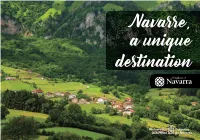
Navarre, a Unique Destination
Navarre, a unique destination LA ZONA MEDIA NAVARRA DESTINO ÚNICO | 1 © GOVERNMENT OF NAVARRE Department of Economic Development Directorate General of Tourism and Trade Tourism Marketing Service 1st edition – february 2019 Written by: Heda Comunicación Cover photo: Gaintza (G. Arrugaeta) DL/LG NA 368-2019 Ref. C203 Printed on recycled paper Plazaola Rail Trail 2 | NAVARRA DESTINO ÚNICO LA ZONA MEDIA You choose; we will win you over Navarre is a unique land of tracks, urbanites will fi nd a green city which is pathways and stunning views; an array home to great treasures, not to mention of villages, farmhouses, landscapes, a world famous festival, San Fermin; tre- traditions and people. Everything is at kkers can choose between the green hills your fi ngertips. Just 100 kilometres as of the Pyrenees and the wide open spaces the crow fl ies separate the high peaks of of the Middle Zone or the Ribera region; the Pyrenees from the lunar landscapes and gourmets will want the taste of the of the Bardenas Reales Natural Park. authentic local cuisine to linger in their The diversity and contrast of Navarre mouths for ever. If you are one of those makes it a paradise for all types of tra- travellers or all of them at the same time, veller. Culture lovers will be enraptured we invite you to live your own experience. by its artistic heritage and everything And remember, Navarre is committed to that has sprung up around the Way of St sustainable tourism! It is possible to dis- James over the years; those with more cover nature while taking care of it, pass curious minds will enjoy the store of through without leaving a trace, take in learning and customs of its people; culture and traditions while helping to adventurers will discover peaceful preserve them, and buy local products to villages and locations where they can help keep the places you visit alive. -

ALAZET-20:PORTADA ALAZET-19 03/03/10 9:11 Página 1
PORTADA ALAZET-20:PORTADA ALAZET-19 03/03/10 9:11 Página 1 20 CONTENIDOS DEL NÚMERO 20 (2008) ESTUDIOS BENÍTEZ MARCO, Mª Pilar, y LATAS ALEGRE, Óscar, Textos inéditos en ansotano de Juan Fran- cisco Aznárez. BUJ ALFARA, Àngela, Restes d’aragonès en etnotextos de Villarroya de los Pinares. CIERBIDE MARTINENA, Ricardo, La scripta medieval bajonavarra y su relación con la jaquesa. FRANCO ANCHELERGUES, Vicente, Esta sequera s’acabará cuando llueva. Facecias paremiológicas en los Refranes de Arnal Cavero. GARGALLO GIL, José Enrique, Los refranes meteorológicos en aragonés, en el marco de la pare- miología románica. LÓPEZ-MUGARTZA IRIARTE, Juan Carlos, Las relaciones históricas entre los valles de Ansó (Ara- gón) y Roncal (Navarra) y su reflejo en la lengua y en la toponimia. NAGORE LAÍN, Francho, Bels aspeutos lingüisticos en un testo en aragonés meyebal: as ordi- nazions d’a Cofrairía d’a Transfixión de Zaragoza (1311-1508). RIZOS JIMÉNEZ, Carlos Ángel, Toponimia prerromana en la Baja Ribagorza occidental. ROMERO CAMBRÓN, Ángeles, El comienzo del manuscrito 2211 de la Biblioteca Nacional de ALAZET España (Grant crónica de los conquiridores, primera partida). SANCHIS I FERRER, Pau, y Nikola VULETIĆ, La construcció cali que + subjuntiu de l’espanyol sefardita: de l’aragonés i el català als Balcans. SANTOMÁ JUNCADELLA, Luis, Aportaciones del gascón al occitano aragonés del siglo XIII. SEGURA MALAGÓN, Juan José, y Guillermo TOMÁS FACI, Conciencia y reivindicación lingüísti- ca en el Aragón medieval: el caso de las Cortes de Aragón de 1382-1384. -

Basque Diaspora Gloria Totoricagüena Phd Is a Political Scientist Who Specializes in Basque Migration and Diaspora Studies
Gloria Totoricagüena Basque DiasporaMigration and Transnational Identity Center for Basque Studies · University of Nevada, Reno Basque Diaspora Gloria Totoricagüena PhD is a political scientist who specializes in Basque migration and diaspora studies. She earned her doctorate degree in Comparative Politics from the London School of Economics and Political Sci- ence, and currently researches and teaches at the Center for Basque Studies at the University of Nevada, Reno. She has conducted unparalleled fieldwork and investigation with Basques from communities in over twenty coun- tries and regularly serves as a consultant for institutions in the Basque Country. Her work has been awarded and recognized internationally, including the Vasca Mun- dial, Worldly Basque, award in 2003, and when selected as the President of the Committee of Academic Experts from the Eusko Ikaskuntza, or Basque Studies Society, initiative for EuskoSare, a worldwide network for Basque studies. Dr. Totoricagüena collaborates in various research projects with homeland institutions and with those of the Basque diaspora. She is a permanent delegate to the North American Basque Organizations, and has repre- sented the United States in each of the World Congresses of Basque Collectivities. Her numerous publications include more than thirty articles and several books including: Identity, Culture, and Politics in the Basque Diaspora; The Basques of New York: A Cosmopolitan Experience; Diáspora Vasca Comparada: Etnicidad, Cul- tura y Política en las Colectividades Vascas del Exterior; and The Basques of Boise: Dreamers and Doers. Gloria Totoricagüena Basque Diaspora Migration and Transnational Identity Basque Textbooks Series Center for Basque Studies University of Nevada, Reno This book was published with generous financial support from the Basque Government. -
The Influence of Emigration and Return on Aezkoa Valley and Its Surrounding Rural Communities in Northern Navarre at the Turn of the 19Th Century
University of Nevada, Reno Homeward Bound: The Influence of Emigration and Return on Aezkoa Valley and its Surrounding Rural Communities in Northern Navarre at the turn of the 19th Century A dissertation submitted in partial fulfillment of the requirements for the degree of Doctor of Philosophy in Basque Studies by Amaia Iraizoz Cia Dr. Xabier Irujo/Dissertation Co-Advisor Dr. Óscar Álvarez Gila/Dissertation Co-Advisor December, 2017 © Copyright by Amaia Iraizoz Cia All Rights Reserved December 2017 THE GRADUATE SCHOOL We recommend that the dissertation prepared under our supervision by AMAIA IRAIZOZ CIA Entitled Homeward Bound: The Influence Of Emigration And Return On Aezkoa Valley And Its Surrounding Rural Communities In Northern Navarre At The Turn Of The 19th Century be accepted in partial fulfillment of the requirements for the degree of DOCTOR OF PHILOSOPHY Xabier Irujo, Ph.D., Advisor Óscar Álvarez Gila Ph.D, Co-Advisor, Committee Member Joseba Zulaika, Ph.D., Committee Member Meredith Oda, Ph.D., Committee Member María del Mar Larraza, Ph.D., Committee Member Deborah Boehm, Ph.D., Graduate School Representative David W. Zeh, Ph. D., Dean, Graduate School December, 2017 i Abstract The aim of this dissertation is to provide a study on Basque transnational migration from the perspective of the homeland. The goal is to see to what extent this transnational migration influenced and impacted local communities in the rural Basque area, concretely in Aezkoa Valley and other villages that surround it at the turn of the nineteenth century into the twentieth. The traditional focus of Basque migration studies has long been on male migrants and unidirectional migratory experiences. -

El Euskera En El Alto Aragón
View metadata, citation and similar papers at core.ac.uk brought to you by CORE provided by Hedatuz EL EUSKERA EN EL ALTO ARAGON Gartzen Lacasta Estaun Cuadernos de Sección. Hizkuntza eta Literatura 12. (1994) p. 141-278 ISSN: 0212-3223 Donostia: Eusko Ikaskuntza El propósito del presente trabajo es poner de relieve una serie de afinidades existentes entre los espacios culturales contiguos constituidos por el Alto Aragón y el País Vasco. Objeto central de estudio es el posible re- flejo que un grupo de étimos vascos, escogidos al azar, han podido ejercer en la toponimia altoaragonesa. El análisis no es exhaustivo, podría aducirse multitud de otros topónimos cuyo carácter vascoide parece bastante transparente. Otra serie de fenómenos de diversa índole dejan entrever que /as concordancias toponomásticas no son un hecho aislado. Se comienza recogiendo la opinión de prestigiosos filólogos sobre la importancia de los estudios de toponimia altoaragonesa para el conocimiento del protovasco o de esas hablas previas a la ro- manización que debieron hablarse en los valles pirenaicos. Lan honen helburua hauxe izango litzateke: Goi Aragoneko eta Euskalerriko kultural hauzoaldeetan agert- zen diren antzekotasun xamarrak eraizte eta azpimarratzea. Ikerketa honen lan gunea asmo gaberik hartutariko euskal ‘etimo’ batzuk Goi Aragoneko toponimian jo egin duen islarak aratzea da. Azterketa hau ez da hain ze- hatza; euskal izaera agirian daukaten hainbat eta hainbat adibide eta toponimo ere erakar erazi lirateke. Bai beste era ezberdinetako fenomenoak ere erakusten digute ez direla adostasun toponomastikoak gauza bat eta bakarra. Hasieran Goi Aragoneko toponimia ikasketen garrantzia azaltzen dituen filolo handien eritsiak batzen dira, batez ere aintzinako euskerean edota erromanizazioaren aurretiz firinioetako aranetan egiten ziren hizkunt- zetan ere. -

Navarre, a Unique Destination
Navarre, a unique destination LA ZONA MEDIA NAVARRA DESTINO ÚNICO | 1 © GOVERNMENT OF NAVARRE Department of Economic Development Directorate General of Tourism and Trade Tourism Marketing Service 1st edition – february 2019 Written by: Heda Comunicación Cover photo: Gaintza (G. Arrugaeta) DL/LG NA 25-2019 Ref. C203 Printed on recycled paper Plazaola Rail Trail 2 | NAVARRA DESTINO ÚNICO LA ZONA MEDIA You choose; we will win you over Navarre is a unique land of tracks, urbanites will fi nd a green city which is pathways and stunning views; an array home to great treasures, not to mention of villages, farmhouses, landscapes, a world famous festival, San Fermin; tre- traditions and people. Everything is at kkers can choose between the green hills your fi ngertips. Just 100 kilometres as of the Pyrenees and the wide open spaces the crow fl ies separate the high peaks of of the Middle Zone or the Ribera region; the Pyrenees from the lunar landscapes and gourmets will want the taste of the of the Bardenas Reales Natural Park. authentic local cuisine to linger in their The diversity and contrast of Navarre mouths for ever. If you are one of those makes it a paradise for all types of tra- travellers or all of them at the same time, veller. Culture lovers will be enraptured we invite you to live your own experience. by its artistic heritage and everything And remember, Navarre is committed to that has sprung up around the Way of St sustainable tourism! It is possible to dis- James over the years; those with more cover nature while taking care of it, pass curious minds will enjoy the store of through without leaving a trace, take in learning and customs of its people; culture and traditions while helping to adventurers will discover peaceful preserve them, and buy local products to villages and locations where they can help keep the places you visit alive.