El Euskera En El Alto Aragón
Total Page:16
File Type:pdf, Size:1020Kb
Load more
Recommended publications
-

Biogeography of Spain and Portugal
VOLUME 4 NUMBER 1 DECEMBER 2014 CONTENTS Biogeography of Spain and Portugal. Preliminary typological synopsis ..................................................... 1-64 S. Rivas-Martínez, Á. Penas, T.E. Díaz-González, S. del Río, P. Cantó, L. Herrero, C. Pinto Gomes & J. C. Costa The Galician-Portuguese biogeographic sector. An inicial advance .......................................................... 65-81 S. Rivas-Martínez, J. Izco, T.E. Díaz-González, Á. Penas, J. C. Costa, J. Amigo, L. Herrero, J. Giménez de Azcárate & S. del Río International Journal of Geobotanical Research, Vol. nº 4. 2014. pp. 1-64 Biogeography of Spain and Portugal. Preliminary typological synopsis Salvador RIVAS-MARTÍNEZ (1), Ángel PENAS (2), Tomás E. DÍAZ-GONZÁLEZ (3), Sara DEL RÍO (2),Paloma CANTÓ(4), Luis HERRERO (2), Carlos PINTO GOMES (5) and Jose Carlos COSTA (6) (1) Phytosociological Research Center, Collado-Villalba, Madrid, Spain. (2) Department of Biodiversity and Environmental Management (Area of Botany). Mountain Livestock Farming Institute (Join Center CSIC- ULE), Faculty of Biological and Environmental Sciences, University of León (Spain), Campus of Vegazana, s/n., E-24071 León. (3) Department of Organisms and Systems, Faculty of Biological, University of Oviedo., E-24071 Oviedo. Spain. (4) Department of Vegetal Biology II, Faculty of Pharmacia, Complutense University of Madrid., E-28071. Madrid. Spain. (5) Department of Paisagem, Ambiente e Ordenamento. Universidade de Evora. Evora. Portugal (6) Instituto Superior de Agronomia, Universidade Técnica de Lisboa, Centro de Botânica Aplicada à Agricultura, Tapada da Ajuda 1349-017 Lisboa, Portugal. Abstract: A preliminary biogeographical typology of Spain and Portugal is established in the present paper. Two regions, 5 subregions, 13 provinces, 18 subprovinces, 62 sectors and 267 districts are recognized. -

Village Federations. Robust Nested Governance in Northern Spain (Navarre, 14Th-20 Centuries) 1
Village Federations. Robust Nested Governance in Northern Spain 1 (Navarre, 14th-20 centuries) Miguel Laborda Pemán Utrecht University M.LabordaPeman@uu.nl José Miguel Lana Berasain Public University of Navarra Josem.lana@unavarra.es November 2012 Very Preliminary Version Do not quote without the authors’ permission Abstract: The aim of this paper is to contribute to the analysis of nested governance of common-pool resources from a long-term perspective. Our main research questions are: How was nesting articulated in pre-industrial societies? Which were their advantages and risks? To answer them, we analyse two historical case studies of nested regimes. In particular, the Valley of Roncal and the Sierra of Lokiz, both of them situated in Navarre, northern Spain, arranged across several levels the management and use of grazing pastures and forests already by the 14 th century. Keywords : Common-Property Institutions, Nesting, Multi-Level Governance. 1 This working paper has been written within the framework of the NWO-funded research project ‘Common Rules’. The regulation of institutions for managing commons in Europe, 1100 - 1800' , co- ordinated by dr. Tine de Moor (September 2011-August 2014), and in the case of J.M.Lana of the project HAR2009-09700, financed by the DGICyT. The authors thanks the members of the research team of the project Common Rules (Tine de Moor, René van Weeren, Annelies Tukker, Angus Winchester and Claudio Tagliapietra) their useful insights and help. All remaining errors are authors’ exclusive responsibility. 1 INTRODUCTION Among Ostrom’s design principles (E. Ostrom, 1990), institutional nesting appears as one of the least explored ones. -

Biogeography of Spain and Portugal. Preliminary Typological Synopsis
International Journal of Geobotanical Research, Vol. nº 4. 2014. pp. 1-64 Biogeography of Spain and Portugal. Preliminary typological synopsis Salvador RIVAS-MARTÍNEZ (1), Ángel PENAS (2), Tomás E. DÍAZ-GONZÁLEZ (3), Sara DEL RÍO (2),Paloma CANTÓ(4), Luis HERRERO (2), Carlos PINTO GOMES (5) and Jose Carlos COSTA (6) (1) Phytosociological Research Center, Collado-Villalba, Madrid, Spain. (2) Department of Biodiversity and Environmental Management (Area of Botany). Mountain Livestock Farming Institute (Join Center CSIC- ULE), Faculty of Biological and Environmental Sciences, University of León (Spain), Campus of Vegazana, s/n., E-24071 León. (3) Department of Organisms and Systems, Faculty of Biological, University of Oviedo., E-24071 Oviedo. Spain. (4) Department of Vegetal Biology II, Faculty of Pharmacia, Complutense University of Madrid., E-28071. Madrid. Spain. (5) Department of Paisagem, Ambiente e Ordenamento. Universidade de Evora. Evora. Portugal (6) Instituto Superior de Agronomia, Universidade Técnica de Lisboa, Centro de Botânica Aplicada à Agricultura, Tapada da Ajuda 1349-017 Lisboa, Portugal. Abstract: A preliminary biogeographical typology of Spain and Portugal is established in the present paper. Two regions, 5 subregions, 13 provinces, 18 subprovinces, 62 sectors and 267 districts are recognized. Its biogeographic content besides nomenclatural changes of those units previously described are shown. Finally, its names in English, Spanish and Portuguese are stated. Keywords: Biogeography. Spain. Portugal. Biogeographic units Introdution nial substitution units- are the only biogeographical units which can be repeated disjointed. Biogeography is the science which studies the distri- The landscape cells, such as horst, peneplains, river bution of species, communities, habitats, biocoenosis and ecosystems on the Earth, as well as the relationships valleys, lake systems, marshes, high mountain summits, between them and their causes. -
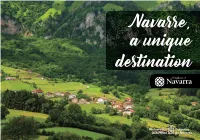
Navarre, a Unique Destination
Navarre, a unique destination LA ZONA MEDIA NAVARRA DESTINO ÚNICO | 1 © GOVERNMENT OF NAVARRE Department of Economic Development Directorate General of Tourism and Trade Tourism Marketing Service 1st edition – february 2019 Written by: Heda Comunicación Cover photo: Gaintza (G. Arrugaeta) DL/LG NA 368-2019 Ref. C203 Printed on recycled paper Plazaola Rail Trail 2 | NAVARRA DESTINO ÚNICO LA ZONA MEDIA You choose; we will win you over Navarre is a unique land of tracks, urbanites will fi nd a green city which is pathways and stunning views; an array home to great treasures, not to mention of villages, farmhouses, landscapes, a world famous festival, San Fermin; tre- traditions and people. Everything is at kkers can choose between the green hills your fi ngertips. Just 100 kilometres as of the Pyrenees and the wide open spaces the crow fl ies separate the high peaks of of the Middle Zone or the Ribera region; the Pyrenees from the lunar landscapes and gourmets will want the taste of the of the Bardenas Reales Natural Park. authentic local cuisine to linger in their The diversity and contrast of Navarre mouths for ever. If you are one of those makes it a paradise for all types of tra- travellers or all of them at the same time, veller. Culture lovers will be enraptured we invite you to live your own experience. by its artistic heritage and everything And remember, Navarre is committed to that has sprung up around the Way of St sustainable tourism! It is possible to dis- James over the years; those with more cover nature while taking care of it, pass curious minds will enjoy the store of through without leaving a trace, take in learning and customs of its people; culture and traditions while helping to adventurers will discover peaceful preserve them, and buy local products to villages and locations where they can help keep the places you visit alive. -

ALAZET-20:PORTADA ALAZET-19 03/03/10 9:11 Página 1
PORTADA ALAZET-20:PORTADA ALAZET-19 03/03/10 9:11 Página 1 20 CONTENIDOS DEL NÚMERO 20 (2008) ESTUDIOS BENÍTEZ MARCO, Mª Pilar, y LATAS ALEGRE, Óscar, Textos inéditos en ansotano de Juan Fran- cisco Aznárez. BUJ ALFARA, Àngela, Restes d’aragonès en etnotextos de Villarroya de los Pinares. CIERBIDE MARTINENA, Ricardo, La scripta medieval bajonavarra y su relación con la jaquesa. FRANCO ANCHELERGUES, Vicente, Esta sequera s’acabará cuando llueva. Facecias paremiológicas en los Refranes de Arnal Cavero. GARGALLO GIL, José Enrique, Los refranes meteorológicos en aragonés, en el marco de la pare- miología románica. LÓPEZ-MUGARTZA IRIARTE, Juan Carlos, Las relaciones históricas entre los valles de Ansó (Ara- gón) y Roncal (Navarra) y su reflejo en la lengua y en la toponimia. NAGORE LAÍN, Francho, Bels aspeutos lingüisticos en un testo en aragonés meyebal: as ordi- nazions d’a Cofrairía d’a Transfixión de Zaragoza (1311-1508). RIZOS JIMÉNEZ, Carlos Ángel, Toponimia prerromana en la Baja Ribagorza occidental. ROMERO CAMBRÓN, Ángeles, El comienzo del manuscrito 2211 de la Biblioteca Nacional de ALAZET España (Grant crónica de los conquiridores, primera partida). SANCHIS I FERRER, Pau, y Nikola VULETIĆ, La construcció cali que + subjuntiu de l’espanyol sefardita: de l’aragonés i el català als Balcans. SANTOMÁ JUNCADELLA, Luis, Aportaciones del gascón al occitano aragonés del siglo XIII. SEGURA MALAGÓN, Juan José, y Guillermo TOMÁS FACI, Conciencia y reivindicación lingüísti- ca en el Aragón medieval: el caso de las Cortes de Aragón de 1382-1384. -

Turismo Rural De Navarra
Turismo Rural de Navarra Esta Guía, editada por la Federación de Asociaciones y Organizaciones Turísticas de Navarra, es fruto del trabajo en unión y la ilusión compartida de 9 Asociaciones de Turismo Rural. Ofrece una oferta turística completa y respetuosa con el entorno y la forma de vida del medio rural, para su dis- frute de una forma sana y saludable, de la naturaleza y sus parajes privilegiados. Podrás conocer la cultura e historia de los pueblos, tareas agrícolas y ganaderas y descubrir activi- dades deportivas impresionantes, todo ello en un ambiente de autenticidad y serenidad. En esta Guía encontrarás oferta de diferentes tipos de alojamientos rurales: albergues, apartamentos turísticos, campings, casas rurales de alquiler íntegro o por habita- ciones, hoteles, hostales, pensiones. Oferta también de restaurantes, donde degustar nuestra tradicional gastrono- mía navarra, así como de empresas de actividades, con las que disfrutar a tope de todos los recursos que la naturaleza pone a nuestro alcance. Establecimientos auténticos en los que contarás con un tratamiento personalizado. El turismo rural se desarrolla en pequeñas localidades y pue- blos y su actividad contribuye al desarrollo y sostenimiento económico de la zona. Tu contribución al mantenimiento de las zonas rurales es muy importante para nosotros, por ello, agradecemos sinceramente tu visita, al tiempo que te deci- mos ¡bienvenid@! Fotografías cedidas por el archivo de Turismo “Reyno de Navarra” y fotografías participantes en los Concursos Foto- gráficos organizados por la Federación de Turismo Rural de Navarra. EDIta: Federación de Asociaciones y Organizaciones Turísticas de Navarra. DISEÑO Y REALIZACIÓN: Your Concept Group. IMPRIME: Gráficas Ulzama. -

Navarre, a Unique Destination
Navarre, a unique destination LA ZONA MEDIA NAVARRA DESTINO ÚNICO | 1 © GOVERNMENT OF NAVARRE Department of Economic Development Directorate General of Tourism and Trade Tourism Marketing Service 1st edition – february 2019 Written by: Heda Comunicación Cover photo: Gaintza (G. Arrugaeta) DL/LG NA 25-2019 Ref. C203 Printed on recycled paper Plazaola Rail Trail 2 | NAVARRA DESTINO ÚNICO LA ZONA MEDIA You choose; we will win you over Navarre is a unique land of tracks, urbanites will fi nd a green city which is pathways and stunning views; an array home to great treasures, not to mention of villages, farmhouses, landscapes, a world famous festival, San Fermin; tre- traditions and people. Everything is at kkers can choose between the green hills your fi ngertips. Just 100 kilometres as of the Pyrenees and the wide open spaces the crow fl ies separate the high peaks of of the Middle Zone or the Ribera region; the Pyrenees from the lunar landscapes and gourmets will want the taste of the of the Bardenas Reales Natural Park. authentic local cuisine to linger in their The diversity and contrast of Navarre mouths for ever. If you are one of those makes it a paradise for all types of tra- travellers or all of them at the same time, veller. Culture lovers will be enraptured we invite you to live your own experience. by its artistic heritage and everything And remember, Navarre is committed to that has sprung up around the Way of St sustainable tourism! It is possible to dis- James over the years; those with more cover nature while taking care of it, pass curious minds will enjoy the store of through without leaving a trace, take in learning and customs of its people; culture and traditions while helping to adventurers will discover peaceful preserve them, and buy local products to villages and locations where they can help keep the places you visit alive. -
Tourist Experiences Pamplona / Navarre 2019
Collaborators Created by TOURIST EXPERIENCES PAMPLONA / NAVARRE 2019 WWW.VISITNAVARRA.INFO www.turismo.navarra.es www.hostelerianavarra.com www.turismodepamplona.es www.turismodepamplona.es www.turismo.navarra.es See everything that awaits you in Navarre... CLOSE TO YOU NAVARRE, JUST A STEP AWAY Navarra shares a border with France, while it is just a three-hour train journey from Madrid, and its motorway and road network is one of the best in Spain. The Autonomous Community of Navarra enjoys excellent accessibility to the main communication hubs, while it also has good connections by rail and air. Pamplona is served by the airport at Noáin and it is also less than 250 kilometres away from six other airports. GERMANY Frankfurt 2 hours FRANCE ITALY Donostia- Biarritz San Sebastián Pau Bilbao FRANCE EUSKADI N-121 A-15 Lourdes A-10 A-1 Vitoria- Pamplona BY ROAD BY PLANE RAIL Gasteiz A-21 AP-1 The road network in Navarra has a radial Navarra has daily direct flights to The train service in Navarra has regular A-12 AP-68 pattern, with Pamplona as its hub. Its two Madrid, departing from the airport at lines connecting with the principal NAVARRE main axes cross the autonomous Noain, located just 6 kilometres from Spain’s cities like: AP-15 Logroño community from north to south, connecting Pamplona. The L16 city bus line links Barcelona - Madrid - Bilbao - Irún ARAGÓN Spain to Europe. Pamplona with the airport. In a radius A Coruña - Valencia - Zaragoza, etc... LA RIOJA AP-68 • N-121-A and N-121: Behobia - Pamplona of 96 to 250 km, there are six airports and Pamplona - Tudela. -

Senda De Camille
SENDA DE CAMILLE Trekking through the territory of the last indigenous Pyrenean bear CICMA: 2608 +34 629 379 894 www.exploring-spain.com info@exploring-spain.com TABLE OF CONTENTS 1 Introduction .............................................................................................................................. 1 2 The destination ......................................................................................................................... 2 3 Basic information ...................................................................................................................... 2 3.1 Required physical condition and type of terrain ........................................................................... 2 4 Programme ............................................................................................................................... 3 4.1 Programme outline ....................................................................................................................... 3 4.2 Detailed programme ..................................................................................................................... 3 5 More information ..................................................................................................................... 5 5.1 Included ......................................................................................................................................... 5 5.2 Not included ................................................................................................................................. -

2014 Y Digital a Través De La Creación De Revistas Online En 4º De La ESO 77 Garikoitz Montañés Laurenz 77 1
Contenido Índice / Aurkibidea 5 Cortesía lingüística: un estudio en el ámbito educativo 9 Iñigo ALDUNTZIN GARCIA 9 1. Introducción 10 2. Marco teórico 13 3. Metodología 21 4. Resultados 25 5. Propuesta de acción 36 6. Conclusiones 37 Bibliografía 41 Una propuesta didáctica para mejorar la motivación hacia la expresión escrita por medio de la creación audiovisual 43 Celia BUSTAMANTE ECHEVARRÍA 43 1. Introducción 43 2. Marco teórico 45 3. Metodología 50 4. Resultados 57 5. Conclusiones 67 Número 14 6. Futuras líneas de investigación 74 Bibliografía 75 Desarrollo de las competencias lingüística 2014 y digital a través de la creación de revistas online en 4º de la ESO 77 Garikoitz MONTAÑÉS LAURENZ 77 1. Introducción 78 14. zenbakia 2. Marco teórico 79 3. Proyecto de investigación 82 4. La propuesta didáctica 93 5. Para el aula de tecnología 106 Bibliografía 108 Hábito lector y expresión oral formal en sujetos vascoparlantes que tienen el castellano como segunda lengua 111 Garazi OTXAGABIA LETAMENDIA 111 1. Introducción 112 UARTE DE AN UAN 2. Objetivos 113 H S J 3. Marco teórico 114 4. Metodología 117 Revista de la Facultad de Ciencias Humanas y Sociales • Giza eta Gizarte Zientzien Fakultatearen Aldizkaria 5. Resultados de la investigación 122 6. Conclusiones 137 Bibliografía 140 Factores externos en la percepción de las consonantes silábicas y la schwa en inglés 143 Inmaculada de Jesús ARBOLEDA GUIRAO 143 Patricia RODRÍGUEZ GÓMEZ 143 1. Introducción 144 2. Revisión de la Literatura 144 3. Objetivos 146 Filología y Didáctica de la Lengua 4. Metodología 147 5. Análisis de Datos 148 6. -

Tourist Experiences
Collaborators Created by TOURIST EXPERIENCES PAMPLONA / NAVARRE Subvencionado por Gobierno de Navarra 2021-2022 www.turismo.navarra.es www.hostelerianavarra.com WWW.VISITNAVARRA.INFO www.pamplona.es/turismo www.pamplona.es/turismo/pamplona-iruna-card www.pamplona.es/turismo www.pamplona.es/turismo/pamplona-iruna-card www.turismo.navarra.es See everything that awaits you in Navarre... CLOSE TO YOU NAVARRE, JUST A STEP AWAY Navarra shares a border with France, while it is just a three-hour train journey from Madrid, and its motorway and road network is one of the best in Spain. The Autonomous Community of Navarra enjoys excellent accessibility to the main communication hubs, while it also has good connections by rail and air. Pamplona is served by the airport at Noáin and it is also less than 250 kilometres away from six other airports. GERMANY Frankfurt 2 hours FRANCE ITALY Donostia- Biarritz San Sebastián Pau Bilbao FRANCE EUSKADI N-121 A-15 Lourdes A-10 A-1 Vitoria- Pamplona BY ROAD BY PLANE RAIL Gasteiz A-21 AP-1 The road network in Navarra has a radial Navarra has daily direct flights to The train service in Navarra has regular A-12 AP-68 pattern, with Pamplona as its hub. Its two Madrid, departing from the airport at lines connecting with the principal NAVARRE main axes cross the autonomous Noain, located just 6 kilometres from Spain’s cities like: AP-15 Logroño community from north to south, connecting Pamplona. The L16 city bus line links Barcelona - Madrid - Bilbao - Irún ARAGÓN Spain to Europe. Pamplona with the airport. -

Village Federations. Institutional Diversity and Polycentric Governance in Northern Spain (Navarre, 14Th-20 Centuries) 1
Rural History 2013 (Bern, 19-22 August 2013) Village Federations. Institutional Diversity and Polycentric Governance in Northern Spain 1 (Navarre, 14th-20 centuries) Miguel Laborda Pemán Utrecht University M.LabordaPeman@uu.nl José Miguel Lana Berasain Public University of Navarra josem.lana@unavarra.es August 2013 Preliminary Version Please, do not quote without the authors’ permission Abstract: The aim of this paper is to contribute to the analysis of nested governance of common-pool resources from a long-term perspective. Our main research questions are: How was nesting articulated in pre-industrial societies? Which were their advantages and risks? To answer them, we analyse two historical case studies of nested regimes. In particular, the Valley of Roncal and the Sierra of Lokiz, both of them situated in Navarre, northern Spain, arranged across several levels the management and use of grazing pastures and forests already by the 14 th century. Keywords : Common-Property Institutions, Nesting, Multi-Level Governance. 1 This working paper has been written within the framework of the NWO-funded research project ‘Common Rules’. The regulation of institutions for managing commons in Europe, 1100 - 1800' , co- ordinated by dr. Tine de Moor (September 2011-August 2014), and in the case of J.M.Lana of the project HAR2012-30732, financed by the DGICyT. The authors thanks the members of the research team of the project Common Rules (Tine de Moor, René van Weeren, Annelies Tukker, Angus Winchester and Claudio Tagliapietra) their useful insights and help. All remaining errors are authors’ exclusive responsibility. 1 Rural History 2013 (Bern, 19-22 August 2013) INTRODUCTION Among Ostrom’s design principles (E.