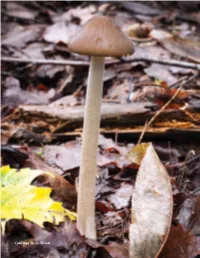
<I>Collybia Cirrata</I>
Total Page:16
File Type:pdf, Size:1020Kb
Load more
Recommended publications
-

Toxic Fungi of Western North America
Toxic Fungi of Western North America by Thomas J. Duffy, MD Published by MykoWeb (www.mykoweb.com) March, 2008 (Web) August, 2008 (PDF) 2 Toxic Fungi of Western North America Copyright © 2008 by Thomas J. Duffy & Michael G. Wood Toxic Fungi of Western North America 3 Contents Introductory Material ........................................................................................... 7 Dedication ............................................................................................................... 7 Preface .................................................................................................................... 7 Acknowledgements ................................................................................................. 7 An Introduction to Mushrooms & Mushroom Poisoning .............................. 9 Introduction and collection of specimens .............................................................. 9 General overview of mushroom poisonings ......................................................... 10 Ecology and general anatomy of fungi ................................................................ 11 Description and habitat of Amanita phalloides and Amanita ocreata .............. 14 History of Amanita ocreata and Amanita phalloides in the West ..................... 18 The classical history of Amanita phalloides and related species ....................... 20 Mushroom poisoning case registry ...................................................................... 21 “Look-Alike” mushrooms ..................................................................................... -

Redalyc.LACTIFLUUS AURANTIORUGOSUS
Darwiniana ISSN: 0011-6793 sdenham@darwin.edu.ar Instituto de Botánica Darwinion Argentina Sá, Mariana C. A.; Wartchow, Felipe LACTIFLUUS AURANTIORUGOSUS (RUSSULACEAE), A NEW SPECIES FROM SOUTHERN BRAZIL Darwiniana, vol. 1, núm. 1, enero-junio, 2013, pp. 54-60 Instituto de Botánica Darwinion Buenos Aires, Argentina Available in: http://www.redalyc.org/articulo.oa?id=66928887003 How to cite Complete issue Scientific Information System More information about this article Network of Scientific Journals from Latin America, the Caribbean, Spain and Portugal Journal's homepage in redalyc.org Non-profit academic project, developed under the open access initiative DARWINIANA, nueva serie 1(1): 54-60. 2013 Versión final, efectivamente publicada el 31 de julio de 2013 ISSN 0011-6793 impresa - ISSN 1850-1699 en línea LACTIFLUUS AURANTIORUGOSUS (RUSSULACEAE), A NEW SPECIES FROM SOUTHERN BRAZIL Mariana C. A. Sá1 & Felipe Wartchow2 1 Universidade Federal do Rio Grande do Norte, Programa de Pós-Graduação em Sistemática e Evolução, Campus Universitário, Lagoa Nova, CEP 59072-970 Natal, Rio Grande do Norte, Brazil; marianasa85@gmail.com (author for correspondence). 2 Universidade Federal da Paraíba, Programa de Pós-Graduação em Sistemática e Evolução, CEP 58051-970 João Pessoa, Paraíba, Brazil. Abstract. Sá, M. C. A. & F. Wartchow. 2013. Lactifluus aurantiorugosus (Russulaceae), a new species from sou- thern Brazil. Darwiniana, nueva serie 1(1): 54-60. Lactifluus aurantiorugosus is proposed as a new species from southern Brazil. It is characterized by the small-sized basidiomata, pileus orange, glabrous and wrinkled when fresh, distant lamellae, ellip- soid and verrucose basidiospores with warts up to 0.7 µm, interconnected with incomplete reticules, a trichopalisade as pileipellis-structure, and the context of lamella and pileus with abundant sphaerocysts. -

Sp. Nov. from Northeast China
ISSN (print) 0093-4666 © 2013. Mycotaxon, Ltd. ISSN (online) 2154-8889 MYCOTAXON http://dx.doi.org/10.5248/124.269 Volume 124, pp. 269–278 April–June 2013 Russula changbaiensis sp. nov. from northeast China Guo-Jie Li1,2, Dong Zhao1, Sai-Fei Li1, Huai-Jun Yang3, Hua-An Wen1a*& Xing-Zhong Liu1b* 1State Key Laboratory of Mycology, Institute of Microbiology, Chinese Academy of Sciences, No 3 1st Beichen West Road, Chaoyang District, Beijing 100101, China 2University of Chinese Academy of Sciences, Beijing 100049, China 3 Shanxi Institute of Medicine and Life Science, No 61 Pingyang Road, Xiaodian District, Taiyuan 030006, China Correspondence to *: awenha@im.ac.cn, bliuxz@im.ac.cn Abstract —Russula changbaiensis (subg. Tenellula sect. Rhodellinae) from the Changbai Mountains, northeast China, is described as a new species. It is characterized by the red tinged pileus, slightly yellowing context, small basidia, short pleurocystidia, septate dermatocystidia with crystal contents, and a coniferous habitat. The phylogenetic trees based on ITS1-5.8S- ITS2 rDNA sequences fully support the establishment of the new species. Key words —Russulales, Russulaceae, taxonomy, morphology, Basidiomycota Introduction The worldwide genus ofRussula Pers. (Russulaceae, Russulales) is characterized by colorful fragile pileus, amyloid warty spores, abundant sphaerocysts in a heteromerous trama, and absence of latex (Romagnesi 1967, 1985; Singer 1986; Sarnari 1998, 2005). As a group of ectomycorrhizal fungi, it includes a large number of edible and medicinal species (Li et al. 2010). The genus has been extensively investigated with a long, rich and intensive taxonomic history in Europe (Miller & Buyck 2002). Although Russula species have been consumed in China as edible and medicinal use for a long time, their taxonomy has been overlooked (Li & Wen 2009, Li 2013). -

A Global View of Gyroporus: Molecular Phylogenetics, Diversity Patterns, and New Species
Mycologia ISSN: 0027-5514 (Print) 1557-2536 (Online) Journal homepage: https://www.tandfonline.com/loi/umyc20 A global view of Gyroporus: molecular phylogenetics, diversity patterns, and new species Naveed Davoodian, Sarah E. Bergemann, Kentaro Hosaka, Olivier Raspé, Neale L. Bougher, Nigel A. Fechner, Terry W. Henkel, Matteo Gelardi, Kasem Soytong, Arooj Naseer, Beatriz Ortiz-Santana, Timothy J. Baroni, Eiji Nagasawa, Matthew E. Smith & Roy E. Halling To cite this article: Naveed Davoodian, Sarah E. Bergemann, Kentaro Hosaka, Olivier Raspé, Neale L. Bougher, Nigel A. Fechner, Terry W. Henkel, Matteo Gelardi, Kasem Soytong, Arooj Naseer, Beatriz Ortiz-Santana, Timothy J. Baroni, Eiji Nagasawa, Matthew E. Smith & Roy E. Halling (2018) A global view of Gyroporus: molecular phylogenetics, diversity patterns, and new species, Mycologia, 110:5, 985-995, DOI: 10.1080/00275514.2018.1511339 To link to this article: https://doi.org/10.1080/00275514.2018.1511339 Published online: 10 Oct 2018. Submit your article to this journal Article views: 415 View Crossmark data Full Terms & Conditions of access and use can be found at https://www.tandfonline.com/action/journalInformation?journalCode=umyc20 MYCOLOGIA 2018, VOL. 110, NO. 5, 985–995 https://doi.org/10.1080/00275514.2018.1511339 A global view of Gyroporus: molecular phylogenetics, diversity patterns, and new species Naveed Davoodiana,b, Sarah E. Bergemannc, Kentaro Hosaka d, Olivier Raspé e, Neale L. Bougherf, Nigel A. Fechnerg, Terry W. Henkelh, Matteo Gelardii, Kasem Soytongj, Arooj Naseerk, Beatriz Ortiz-Santana l, Timothy J. Baronim, Eiji Nagasawan, Matthew E. Smith o, and Roy E. Halling a aInstitute of Systematic Botany, The New York Botanical Garden, Bronx, New York 10458; bThe Graduate Center, City University of New York, 365 5th Avenue, New York, New York 10016; cDepartment of Biology, Middle Tennessee State University, P.O. -
MYCOLEGIUM: Making Sense New Mushroom Genera: of a Ll T He Ne W Horn of Plenty Or Deluge? Mushroom Names Else C
Courtesy M. G. Wood. MYCOLEGIUM: Making Sense New mushroom genera: of a ll t he Ne w horn of plenty or deluge? Mushroom Names Else C. Vellinga and Thomas W. Kuyper ecvellinga@comcast.net n 2014 and the first Text box #1 – Some definitions six months of 2015 clade – a monophyletic group consisting of a common ancestor and all its descendants. alone, more than 20 genus (plural: genera) – a monophyletic group of species that have (preferably) new bolete genera were morphological characters in common. I monophyletic – a genus is called monophyletic when all its members share a proposed. Contrary to what most recent common ancestor that is not shared by species outside that many people would expect, these genera genus (the red and blue blocks in Fig. 1 represent monophyletic groups). are not restricted to some faraway exotic A single species is monophyletic by definition. locale where the boletes have novel paraphyletic – a genus is called paraphyletic, when only by including members character combinations, no, these new of another genus or other genera, all its members share a common ancestor genus names are for familiar species that (the green block in Fig. 1 represents a paraphyletic genus). occur in North America and Europe and polyphyletic – a genus is called polyphyletic as a more advanced case of that we have been calling by the name paraphyly and the members of the genus are scattered over widely different “Boletus” for a long time. clades (example: Marasmius with M. androsaceus falling inside Gymnopus, This creation of new genera is not and M. minutus outside the family Marasmiaceae). -

<I>Lepiota Himalayensis</I> (<I>Basidiomycota, Agaricales</I
ISSN (print) 0093-4666 © 2012. Mycotaxon, Ltd. ISSN (online) 2154-8889 MYCOTAXON http://dx.doi.org/10.5248/121.319 Volume 121, pp. 319–325 July–September 2012 Lepiota himalayensis (Basidiomycota, Agaricales), a new species from Pakistan A. Razaq1*, A.N. Khalid1 & E.C. Vellinga2 1Department of Botany, University of the Punjab, Lahore. 54590, Pakistan. 2Department of Plant and Microbial Biology, University of California Berkeley California USA *Correspondence to: ectomycorrhiza@gmail.com Abstract — A new Lepiota species from the Himalayan moist temperate forests in Pakistan is described and illustrated. The orangish-brown basidiocarp with dark blackish scales on the pileus, ellipsoid spores, narrowly clavate to clavate cheilocystidia, and the narrowly clavate to clavate nature of trichodermial elements of pileal covering are striking features of this species. The phylogenetic relationship with related species based on ITS-rDNA sequences is discussed. Keywords — lepiotaceous fungi, mushroom diversity, phylogeny, rDNA Introduction The Himalayan moist temperate forests of Pakistan are distinguished by the luxurious vegetation of conifers and deciduous trees. In these forests, located at elevations of 1370–3050 m, maximum summer temperatures vary from 10.7– 18°C, rainfall averages 59.3 cm, and humidity ranges up to 57% (Champion et al. 1968). Most of the mushrooms are still to be identified, even though Himalaya is one of the twenty-five world biodiversity hotspots (Myers et al. 2000). Lepiota (Pers.) Gray (Agaricales, Basidiomycota) is an important and diversified genus comprising more than 400 species (Kirk et al. 2008, Liang &Yang 2011). This genus is characterized by a scaly pileus, free lamellae, partial veil in the form of annulus, a universal veil, and smooth, white, dextrinoid spores; most species have clamp connections (Vellinga 2001, Kumar & Manimohan 2009). -

Russulaceae) from Southern China
Phytotaxa 202 (2): 094–102 ISSN 1179-3155 (print edition) www.mapress.com/phytotaxa/ PHYTOTAXA Copyright © 2015 Magnolia Press Article ISSN 1179-3163 (online edition) http://dx.doi.org/10.11646/phytotaxa.202.2.2 Morphological and molecular evidence for a new species of Russula (Russulaceae) from southern China YANG-KUN LI1, XIN ZHANG1,2, YE YUAN1, ZHENG CAO1,2 & JUN-FENG LIANG1* 1 Research Institute of Tropical Forestry, Chinese Academy of Forestry, Guangzhou 510520, P. R. China 2 Southwest Forestry University, Kunming 650224, P. R. China *e-mail: jfliang2000@163.com Abstract Russula subrutilans sp. nov., a new species of Russula is described from southern China. It is unique for having buff pink to light congo-pink pileus, distant ventricose to subventricose lamellae with rare lamellulae, globose to broadly ellipsoid spores with bluntly conical warts forming a partial reticulum, and narrowly clavate to clavate cheilocystidia and pleurocysit- idia with variable tips. Phylogenetic relationships among the new species and other closely related species in the genus are inferred based on the internal transcribed spacer (ITS) region. Keywords: Basidiomycetes, phylogeny, Russulales & taxonomy Introduction Russula Pers. (Russulaceae, Russulales, Basidiomycota), erected by Persoon in 1796, is a widely distributed genus in the world (Persoon 1796; Lebel & Tonkin 2007). Species within Russula are well known by the combination of their conspicuous and fleshy fruit bodies, colorful fragile pileus, amyloid warty spores, abundant sphaerocysts in a heteromerous trama that can make the fungi brittle, absence of latex, and the hyphae that lack of clamp connections (Romagnesi 1967, 1985; Singer 1986; Sarnari 1998, 2005). The genus is considered to be of great ecological and economical importance. -

Russula Ryukokuensis Sp. Nov., an Outstanding Species of the Genus Russula (Russulaceae) Having Minute Basidiomata from Japan
Bull. Natl. Mus. Nat. Sci., Ser. B, 47(1), pp. 1–12, February 22, 2021 Russula ryukokuensis sp. nov., an Outstanding Species of the Genus Russula (Russulaceae) Having Minute Basidiomata from Japan Yoshito Shimono1*,2, Taiga Kasuya3*,** and Kentaro Hosaka4 1 Graduate School of Bioresources, Mie University, 1577 Kurimamachiya-machi, Tsu, Mie 514–8507, Japan 2 Osaka Museum of Nature History, 1–23 Nagai-koen, Sumiyoshi-ku, Osaka, Osaka 546–0034, Japan 3 Department of Biology, Keio University, 4–1–1 Hiyoshi, Kohoku-ku, Yokohama, Kanagawa 223–8521, Japan 4 Department of Botany, National Museum of Nature and Science, 4–1–1 Amakubo, Tsukuba, Ibaraki 305–0005, Japan *Both authors contributed equally to this work. **E-mail: tkasuya@keio.jp (Received 23 September 2020; accepted 23 December 2020) Abstract. Russula ryukokuensis, a new species of Russula is described from mixed broad-leaved trees and coniferous forests in Japan based on macro- and microscopic features with molecular data. Russula ryukokuensis is characterized by small-sized, orange to reddish basidiomata, convex to plano-convex pileus with shallowly tuberculate to sulcate margin, and whitish to slightly light orange lamellae with strongly acrid taste. Detailed macro- and micro-morphological descriptions of R. ryukokuensis are given, and its taxonomic and phylogenetic positions were confirmed using DNA sequences. Morphological observations and molecular phylogenetic analysis revealed that this species belongs to the subsection Emeticinae of the section Russula in the subgenus Russula. Keywords : Agaricomycetes, ITS and LSU sequences, mycobiota, phylogeny, Russulales, taxon- omy. Introduction (Atri et al., 1993, 1997; Buyck and Horak, 1999; Miller and Buyck, 2002; Chou and Wang, 2005; Species of the genus Russula Pers. -

Identifying and Naming the Currently Known Diversity of the Genus Hydnum, with an Emphasis on European and North American Taxa
Mycologia ISSN: 0027-5514 (Print) 1557-2536 (Online) Journal homepage: http://www.tandfonline.com/loi/umyc20 Identifying and naming the currently known diversity of the genus Hydnum, with an emphasis on European and North American taxa Tuula Niskanen, Kare Liimatainen, Jorinde Nuytinck, Paul Kirk, Ibai Olariaga Ibarguren, Roberto Garibay-Orijel, Lorelei Norvell, Seppo Huhtinen, Ilkka Kytövuori, Juhani Ruotsalainen, Tuomo Niemelä, Joseph F. Ammirati & Leho Tedersoo To cite this article: Tuula Niskanen, Kare Liimatainen, Jorinde Nuytinck, Paul Kirk, Ibai Olariaga Ibarguren, Roberto Garibay-Orijel, Lorelei Norvell, Seppo Huhtinen, Ilkka Kytövuori, Juhani Ruotsalainen, Tuomo Niemelä, Joseph F. Ammirati & Leho Tedersoo (2018) Identifying and naming the currently known diversity of the genus Hydnum, with an emphasis on European and North American taxa, Mycologia, 110:5, 890-918, DOI: 10.1080/00275514.2018.1477004 To link to this article: https://doi.org/10.1080/00275514.2018.1477004 Accepted author version posted online: 22 May 2018. Published online: 14 Sep 2018. Submit your article to this journal Article views: 527 View Crossmark data Full Terms & Conditions of access and use can be found at http://www.tandfonline.com/action/journalInformation?journalCode=umyc20 MYCOLOGIA 2018, VOL. 110, NO. 5, 890–918 https://doi.org/10.1080/00275514.2018.1477004 Identifying and naming the currently known diversity of the genus Hydnum, with an emphasis on European and North American taxa Tuula Niskanen a, Kare Liimatainen a,b, Jorinde Nuytinck c, Paul Kirka, Ibai Olariaga Ibarguren d, Roberto Garibay-Orijel e, Lorelei Norvell f, Seppo Huhtineng, Ilkka Kytövuorih, Juhani Ruotsalainen†, Tuomo Niemelä h, Joseph F. Ammiratii, and Leho Tedersoo j aJodrell Laboratory, Royal Botanic Gardens, Kew, Surrey TW9 3AB, United Kingdom; bDepartment of Biosciences, Plant Biology, P.O. -
Mushrooms of the National Forests in Alaska
Mushrooms of the National Forests in Alaska United States Forest Service R10 --RG 209 Department of Alaska Region FEB 2013 Agriculture Introduction The coastal temperate rainforests of the Tongass and Chugach national forests often produce prolific fruitings of mushrooms in late summer and fall. For many Alaskans, mushrooms are a source of food. For others, they are a source of pigments for dyeing wool and other natural fibers. Still others merely enjoy their beauty. However, all Alaskans should appreciate these fungi for, without them, there would be no forests here. This brochure presents an introduction to mushrooms and illustrates a number of the more common and interesting of our local species to help Alaskans and visitors to better understand and enjoy our magnificent national forests. Unlike most plants, birds, and mammals, very few mushrooms have common names. Thus, while we have used common names where they exist, many of the species in this brochure can be referred to only by their scientific names. But, never fear. If you can talk with your kids about Tyrannosaurus rex, you can handle mushroom names! What is a mushroom? Mushrooms are produced by some fungi (singular: fungus), and their primary purpose is to make and spread tiny reproductive propagules called spores, which function much like plant seeds. After long being considered primitive plants, fungi now are accepted as their own kingdom. Unlike plants, fungi cannot make their own food, and their cell walls contain chitin rather than cellulose. Interestingly, chitin also is found in insect exoskeletons, providing evidence that the fungi are more closely related to animals (including us!) than they are to plants. -
<I>Collybia Cirrata</I>
MYCOTAXON Volume 107, pp. 81–86 January–March 2009 Fructification of Collybia cirrata on mummified gleba of Bovista dermoxantha in Hokkaido, Northern Japan Taiga Kasuya1 & Seikichi Sato2 tkasuya@sakura.cc.tsukuba.ac.jp 1Laboratory of Plant Parasitic Mycology Graduate School of Life and Environmental Sciences, University of Tsukuba Tsukuba, Ibaraki 305-8572, Japan 2Asahicho 58-4, Kamikawa, Hokkaido 078-1761, Japan Abstract — Fructification of Collybia cirrata on mummified gleba of Bovista dermoxantha is newly recorded from Daisetsuzan volcanic group, Hokkaido, Northern Japan. Also, it is the first report of C. cirrata in Japan. Macro- and microscopic characteristics and unusual habitat of this fungus are described and illustrated based on Japanese specimens. Key words — gasteromycetes, host fungus, Lycoperdaceae, Tricholomataceae Introduction Collybia (Fr.) Staude sensu Antonín & Noordeloos (1997) comprises four species, C. tuberosa (Bull.) P. Kumm., C. cirrata, C. cookei (Bres.) J.D. Arnold and C. racemosa (Pers.) Quél. These are small, grayish to whitish agaricoid mushrooms that share a unique habitat, fruiting on the remains of dead fleshy mushrooms (Hughes & Petersen 2006). Hughes et al. (2001), however, separated C. racemosa from the rest based on a molecular study and described the new genus Dendrocollybia for it with D. racemosa (Pers.) R.H. Petersen & Redhead as sole species. Therefore, now only three species remain in Collybia sensu stricto. During our floristic investigation of subarctic and subalpine to alpine zones of Daisetsuzan volcanic group, Hokkaido, Northern Japan, we collected an unusual small agaric that was associated with the mummified gleba of dead lycoperdaceous fungus. According to our morphological observations, we identified this agaric as C. -
Two New Species of Termitomyces (Agaricales, Lyophyllaceae) from China and Thailand
Phytotaxa 439 (3): 231–242 ISSN 1179-3155 (print edition) https://www.mapress.com/j/pt/ PHYTOTAXA Copyright © 2020 Magnolia Press Article ISSN 1179-3163 (online edition) https://doi.org/10.11646/phytotaxa.439.3.5 Two new species of Termitomyces (Agaricales, Lyophyllaceae) from China and Thailand SONG-MING TANG1,2,3,6, MAO-QIANG HE4,7, OLIVIER RASPÉ2,3,8*, XIA LUO5,9, XIAO-LEI ZHANG1,10, YONG- JUN LI1,11, KAI-MEI SU1,12, SHU-HONG LI1,13*, NARITSADA THONGKLANG2,3,14 & KEVIN D. HYDE2,15 1 Biotechnology and Germplasm Resources Institute, Yunnan Academy of Agricultural Sciences, Kunming 650223, China; 2 Center of Excellence in Fungal Research, Mae Fah Luang University, Chiang Rai 57100, Thailand; 3 School of Science, Mae Fah Luang University, Chiang Rai 57100, Thailand 4 State Key Laboratory of Mycology, Institute of Microbiology, Chinese Academy of Science, Beijing 100101, China; 5 School of Biological Science and Food Engineering, Chu Zhou University, Anhui 239000, China; 6 2567139016@qq.com; http://orcid.org/0000-0002-6174-7314 7 hemaoqiangLeo@gmail.com; http://orcid.org/0000-0002-9300-7484 8 ojmraspe@gmail.com; http://orcid.org/0000-0002-8426-2133 9 luoxiacz@163.com; http://orcid.org/0000-0001-6206-8711 10 1262529770@qq.com; http://orcid.org/0000-0002-5856-4189 11 2511129507@qq.com; http://orcid.org/0000-0003-2407-9334 12 kaimei@sina.com; http://orcid.org/0000-0001-5964-8897 13 shuhongfungi@126.com; http://orcid.org/0000-0001-5806-9148 14 fah_naritsada@hotmail.com; http://orcid.org/0000-0001-9337-5001 15 kdhyde3@gmail.com; http://orcid.org/0000-0002-3407-9517 *Corresponding authors Abstract Termitomyces floccosus and T.