Russulaceae) from Southern China
Total Page:16
File Type:pdf, Size:1020Kb
Load more
Recommended publications
-
Russula Pyriodora, a New Fragrant Species Described from Finland
Karstenia 51: 23–30, 2011 Russula pyriodora, a new fragrant species described from Finland. JUHANI RUOTSALAINEN and SEPPO HUHTINEN RUOTSALAINEN, J. & HUHTINEN, S. 2011: Russula pyriodora, a new fragrant spe cies described from Finland. – Karstenia 51: 23–30. Helsinki. ISSN 04533402. A new species, Russula pyriodora, is described based on Finnish material. It is char acterized by an appearance of R. betularum, but has a distinctive odour of pears. Other differentiating features, both macroscopical and microscopical, are also discussed. The new species is also compared with the type of R. alborosea, which is a likely synonym of R. mairei. Key words: Russulaceae, Russula, Atropurpurea, Russula pyriodora, Finland, taxonomy Juhani Ruotsalainen, Metsätie 12 A 4, FI–71310 Vehmersalmi, Finland; e-mail: juhani. ruotsalainen@pp.inet.fi Seppo Huhtinen, Herbarium, University of Turku, FI–20014 Turku, Finland; e-mail: seppo.huhtinen@utu.fi Introduction typification by Kärcher (1996) is based on two fruitbodies which are not conspecific. Selection New taxa of the genus Russula Pers. are en of a type without actually carefully studying ma countered in Finland every year. In most cases terial is never advisable. For example, descrip these new finds consist of only a few fruitbodies. tions like those by Romagnesi based on “clear” Furthermore, it is often very laborious to find a type specimens, are of questionable value when second collection, even from the existing, plen it is realized that those “clear” type collections tiful collections. Consequently, during the past are mixtures of more than one taxon, e.g. R. decades the senior author has refrained from amoenoides Romagn. -

Three Species of Russula New to Taiwan
Fung. Sci. 20(1, 2): 47–52, 2005 Three species of Russula new to Taiwan Edelgard Fu-Tschin Tschen1 and Johannes Scheng-Ming Tschen2 1. National Museum of Natural Science, Kuan-Chien Rd. Taichung 404, Taiwan. Edelgard@mail.nmns.edu.tw 2. Department of Life Sciences, National Chung Hsing University, 250 Kuokuang Road, Taichung 402, Tai- wan, R.O.C. (Accepted: June 22, 2005) ABSTRACT Three species of Russula new to Taiwan are described and illustrated. They are: Russua betularum, R. sub- foetens, and R. violeipes. Key words: Russula, Russulaceae, Taiwan. Introduction served in a medium of 3% KOH. Spores size and shape are from optical sections in side view The genus Russula, a very large group of the in Melzer’s regent and exclude the ornamenta- family Russulaceae, is one of the most common tion. and abundant ectomycorrhizal macrofungi in mountain forests of Taiwan. Thirty-six Russula Description species were reported in the past from Taiwan. In this study three species of Russula new to Russula violeipes Quél. Assoc. Fr. Avancem. Taiwan are described and illustrated. All Sci. 26(2): 450, 1898. (Fig. 1) specimens are deposit at TNM (Herbarium of ≡ Russula punctata f. violeipes (Quél.) Maire, Bull. Soc. National Museum of Natural Science, Taiwan). mycol. Fr. 26: 118, 1910. ≡ Russula amoena var. violeipes (Quél.) Melzer & Zvára, Materials and Methods Arch. pr. výzk. Cech. 17(4): 74, 1927. Pileus 3–8 cm broad at maturity, convex when Specimens were collected in the period of young, expanding to plano-convex to plane, March to August in 2000 and 2001. Macromor- usually with a broad depression on the disc phological characters were recorded from fresh with age; surface dry, viscid when wet, smooth, condition of the specimens. -

Diversity of Ectomycorrhizal Fungi in Minnesota's Ancient and Younger Stands of Red Pine and Northern Hardwood-Conifer Forests
DIVERSITY OF ECTOMYCORRHIZAL FUNGI IN MINNESOTA'S ANCIENT AND YOUNGER STANDS OF RED PINE AND NORTHERN HARDWOOD-CONIFER FORESTS A THESIS SUBMITTED TO THE FACULTY OF THE GRADUATE SCHOOL OF THE UNIVERSITY OF MINNESOTA BY PATRICK ROBERT LEACOCK IN PARTIAL FULFILLMENT OF THE REQUIREMENTS FOR THE DEGREE OF DOCTOR OF PHILOSOPHY DAVID J. MCLAUGHLIN, ADVISER OCTOBER 1997 DIVERSITY OF ECTOMYCORRHIZAL FUNGI IN MINNESOTA'S ANCIENT AND YOUNGER STANDS OF RED PINE AND NORTHERN HARDWOOD-CONIFER FORESTS COPYRIGHT Patrick Robert Leacock 1997 Saint Paul, Minnesota ACKNOWLEDGEMENTS I am indebted to Dr. David J. McLaughlin for being an admirable adviser, teacher, and editor. I thank Dave for his guidance and insight on this research and for assistance with identifications. I am grateful for the friendship and support of many graduate students, especially Beth Frieders, Becky Knowles, and Bev Weddle, who assisted with research. I thank undergraduate student assistants Dustine Robin and Tom Shay and school teacher participants Dan Bale, Geri Nelson, and Judith Olson. I also thank the faculty and staff of the Department of Plant Biology, University of Minnesota, for their assistance and support. I extend my most sincere thanks and gratitude to Judy Kenney and Adele Mehta for their dedication in the field during four years of mushroom counting and tree measuring. I thank Anna Gerenday for her support and help with identifications. I thank Joe Ammirati, Tim Baroni, Greg Mueller, and Clark Ovrebo, for their kind aid with identifications. I am indebted to Rich Baker and Kurt Rusterholz of the Natural Heritage Program, Minnesota Department of Natural Resources, for providing the opportunity for this research. -

Toxic Fungi of Western North America
Toxic Fungi of Western North America by Thomas J. Duffy, MD Published by MykoWeb (www.mykoweb.com) March, 2008 (Web) August, 2008 (PDF) 2 Toxic Fungi of Western North America Copyright © 2008 by Thomas J. Duffy & Michael G. Wood Toxic Fungi of Western North America 3 Contents Introductory Material ........................................................................................... 7 Dedication ............................................................................................................... 7 Preface .................................................................................................................... 7 Acknowledgements ................................................................................................. 7 An Introduction to Mushrooms & Mushroom Poisoning .............................. 9 Introduction and collection of specimens .............................................................. 9 General overview of mushroom poisonings ......................................................... 10 Ecology and general anatomy of fungi ................................................................ 11 Description and habitat of Amanita phalloides and Amanita ocreata .............. 14 History of Amanita ocreata and Amanita phalloides in the West ..................... 18 The classical history of Amanita phalloides and related species ....................... 20 Mushroom poisoning case registry ...................................................................... 21 “Look-Alike” mushrooms ..................................................................................... -

Redalyc.LACTIFLUUS AURANTIORUGOSUS
Darwiniana ISSN: 0011-6793 sdenham@darwin.edu.ar Instituto de Botánica Darwinion Argentina Sá, Mariana C. A.; Wartchow, Felipe LACTIFLUUS AURANTIORUGOSUS (RUSSULACEAE), A NEW SPECIES FROM SOUTHERN BRAZIL Darwiniana, vol. 1, núm. 1, enero-junio, 2013, pp. 54-60 Instituto de Botánica Darwinion Buenos Aires, Argentina Available in: http://www.redalyc.org/articulo.oa?id=66928887003 How to cite Complete issue Scientific Information System More information about this article Network of Scientific Journals from Latin America, the Caribbean, Spain and Portugal Journal's homepage in redalyc.org Non-profit academic project, developed under the open access initiative DARWINIANA, nueva serie 1(1): 54-60. 2013 Versión final, efectivamente publicada el 31 de julio de 2013 ISSN 0011-6793 impresa - ISSN 1850-1699 en línea LACTIFLUUS AURANTIORUGOSUS (RUSSULACEAE), A NEW SPECIES FROM SOUTHERN BRAZIL Mariana C. A. Sá1 & Felipe Wartchow2 1 Universidade Federal do Rio Grande do Norte, Programa de Pós-Graduação em Sistemática e Evolução, Campus Universitário, Lagoa Nova, CEP 59072-970 Natal, Rio Grande do Norte, Brazil; marianasa85@gmail.com (author for correspondence). 2 Universidade Federal da Paraíba, Programa de Pós-Graduação em Sistemática e Evolução, CEP 58051-970 João Pessoa, Paraíba, Brazil. Abstract. Sá, M. C. A. & F. Wartchow. 2013. Lactifluus aurantiorugosus (Russulaceae), a new species from sou- thern Brazil. Darwiniana, nueva serie 1(1): 54-60. Lactifluus aurantiorugosus is proposed as a new species from southern Brazil. It is characterized by the small-sized basidiomata, pileus orange, glabrous and wrinkled when fresh, distant lamellae, ellip- soid and verrucose basidiospores with warts up to 0.7 µm, interconnected with incomplete reticules, a trichopalisade as pileipellis-structure, and the context of lamella and pileus with abundant sphaerocysts. -
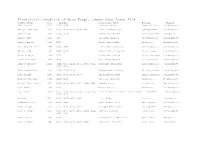
Provisional Checklist of Manx Fungi: Common Name Index 2014
Provisional Checklist of Manx Fungi: Common Name Index 2014 Common Name Year GridSQ Scientific Name Family Phylum Alder Bracket 2012 SC37, SC38 Inonotus radiatus Hymenochaetaceae Basidiomycota Amethyst Deceiver 2012 SC27, SC28, SC37, SC38, SC47 Laccaria amethystina Hydnangiaceae Basidiomycota Anemone Cup 1994 SC28, SC38 Dumontinia tuberosa Sclerotiniaceae Ascomycota Anemone Smut 1994 SC27 Urocystis anemones Urocystidaceae Basidiomycota Angel's Bonnet 1982 NX30 Mycena arcangeliana Mycenaceae Basidiomycota Aniseed Cockleshell 1996 SC38, SC48 Lentinellus cochleatus Auriscalpiaceae Basidiomycota Apricot Club 1981 NX40, SC37 Clavulinopsis luteoalba Clavariaceae Basidiomycota Aromatic Knight 1969 SC48 Tricholoma lascivum Tricholomataceae Basidiomycota Aromatic Pinkgill 1982 NX40 Entoloma pleopodium Entolomataceae Basidiomycota Artist's Bracket 2012 SC26, SC27, SC28, SC37, SC39, SC39, Ganoderma applanatum Ganodermataceae Basidiomycota SC48, SC49 Ashen Chanterelle 1985 SC28, SC38, SC39 Cantharellus cinereus Cantharellaceae Basidiomycota Ashen Knight 1997 SC28, SC38, SC39, SC48 Tricholoma virgatum Tricholomataceae Basidiomycota Banded Mottlegill 1982 NX30, NX40 Panaeolus cinctulus Agaricales Basidiomycota Bare-Toothed Russula 2012 SC28, SC38, SC39, SC47, SC48, SC49 Russula vesca Russulaceae Basidiomycota Bark Bonnet 1982 SC28 Mycena speirea Mycenaceae Basidiomycota Bay Bolete 2012 SC27, SC28, SC37, SC38, SC39, SC47, Boletus badius non sensu Persoon (1801) Boletaceae Basidiomycota SC48, SC49 Bay Cup 2012 SC27, SC37, SC38, SC48 Peziza badia Pezizaceae -

Sp. Nov. from Northeast China
ISSN (print) 0093-4666 © 2013. Mycotaxon, Ltd. ISSN (online) 2154-8889 MYCOTAXON http://dx.doi.org/10.5248/124.269 Volume 124, pp. 269–278 April–June 2013 Russula changbaiensis sp. nov. from northeast China Guo-Jie Li1,2, Dong Zhao1, Sai-Fei Li1, Huai-Jun Yang3, Hua-An Wen1a*& Xing-Zhong Liu1b* 1State Key Laboratory of Mycology, Institute of Microbiology, Chinese Academy of Sciences, No 3 1st Beichen West Road, Chaoyang District, Beijing 100101, China 2University of Chinese Academy of Sciences, Beijing 100049, China 3 Shanxi Institute of Medicine and Life Science, No 61 Pingyang Road, Xiaodian District, Taiyuan 030006, China Correspondence to *: awenha@im.ac.cn, bliuxz@im.ac.cn Abstract —Russula changbaiensis (subg. Tenellula sect. Rhodellinae) from the Changbai Mountains, northeast China, is described as a new species. It is characterized by the red tinged pileus, slightly yellowing context, small basidia, short pleurocystidia, septate dermatocystidia with crystal contents, and a coniferous habitat. The phylogenetic trees based on ITS1-5.8S- ITS2 rDNA sequences fully support the establishment of the new species. Key words —Russulales, Russulaceae, taxonomy, morphology, Basidiomycota Introduction The worldwide genus ofRussula Pers. (Russulaceae, Russulales) is characterized by colorful fragile pileus, amyloid warty spores, abundant sphaerocysts in a heteromerous trama, and absence of latex (Romagnesi 1967, 1985; Singer 1986; Sarnari 1998, 2005). As a group of ectomycorrhizal fungi, it includes a large number of edible and medicinal species (Li et al. 2010). The genus has been extensively investigated with a long, rich and intensive taxonomic history in Europe (Miller & Buyck 2002). Although Russula species have been consumed in China as edible and medicinal use for a long time, their taxonomy has been overlooked (Li & Wen 2009, Li 2013). -

This Is a Self-Archived Version of an Original Article. This Version May Differ from the Original in Pagination and Typographic Details
This is a self-archived version of an original article. This version may differ from the original in pagination and typographic details. Author(s): Tervonen, Kaisa; Oldén, Anna; Halme, Panu Title: Ectomycorrhizal fungi in wood-pastures : Communities are determined by trees and soil properties, not by grazing Year: 2019 Version: Accepted version (Final draft) Copyright: © 2018 Elsevier B.V. Rights: CC BY-NC-ND 4.0 Rights url: https://creativecommons.org/licenses/by-nc-nd/4.0/ Please cite the original version: Tervonen, K., Oldén, A., & Halme, P. (2019). Ectomycorrhizal fungi in wood-pastures : Communities are determined by trees and soil properties, not by grazing. Agriculture, Ecosystems and Environment, 269, 13-21. https://doi.org/10.1016/j.agee.2018.09.015 1 Ectomycorrhizal fungi in wood-pastures: Communities are 2 determined by trees and soil properties, not by grazing 3 4 Authors: Kaisa Tervonena,b,c, Anna Oldéna,c, and Panu Halmea,c 5 6 a Department of Biological and Environmental Science, P.O. Box 35, FIN-40014 University 7 of Jyväskylä, Finland. 8 b Natural History Museum, P.O. Box 35, FIN-40014 University of Jyväskylä, Finland. 9 c School of Resource Wisdom, University of Jyväskylä, P.O. Box 35, FI-40014 University of 10 Jyväskylä, Finland. 11 Corresponding author: Kaisa Tervonen, kaisa.i.tervonen@jyu.fi, +358 50 5942478 12 13 Keywords: forest pastures, semi-natural, semi-open, traditional rural biotopes 14 Abstract 15 Traditional rural biotopes such as wood-pastures are species-rich environments that 16 have been created by low-intensity agriculture. Their amount has decreased 17 dramatically during the 20th century in whole Europe due to the intensification of 18 agriculture. -

Análise Em Larga Escala Das Regiões Intergênicas ITS, ITS1 E ITS2 Para O Filo Basidiomycota (Fungi)
UNIVERSIDADE FEDERAL DE MINAS GERAIS INSTITUTO DE CIÊNCIAS BIOLÓGICAS PROGRAMA INTERUNIDADES DE PÓS-GRADUAÇÃO EM BIOINFORMÁTICA DISSERTAÇÃO DE MESTRADO FRANCISLON SILVA DE OLIVEIRA Análise em larga escala das regiões intergênicas ITS, ITS1 e ITS2 para o filo Basidiomycota (Fungi) Belo Horizonte 2015 Francislon Silva de Oliveira Análise em larga escala das regiões intergênicas ITS, ITS1 e ITS2 para o filo Basidiomycota (Fungi) Dissertação apresentada ao Programa Interunidades de Pós-Graduação em Bioinformática da UFMG como requisito parcial para a obtenção do grau de Mestre em Bioinformática. ORIENTADOR: Prof. Dr. Guilherme Oliveira Correa CO-ORIENTADOR: Prof. Dr. Aristóteles Góes-Neto Belo Horizonte 2015 AGRADECIMENTOS À minha família e amigos pelo amor e confiança depositadas em mim. Aos meus orientadores Guilherme e Aristóteles por todo o suporte oferecido durante todo o mestrado. À Fernanda Badotti pelas discussões biológicas sobre o tema de DNA barcoding e por estar sempre disposta a ajudar. À toda equipe do Centro de Excelência em Bioinformática pelos maravilhosos momentos que passamos juntos. Muito obrigado por toda paciência nesse momento final de turbulência do mestrado. Aos membros do Center for Tropical and Emerging Global Diseases pela sensacional receptividade durante o meu estágio de quatro meses na University of Georgia. Um agradecimento especial à Dra. Jessica Kissinger pelos conselhos científicos e à Betsy pela atenção e disponibilidade de ajudar a qualquer momento. Aos colegas do programa de pós-graduação em bioinformática da UFMG pelos momentos de descontração e discussão científica na mesa do bar !. Aos membros da secretaria do programa de pós-graduação pela simpatia e vontade de ajudar sempre. -

Suomen Helttasienten Ja Tattien Ekologia, Levinneisyys Ja Uhanalaisuus
Suomen ympäristö 769 LUONTO JA LUONNONVARAT Pertti Salo, Tuomo Niemelä, Ulla Nummela-Salo ja Esteri Ohenoja (toim.) Suomen helttasienten ja tattien ekologia, levinneisyys ja uhanalaisuus .......................... SUOMEN YMPÄRISTÖKESKUS Suomen ympäristö 769 Pertti Salo, Tuomo Niemelä, Ulla Nummela-Salo ja Esteri Ohenoja (toim.) Suomen helttasienten ja tattien ekologia, levinneisyys ja uhanalaisuus SUOMEN YMPÄRISTÖKESKUS Viittausohje Viitatessa tämän raportin lukuihin, käytetään lukujen otsikoita ja lukujen kirjoittajien nimiä: Esim. luku 5.2: Kytövuori, I., Nummela-Salo, U., Ohenoja, E., Salo, P. & Vauras, J. 2005: Helttasienten ja tattien levinneisyystaulukko. Julk.: Salo, P., Niemelä, T., Nummela-Salo, U. & Ohenoja, E. (toim.). Suomen helttasienten ja tattien ekologia, levin- neisyys ja uhanalaisuus. Suomen ympäristökeskus, Helsinki. Suomen ympäristö 769. Ss. 109-224. Recommended citation E.g. chapter 5.2: Kytövuori, I., Nummela-Salo, U., Ohenoja, E., Salo, P. & Vauras, J. 2005: Helttasienten ja tattien levinneisyystaulukko. Distribution table of agarics and boletes in Finland. Publ.: Salo, P., Niemelä, T., Nummela- Salo, U. & Ohenoja, E. (eds.). Suomen helttasienten ja tattien ekologia, levinneisyys ja uhanalaisuus. Suomen ympäristökeskus, Helsinki. Suomen ympäristö 769. Pp. 109-224. Julkaisu on saatavana myös Internetistä: www.ymparisto.fi/julkaisut ISBN 952-11-1996-9 (nid.) ISBN 952-11-1997-7 (PDF) ISSN 1238-7312 Kannen kuvat / Cover pictures Vasen ylä / Top left: Paljakkaa. Utsjoki. Treeless alpine tundra zone. Utsjoki. Kuva / Photo: Esteri Ohenoja Vasen ala / Down left: Jalopuulehtoa. Parainen, Lenholm. Quercus robur forest. Parainen, Lenholm. Kuva / Photo: Tuomo Niemelä Oikea ylä / Top right: Lehtolohisieni (Laccaria amethystina). Amethyst Deceiver (Laccaria amethystina). Kuva / Photo: Pertti Salo Oikea ala / Down right: Vanhaa metsää. Sodankylä, Luosto. Old virgin forest. Sodankylä, Luosto. Kuva / Photo: Tuomo Niemelä Takakansi / Back cover: Ukonsieni (Macrolepiota procera). -

Fungal Foray 9 November 2013 Recorded by Phil Budd
St Catherine's Hill Fungal Foray 9 November 2013 recorded by Phil Budd 1 Tawny Grisette Amanita fulva SZ1496 2 Fly Agaric Amanita muscaria SZ1495 3 The Blusher Amanita rubescens SZ1395 4 Purple Jellydisc Ascocornyne sarcoides SZ1495 5 Earpick fungus Auriscalpium vulgare SZ1395 6 Conifer cone Cap Baeospora myosura SZ1496 7 Penny Bun / Cep Boletus edulis SZ1495 8 Silver Leaf Fungus Chondrostereum purpureum SZ1395 9 Crested Coral Clavulina coralloides SZ1495 10 Glistening Ink Cap Coprinus micaceus SZ1395 11 Frosty Webcap Cortinarius hemitrichus SZ1495 12 Surprise Webcap Cortinarius semisanguineus SZ1495 13 Common Jellyspot Dacrymyces stillatus SZ1395 14 Blushing Bracket Daedaleopsis confragosa SZ1495 15 Rosy Spike Gomphidius roseus SZ1395 16 Spectacular Rustgill Gymnopilus (c.f. Pholiota) junonius SZ1395 17 Common Rustgill Gymnopilus penetrans SZ1395 18 Poisonpie Hebeloma crustuliniforme SZ1495 A Poisonpie Hebeloma hiemale? Hillside Drive 19 SZ1395 verge 20 Root polypore Heterodasidion annosum SZ1495 Blackening Waxcap Hygrocybe conica Hillside Drive 21 SZ1395 verge Parrot Waxcap Hygrocybe psittacina Hillside Drive 22 SZ1395 verge Snowy Waxcap Hygrocybe virginea Hillside Drive 23 SZ1395 verge 24 False Chanterelle Hygrophoropsis aurantiaca SZ1495 25 False Chanterelle Hygrophoropsis aurantiaca var. pallida SZ1495 26 Herald of Winter Hygrophorus hypothejus SZ1395 27 Sulphur Tuft Hypholoma fasciculare SZ1495 Lilac fibrecap Inocybe geophylla var lilacina hillside drive 28 SZ1395 verge 29 Benzoin Bracket Ishnoderma resinosum SZ1495 30 Deceiver Laccaria laccata SZ1495 31 Saffron Milkcap Lactarius deliciosus SZ1495 32 Liver Milkcap Lactarius hepaticus SZ1495 33 Red Milkcap Lactarius rufus SZ1395 34 Birch Milkcap Lactarius tabidus SZ1495 35 Ugly Milkcap Lactarius turpis SZ1395 36 Grey Milkcap Lactarius vietus SZ1495 37 Dusky Puffball Lycoperdon foetidum SZ1495 38 Common Puffball Lycoperdon perlatum SZ1395 39 A polypore Merulius (c.f. -
The Diversity of Fungi in Four Irish Forest Types by Richard O'hanlon B.Sc
The diversity of fungi in four Irish forest types By Richard O’Hanlon B.Sc. (Ed) A thesis submitted for the degree of Doctor of Philosophy, At the Faculty of Science and Engineering, University of Limerick, Ireland. Supervisor: Dr Thomas Harrington, Department of Life Sciences, University of Limerick. Submitted to the University of Limerick: May 2011 i ii “The task of an ecologist” There is an old story about a man who, returning home one night found his neighbour searching the ground beneath a street lamp. “Can I help you find something?” he asked. “I lost my key” replied the neighbour. “Do you know about where you dropped it?”, “Yes” replied the neighbour “over there” pointing to a dark corner of the street. “If you dropped it over there then why are you looking here” asked the man. “Because this is where the light is” replied the neighbour. The task of the ecologist is not to bring the search to where the light is, but to bring the light to where the search is. Perry et al. (2008) iii iv Abstract Sampling of the macrofungal sporocarps, ectomycorrhizal morphotypes and vascular plants was carried out in 28 plots from four forest types (ash, oak, Scot’s pine, Sitka spruce) between the years 2007 and 2009. A total of 409 macrofungal species, 51 ectomycorrhizal morphotypes and 68 vascular plant species were recorded over the three years. It was found that at equal sampling intensities, there were no significant differences in total macrofungal species or ectomycorrhizal morphotype richness between the oak, Scot’s pine and Sitka spruce forest types.