Water, Land and Law
Total Page:16
File Type:pdf, Size:1020Kb
Load more
Recommended publications
-
Food Insecurity and Undernutrition in Nepal
SMALL AREA ESTIMATION OF FOOD INSECURITY AND UNDERNUTRITION IN NEPAL GOVERNMENT OF NEPAL National Planning Commission Secretariat Central Bureau of Statistics SMALL AREA ESTIMATION OF FOOD INSECURITY AND UNDERNUTRITION IN NEPAL GOVERNMENT OF NEPAL National Planning Commission Secretariat Central Bureau of Statistics Acknowledgements The completion of both this and the earlier feasibility report follows extensive consultation with the National Planning Commission, Central Bureau of Statistics (CBS), World Food Programme (WFP), UNICEF, World Bank, and New ERA, together with members of the Statistics and Evidence for Policy, Planning and Results (SEPPR) working group from the International Development Partners Group (IDPG) and made up of people from Asian Development Bank (ADB), Department for International Development (DFID), United Nations Development Programme (UNDP), UNICEF and United States Agency for International Development (USAID), WFP, and the World Bank. WFP, UNICEF and the World Bank commissioned this research. The statistical analysis has been undertaken by Professor Stephen Haslett, Systemetrics Research Associates and Institute of Fundamental Sciences, Massey University, New Zealand and Associate Prof Geoffrey Jones, Dr. Maris Isidro and Alison Sefton of the Institute of Fundamental Sciences - Statistics, Massey University, New Zealand. We gratefully acknowledge the considerable assistance provided at all stages by the Central Bureau of Statistics. Special thanks to Bikash Bista, Rudra Suwal, Dilli Raj Joshi, Devendra Karanjit, Bed Dhakal, Lok Khatri and Pushpa Raj Paudel. See Appendix E for the full list of people consulted. First published: December 2014 Design and processed by: Print Communication, 4241355 ISBN: 978-9937-3000-976 Suggested citation: Haslett, S., Jones, G., Isidro, M., and Sefton, A. (2014) Small Area Estimation of Food Insecurity and Undernutrition in Nepal, Central Bureau of Statistics, National Planning Commissions Secretariat, World Food Programme, UNICEF and World Bank, Kathmandu, Nepal, December 2014. -

Japan International Cooperation Agency (JICA)
Chapter 3 Project Evaluation and Recommendations 3-1 Project Effect It is appropriate to implement the Project under Japan's Grant Aid Assistance, because the Project will have the following effects: (1) Direct Effects 1) Improvement of Educational Environment By replacing deteriorated classrooms, which are danger in structure, with rainwater leakage, and/or insufficient natural lighting and ventilation, with new ones of better quality, the Project will contribute to improving the education environment, which will be effective for improving internal efficiency. Furthermore, provision of toilets and water-supply facilities will greatly encourage the attendance of female teachers and students. Present(※) After Project Completion Usable classrooms in Target Districts 19,177 classrooms 21,707 classrooms Number of Students accommodated in the 709,410 students 835,820 students usable classrooms ※ Including the classrooms to be constructed under BPEP-II by July 2004 2) Improvement of Teacher Training Environment By constructing exclusive facilities for Resource Centres, the Project will contribute to activating teacher training and information-sharing, which will lead to improved quality of education. (2) Indirect Effects 1) Enhancement of Community Participation to Education Community participation in overall primary school management activities will be enhanced through participation in this construction project and by receiving guidance on various educational matters from the government. 91 3-2 Recommendations For the effective implementation of the project, it is recommended that HMG of Nepal take the following actions: 1) Coordination with other donors As and when necessary for the effective implementation of the Project, the DOE should ensure effective coordination with the CIP donors in terms of the CIP components including the allocation of target districts. -

Nepal EGRP-RFP-FY19-P006
Request for Proposal (RFP) - Nepal EGRP-RFP-FY19-P006 Amendment #1 Commodity/Service Required: Endline Assessment of Early Grade Reading Program (EGRP) Type of Procurement: One Time Purchase Order Type of Contract: Firm Fixed Price Term of Contract: December 01, 2019- April 15, 2020 Contract Funding: AID-367-TO-15-00002 This Procurement supports: USAID’s Early Grade Reading Program (EGRP) Submit Proposal to: The Selection Committee RTI- USAID Early Grade Reading Program House no. 46/64, Uttar Dhoka, Lazimpat, Kathmandu, Nepal Original Date of Issue of RFP: Tuesday, July 23, 2019 Date Questions from Supplier Due: Wednesday, July 31, 2019 11:00 a.m. Nepal Standard Time email procurement@np-egrp.rti.org Note:- Q&A will be posted on RTI website Pre-submission conference on RFP Thursday, August 01, 2019, 10:00 to 11:00 AM at EGRP meeting hall, Lazimpat. Date Proposal Due: Thursday, August 22, 2019, 11:00 a.m. Nepal Standard Time Approximate Purchase Order effective date to December 01, 2019 Successful Bidder(s): Method of Submittal: Hard Copy of proposal along with the soft copy in a CD or pen drive. Proposal documents should be submitted in a closed envelope with wax seal (laah chhap) and clearly marked with the solicitation number to the following address: The Selection Committee RTI-USAID Early Grade Reading Program House no. 46/64, Uttar Dhoka, Lazimpat, Kathmandu, Nepal. Bidder’s quote must be printed on the organization’s letterhead, signed, stamped, dated and must include all items and/or services. In addition, each and every pages of the proposal documents needs to be signed and stamped by the authorized person in order to be considered for evaluation. -
Saath-Saath Project
Saath-Saath Project Saath-Saath Project THIRD ANNUAL REPORT August 2013 – July 2014 September 2014 0 Submitted by Saath-Saath Project Gopal Bhawan, Anamika Galli Baluwatar – 4, Kathmandu Nepal T: +977-1-4437173 F: +977-1-4417475 E: Nepal-info@fhi360.org FHI 360 Nepal USAID Cooperative Agreement # AID-367-A-11-00005 USAID/Nepal Country Assistance Objective Intermediate Result 1 & 4 1 Table of Contents List of Acronyms .................................................................................................................................................i Executive Summary ............................................................................................................................................ 1 I. Introduction ........................................................................................................................................... 4 II. Program Management ........................................................................................................................... 6 III. Technical Program Elements (Program by Outputs) .............................................................................. 6 Outcome 1: Decreased HIV prevalence among selected MARPs ...................................................................... 6 Outcome 2: Increased use of Family Planning (FP) services among MARPs ................................................... 9 Outcome 3: Increased GON capacity to plan, commission and use SI ............................................................ 14 Outcome -

Global Initiative on Out-Of-School Children
ALL CHILDREN IN SCHOOL Global Initiative on Out-of-School Children NEPAL COUNTRY STUDY JULY 2016 Government of Nepal Ministry of Education, Singh Darbar Kathmandu, Nepal Telephone: +977 1 4200381 www.moe.gov.np United Nations Educational, Scientific and Cultural Organization (UNESCO), Institute for Statistics P.O. Box 6128, Succursale Centre-Ville Montreal Quebec H3C 3J7 Canada Telephone: +1 514 343 6880 Email: uis.publications@unesco.org www.uis.unesco.org United Nations Children´s Fund Nepal Country Office United Nations House Harihar Bhawan, Pulchowk Lalitpur, Nepal Telephone: +977 1 5523200 www.unicef.org.np All rights reserved © United Nations Children’s Fund (UNICEF) 2016 Cover photo: © UNICEF Nepal/2016/ NShrestha Suggested citation: Ministry of Education, United Nations Children’s Fund (UNICEF) and United Nations Educational, Scientific and Cultural Organization (UNESCO), Global Initiative on Out of School Children – Nepal Country Study, July 2016, UNICEF, Kathmandu, Nepal, 2016. ALL CHILDREN IN SCHOOL Global Initiative on Out-of-School Children © UNICEF Nepal/2016/NShrestha NEPAL COUNTRY STUDY JULY 2016 Tel.: Government of Nepal MINISTRY OF EDUCATION Singha Durbar Ref. No.: Kathmandu, Nepal Foreword Nepal has made significant progress in achieving good results in school enrolment by having more children in school over the past decade, in spite of the unstable situation in the country. However, there are still many challenges related to equity when the net enrolment data are disaggregated at the district and school level, which are crucial and cannot be generalized. As per Flash Monitoring Report 2014- 15, the net enrolment rate for girls is high in primary school at 93.6%, it is 59.5% in lower secondary school, 42.5% in secondary school and only 8.1% in higher secondary school, which show that fewer girls complete the full cycle of education. -

Nepali, Aged 41, a Resident of Dhawa VDC- 6 of Gorkha
An unofficial translation of the decision, a joint work of the UN and ICJ Supreme Court Special Bench Honorable Justice Kalyan Shrestha Honorable Justice Baidyanath Upadhyaya Honorable Justice Sushila Karki ORDER 069-WS-0057 Subject: Mandamus including Certiorari Petitioners: Suman Adhikari, aged 37, a resident of Chandreshwor VDC- 6 of Lamjung District.................1 Gyanendra Raj Aaran, aged 37, a resident of Puranagaun VDC- 5 of Ramechhap District.........1 Prakash Chandra Shrestha, aged 29, a resident of Tilpung VDC- 9 of Ramechhap District.....1 Manjima Dhakal, aged 24, a resident of Harmi VDC- 8 of Gorkha District........................1 Savitri Shrestha, aged 50, permanent resident of Saghutar VDC- 5 of Ramechhap District, currently residing at Kathmandu Municipality- 2 of Kathmandu District............................1 Purni Maya Tamang, aged 52, a resident of Chhatrebas VDC- 5 of Kavrepalanchowk District......1 Ruku Acharya,aged 56, a resident of Kewalpur VDC- 8 of Dhading District..........................1 Devi Sunuwar Kharel, aged 49, a resident of PokhariChauki VDC- 4 of Kavre District..............1 1 An unofficial translation of the decision, a joint work of the UN and ICJ Anjan Kumar Shrestha, aged 46, a resident of Pokali VDC- 2 of Okhaldhunga District.............1 Laxmi Devi Shrestha, aged 44, a resident of Tarkerabari VDC- 6 of Okhaldhunga District........1 Navraj Pokharel, aged 34, a resident of Choprak VDC- 8 of Gorkha District........................1 Binod Sapkota, aged 25, a resident of Aarupokhari VDC- 6 -

President Chure-Tarai Madhesh Conservation and Management Master Plan
The Government of Nepal President Chure-Tarai Madhesh Conservation Development Board President Chure-Tarai Madhesh Conservation and Management Master Plan 2074 Foreword The Chure hill has remained to be fragile, susceptible and the store of forest/vegetation in the geo-physical, geological and the like points of view, but it has severely eroded as well as depleted because of the developmental endeavors in the last few decades. The Chure Hill, Dun, Bhavar and Tarai Madhesh are connected with one another in harmonious manner. Although the Chure has been providing support to the agriculture business and the inhabitants of the Dun and Tarai Madhesh regions with the natural fertilizer, water and other resources from its region, it has now created disasters and worries following its gradual destruction. Due to its inappropriate or incorrect use, it is affecting upon all- the Dun, the Bhavar and the Tarai Madhesh. Due to the unmanaged cultivation, animal husbandry and uncontrolled grazing on its sloped terrains, the soil of this region has arrived at the Tarai Madhesh region. Furthermore, the impromptu collection of the sand, rock and pebbles from the streams/rivers in the deep-valleys of the Chure and in the Bhavar regions has turned the Tarai land in the grip of river-cutting and flood. Although the manpower and land are the main sources of the Tarai Madhesh region, both the production and productivity of this region are in the decreasing trend because of the migration of the youths outside the nation for employment together with the ever-increasing disasters such as landslide, river-cutting and flood. -

Bardiya-District-Prayer-Guide-Nepali
g]kfn b]zsf] nfuL k|fy{fgf ug{' xf]: b}n]v hfh/sf]6 ;'v]{t alb{of afFs] e]/L, alb{of o]z" v|Li6sf] gfpFdf ;a}nfO{ ho dl;x Û xfd|f] ;'Gb/ b]zsf] x/]s ufpFsf] lglDt k|fy{gf ug{ cfk"mnfO{ xfdL ;Fu} ;lDk{t ug'{ ePsf] nfuL wGojfb lbbF5f}+ . o]z" cfk}mn] x/]s ufpFnfO{ k|]d ug'{ x'GYof] eGg] gd'gf cfkmgf] ;]jfsfO{sf] ;dodf cfkmg} r]nfx?nfO{ Pp6f zx/ b]lv csf]{ ufFpx?df hfFbf b]vfpg' eof] . csf]{ s'/f], o]z" cfkm}n] cfkmgf] r]nfx?nfO{ cfk'mn] u/]em}+ ug{ l;sfpg] / ljleGg ufpFdf k7fpg] sfd ug'{ eof] . afbdf, pxfFn] ;Q/L hgfnfO{ klg b'O{–b'O{ hgf u/L ljleGg ufpFdf k7fpg' eof] . n'sf *–!) cWofo . t/, xfdLx?n] cfh s;/L xfd|f] b]z g]kfnsf] #,(*$ uf=lj=;= sf] lglDt k|fy{gf ug]{< gx]Dofxsf] ;dodf, o?zn]dsf] kv{fn elTsPsf] va/ ox'bfsf bfHo–efO{x?n] NofP . o; kf7df kv{fn zAbn] /Iff, ;'/Iff, cflzif clg Pp6f eljiosf] cfzf b]vfpFb5 . gx]Dofxn] k|fy{gf u/], pkjf; a;], clg dflg;x?sf] kfksf] lglDt kZrtfk klg u/] . k/dk|e'n] gx]Dofxsf] k|fy{gfsf] pQ/ lbg'eof] . w]/} 7"nf] lhDd]jf/L ;f/f kv{fn k'g lgdf0f{ ug'{ kg]{ sfd pxfFsf] cflzif / cg'u|xdf ;Defj eof] . x/]sn] w]/} lj/f]w / ;tfj6 ;fdfgf ug'{ k/]tf klg cfkmgf] c3f8Lsf] kv{fnsf] lgdf0f{ ul//x] . -
The Polemics and Discourse of Conservation in Nepal: a Case Study of Sonaha Indigenous Minorities and Bardia National Park
School of Built Environment Department of Urban and Regional Planning The Polemics and Discourse of Conservation in Nepal: a case study of Sonaha Indigenous Minorities and Bardia National Park Sudeep Jana Thing This Thesis is presented for the Degree of Doctor of Philosophy of Curtin University June 2014 Declaration To the best of my knowledge and belief this thesis contains no material previously published by any other person except where due acknowledgment has been made. This thesis contains no material which has been accepted for the award of any other degree or diploma in any university. Signature: Date: June 11, 2014 ii Abstract Contestations between indigenous peoples and practices of modern Protected Areas are at the heart of contemporary people-conservation debates globally. This thesis presents an ethnographic investigation into tensions between the Sonaha indigenous minority group, who are the original inhabitants of the lower Karnali river delta, and the management of Bardia National Park, the largest lowland protected area in Nepal. I approach this case study through the frameworks of the political ecology of conservation and social theories of space. This work is a critical ethnography conducted under a qualitative and interpretive research paradigm. I argue that the Sonahas’ marginalisation and, in their terms, unjust separation from their ancestral territory, dismantling of their customary livelihoods without adequate provision of alternatives and other negative consequences resulting from the national park interventions is a case of conservation violence that continues to exist despite recent participatory conservation reforms and initiatives. The discursive creations of the Park and the riverscape in the delta by the various parties and the associated mainstream conservation discourse and practice are considered in an historical perspective, with respect to their implications for the Sonahas. -
Mcpms Result of Lbs for FY 2065-66
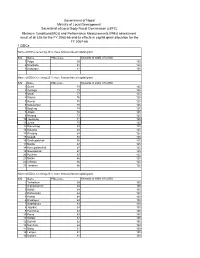
Government of Nepal Ministry of Local Development Secretariat of Local Body Fiscal Commission (LBFC) Minimum Conditions(MCs) and Performance Measurements (PMs) assessment result of all LBs for the FY 2065-66 and its effects in capital grant allocation for the FY 2067-68 1.DDCs Name of DDCs receiving 30 % more formula based capital grant S.N. Name PMs score Rewards to staffs ( Rs,000) 1 Palpa 90 150 2 Dhankuta 85 150 3 Udayapur 81 150 Name of DDCs receiving 25 % more formula based capital grant S.N Name PMs score Rewards to staffs ( Rs,000) 1 Gulmi 79 125 2 Syangja 79 125 3 Kaski 77 125 4 Salyan 76 125 5 Humla 75 125 6 Makwanpur 75 125 7 Baglung 74 125 8 Jhapa 74 125 9 Morang 73 125 10 Taplejung 71 125 11 Jumla 70 125 12 Ramechap 69 125 13 Dolakha 68 125 14 Khotang 68 125 15 Myagdi 68 125 16 Sindhupalchok 68 125 17 Bardia 67 125 18 Kavrepalanchok 67 125 19 Nawalparasi 67 125 20 Pyuthan 67 125 21 Banke 66 125 22 Chitwan 66 125 23 Tanahun 66 125 Name of DDCs receiving 20 % more formula based capital grant S.N Name PMs score Rewards to staffs ( Rs,000) 1 Terhathum 65 100 2 Arghakhanchi 64 100 3 Kailali 64 100 4 Kathmandu 64 100 5 Parbat 64 100 6 Bhaktapur 63 100 7 Dadeldhura 63 100 8 Jajarkot 63 100 9 Panchthar 63 100 10 Parsa 63 100 11 Baitadi 62 100 12 Dailekh 62 100 13 Darchula 62 100 14 Dang 61 100 15 Lalitpur 61 100 16 Surkhet 61 100 17 Gorkha 60 100 18 Illam 60 100 19 Rukum 60 100 20 Bara 58 100 21 Dhading 58 100 22 Doti 57 100 23 Sindhuli 57 100 24 Dolpa 55 100 25 Mugu 54 100 26 Okhaldhunga 53 100 27 Rautahat 53 100 28 Achham 52 100 -

Effectiveness of Investment in Rajapur
..-~-. His Majesty's Government National Planning Commission Secretariat (NPCS) Singha Durbar, Kathmandu ~~~~l ~~[P(Q)lRil on I. Effectiveness ofInvestment in Rajapur Irrigation Project I I June 2002 I I Submitted Bv:.. I' ir:Cii'....-~ Gaurav Engineering Consultant (GEC) !1 EC I . "'--.........1 POBox 1248 New Baneswor. Kathmandu Tel. 482060 e-mail gec!J~12al(pwlinkcom.np L .. , I j Table Of Content Pages ACKNOWLEDGEMENT ACRONYMS EXECUTIVE SUMMARY 1.l. APPARENT SITUATION 1 1.2. MACRO PERSPECTIVE OF THE SYSTEM 3 1.2.1. NET WATER A V AILABILITY 4 1.2.2. INCREMENTAL CROP WATER RELATION 4 1.2.3. CROPWISE AND TOTAL INCREASE IN WATER DEMAND 5 1.2.4. STRUCTURES, OPERATION AND MAINTENANCE 5 1.2.5. ACCESS DEVELOPMENT AND SUSTAINABILITY 6 1.2.6. INCREMENT IN IRRIGATED LAND 6 1.2.7. IRRIGATION CHANNEL DEVELOPMENT 6 1.2.8. PRODUCTION INCREASE AND INCREMENTAL DEMAND 6 1.2.9. PARTICIPATION AND COST RECOVERY 7 1.2.10. POVERTY ALLEVIATION AND WELFARE 8 1.2.11. INSTITUTIONAL DEVELOPMENT 8 1.2.12. MARKET AND PRICES 8 1.2.13. ENVIRONMENTAL DEVELOPMENT 9 1.3. ALTERNATIVE STRATEGIES 9 1.4. OBJECTIVE OF THE STUDY 9 2.1. RESEARCH DESIGN 11 2.2. NATURE AND SOURCES OF DATA 11 2.3. SAMPLE DESIGN 12 2.4. HOUSEHOLD SAMPLING 12 2.5. FIELD SURVEY ORGANlZATION 13 2.6. DAT A ANALYSIS, TOOLS AND TECHNIQUES 13 4.1. APPROACH AND ASSUMPTIONS 30 4.1. 1. RATIONALE 30 4.1.2. PRICES 30 4.1.3. CROPPING PATTERNS AND CORP BUDGET 31 4.1.4. -

Missing Persons in Nepal
MISSING PERSONS IN NEPAL Updated list - 2013 International Committee of the Red Cross GPO Box: 21225, Meen Bhawan, Naya Baneshwor Kathmandu, Nepal National Headquarters, Red Cross Marga, T +977 1 4107285 / 4107279 PO Box 217, Kalimati, Kathmandu , Nepal F +977 1 4107137 Tel: +977 1 4270650 / 4272761 E-mail: kathmandu@icrc.org www.icrc.org Fax: +977 1 4271915 ICRC © ICRC, August 2013 E-mail: info@nrcs.org www.nrcs.org Cover photo: Narendra Shrestha/ICRC MISSING PERSONS IN NEPAL The right to know Following the 10-years long armed conflict in Nepal, which ended in November 2006, families of 3’198 missing people reported to the International Committee of the Red Cross (ICRC) and the Nepal Red Cross Society (NRCS) the disappearance of their relatives, often following their alleged arrest or capture by one of the parties to the conflict, or during armed encounters. As a neutral, independent and impartial humanitarian organization with an international mandate to alleviate the suffering of the victims of armed conflicts and other situations of violence, one of the tasks of the ICRC is to assist all parties to the former conflict in Nepal to fulfill their obligations to clarify the fate and whereabouts of missing persons. The various field assessments conducted by the ICRC and the NRCS on the needs of these families have repeatedly shown that their primary need is to know what happened to their missing loved-ones, even years after the events took place. WHAT IS THIS PUBLICATION? This publication aims to bring public recognition to the families of missing persons in Nepal as a result of the conflict and to highlight their suffering and their needs.