Subgenus Nothonotus) from the Duck and Buffalo Rivers, Tennessee
Total Page:16
File Type:pdf, Size:1020Kb
Load more
Recommended publications
-

OCCASIONAL PAPERS of the MUSEUM of ZOOLOGY UNIVERSITY of MICHIGAN Asx ARBOR,MICHIGAN
OCCASIONAL PAPERS OF THE MUSEUM OF ZOOLOGY UNIVERSITY OF MICHIGAN Asx ARBOR,MICHIGAN ETHEOSTOAPA ACUTICEPS, .A NET41 DARTER FROM THE TENNESSEE RIVER SYSTEM, TWITH REMARKS ON THE SUBGENUS NOTHOATOTUS PRIOR10 the impoundment of the South Fork of thc I-Iolston River, Tennessee, a qualitative fish survey oT the area to be inundated was conducted by a party representing the Tennessee Valley Authority, the Tennessee Department of Conservation, and The University of Michigan. On the last day of field operations, September, 1947, two specimens of an undescribed darter were secured. In an attempt to obtain additional material the locality was revisited in June, 1949, by Gerald P. Cooper, John D. Kilby, and myself. Low water made success possible, because we found that the species was apparently confined to the deeper, faster riffles near the center of the stream. The darter was so rare that only four individuals were seined in three hours. The South Holston Reservoir is now full and the only known locality for Etheostomn acuticeps lies beneath 190 feet of water. Since it is unlikely that this swift-water species can tolerate quiet water, it is hoped that other stations of occurrence may be disco~.ered.To my companions in the field work, the late R. W. Eschmeyer, then with the Tennessee Valley Authority, Jack Chance, formerly with the Tennessee Department of Conservation, Gerald P. Cooper, Michigan Department of Conservation, and John D. Kilby, University of Flor- ida, I am sincerely grateful. For several years I have been assembling data leading toward a revision of the bluebreast darters (subgenus Nothonotus). -

Proceedings of the United States National Museum
Proceedings of the United States National Museum SMITHSONIAN INSTITUTION . WASHINGTON, D.C. Volume 119 1966 Number 3550 CATALOG OF TYPE SPECIMENS OF THE DARTERS (PISCES, PERCIDAE, ETHEOSTOMATINI) ^ By Bruce B. Collette and Leslie W. Knapp ^ Introduction The darters are a tribe of small freshwater fishes restricted to North America. Some 212 specific and subspecific names have been pro- posed for the approximately 100 vahd described species. About a dozen species await description. As part of a long-term study of these fishes, we have prepared this catalog of type specimens. We hope that our efforts will be of value in furthering systematic research and stabilizing the nomenclature of this most fascinating group of North American fishes. In preparing this catalog we have attempted to examine or at least to verify the location of the type specimens of all nominal forms of the three presently recognized genera of darters: Percina, Ammo- crypta, and Etheostoma. By type specimens we mean holotypes, lectotypes, syntypes, paralectotypes, and paratypes. Each form is ' Fifth paper in a series on the systematics of the Percidae by the senior author. 2 Collette: Assistant Laboratory Director, Bureau of Commercial Fisheries Ichthyological Laboratory, Division of Fishes, U.S. National Museum; Knapp: Supervisor in charge of vertebrates, Oceanographic Sorting Center, Smithsonian Institution. a 2 PROCEEDINGS OF THE NATIONAL MUSEUM vol. 119 listed in alphabetical order by the generic and specific name used in the original description. If subgeneric allocation was made in the original description, that name has been placed in parentheses between the genus and the species. Holotypes or lectotypes are listed before paratypes or paralectotypes. -
Proceedings of the Indiana Academy of Science 1 1 8(2): 143—1 86
2009. Proceedings of the Indiana Academy of Science 1 1 8(2): 143—1 86 THE "LOST" JORDAN AND HAY FISH COLLECTION AT BUTLER UNIVERSITY Carter R. Gilbert: Florida Museum of Natural History, University of Florida, Gainesville, Florida 32611 USA ABSTRACT. A large fish collection, preserved in ethanol and assembled by Drs. David S. Jordan and Oliver P. Hay between 1875 and 1892, had been stored for over a century in the biology building at Butler University. The collection was of historical importance since it contained some of the earliest fish material ever recorded from the states of South Carolina, Georgia, Mississippi and Kansas, and also included types of many new species collected during the course of this work. In addition to material collected by Jordan and Hay, the collection also included specimens received by Butler University during the early 1880s from the Smithsonian Institution, in exchange for material (including many types) sent to that institution. Many ichthyologists had assumed that Jordan, upon his departure from Butler in 1879. had taken the collection. essentially intact, to Indiana University, where soon thereafter (in July 1883) it was destroyed by fire. The present study confirms that most of the collection was probably transferred to Indiana, but that significant parts of it remained at Butler. The most important results of this study are: a) analysis of the size and content of the existing Butler fish collection; b) discovery of four specimens of Micropterus coosae in the Saluda River collection, since the species had long been thought to have been introduced into that river; and c) the conclusion that none of Jordan's 1878 southeastern collections apparently remain and were probably taken intact to Indiana University, where they were lost in the 1883 fire. -
Kyfishid[1].Pdf
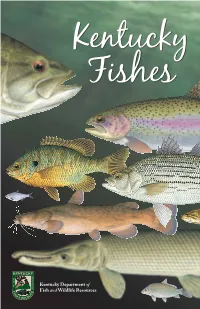
Kentucky Fishes Kentucky Department of Fish and Wildlife Resources Kentucky Fish & Wildlife’s Mission To conserve, protect and enhance Kentucky’s fish and wildlife resources and provide outstanding opportunities for hunting, fishing, trapping, boating, shooting sports, wildlife viewing, and related activities. Federal Aid Project funded by your purchase of fishing equipment and motor boat fuels Kentucky Department of Fish & Wildlife Resources #1 Sportsman’s Lane, Frankfort, KY 40601 1-800-858-1549 • fw.ky.gov Kentucky Fish & Wildlife’s Mission Kentucky Fishes by Matthew R. Thomas Fisheries Program Coordinator 2011 (Third edition, 2021) Kentucky Department of Fish & Wildlife Resources Division of Fisheries Cover paintings by Rick Hill • Publication design by Adrienne Yancy Preface entucky is home to a total of 245 native fish species with an additional 24 that have been introduced either intentionally (i.e., for sport) or accidentally. Within Kthe United States, Kentucky’s native freshwater fish diversity is exceeded only by Alabama and Tennessee. This high diversity of native fishes corresponds to an abun- dance of water bodies and wide variety of aquatic habitats across the state – from swift upland streams to large sluggish rivers, oxbow lakes, and wetlands. Approximately 25 species are most frequently caught by anglers either for sport or food. Many of these species occur in streams and rivers statewide, while several are routinely stocked in public and private water bodies across the state, especially ponds and reservoirs. The largest proportion of Kentucky’s fish fauna (80%) includes darters, minnows, suckers, madtoms, smaller sunfishes, and other groups (e.g., lam- preys) that are rarely seen by most people. -

Spotted Darter Status Assessment
SPOTTED DARTER STATUS ASSESSMENT Prepared by: Joseph M. Mayasich and David Grandmaison Natural Resources Research Institute University of Minnesota 5013 Miller Trunk Highway Duluth, MN 55811-1442 and David Etnier Ecology and Evolutionary Biology University of Tennessee 569 Dabney Hall Knoxville, TN 37996-1610 Prepared for: U.S. Fish and Wildlife Service Region 3 1 Federal Drive Fort Snelling, MN 55111 March 2004 NRRI Technical Report No. NRRI/TR-2004-02 DISCLAIMER This document is a compilation of biological data and a description of past, present, and likely future threats to the spotted darter, Etheostoma maculatum (Kirtland). It does not represent a decision by the U.S. Fish and Wildlife Service (Service) on whether this taxon should be designated as a candidate species for listing as threatened or endangered under the Federal Endangered Species Act. That decision will be made by the Service after reviewing this document; other relevant biological and threat data not included herein; and all relevant laws, regulations, and policies. The result of the decision will be posted on the Service's Region 3 Web site (refer to: http://midwest.fws.gov/eco_serv/endangrd/lists/concern.html). If designated as a candidate species, the taxon will subsequently be added to the Service's candidate species list that is periodically published in the Federal Register and posted on the World Wide Web (refer to: http://endangered.fws.gov/wildlife.html). Even if the taxon does not warrant candidate status it should benefit from the conservation recommendations that are contained in this document. i TABLE OF CONTENTS DISCLAIMER............................................................................................................................... ii NARRATIVE ................................................................................................................................1 SYSTEMATICS............................................................................................................... -

Teleostei: Percidae: Etheostomatinae)
University of Tennessee, Knoxville TRACE: Tennessee Research and Creative Exchange Doctoral Dissertations Graduate School 5-2009 Hybridization, ancestral polymorphism, and cryptic species in Nothonotus darters (Teleostei: Percidae: Etheostomatinae) Benjamin Paul Keck University of Tennessee Follow this and additional works at: https://trace.tennessee.edu/utk_graddiss Recommended Citation Keck, Benjamin Paul, "Hybridization, ancestral polymorphism, and cryptic species in Nothonotus darters (Teleostei: Percidae: Etheostomatinae). " PhD diss., University of Tennessee, 2009. https://trace.tennessee.edu/utk_graddiss/5992 This Dissertation is brought to you for free and open access by the Graduate School at TRACE: Tennessee Research and Creative Exchange. It has been accepted for inclusion in Doctoral Dissertations by an authorized administrator of TRACE: Tennessee Research and Creative Exchange. For more information, please contact trace@utk.edu. To the Graduate Council: I am submitting herewith a dissertation written by Benjamin Paul Keck entitled "Hybridization, ancestral polymorphism, and cryptic species in Nothonotus darters (Teleostei: Percidae: Etheostomatinae)." I have examined the final electronic copy of this dissertation for form and content and recommend that it be accepted in partial fulfillment of the equirr ements for the degree of Doctor of Philosophy, with a major in Ecology and Evolutionary Biology. Thomas J. Near, Major Professor We have read this dissertation and recommend its acceptance: Accepted for the Council: Carolyn -

Elassoma Alabamae, Anew Species of Pygmy Sunfish Endemic to the Tennessee River Drainage of Alabama (Teleostei: Elassomatidae)
Number 16 June 15, 1993 Elassoma alabamae, aNew Species of Pygmy Sunfish Endemic to the Tennessee River Drainage of Alabama (Teleostei: Elassomatidae) ANew Species of Percina (Odontopholis) from Kentucky and Tennessee with Comparisons to Percina cymatotaenia (Teleostei: Percidae) Systematics of the Etheostoma jordani Species Group (Teleostei: Percidae), with Descriptions of Three New Species BULLETIN ALABAMA MUSEUM OF NATURAL HISTORY The scientific publication of the Alabama Museum of Natural History. Richard L. Mayden, Editor,john C. Hall, Managing Editor. BULLETIN ALABAMA MUSEUM OF NATURAL HISTORYis published by the Alabama Museum of Natural History, a unit of The University of Alabama. The BULLETIN succeeds its predecessor, the MUSEUM PAPERS, which was termi nated in 1961 upon the transfer of the Museum to the University from its parent organization, the Geological Survey of Alabama. The BULLETIN is devoted primarily to scholarship and research concerning the natural history of Alabama and the Midsouth. It appears irregularly in consecutively numbered issues. Communication concerning manuscripts, style, and editorial policy should be addressed to: Editor, BULLETIN ALABAMA MUSEUM OF NATURAL HIS TORY, The University of Alabama, Box 870340, Tuscaloosa, AL 35487-0340; Telephone (205) 348-7550. Prospective authors should examine the Notice to Authors inside the back cover. Orders and requests for general information should be addressed to Managing Editor, BULLETIN ALABAMA MUSEUM OF NATURAL HISTORY, at the above address. Numbers may be purchased individually; standing orders are accepted. Remittances should accompany orders for individual numbers and be payable to The University of Alabama. The BULLETIN will invoice standing orders. Library exchanges may be handled through: Exchange Librarian, The University of Alabama, Box 870266, Tuscaloosa, AL 35487-0340. -

Serendipity the Nothonotus Wapiti Story
25 American Currents Vol. 41, No. 2 SERENDIPITY THE NOTHONOTUS WAPITI STORY Dave Etnier University of Tennessee-Knoxville In 1963 John Ramsey, then a Ph.D. student with R. D. Sutt- gocephalus species tend to occupy the weaker currents of kus at Tulane University, New Orleans, collected a single ju- pool areas. The 1963 Elk River capture was much more re- venile of what he thought to be an undescribed darter in the cent than the 1884 Shoal Creek specimens, so the University genus Etheostoma, subgenus Oligocephalus, from Elk River of Tennessee (UT) group directed our collection efforts to at Fayetteville, Lincoln Co., TN. This “undescribed species” that river system. was subsequently known to southeastern ichthyologists as During this era, TVA biologists were actively collecting Etheostoma (Oligocephalus) wapiti ms, after the Cherokee and preserving fishes from throughout the Tennessee River name for the American Elk. The abbreviation “ms” means drainage, and many were being deposited in the collection manuscript species, or names lacking a formal description at UT. Charles F. Saylor, fish expert at TVA, noticed some (nomina nuda, or “naked names”). Prior to a recent change juvenile darters from the lower main channel Elk River that in the Rules of Zoological Nomenclature, if a naked name he couldn’t identify, thought they were in subgenus Notho- appeared in a publication, that name was unavailable for fu- notus, but that they were neither Bluebreast nor Redline ture use. darters, the only Nothonotus then known from the Elk. They While visiting the wonderful fish collection at Tulane certainly appeared to be identical to the three juvenile Noth- University in the 1970s, Jim Williams and I decided to have onotus that Jim and I had been puzzling over. -

Etheostoma (Boleosoma) Longimanum and E. (Catonotus) Obeyense, Two More Darters Confirmed As Egg-Clusterers
Trans. Ky. Acad. Sci., 42(1-2), 1981,35-36 Etheostoma (Boleosoma) longimanum and E. (Catonotus) obeyense, Two More Darters Confirmed as Egg-clusterers LAWRENCE M. PAGE, W. LAWRENCE KELLER, AND LYNN E. CORDES Illinois Natural History Survey, Urbana, Illinois 61801 ABSTRACT Egg-clustering and guarding by males are reported for the first time in the longfin darter, Etheostoma /ongimanum, and the barcheek darter, E. obeyense. Darters either bury their eggs in the an egg-clusterer (Raney and Lachner substrate and abandon them, or they at- 1939); E. tip pecanoe, E. camurum, and tach them to an object, usually a rock or E. rufilineaturn are egg-buriers (Traut- plant, above the substrate. Some species man 1957, Mount 1959, Stiles 1972). attach their eggs singly or in small groups Breeding habits of the other nine species and then abandon them; others arrange of Nothonotus are unknown but E. the eggs in a cluster on the underside of aquali and E. microlepidum, close rela- a stone or log and the male guards them tives of E. maculatum, are probably egg- until hatching. clusterers. Egg-clustering, which includes paren- Nests of the longfin darter, E. longi- tal care, is the most complex form of manum, were sought in Craig Creek, breeding behavior in darters and has both above and below New Castle, Craig evolved in at least three unrelated sub- County, Virginia, on 23 May 1980. Only genera (i.e., nonsister-groups) of Etheo- one nest of eggs was found, although sev- stoma: Boleosoma, Nothonotus, and Ca- eral large males in breeding coloration tonotus. -

Aflps Do Not Support Deep Phylogenetic Relationships Among Darters (Teleostei: Percidae: Etheostomatinae)
Heredity (2012) 108, 647–648 & 2012 Macmillan Publishers Limited All rights reserved 0018-067X/12 www.nature.com/hdy LETTER TO THE EDITOR AFLPs do not support deep phylogenetic relationships among darters (Teleostei: Percidae: Etheostomatinae) Heredity (2012) 108, 647–648; doi:10.1038/hdy.2011.130; published online 11 January 2012 In a recent paper Smith et al. (2011) presented an amplified fragment to the frequentist probability that the tree is correct when length polymorphism (AFLP) data set from 20 primer pairs that were all assumptions of the Bayesian analysis are satisfied (Huelsenbeck scored for 69 darter species to infer phylogenetic relationships. Our and Rannala, 2004). This correlation has contributed to the primary concern with the conclusions presented in Smith et al. (2011) common practice in Bayesian phylogenetics that a given node in a is an overstatement of the phylogenetic utility of ALFP markers for phylogeny is considered strongly supported if it is present in X95% deep relationships among darters, and support for taxonomic groups in the posterior distribution of trees. Therefore, a clade that is not inferred from non-phylogenetic assessments of morphology. Despite present in X95% of the posterior set of trees is not considered claims to the contrary, the Bayesian phylogeny presented in Figure 2 of strongly supported in Bayesian phylogenetical analyses (Huelsenbeck Smith et al. (2011) conclusively demonstrates that AFLP markers do et al., 2000). not provide strong support for deep relationships among darters, nor The deep relationships that concern Smith et al. (2011) are focused does phylogenetic analysis of this data support a majority of the on the monophyly of Etheostoma, as delimited in Page (2000), and the sampled taxonomic groups. -

Ecological and Morphological Variation of Darters Among Assemblages in Oklahoma Streams
ECOLOGICAL AND MORPHOLOGICAL VARIATION OF DARTERS AMONG ASSEMBLAGES IN OKLAHOMA STREAMS by GARRETT W. HOPPER B.S., Oklahoma State University, 2013 A THESIS submitted in partial fulfillment of the requirements for the degree MASTER OF SCIENCE Division of Biology College of Arts and Sciences KANSAS STATE UNIVERSITY Manhattan, Kansas 2015 Approved by: Major Professor Michael Tobler Copyright GARRETT W. HOPPER 2015 Abstract Environmental variation can shape phenotypic variation in organisms. Most evidence for trait differentiation along environmental gradients comes from analyses of dichotomous habitat types that differ in only one or few environmental factors. In reality, however, environmental variation is often more subtle, gradual, and multifarious. I investigated geographic variation in body shape, trophic resource use, and individual diet specialization in two species of darters (Etheostoma spectabile and E. flabellare; Percidae) that occur along river gradients. I explicitly tested how abiotic and biotic environmental factors shape trait variation within and between species. Results indicated significant among population variation in the body shape of both species. Population differences in body shape were correlated with variation in substrate composition. Although body shape analyses revealed a small but significant signal of convergent evolution of body shape when both species occur in sympatry, E. spectabile and E. flabellare mostly exhibited unique responses to shared sources of selection. The analyses of darter trophic resource use uncovered significant resource partitioning between the two species and geographic variation in diets that is likely driven by differences in resource availability. Furthermore, the majority of populations exhibited significant individual specialization. Variation in individual specialization in populations of E. flabellare was related to invertebrate density and competitor richness, and in E. -

* This Is an Excerpt from Protected Animals of Georgia Published By
Common Name: WOUNDED DARTER Scientific Name: Etheostoma vulneratum Other Commonly Used Names: none Previously Used Scientific Names: The species is in the subgenus Nothonotus, which some authors recognize at the generic level. Family: Percidae Rarity Ranks: G3/S1 State Legal Status: Endangered Federal Legal Status: Not Listed Description: The wounded darter attains a total length of about 87 mm (3.4 in). This species has a frenum, six branchiostegal fin rays, and narrowly joined gill membranes. Males and females have a prominent suborbital bar (teardrop) and faint horizontal rows of pigment along the light-brown to olive body. There is a vertical row of four dark spots on the base of the caudal fin: two prominent spots clustered near the middle of the fin and 2 less prominent spots on the fin margins. There are eight dorsal saddles and about 10 vertical bars that are more evident in juvenile fish than more darkly colored adults. Although pigmentation intensifies during spawning (see photo at bottom of account), adult males are brightly colored throughout the year with a green breast and red spots along the sides. Bright red spots mark the front and rear margins of the first dorsal fin. The second dorsal fin is reddish, and the caudal fin is predominantly red with black streaks of pigment between the middle fin rays. Females from the Toccoa River have a red ocellus in the first dorsal fin, but otherwise lack bright breeding coloration (see photo at bottom of account). Descriptions from other drainages have noted that females may have some red-spots on their sides.