Headline Discoveries Apr/May 2011; Issue 2
Total Page:16
File Type:pdf, Size:1020Kb
Load more
Recommended publications
-
Copyrighted Material
Index INDEX Note: page numbers in italics refer to fi gures, those in bold refer to tables and boxes. abducens nerve 55 activity cycles 499–522 inhibition 485 absorption effi ciency 72 annual patterns 515, 516, 517–22 interactions 485–6 abyssal zone 393 circadian rhythms 505 prey 445 Acanthaster planci (Crown-of-Thorns Starfi sh) diel patterns 499, 500, 501–2, 503–4, reduction 484 579 504–7 aggressive mimicry 428, 432–3 Acanthocybium (Wahoo) 15 light-induced 499, 500, 501–2, 503–4, aggressive resemblance 425–6 Acanthodii 178, 179 505 aglomerular 52 Acanthomorpha 284–8, 289 lunar patterns 507–9 agnathans Acanthopterygii 291–325 seasonal 509–15 gills 59, 60 Atherinomorpha 293–6 semilunar patterns 507–9 osmoregulation 101, 102 characteristics 291–2 supra-annual patterns 515, 516, 517–22 phylogeny 202 distribution 349, 350 tidal patterns 506–7 ventilation 59, 60 jaws 291 see also migration see also hagfi shes; lampreys Mugilomorpha 292–3, 294 adaptive response 106 agnathous fi shes see jawless fi shes pelagic 405 adaptive zones 534 agonistic interactions 83–4, 485–8 Percomorpha 296–325 adenohypophysis 91, 92 chemically mediated 484 pharyngeal jaws 291 adenosine triphosphate (ATP) 57 sound production 461–2 phylogeny 292, 293, 294 adipose fi n 35 visual 479 spines 449, 450 adrenocorticotropic hormone (ACTH) 92 agricultural chemicals 605 Acanthothoraciformes 177 adrianichthyids 295 air breathing 60, 61–2, 62–4 acanthurids 318–19 adult fi shes 153, 154, 155–7 ammonia production 64, 100–1 Acanthuroidei 12, 318–19 death 156–7 amphibious 60 Acanthurus bahianus -
Wild About Learning
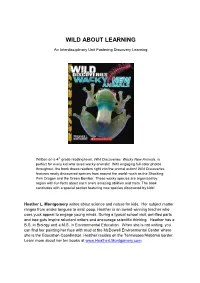
WILD ABOUT LEARNING An Interdisciplinary Unit Fostering Discovery Learning Written on a 4th grade reading level, Wild Discoveries: Wacky New Animals, is perfect for every kid who loves wacky animals! With engaging full-color photos throughout, the book draws readers right into the animal action! Wild Discoveries features newly discovered species from around the world--such as the Shocking Pink Dragon and the Green Bomber. These wacky species are organized by region with fun facts about each one's amazing abilities and traits. The book concludes with a special section featuring new species discovered by kids! Heather L. Montgomery writes about science and nature for kids. Her subject matter ranges from snake tongues to snail poop. Heather is an award-winning teacher who uses yuck appeal to engage young minds. During a typical school visit, petrified parts and tree guts inspire reluctant writers and encourage scientific thinking. Heather has a B.S. in Biology and a M.S. in Environmental Education. When she is not writing, you can find her painting her face with mud at the McDowell Environmental Center where she is the Education Coordinator. Heather resides on the Tennessee/Alabama border. Learn more about her ten books at www.HeatherLMontgomery.com. Dear Teachers, Photo by Sonya Sones As I wrote Wild Discoveries: Wacky New Animals, I was astounded by how much I learned. As expected, I learned amazing facts about animals and the process of scientifically describing new species, but my knowledge also grew in subjects such as geography, math and language arts. I have developed this unit to share that learning growth with children. -

18 Special Habitats and Special Adaptations 395
THE DIVERSITY OF FISHES Dedications: To our parents, for their encouragement of our nascent interest in things biological; To our wives – Judy, Sara, Janice, and RuthEllen – for their patience and understanding during the production of this volume; And to students and lovers of fishes for their efforts toward preserving biodiversity for future generations. Front cover photo: A Leafy Sea Dragon, Phycodurus eques, South Australia. Well camouflaged in their natural, heavily vegetated habitat, Leafy Sea Dragons are closely related to seahorses (Gasterosteiformes: Syngnathidae). “Leafies” are protected by Australian and international law because of their limited distribution, rarity, and popularity in the aquarium trade. Legal collection is highly regulated, limited to one “pregnant” male per year. See Chapters 15, 21, and 26. Photo by D. Hall, www.seaphotos.com. Back cover photos (from top to bottom): A school of Blackfin Barracuda, Sphyraena qenie (Perciformes, Sphyraenidae). Most of the 21 species of barracuda occur in schools, highlighting the observation that predatory as well as prey fishes form aggregations (Chapters 19, 20, 22). Blackfins grow to about 1 m length, display the silvery coloration typical of water column dwellers, and are frequently encountered by divers around Indo-Pacific reefs. Barracudas are fast-start predators (Chapter 8), and the pan-tropical Great Barracuda, Sphyraena barracuda, frequently causes ciguatera fish poisoning among humans (Chapter 25). Longhorn Cowfish, Lactoria cornuta (Tetraodontiformes: Ostraciidae), Papua New Guinea. Slow moving and seemingly awkwardly shaped, the pattern of flattened, curved, and angular trunk areas made possible by the rigid dermal covering provides remarkable lift and stability (Chapter 8). A Silvertip Shark, Carcharhinus albimarginatus (Carcharhiniformes: Carcharhinidae), with a Sharksucker (Echeneis naucrates, Perciformes: Echeneidae) attached. -
Curriculum Vitae
CURRICULUM VITAE NAME: THEODORE WELLS PIETSCH TITLES: Professor Emeritus, School of Aquatic and Fishery Sciences, College of the Environment, University of Washington, Seattle, Washington Curator Emeritus of Fishes, Burke Museum of Natural History and Culture, University of Washington, Seattle, Washington Professor Emeritus, Graduate Program in Museology, University of Washington, Seattle, Washington Research Associate in Ichthyology, Museum of Comparative Zoology, Harvard University, Cambridge, Massachusetts Research Associate in Ichthyology, Natural History Museum of Los Angeles County, Los Angeles, California Fellow of the California Academy of Sciences, elected 1984 Fellow of the Gilbert Ichthyological Society, elected 1989 Fellow of The Linnean Society of London, elected 1996 Fellow of the American Association for the Advancement of Science, elected 1996 Fellow of the University of Washington Teaching Academy, elected 1998 Honorary Member, Ichthyological Society of Japan, elected 2001 Honorary Member, Russian Hydrobiological Society, Russian Academy of Sciences, elected 2009 Member, Washington State Academy of Sciences, elected 2010 ADDRESS: Professional: School of Aquatic and Fishery Sciences College of the Environment University of Washington Campus Box 355020 Seattle, Washington 98195 Telephone: (206) 543-8923 FAX: (206) 616-6716 E-mail: twp@uw.edu Internet: http://faculty.washington.edu/twp http://www.burkemuseum.org/ichthyology EDUCATION: High School Diploma, John Adams High School, South Bend, Indiana, 1963 (mentor Ernest Litweiler). B.A. Zoology, University of Michigan, Ann Arbor, Michigan 48104, 1967 (mentor Arnold G. Kluge). M.S. Biology, University of Southern California, Los Angeles, California 90007, 1969 (major professor Basil G. Nafpaktitis). Ph.D. Biology, University of Southern California, Los Angeles, California 90007, 1973 (major professor Basil G. -
Figure Captions
Figure I (opposite) A school of Blackfin Barracuda, Sphyraena qenie (Perciformes, Sphyraenidae). Most of the 21 species of barracuda occur in schools, highlighting the observation that predatory as well as prey fishes form aggregations (Chapters 19, 20, 22). Blackfins grow to about 1 m length, display the silvery coloration typical of water column dwellers, and are frequently encountered by divers around Indo-Pacific reefs. Barracudas are fast-start predators (Chapter 8), and the pantropical Great Barracuda, S. barracuda, frequently causes ciguatera fish poisoning among humans (Chapter 25). Photo by D. Hall, www.seaphotos.com. Figure 1.1 Fish versus fishes. By convention, “fish” refers to one or more individuals of a single species. “Fishes” is used when discussing more than one species, regardless of the number of individuals involved. Megamouth, paddlefish, and char drawings courtesy of P. Vecsei; oarfish drawing courtesy of T. Roberts. Figure 2.1 Cladogram of hypothesized relationships of the Louvar (Luvarus, Luvaridae) and other Acanthuroidei. Arabic numerals show synapomorphies: numbers 1 through 60 represent characters from adults, 61 through 90 characters from juveniles. Some sample synapomorphies include: 2, branchiostegal rays reduced to four or five; 6, premaxillae and maxillae (upper jawbones) bound together; 25, vertebrae reduced to nine precaudal plus 13 caudal; 32, single postcleithrum behind the pectoral girdle; 54, spine or plate on caudal peduncle; 59, teeth spatulate. From Tyler et al. (1989). Figure 2.2 Some meristic and morphometric characters shown on a hypothetical scombrid fish. Figure II (opposite) Longhorn Cowfish, Lactoria cornuta (Tetraodontiformes: Ostraciidae), Papua New Guinea. Slow moving and seemingly awkwardly shaped, the pattern of flattened, curved, and angular trunk areas made possible by the rigid dermal covering provides remarkable lift and stability (Chapter 8). -

Dive Into Ambon; Maluku Resort & Spa, Indonesia + [Other Articles
The Private, Exclusive Guide for Serious Divers February 2017 Vol. 32, No. 2 Dive Into Ambon; Maluku Resort & Spa, Indonesia a psychedelic experience without drugs IN THIS ISSUE: Dear Fellow Diver: Maluku Resort & Spa, Ambon, I returned from my first day of diving off the island Indonesia . 1 of Ambon to find a big, red-haired Viking from Finland Eight-Hour Ordeal for Shark Attack I’ll call Aleksi regaling our congenial dive hosts, a Victim, Craig DeWit . .3 big, easy-going former Londoner, Kaj (pronounced “Kai”) Maney and his vivacious Aussie partner, Barb Makohin. The You’d Better Have Blank Pages in that table before him was littered with empty bottles of “Big” Passport . 5 Bintang beer. The grinning Finn explained that he pos- MV Valentina . Sea of Cortez, Baja, sessed the directions to find an ultra-rare psychedelic Mexico . 7 frogfish, first discovered in 2009. He had flown in for a Swimming with La Paz Whale Sharks . 8 few days on news that the frogfish had returned. He had Disintegrating Dive Gear . .10 reconnoitered the location and was now happy to share it with Kaj, a long-time friend. Wes Skiles Verdict Unlucky for Some . 11 The next morning Aleksi pointed out a stand of palms In-Water Recompression? Our Readers React . .12 to triangulate the “secret” spot. Within minutes, I beheld the pink- and white-striped psychedelic frogfish -- Sri Lanka Aggressor Postscript . 13 a mesmerizing peppermint swirl of color straight out of Not a Diving Accident . 14 a ‘60s Jefferson Airplane poster -- not seen since 2014, Big Sharks Spotted Off Florida’s Atlantic and before that, not since it was discovered in Ambon on Coast . -

Curriculum Vitae ______
CURRICULUM VITAE _______________________________ Theodore Wells Pietsch TITLES: Professor Emeritus, School of Aquatic and Fishery Sciences, College of the Environment, and Graduate Program in Museology, University of Washington, Seattle, Washington Curator Emeritus of Fishes, Burke Museum of Natural History and Culture, University of Washington, Seattle, Washington Research Associate in Ichthyology, Museum of Comparative Zoology, Harvard University, Cambridge, Massachusetts Research Associate in Ichthyology, Natural History Museum of Los Angeles County, Los Angeles, California Fellow of the California Academy of Sciences, elected 1984 Fellow of the Gilbert Ichthyological Society, elected 1989 Fellow of The Linnean Society of London, elected 1996 Fellow of the American Association for the Advancement of Science, elected 1996 Fellow of the University of Washington Teaching Academy, elected 1998 Honorary Member, Ichthyological Society of Japan, elected 2001 Honorary Member, Russian Hydrobiological Society, Russian Academy of Sciences, elected 2009 Member, Washington State Academy of Sciences, elected 2010 Correspondant du Museum, Museum national d’Histoire naturelle, Paris, elected March 2016 ADDRESS: School of Aquatic and Fishery Sciences College of the Environment University of Washington Campus Box 355020 Seattle, Washington 98105-5020 Telephone: (206) 543-8923 E-mail: twp@uw.edu Internet: fish.uw.edu/faculty/theodore-w-pietsch environment.uw.edu/faculty/theodore-pietsch burkemuseum.org/research-and-collections/ichthyology en.wikipedia.org/wiki/Theodore Wells_Pietsch_III EDUCATION: High School Diploma, John Adams High School, South Bend, Indiana, 1963 (mentor Ernest Litweiler). B.A. Zoology, University of Michigan, Ann Arbor, Michigan 48104, 1967 (mentor Arnold G. Kluge). M.S. Biology, University of Southern California, Los Angeles, California 90007, 1969 (major professor Basil G. -

Planet Crunch by Richard Brock Planet Crunch the LIFE (OR DEATH?) of PLANET EARTH by Richard Brock
A personal view of the planet from Richard Brock, a producer at the BBC Natural History Unit for 35 years The Life (or Death?) OF PLANET EARTH Planet Crunch by Richard Brock Planet Crunch THE LIFE (OR DEATH?) OF PLANET EARTH by Richard Brock This book and the three films are dedicated, with much gratitude, to my mother, Eileen, and my sister, Cherry, who helped them happen in our efforts to survive the crunch of planet Earth. This book © copyright 2021 Richard Brock Unauthorised reproduction of any part of this publication by any means including photocopying is an infringement of copyright. Written by Richard Brock Typing Moira Sage Film image delivery Gareth Trezise Abbreviations Because many of the sources of the material I’ve included vary considerably, so do the forms of abbreviation such as % and per cent; trn, b and m = trillion, billion (bn) and million; UN and U.N.; km – kilometres; I do hope you can understand – literally! Sustainability and the environment. As part of my commitment to demonstrable environmental management, conserving raw materials and energy, my printed materials are sustainable wherever possible. I select printers who recycle, reuse and prioritise sustainable practice and who have gained FSC ® and ISO 14001 Environmental Standard certification. As well as other planet-friendly work-place initiatives, our printer guarantees: all paper and cardboard waste is recycled, all printing plates are recycled, use of vegetable-based inks, papers from managed forests and use PUBLISHED BY RICHARD BROCK, of recycled papers when appropriate. THE BROCK INITIATIVE, CHEW MAGNA, BRISTOL, UK Contents Chapter 1 – Foreword ..........................................4 Chapter 7 – Fishing ............................................32 Chapter 11 – Energy and Oil ............................54 Chapter 15 – Money ...........................................86 Richard Brock’s introduction to his method of working i.e. -

Drumand CROAKER
DRUM and CROAKER A Highly Irregular Journal for the Public Aquarist Volume 52 Feb. 2021 TABLE OF CONTENTS Volume 52, 2021 2 Drum and Croaker 50 Years Ago Richard M. Segedi 3 Aquaculture of Patiria miniata Ben Morrow 11 The Use of Antibiotics to Treat Brown Jelly Disease within a Closed System Aquarium Jack Willans and Matthew Bradshaw 18 Collection, Culture, and Display of Gonionemus vertens at the Maritime Aquarium at Norwalk Bianca Milano, Lindsey Levine, and Rachel Stein 24 Book Review - Frogfishes: Biodiversity, Zoogeography, and Behavioral Ecology Theodore W. Pietsch and Rachel J. Arnold Reviewed by Barrett L. Christie 26 Behavioral Responses of Bonnethead Sharks (Sphyrna tiburo) to Changing Exhibit Salinity Lindsay Phenix and Michael O’Neill 36 Visual Signals of the East Pacific Red Octopus (Octopus rubescens) During Conspecific Interactions Rachel L. Borisko, Kirt L. Onthank, and E. Alan Verde 57 The Use of Visible Implant Elastomer Tags in Jellyfish Rachel Stein, Bianca Milano, and Lindsey Levine 69 Historical Book Review - A Summer Cruise on the Coast of New England Robert Carter, 1865 Reviewed by Pete Mohan 71 Case Report of the Leech Zeylanicobdella arugamensis in a Public Aquarium Setting, with a Review of Management Options Timothy Smith, Malini Pather, José Ganess, and Kerry Lavender 84 Stegostoma fasciatum Breeding Program at Loro Parque Aquarium Héctor Toledo and Ester Alonso 91 Husbandry Techniques and Medical Intervention in the Care of Green Morays (Gymnothorax funebris) at New England Aquarium Chris Bauernfeind, Melissa Joblon, and Michael O’Neill 99 The End of the Dallas Aquarium/Children’s Aquarium at Fair Park? Barrett L. -

Reef Encounter
Volume 35, No. 1 July 2020 Number 48 REEF ENCOUNTER REEF LIVES –Jack Randall, Ian Macintyre, David Bellamy ARTICLES – Corals and aesthetics, Feed your corals, The deepest photosynthetic coral, Coral wreaths & phoenix corals GRANTS & AWARDS – ICRS Honors, Graduate Fellowships, Travel Grants The CBD Post-2020 Framework, The Allen Coral Atlas, 4-D REEF GRADUATE FELLOWSHIP REPORTS and BOOK REVIEWS Bleaching in Galapagos, Crown-of-thorns in Mexico, Astropyga in St. Croix The News Magazine of the International Coral Reef Society www.coralreefs.org ISSN 0225 -27987 EDITORS, OFFICERS & COUNCIL MEMBERS REEF ENCOUNTER Reef Encounter is the Magazine Style Newsletter of the International Coral Reef Society. It was first published in 1983. Following a short break in production it was re-launched in electronic (pdf) form. Contributions are welcome, especially from members. Coordinating Editor Rupert Ormond (email: rupert.ormond.mci@gmail.com) Deputy Editor Caroline Rogers (email: caroline_rogers@usgs.gov) Editors Reef Edge (Scientific Letters) Dennis Hubbard (email: dennis.hubbard@oberlin.edu) Alastair Harborne (email: alastair.harborne@fiu.edu) Edwin Hernandez-Delgado (email: coral_giac@yahoo.com) Nicolas Pascal (email: nppacific@gmail.com) Beatriz Casareto (email: becasar@shizuoka.ac.jp) Douglas Fenner (email: douglasfennertassi@gmail.com) Editor Conservation and Obituaries Sue Wells (email: suewells1212@gmail.com) INTERNATIONAL CORAL REEF SOCIETY The International Coral Reef Society was founded (as the International Society for Reef Studies) in