São Tomé & Príncipe
Total Page:16
File Type:pdf, Size:1020Kb
Load more
Recommended publications
-

Download Download
Biodiversity Observations http://bo.adu.org.za An electronic journal published by the Animal Demography Unit at the University of Cape Town The scope of Biodiversity Observations consists of papers describing observations about biodiversity in general, including animals, plants, algae and fungi. This includes observations of behaviour, breeding and flowering patterns, distributions and range extensions, foraging, food, movement, measurements, habitat and colouration/plumage variations. Biotic interactions such as pollination, fruit dispersal, herbivory and predation fall within the scope, as well as the use of indigenous and exotic species by humans. Observations of naturalised plants and animals will also be considered. Biodiversity Observations will also publish a variety of other interesting or relevant biodiversity material: reports of projects and conferences, annotated checklists for a site or region, specialist bibliographies, book reviews and any other appropriate material. Further details and guidelines to authors are on this website. Paper Editor: Les G. Underhill OVERVIEW OF THE DISCOVERY OF THE WEAVERS H. Dieter Oschadleus Recommended citation format: Oschadleus HD 2016. Overview of the discovery of the weavers. Biodiversity Observations 7. 92: 1–15. URL: http://bo.adu.org.za/content.php?id=285 Published online: 13 December 2016 – ISSN 2219-0341 – Biodiversity Observations 7.92: 1–15 1 TAXONOMY Currently, 117 living species of weavers in the Ploceidae family are recognised. Hoyo et al. OVERVIEW OF THE DISCOVERY OF THE WEAVERS (2010) listed 116 species but Safford & Hawkins (2013) split the Aldabra Fody Foudia H. Dieter Oschadleus aldabrana from the Red- headed Fody Foudia Animal Demography Unit, Department of Biological Sciences, eminentissima. Dickinson & University of Cape Town, Rondebosch, 7701 South Africa Christidis (2014) also listed 117 species. -

Proceedings of the United States National Museum
FIELD NOTES ON VERTEBRATES COLLECTED BY THE SMITHSONIAN - CHRYSLER EAST AFRICAN EXPEDI- TION OF 1926 By Arthur Loveridge, Of the Museum of Comparative Zoology, Cambridge, Mass. In 1926 an expedition to secure live animals for the United States National Zoological Park at Washington was made possible through the generosity of Mr. Walter Chrysler. Dr. W. M. Mann, the director of the Zoological Park, has already published a report on the trip; ^ the following observations were made by the present writer, who was in charge of the base camp at Dodoma during three and a half of the four months that the expedition was in the field. The personnel of the party consisted of Dr. W. M. Mann, leader of the expedition; F. G. Carnochan, zoologist; Stephen Haweis, artist; Charles Charlton, photographer; and the writer. Several local hunters assisted the party in the field for longer or shorter periods, and Mr. Le Mesurier operated the Chrysler car. The expedition landed at Dar es Salaam, capital and chief port of entry for Tanganyika Territory (late German East Africa), on Thursday, May 6, and left on the following Monday by train for Dodoma, which had been selected as headquarters. The expedition sailed from Dar es Salaam on September 9. Dodoma is situated on the Central Railway almost exactly one- third of the distance between the coast and Lake Tanganyika. It was primarily selected as being a tsetse-free area and therefore a cattle country where milk in abundance could be obtained for the young animals; it is also the center of a region unusually free from stock diseases. -
The Collection of Birds from São Tomé and Príncipe at the Instituto De Investigação Científica Tropical of the University of Lisbon (Portugal)
A peer-reviewed open-access journal ZooKeys 600:The 155–167 collection (2016) of birds from São Tomé and Príncipe at the Instituto de Investigação... 155 doi: 10.3897/zookeys.600.7899 DATA PAPER http://zookeys.pensoft.net Launched to accelerate biodiversity research The collection of birds from São Tomé and Príncipe at the Instituto de Investigação Científica Tropical of the University of Lisbon (Portugal) Miguel Monteiro1,2, Luís Reino1,2,3, Martim Melo1,4, Pedro Beja1,2, Cristiane Bastos-Silveira5, Manuela Ramos7, Diana Rodrigues5, Isabel Queirós Neves5,6, Susana Consciência8, Rui Figueira1,2 1 CIBIO/InBIO-Centro de Investigação em Biodiversidade e Recursos Genéticos, Universidade do Porto, Vairão, Portugal 2 CEABN/InBio, Centro de Ecologia Aplicada “Professor Baeta Neves”, Instituto Superior de Agronomia, Universidade de Lisboa, Tapada da Ajuda, 1349-017 Lisboa, Portugal 3 CIBIO/InBIO-Centro de Investigação em Biodiversidade e Recursos Genéticos, Universidade de Évora, 7004-516 Évora, Portugal 4 Percy FitzPatrick Institute of African Ornithology, University of Cape Town, Rondebosch 7701X, South Africas 5 Museu Nacional de História Natural e da Ciência, Universidade de Lisboa, Rua da Escola Politécnica 56, 1250-102 Lisboa, Portugal 6 CESAM-Centre for Environmental and Marine Studies, Universidade de Aveiro, 3810-193 Aveiro, Portugal 7 MARE-FCUL, DOP/UAç - Departamento Oceanografia e Pescas, Univ. Açores, Rua Prof. Dr. Fre- derico Machado, 9901-862 Horta, Portugal 8 Estrada de Mem Martins n251 1ºDto, 2725-391 Mem Martins, Sintra, Portugal Corresponding author: Rui Figueira (ruifigueira@isa.ulisboa.pt) Academic editor: G. Sangster | Received 29 January 2015 | Accepted 2 June 2016 | Published 22 June 2016 http://zoobank.org/68209E54-00D0-4EFA-B095-AB7D346ACD8E Citation: Monteiro M, Reino L, Melo M, Beja P, Bastos-Silveira C, Ramos M, Rodrigues D, Neves IQ, Consciência S, Figueira R (2016) The collection of birds from São Tomé and Príncipe at the Instituto de Investigação Científica Tropical of the University of Lisbon (Portugal). -
Adobe PDF, Job 6
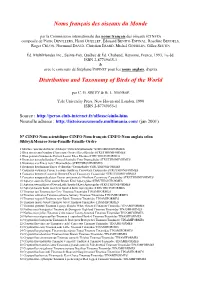
Noms français des oiseaux du Monde par la Commission internationale des noms français des oiseaux (CINFO) composée de Pierre DEVILLERS, Henri OUELLET, Édouard BENITO-ESPINAL, Roseline BEUDELS, Roger CRUON, Normand DAVID, Christian ÉRARD, Michel GOSSELIN, Gilles SEUTIN Éd. MultiMondes Inc., Sainte-Foy, Québec & Éd. Chabaud, Bayonne, France, 1993, 1re éd. ISBN 2-87749035-1 & avec le concours de Stéphane POPINET pour les noms anglais, d'après Distribution and Taxonomy of Birds of the World par C. G. SIBLEY & B. L. MONROE Yale University Press, New Haven and London, 1990 ISBN 2-87749035-1 Source : http://perso.club-internet.fr/alfosse/cinfo.htm Nouvelle adresse : http://listoiseauxmonde.multimania. -

ON a COLLECTION of BIRDS from TURKANALAND by V. G. L. VANSOMEREN,With Introduction by CAPT
3 ON A COLLECTION OF BIRDS FROM TURKANALAND By V. G. L. VANSOMEREN,with Introduction by CAPT. GEMMEL,Survey Dept., attchd. 6th K.A.R. Before we come to the study of the wonderful and interesting collection of bird life contained in this article, let us have an idea of the road to the district from which the collection comes and the class of country we pass through. There are two main routes from Nairobi-viz., via Londiani, Eldoret, Kacheliba (a small administrative post on the north• east slopes of Elgon), and Moroto; or via Kisumu, Jinja, Namasagali, the Nile and Lake Kioga steamer service to Lale Port, Soroti, and on to Moroto. The first-mentioned route is not the generally travelled one, as it entails a much longer period of safari, and the second is the one that concerns us. The journey from Nairobi by train and on to Jinja by the steamer Clement Hill will be already too familiar to the reader to need any further description. From Jinja you take the train again on the 13usoga Railway to Namasagali, a port established as head• quarters of the Nile-Kioga Lake Service. The distance is approximately 60 miles, and, generally speaking, the country is slightly undulating and scrubby with long grass. The railway follows the general line of the Nile, and at Namasa• gali the river is a fine wide stream. At Namasagali you embark on the steamer Stanley. To one unacquainted with Africa and her ways, you would have grave doubts when embarking, and would wonder in what depth of water you would finish up ! but in reality the Stanley is very comfort• able for travelling on the Lake and the Nile, and is just another instance of making the means meet the end. -

The Status and Conservation of the Endemic Bird Species of São Tomé
Bird Conservation International (1991) 1:255-282 The status and conservation of the endemic bird species of Sao Tome and Principe, West Africa PHIL ATKINSON, NIC PEET and JAMES ALEXANDER Summary Fieldwork on the distribution, status and ecology of the endemic bird species of Sao Tome and Principe was conducted from June to September 1990. The results are here combined with other evidence, notably from recent ICBP-backed fieldwork. Findings largely sup- port existing Red Data Book listings, although Oriolus crassirostris is now found only in remote undisturbed areas at low density, and deserves "Rare" status. Particular achieve- ments of the 1990 fieldwork were the first observations since the 1920s of Bostrychia bocagei, Lanius newtoni and Amaurocichla bocagii, the first two being very rare (one seen of each) and the last patchily common (along streams), records of all three being from either Rio Xufexufe or Rio Ana Chaves or both. Primary forest, mature secondary forest and shade forest are all important to the security of the full avifauna of both islands. Trabalho de campo sobre a distribuicao, situacao e ecologia das especies endemicas de aves de Sao Tome e Principe foi conduzido de junho ate setembro de 1990. Os resultados estao aqui combinados com outras evidencias, notavelmente de trabalho de campo recente endorsado pelo ICBP. Os resultados suportam principalmente as listas correntes do Livro Vermelho, apesar do Oriolus crassirostris so ser encontrado em areas remotas e inalteradas numa densidade baixa, e pore isso merece a categoria "Raro". As realizac5es de maior destaque do trabalho de campo em 1990 foram as primeiras observac5es depois dos 1920s de Bostrychia bocagei, Lanius newtoni e Amaurocichla bocagii, os primeiros dois sendo muito raros (so um individuo de cada tendo sido visto) e o ultimo comum em certos lugares (ao longo dos corregos), registros de todos os tres vindos ou do Rio Xufexufe ou do Rio Ana Chaves ou de ambos. -

Birds Name List in English Pdf
Birds name list in english pdf Continue The names of the birds! A useful list of birds in English with an example of suggestions. Learn these images of birds with names to improve your vocabulary of animals in English. There are thousands of different types of birds, and for this simple reason, it may seem an irresistible task to learn all the names of birds in English. But that doesn't have to be a problem. A great way to learn the names of birds in English is to try to remember five every day, slowly but surely add new words to your arsenal and gives you an edge during any conversations that relate to birds. The bird names a bird animal with wings, feathers and two legs. Birds, from chickens to crows, are also warm-blooded and lay eggs. List of Birds Crow Peacock Dove Dove Goose Ostrich Pigeon Turkey Hawk Bald Eagle Crow Parrot Flamingo Seagull Swallow Penguin Swan Owl Stork Bird Images Images with photos Learn more with different parts of the bird in English. Bird names with examples List of bird names with pictures and example sentences. The crows are black. Peacock In the courtyard of the peacock. The pigeon pigeon is a symbol of peace. Sparrow Sparrow has a worm in its beak. Goose It was a wild pursuit of geese. Ostrich Ostrich has wings, but it can't fly. Have you ever seen a pigeon? Turkey turkey is little more than chicken. Hawks are birds of prey. Bald eagle Bald Eagle Big White - at the head of the eagle. -

São Tome and Principe
São Tome and Principe Naturetrek Tour Report 11 - 22 September 2019 Black-capped Speirops - Kenny Ross Principe Kingfisher - Kenny Ross Sao Tome Caecilian - Andy Smith Principe Golden Weaver - Kenny Ross Report by Andy Smith Images courtesy of Kenny Ross & Andy Smith Naturetrek Mingledown Barn Wolf's Lane Chawton Alton Hampshire GU34 3HJ UK T: +44 (0)1962 733051 E: info@naturetrek.co.uk W: www.naturetrek.co.uk Tour Report São Tome and Principe Tour participants: Andy Smith (Tour Leader) plus eight Naturetrek clients Day 1 Wednesday 11th September For this inaugural trip to Sao Tomé and Principe, the group members travelled to Lisbon, where they spent the night prior to the onward flight to Sao Tomé. Day 2 Thursday 12th September The group landed at Sao Tomé airport in the early evening, met up with Andy who had preceded them by a couple of days and transferred the short distance to the comfortable Omali Lodge hotel. After settling in, we enjoyed a first dinner together and talked over plans for the days ahead. Day 3 Friday 13th September Today the weather was sunny and warm with scattered cloud first thing; however, from mid-morning, it became overcast and some rain in the highlands. Early morning around the grounds of the hotel provided everyone with a first taste of Sao Tomé birding and our first few endemics. In a short space of time we had great views of Newton’s Sunbirds, Sao Tome Prinias and a Sao Tome Thrush, plus a supporting cast of Common Waxbills, Blue Waxbills, Yellow-fronted Canaries and Southern Masked Weavers. -

Sexual Dimorphism and Reproductive Phenology of Common Birds in São Tomé Island – Conservation Implications
UNIVERSIDADE DE LISBOA FACULDADE DE CIÊNCIAS DEPARTAMENTO DE BIOLOGIA ANIMAL Sexual dimorphism and reproductive phenology of common birds in São Tomé Island – conservation implications Bárbara de Castro Marques Arez Madeira Mestrado em Biologia da Conservação Dissertação orientada por: Doutor Ricardo Faustino Lima Doutor Martim Pinheiro de Melo 2018 AGRADECIMENTOS Quero começar por agradecer aos meus orientadores por todo o apoio que me deram quer em São Tomé, quer no Porto e em Lisboa, nunca deixei de me sentir apoiada. Quero agradecer principalmente ao Ricardo Lima pela ajuda e orientação em São Tomé. Sem ele seria muito difícil orientar o trabalho de campo e toda a logística que isso envolve, pelo incansável apoio ao longo do ano e por me incentivar mesmo quando parecia difícil avançar. Quero também agradecer a duas pessoas impecáveis ao Martim Melo e à Rita Covas por me receberem em sua casa como se eu fosse família e me orientarem no laboratório para o tratamento das amostras de ADN, pela sua disponibilidade em fazer reuniões mesmo estando longe ou atarefados, agradeço imenso os vossos “inputs” para melhorar o desenvolvimento da tese e por vezes “desatar nós” quando parecia não haver solução. Quero também agradecer a simpatia e a ajuda determinante de Carlos Pacheco, e a sua disponibilidade para viajar para São Tomé, onde ajudou na identificação de algumas características morfológicas das nossas espécies em estudo. Com a sua ajuda pudemos também confirmar algumas suspeitas e ideias. O trabalho de campo foi parcialmente financiado por uma “Booster Grant” da “Rufford Foundation” (“The Role of Bird Seed Dispersal on São Tomé Forest Dynamics” - Ref.: 18618-B). -
Table 7: Species Changing IUCN Red List Status (2017-2018)
IUCN Red List version 2018-2: Table 7 Last Updated: 14 November 2018 Table 7: Species changing IUCN Red List Status (2017-2018) Published listings of a species' status may change for a variety of reasons (genuine improvement or deterioration in status; new information being available that was not known at the time of the previous assessment; taxonomic changes; corrections to mistakes made in previous assessments, etc. To help Red List users interpret the changes between the Red List updates, a summary of species that have changed category between 2017 (IUCN Red List version 2017-3) and 2018 (IUCN Red List version 2018-2) and the reasons for these changes is provided in the table below. IUCN Red List Categories: EX - Extinct, EW - Extinct in the Wild, CR - Critically Endangered [CR(PE) - Critically Endangered (Possibly Extinct), CR(PEW) - Critically Endangered (Possibly Extinct in the Wild)], EN - Endangered, VU - Vulnerable, LR/cd - Lower Risk/conservation dependent, NT - Near Threatened (includes LR/nt - Lower Risk/near threatened), DD - Data Deficient, LC - Least Concern (includes LR/lc - Lower Risk, least concern). Reasons for change: G - Genuine status change (genuine improvement or deterioration in the species' status); N - Non-genuine status change (i.e., status changes due to new information, improved knowledge of the criteria, incorrect data used previously, taxonomic revision, etc.); E - Previous listing was an Error. IUCN Red List IUCN Red Reason for Red List Scientific name Common name (2017) List (2018) change version Category -

Restricted-Range Bird Species Listed by Family
APPENDIX 1: Restricted-range bird species listed by family NCLUDED here are all the landbird species treated Threat codes Ias having restricted ranges, listed with the coun- 0 Unknown tries in which they breed (but omitting countries in 1 Loss or alteration of habitat 2 Hunting, persecution, egg-collecting (subsistence) which all populations originate from introductions), 3 Disturbance (by humans, stock) the Endemic Bird Areas (and Secondary Areas) in 4 Pollution, pesticides, poisoning which they occur, the broad habitat-types which they 5 Introduced species (predators, competitors, herbivores, prefer, their status and (for those which are classified diseases) 6 Trade, egg-collecting (commercial) as threatened) the major threats which affect them. 7 Natural causes (exacerbated by other influences) Some species are of unknown provenance, and these 8 Small range or population are listed on p. 724. Notes Habitat codes * Taxonomy deviates from Sibley and Monroe (1990, F All forest and D Desert 1993); see EBA (or Secondary Area) account for further woodland types R Rocky areas details and references. The relationship of the new genus S Scrub A Agricultural areas Cryptosylvicola (p. 708) within Sylviinae is unconfirmed, V Savanna X Introduced vegetation and so it has been placed at the end of that subfamily. G Grassland Z Unknown X Extinct in that country or in that EBA/SA. W Wetland 1 Antigua and Barbuda, Dominica, Guadeloupe (to France), Martinique (to France), Montserrat (to UK), Netherlands Status Antilles (to Netherlands), Puerto Rico (to USA), St Lucia, IUCN Red List Categories have been used as applied by Virgin Islands (to UK), Virgin Islands (to USA). -

& São Tomé & Príncipe
Gabon & São Tomé & Príncipe A Greentours Natural History Holiday 4th to 25th August 2005 Led by Paul Cardy and Phil Benstead Daily reports by Phil Benstead and Paul Cardy Day 1 Thursday 4th August UK departure, the journey begins We all assembled at Heathrow in good order and flew off more or less on time to Casablanca. Here we met up with Anthony and waited a little bit longer than we were supposed to before our flight left for Libreville (via Douali in Cameroon). A group of cattle egrets picked out by the terminal building floodlights as they flew by were the first birds of the trip. Most of us were so tired by the time the plane got going that we managed to get some sleep. Day 2 Friday 5th August Arrival in Libreville and the train to Lopé We woke to a rainy landing in Cameroon and after re-fuelling were on our way on the short hop to Libreville. We made up most of the time lost in Casablanca overnight. Customs and Immigration were all cleared remarkably smoothly and we were soon walking to the nearby Hotel Atlantique, whilst the bags went by road. In the very short distance between the airport and the hotel the bird list was truly started with village weaver, bronze mannikin, pied crow, Northern grey-headed sparrow and long-legged pipit all being seen. After settling into our rooms it was quickly time for lunch and whilst we waited we added yet more species to the list with copper sunbird, woodland kingfisher and common bulbul being added.