Rod Oram, Business Journalist November 22Nd, 2016
Total Page:16
File Type:pdf, Size:1020Kb
Load more
Recommended publications
-
Public Version Fairfax / Nzme Response to Submissions 29
PUBLIC VERSION FAIRFAX / NZME RESPONSE TO SUBMISSIONS 29 JULY 2016 INTRODUCTION 1. NZME Limited 1 (" NZME ") and Fairfax NZ Limited (" Fairfax ") have had the opportunity to review the public submissions to the Commerce Commission (" Commission ") in response to the Commission's Statement of Preliminary Issues dated 14 June 2016 (" SOPI ") in relation to the Fairfax / NZME application (the " Application ") seeking approval to merge the New Zealand operations of NZME and Fairfax (the "Transaction "). 2. Fairfax and NZME's responses and observations in relation to the submissions and the key points contained in them are set out below. Appendix Two also contains an overview of the recent Reuters Institute Digital News Report 2016 and The Pew Research Center State of the News Media 2016 report that reinforce the acceleration of the trends identified in the Application. SUMMARY 3. The Commission received 49 submissions in total. Once duplicated submissions from a single person / economic entity are removed, there are fewer than 40.2 This is a low number of submissions on a high-profile transaction involving media. 3 4. All the submissions were from competitors, journalists, or academics / public policy lobby groups. That is unusual when measured, for example, against the range of submissions received by the Commission on its last high profile authorisation. 4 It is however not surprising. In traditional competition analysis, if competitors are opposing, it is often an indicator that the merger will be pro-competitive,5 as the merged entity is potentially expected to provide a better offering to customers (in this case, consumers and advertisers). 5. -

A Review of Regional Video News Funded by NZ on Air May 2018
A Review of Regional Video News Funded by NZ on Air May 2018 TABLE OF CONTENTS AUTHORSHIP .................................................................................................................................. 2 INTRODUCTION .............................................................................................................................. 3 EXECUTIVE SUMMARY .............................................................................................................. 3-5 PART A: PROJECT ASSESSMENTS ....................................................................................... 6-26 HAUKĀINGA (TE HIKU MEDIA) .............................................................................................. 6-10 Overview .................................................................................................................................... 6 Content: Subject overview ......................................................................................................... 6 Content: Individual video sample............................................................................................... 7 Audience .................................................................................................................................... 9 Stakeholder feedback ................................................................................................................ 9 Assessment ............................................................................................................................ -

NZCC 8 NZME Limited and Fairfax NZ Limited – Authorisation Determination
ISSN 1178–2560 Decision Series Project no. 11.04/15933 Public version Determination NZME Limited and Fairfax New Zealand Limited [2017] NZCC 8 The Commission: Dr Mark Berry Sue Begg Elisabeth Welson Graham Crombie Summary of application: NZME Limited and Fairfax NZ Limited and its parent company, Fairfax Media Limited, seek approval to merge the New Zealand operations of NZME Limited and Fairfax NZ Limited. Determination: The Commerce Commission is not satisfied that the merger will not have, or would not be likely to have, the effect of substantially lessening competition in a market. The Commission is also not satisfied that the merger will result, or will be likely to result, in such a benefit to the public that it should be permitted. Therefore, the Commerce declines to grant authorisation for the merger pursuant to section 67(3)(c) of the Commerce Act 1986. Date of Determination: 2 May 2017 2875553 2 Confidential material in this report has been removed. Its location in the document is denoted by [ ]. 2875553 3 CONTENTS GLOSSARY ..................................................................................................................................5 SECTION 1: THE COMMISSION’S DETERMINATION ..................................................................... 15 The proposed merger ....................................................................................................................... 15 Determination ................................................................................................................................. -

New Zealand Media Ownership 2018
NEW ZEALAND MEDIA OWNERSHIP 2020 AUT research centre for Journalism, Media and Democracy (JMAD) Edited by Merja Myllylahti and Wayne Hope December 7, 2020 ABOUT THIS REPORT This report is part of JMAD’s ongoing series of reports on New Zealand media ownership. Since 2011, the AUT research centre for Journalism, Media and Democracy (JMAD) has published reports that document and analyse developments within New Zealand media. These incorporate media ownership, market structures and key events during each year. The reports are freely available and accessible to anyone via the JMAD research centre: https://www.aut.ac.nz/study/study-options/communication- studies/research/journalism,-media-and-democracy-research-centre 2020 report team To celebrate the JMAD research centre’s 10th anniversary, this 10th New Zealand media ownership report is co-written by AUT lecturers who are experts in their fields. The report is co-edited by the JMAD Co-Directors Dr Merja Myllylahti and Professor Wayne Hope. Contributors Dr Sarah Baker Dr Peter Hoar Professor Wayne Hope Dr Rufus McEwan Dr Atakohu Middleton Dr Merja Myllylahti Dr Greg Treadwell This report is covered by the Creative Commons Attribution License 4.0 International. When reproducing any part of this report – including tables and graphs – full attribution must be given to the report author(s). 1 10TH ANNIVERSARY OF JOURNALISM, MEDIA AND DEMOCRACY RESEARCH CENTRE The AUT research centre for Journalism, Media and Democracy (JMAD) was established in 2010 by (then) Associate Professors Wayne Hope and Martin Hirst to promote research into the media and communication industries and to increase knowledge about news and professional practices in journalism. -

Words That Make Worlds. Arguments That Change Minds. Ideas That Illuminate. Publishing Books That Make a Difference – 2016 Edition
Words that make worlds. Arguments that change minds. Ideas that illuminate. Publishing books that make a difference – 2016 edition. Summer 2016 POLITICS AND THE MEDIA: SECOND EDITION Edited by Geoff Kemp, Babak Bahador, Kate McMillan & Chris Rudd Journalists and presidents, hacks and spin doctors, media moguls and prime ministers: in New Zealand and around the world, politics and the media are deeply intertwined. Politics and the Media introduces students to the rich literature on media and politics internationally, covering history, political economy and contemporary trends, and then analyses the particular shape of the media in New Zealand and its political role. This second edition features extensive coverage of the 2014 ‘Dirty Politics’ campaign, the increasing importance of online media, and updated material in all chapters. Geoff Kemp is a senior lecturer in Politics and International Relations at the University of Auckland, Babak Bahador is a senior lecturer at the University of Canterbury in New Zealand, Kate McMillan is a senior lecturer in politics at Victoria University of Wellington, and Chris Rudd is a senior lecturer in the Department of Politics at the University of Otago. February 2016, 230 x 165 mm, 360 pages Paperback, 978 1 86940 847 3, $59.99 2/3 Summer 2016 THIS PAPER BOAT Gregory Kan This Paper Boat follows the author as he traces his own history through the lives and written fragments of Iris Wilkinson (aka Robin Hyde), of his parents and grandparents. He explores old territories of Robin Hyde’s, still dripping with the past – the tide pool at Island Bay, the garden at Laloma. -

Climate Change Communication in New Zealand
Climate Change Communication in New Zealand Oxford Research Encyclopedia of Climate Science Climate Change Communication in New Zealand Rhian Salmon, Rebecca Priestley, Michele Fontana, and Taciano L. Milfont Subject: Communication Online Publication Date: Aug 2017 DOI: 10.1093/acrefore/9780190228620.013.475 Summary and Keywords Climate change communication in Aotearoa New Zealand occurs through multiple channels, including public communication by experts; formal and informal science-policy dialogues; and publication of popular books, documentaries, and media reports. There is, in addition, a wide array of climate change communication activities that are less well documented, such as those that utilize the education system, social media, art, community events and festivals, and co-production processes related to adaptation and mitigation choices. Although research into the communication of climate change is in its infancy in the country, data on public attitudes toward climate change over the past decade indicate that most New Zealanders believe climate change is occurring, is anthropogenic, and is a serious concern. This is mirrored by research into media coverage on climate change, which shows that mainstream news reports are largely consistent with the scientific consensus and reports issued by the Intergovernmental Panel on Climate Change (IPCC), and do not give much coverage to skeptical or catastrophic viewpoints. Keywords: Aotearoa New Zealand, climate change communication, public engagement with science, science communication, Māori knowledge, Antarctic science, emissions trading scheme Introduction Aotearoa New Zealand is a relatively small and prosperous liberal democracy in the South Pacific with a well-educated population and an economy based substantially on tourism, dairy farming, and light manufacturing (Organisation for Economic Co-operation and Development [OECD], 2007). -

New Zealand Media Ownership 2016
NEW ZEALAND In 2016, the New Zealand media market MEDIA and ownership structures were stirred, and shaken as ownership convergence plans across media and telecom sectors were OWNERSHIP announced. Author: Merja Myllylahti 2016 December 1, 2016 AUT’s Centre for Journalism, Media and Democracy 1 New Zealand Media Ownership Report 2016 This JMAD New Zealand media ownership report observes that New Zealand media institutions are facing major changes in ownership and management, but it is not clear what combinations will eventually emerge. For the first time in six years, New Zealand media companies are exclusively owned by financial institutions. Media moguls and News Corp have sold all their shares in New Zealand media companies. The report also finds that the board structures of New Zealand media corporates favour further consolidation. This is not surprising, as many board directors have other directorships in financial institutions and corporate advisory businesses. In November, the Commerce Commission declined its preliminary merger approval of NZME & Fairfax. Unexpectedly, the commission stated in strong terms that the merger would give the combined company too much editorial and commercial power in print and digital platforms. It concluded that the merger failed the public benefit test, and would not be beneficial for democracy. However, the Commerce Commission makes its final decision about the NZME and Fairfax merger on March 2017. It is still possible that the merger will go ahead. In October, the commission delayed its decision about Sky TV & Vodafone NZ merger as it sought answers to “unresolved issues.” The commission raised concerns about the merged company’s market power in premium content such as live sports, as well as the likely impact on consumer prices. -

Fairfax/NZME's Response to TVNZ and Mediaworks' Submissions on The
PUBLIC VERSION Cross submission by NZME and Fairfax on TVNZ's submission dated 14 September 2016 and MediaWorks' submission dated 30 September 2016 Introduction 1. NZME Limited (" NZME ") and Fairfax NZ Limited (" Fairfax ") have reviewed the submissions by TVNZ and MediaWorks to the Commerce Commission (" Commission ") in response to the Commission's 14 June 2016 Statement of Preliminary Issues (" SOPI ") relating to the Fairfax / NZME application (the " Application ") seeking approval to merge the New Zealand operations of NZME and Fairfax (the " Transaction "). Executive summary 2. TVNZ and MediaWorks agree with a number of key and fundamental premises of NZME and Fairfax's original application, which are: (a) NZME and Fairfax, in their digital-first configurations, both have as their core business the online delivery of news / information. (b) TVNZ and MediaWorks compete with NZME and Fairfax in the production of that content and distribution of it online. (c) Both TVNZ and MediaWorks are substantial businesses with substantial reach: (i) TVNZ describes itself as the country's leading free-to-view video content provider, highlighting that it reaches 2.2 million New Zealanders every day and 3.7 million every month via its main broad channels (TVNZ1 and TVNZ2) as well as its TVNZ OnDemand and 1 News Now online services; (ii) MediaWorks describes itself as New Zealand's largest independent cross-platform media company, reaching 3.7m Kiwis and providing news and entertainment content across TV, radio and digital properties, including Newshub, which it describes as "New Zealand's only 24/7 TV, radio and digital news service". (d) These different characterisations by two major providers of news / information demonstrate the cross-platform and multimedia nature of the online distribution of news / information, in which NZME and Fairfax must compete. -
JMAD New Zealand Media Ownership Report 2012
JMAD New Zealand Media Ownership Report 2012 Published: November 23, 2012 Author: Merja Myllylahti This New Zealand Media Ownership Report is the second one published by AUT’s Centre for Journalism, Media and Democracy (JMAD). This report finds that in 2012 the ownership of New Zealand media companies concentrated even more tightly in hands of transnational corporations, financial institutions and private equity firms, following the international trend. It also discovers that the financialisation of media companies has intensified their need to maximise revenues. Consequently, media companies have implemented cost cutting programmes, outsourced jobs, closed down operations and sold core assets. The speed of these developments suggest that the future of New Zealand media companies is even more unpredictable than in September 2011 when the first JMAD report was published. At the same time print media organisations and online news formats struggled for commercial viability. In these fraught circumstances the principles of public broadcasting and public interest journalism were difficult to sustain. Key events and trends concerning New Zealand media ownership in 2012: Transnational media corporations tighten control over New Zealand media companies Financial institutions and private equity firms increase their New Zealand media holdings Fairfax and APN: asset sales, job cuts, paywalls and tabloid formats Traditional business models in New Zealand print media become less viable Public broadcasting shrinks further after the government effectively closes TVNZ 7 and Stratos Sky TV’s spreading influence triggers Commerce Commission investigation Journalism.org.nz: web based public interest journalism emerges Keywords: New Zealand media, ownership, convergence, financialization Note: The first JMAD New Zealand Media Ownership Report was published 2011 by AUT’s Centre for Journalism, Media and Democracy (JMAD). -
Re-Invention of the Daily News
PRESS ING ON Re-invention of the daily news An era lasting 163 years ended when the Taranaki Daily News printing press shut down for the last time on May 15. JIM TUCKER looks at the implications of big changes at our local rag: In 2004, a man in America suggested that the world’s last newspaper could be printed in 2044. That’s now less than a generation away. If Philip Meyer was right, papers like the Taranaki Daily News will disappear in fewer than 30 years. The trouble is, that’s not exactly what he said, although that hasn’t stopped his “prediction” becoming lore, especially among the newspaper industry’s rivals in broadcasting and online publishing. In his 2004 book, The Vanishing Newspaper, the US journalist- turned-academic used a couple of graphs that showed a steep drop in the number of Americans reading a paper each day (down from 70 percent in 1965 to half that by 2003). He noted: “Try extending (the) line with a straight edge, and it shows us running out of daily readers in March 2044.” But he added a rider: “Please don't take that observation as a prediction. Straight-line trends do not continue indefinitely. Nature likes to throw us curves.” No matter. The damage was done, and no amount of explaining by Meyer - and his book, updated with a second edition in 2009, does that in great detail - has swayed those who are convinced the advent of the internet and social media spell the finish of newspapers. So where does that leave the Daily News, which at last official count was still selling 17,791 copies a day, and has been the province’s prime source of news, advertising, social information and political exchange for more than a century and a half? friend declined, saying it seemed inappropriate This story is about what is being done to ensure considering what was happening. -

New Zealand Media Ownership 2017
NEW ZEALAND MEDIA OWNERSHIP 2017 AUT’s research center for Journalism, Media and Democracy (JMAD) Merja Myllylahti 4/12/2017 4/12/2017 Summary This JMAD New Zealand media ownership report 2017 reveals a considerable shift in the pattern of New Zealand media ownership. For the first time in seven years, the number of privately/independently owned media outlets exceeded the number of publicly (shareholder) and Crown owned companies. In 2017, there were seven privately owned media companies: BusinessDesk, NBR, The Spinoff, Allied Press, Newsroom, Bauer Media and MediaWorks - five of these were locally owned. Additionally, Scoop was owned by a New Zealand based non-profit charitable trust. The media market maintained some competition as the Commerce Commission ruled against NZME & Fairfax and Sky TV & Vodafone mergers. However, at the time of writing it was not clear how the competitive landscape will evolve. In October, NZME & Fairfax took their fight to the High Court, and that decision was pending when the report was published. In June, Sky TV and Vodafone decided to abandon their merger. The report notes that the digital news market expanded during 2017. There was more available digital news and current affairs content for the public. Yet, at the same time the print newspaper market shrunk with regional and local newspapers reducing staff and publication dates. Commercial television broadcasting showed signs of distress. New Zealand media ownership: key trends and events • More privately-owned media outlets than in any previous year • Sky TV and Vodafone merger denied and abandoned • NZME-Fairfax merger appeal at the High Court • Newsroom enters the digital news market • Financial difficulties for commercial TV broadcasters JMAD reports are freely available on AUT online: http://www.aut.ac.nz/study-at- aut/study-areas/communications/research/journalism,-media-and-democracy-research- centre/journalists-and-projects/new-zealand-media-ownership-report 1 4/12/2017 Content Summary p.1 Content p.2 1. -
AUTHOR Showcase
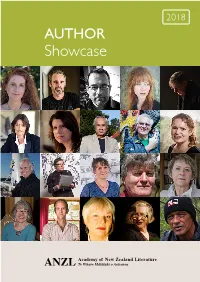
2018 AUTHOR Showcase AcademyAcademy ofof NewNew Zealand Zealand Literature Literature ANZLANZLTe WhareTe Whare Mātātuhi Mātātuhi o Aotearoa o Aotearoa Design: Diane Curry Please visit the Academy of New Zealand Literature web site for in-depth features, interviews and conversations. www.anzliterature.com Academy of New Zealand Literature ANZL Te Whare Mātātuhi o Aotearoa Academy of New Zealand Literature ANZL Te Whare Mātātuhi o Aotearoa Kia ora festival directors, This is the second Author Showcase produced by the Academy of New Zealand Literature (ANZL). We are writers from Aotearoa New Zealand, mid-career and senior practitioners who write fiction, poetry and creative nonfiction. ANZL Fellows and Members include New Zealand’s most acclaimed contemporary writers, including Maurice Gee, Keri Hulme, Lloyd Jones, Paul Cleave, Eleanor Catton, Anna Smaill, Witi Ihimaera, C.K. Stead and Albert Wendt. This showcase includes information on writers who are available to appear at literary festivals around the world in 2018. In this e-book you’ll find pages for each writer with a bio, a short blurb about their latest books, information on their interests and availability, and links to online interviews and performances. Each writer’s page lists email addresses so you can contact them or their publishers. Please note that New Zealand writers can apply for local funding for travel to festivals and other related events. Ngā mihi, Paula Morris Contact: p.morris@auckland.ac.nz Catherine Chidgey Catherine’s novels have achieved international acclaim. She is a multi- award winner, including Best First Book at both the New Zealand Book Awards and the Commonwealth Writers’ Prize, the UK Betty Trask Award, the prestigious Katherine Mansfield Short Story Award and the inaugural Prize in Modern Letters.