Matthew Hooton and Dirty Politics
Total Page:16
File Type:pdf, Size:1020Kb
Load more
Recommended publications
-
Public Version Fairfax / Nzme Response to Submissions 29
PUBLIC VERSION FAIRFAX / NZME RESPONSE TO SUBMISSIONS 29 JULY 2016 INTRODUCTION 1. NZME Limited 1 (" NZME ") and Fairfax NZ Limited (" Fairfax ") have had the opportunity to review the public submissions to the Commerce Commission (" Commission ") in response to the Commission's Statement of Preliminary Issues dated 14 June 2016 (" SOPI ") in relation to the Fairfax / NZME application (the " Application ") seeking approval to merge the New Zealand operations of NZME and Fairfax (the "Transaction "). 2. Fairfax and NZME's responses and observations in relation to the submissions and the key points contained in them are set out below. Appendix Two also contains an overview of the recent Reuters Institute Digital News Report 2016 and The Pew Research Center State of the News Media 2016 report that reinforce the acceleration of the trends identified in the Application. SUMMARY 3. The Commission received 49 submissions in total. Once duplicated submissions from a single person / economic entity are removed, there are fewer than 40.2 This is a low number of submissions on a high-profile transaction involving media. 3 4. All the submissions were from competitors, journalists, or academics / public policy lobby groups. That is unusual when measured, for example, against the range of submissions received by the Commission on its last high profile authorisation. 4 It is however not surprising. In traditional competition analysis, if competitors are opposing, it is often an indicator that the merger will be pro-competitive,5 as the merged entity is potentially expected to provide a better offering to customers (in this case, consumers and advertisers). 5. -

A Review of Regional Video News Funded by NZ on Air May 2018
A Review of Regional Video News Funded by NZ on Air May 2018 TABLE OF CONTENTS AUTHORSHIP .................................................................................................................................. 2 INTRODUCTION .............................................................................................................................. 3 EXECUTIVE SUMMARY .............................................................................................................. 3-5 PART A: PROJECT ASSESSMENTS ....................................................................................... 6-26 HAUKĀINGA (TE HIKU MEDIA) .............................................................................................. 6-10 Overview .................................................................................................................................... 6 Content: Subject overview ......................................................................................................... 6 Content: Individual video sample............................................................................................... 7 Audience .................................................................................................................................... 9 Stakeholder feedback ................................................................................................................ 9 Assessment ............................................................................................................................ -

Words That Make Worlds. Arguments That Change Minds. Ideas That Illuminate. Publishing Books That Make a Difference – 2016 Edition
Words that make worlds. Arguments that change minds. Ideas that illuminate. Publishing books that make a difference – 2016 edition. Summer 2016 POLITICS AND THE MEDIA: SECOND EDITION Edited by Geoff Kemp, Babak Bahador, Kate McMillan & Chris Rudd Journalists and presidents, hacks and spin doctors, media moguls and prime ministers: in New Zealand and around the world, politics and the media are deeply intertwined. Politics and the Media introduces students to the rich literature on media and politics internationally, covering history, political economy and contemporary trends, and then analyses the particular shape of the media in New Zealand and its political role. This second edition features extensive coverage of the 2014 ‘Dirty Politics’ campaign, the increasing importance of online media, and updated material in all chapters. Geoff Kemp is a senior lecturer in Politics and International Relations at the University of Auckland, Babak Bahador is a senior lecturer at the University of Canterbury in New Zealand, Kate McMillan is a senior lecturer in politics at Victoria University of Wellington, and Chris Rudd is a senior lecturer in the Department of Politics at the University of Otago. February 2016, 230 x 165 mm, 360 pages Paperback, 978 1 86940 847 3, $59.99 2/3 Summer 2016 THIS PAPER BOAT Gregory Kan This Paper Boat follows the author as he traces his own history through the lives and written fragments of Iris Wilkinson (aka Robin Hyde), of his parents and grandparents. He explores old territories of Robin Hyde’s, still dripping with the past – the tide pool at Island Bay, the garden at Laloma. -

Climate Change Communication in New Zealand
Climate Change Communication in New Zealand Oxford Research Encyclopedia of Climate Science Climate Change Communication in New Zealand Rhian Salmon, Rebecca Priestley, Michele Fontana, and Taciano L. Milfont Subject: Communication Online Publication Date: Aug 2017 DOI: 10.1093/acrefore/9780190228620.013.475 Summary and Keywords Climate change communication in Aotearoa New Zealand occurs through multiple channels, including public communication by experts; formal and informal science-policy dialogues; and publication of popular books, documentaries, and media reports. There is, in addition, a wide array of climate change communication activities that are less well documented, such as those that utilize the education system, social media, art, community events and festivals, and co-production processes related to adaptation and mitigation choices. Although research into the communication of climate change is in its infancy in the country, data on public attitudes toward climate change over the past decade indicate that most New Zealanders believe climate change is occurring, is anthropogenic, and is a serious concern. This is mirrored by research into media coverage on climate change, which shows that mainstream news reports are largely consistent with the scientific consensus and reports issued by the Intergovernmental Panel on Climate Change (IPCC), and do not give much coverage to skeptical or catastrophic viewpoints. Keywords: Aotearoa New Zealand, climate change communication, public engagement with science, science communication, Māori knowledge, Antarctic science, emissions trading scheme Introduction Aotearoa New Zealand is a relatively small and prosperous liberal democracy in the South Pacific with a well-educated population and an economy based substantially on tourism, dairy farming, and light manufacturing (Organisation for Economic Co-operation and Development [OECD], 2007). -

New Zealand Media Ownership 2016
NEW ZEALAND In 2016, the New Zealand media market MEDIA and ownership structures were stirred, and shaken as ownership convergence plans across media and telecom sectors were OWNERSHIP announced. Author: Merja Myllylahti 2016 December 1, 2016 AUT’s Centre for Journalism, Media and Democracy 1 New Zealand Media Ownership Report 2016 This JMAD New Zealand media ownership report observes that New Zealand media institutions are facing major changes in ownership and management, but it is not clear what combinations will eventually emerge. For the first time in six years, New Zealand media companies are exclusively owned by financial institutions. Media moguls and News Corp have sold all their shares in New Zealand media companies. The report also finds that the board structures of New Zealand media corporates favour further consolidation. This is not surprising, as many board directors have other directorships in financial institutions and corporate advisory businesses. In November, the Commerce Commission declined its preliminary merger approval of NZME & Fairfax. Unexpectedly, the commission stated in strong terms that the merger would give the combined company too much editorial and commercial power in print and digital platforms. It concluded that the merger failed the public benefit test, and would not be beneficial for democracy. However, the Commerce Commission makes its final decision about the NZME and Fairfax merger on March 2017. It is still possible that the merger will go ahead. In October, the commission delayed its decision about Sky TV & Vodafone NZ merger as it sought answers to “unresolved issues.” The commission raised concerns about the merged company’s market power in premium content such as live sports, as well as the likely impact on consumer prices. -

Fairfax/NZME's Response to TVNZ and Mediaworks' Submissions on The
PUBLIC VERSION Cross submission by NZME and Fairfax on TVNZ's submission dated 14 September 2016 and MediaWorks' submission dated 30 September 2016 Introduction 1. NZME Limited (" NZME ") and Fairfax NZ Limited (" Fairfax ") have reviewed the submissions by TVNZ and MediaWorks to the Commerce Commission (" Commission ") in response to the Commission's 14 June 2016 Statement of Preliminary Issues (" SOPI ") relating to the Fairfax / NZME application (the " Application ") seeking approval to merge the New Zealand operations of NZME and Fairfax (the " Transaction "). Executive summary 2. TVNZ and MediaWorks agree with a number of key and fundamental premises of NZME and Fairfax's original application, which are: (a) NZME and Fairfax, in their digital-first configurations, both have as their core business the online delivery of news / information. (b) TVNZ and MediaWorks compete with NZME and Fairfax in the production of that content and distribution of it online. (c) Both TVNZ and MediaWorks are substantial businesses with substantial reach: (i) TVNZ describes itself as the country's leading free-to-view video content provider, highlighting that it reaches 2.2 million New Zealanders every day and 3.7 million every month via its main broad channels (TVNZ1 and TVNZ2) as well as its TVNZ OnDemand and 1 News Now online services; (ii) MediaWorks describes itself as New Zealand's largest independent cross-platform media company, reaching 3.7m Kiwis and providing news and entertainment content across TV, radio and digital properties, including Newshub, which it describes as "New Zealand's only 24/7 TV, radio and digital news service". (d) These different characterisations by two major providers of news / information demonstrate the cross-platform and multimedia nature of the online distribution of news / information, in which NZME and Fairfax must compete. -
Re-Invention of the Daily News
PRESS ING ON Re-invention of the daily news An era lasting 163 years ended when the Taranaki Daily News printing press shut down for the last time on May 15. JIM TUCKER looks at the implications of big changes at our local rag: In 2004, a man in America suggested that the world’s last newspaper could be printed in 2044. That’s now less than a generation away. If Philip Meyer was right, papers like the Taranaki Daily News will disappear in fewer than 30 years. The trouble is, that’s not exactly what he said, although that hasn’t stopped his “prediction” becoming lore, especially among the newspaper industry’s rivals in broadcasting and online publishing. In his 2004 book, The Vanishing Newspaper, the US journalist- turned-academic used a couple of graphs that showed a steep drop in the number of Americans reading a paper each day (down from 70 percent in 1965 to half that by 2003). He noted: “Try extending (the) line with a straight edge, and it shows us running out of daily readers in March 2044.” But he added a rider: “Please don't take that observation as a prediction. Straight-line trends do not continue indefinitely. Nature likes to throw us curves.” No matter. The damage was done, and no amount of explaining by Meyer - and his book, updated with a second edition in 2009, does that in great detail - has swayed those who are convinced the advent of the internet and social media spell the finish of newspapers. So where does that leave the Daily News, which at last official count was still selling 17,791 copies a day, and has been the province’s prime source of news, advertising, social information and political exchange for more than a century and a half? friend declined, saying it seemed inappropriate This story is about what is being done to ensure considering what was happening. -

New Zealand Media Ownership 2017
NEW ZEALAND MEDIA OWNERSHIP 2017 AUT’s research center for Journalism, Media and Democracy (JMAD) Merja Myllylahti 4/12/2017 4/12/2017 Summary This JMAD New Zealand media ownership report 2017 reveals a considerable shift in the pattern of New Zealand media ownership. For the first time in seven years, the number of privately/independently owned media outlets exceeded the number of publicly (shareholder) and Crown owned companies. In 2017, there were seven privately owned media companies: BusinessDesk, NBR, The Spinoff, Allied Press, Newsroom, Bauer Media and MediaWorks - five of these were locally owned. Additionally, Scoop was owned by a New Zealand based non-profit charitable trust. The media market maintained some competition as the Commerce Commission ruled against NZME & Fairfax and Sky TV & Vodafone mergers. However, at the time of writing it was not clear how the competitive landscape will evolve. In October, NZME & Fairfax took their fight to the High Court, and that decision was pending when the report was published. In June, Sky TV and Vodafone decided to abandon their merger. The report notes that the digital news market expanded during 2017. There was more available digital news and current affairs content for the public. Yet, at the same time the print newspaper market shrunk with regional and local newspapers reducing staff and publication dates. Commercial television broadcasting showed signs of distress. New Zealand media ownership: key trends and events • More privately-owned media outlets than in any previous year • Sky TV and Vodafone merger denied and abandoned • NZME-Fairfax merger appeal at the High Court • Newsroom enters the digital news market • Financial difficulties for commercial TV broadcasters JMAD reports are freely available on AUT online: http://www.aut.ac.nz/study-at- aut/study-areas/communications/research/journalism,-media-and-democracy-research- centre/journalists-and-projects/new-zealand-media-ownership-report 1 4/12/2017 Content Summary p.1 Content p.2 1. -
AUTHOR Showcase
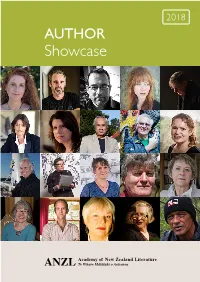
2018 AUTHOR Showcase AcademyAcademy ofof NewNew Zealand Zealand Literature Literature ANZLANZLTe WhareTe Whare Mātātuhi Mātātuhi o Aotearoa o Aotearoa Design: Diane Curry Please visit the Academy of New Zealand Literature web site for in-depth features, interviews and conversations. www.anzliterature.com Academy of New Zealand Literature ANZL Te Whare Mātātuhi o Aotearoa Academy of New Zealand Literature ANZL Te Whare Mātātuhi o Aotearoa Kia ora festival directors, This is the second Author Showcase produced by the Academy of New Zealand Literature (ANZL). We are writers from Aotearoa New Zealand, mid-career and senior practitioners who write fiction, poetry and creative nonfiction. ANZL Fellows and Members include New Zealand’s most acclaimed contemporary writers, including Maurice Gee, Keri Hulme, Lloyd Jones, Paul Cleave, Eleanor Catton, Anna Smaill, Witi Ihimaera, C.K. Stead and Albert Wendt. This showcase includes information on writers who are available to appear at literary festivals around the world in 2018. In this e-book you’ll find pages for each writer with a bio, a short blurb about their latest books, information on their interests and availability, and links to online interviews and performances. Each writer’s page lists email addresses so you can contact them or their publishers. Please note that New Zealand writers can apply for local funding for travel to festivals and other related events. Ngā mihi, Paula Morris Contact: p.morris@auckland.ac.nz Catherine Chidgey Catherine’s novels have achieved international acclaim. She is a multi- award winner, including Best First Book at both the New Zealand Book Awards and the Commonwealth Writers’ Prize, the UK Betty Trask Award, the prestigious Katherine Mansfield Short Story Award and the inaugural Prize in Modern Letters. -

Rod Oram, Business Journalist November 22Nd, 2016
Wilson & Horton Limited and Fairfax New Zealand Limited – Application for authorisation of a business acquisition Second submission by: Rod Oram, business journalist November 22nd, 2016 Rod.Oram@NZ2050.com 021 444 839 Summary: This submission is in response to the Commerce Commission’s draft determination on the merger application of NZME and Fairfax. It concerns codes of conduct and I offer it alongside the submission of Dr Gavin Ellis on media ownership, editorial content and intellectual property, which I support. 1. In my first submission dated July 1st, 2016, I made the case that NZME and Fairfax need to considerably strengthen and deepen their codes of conduct to: a. Bring greater transparency and accountability to their very powerful position in NZ media, if they were allowed to merge b. Greatly strengthen their competitive position against their main rivals, Facebook and Google. 2. In their Response to Submissions dated July 29th, 2016, NZME and Fairfax said in paragraph 94: “Both NZME and Fairfax already have such charters in place.” 3. However, seven problems arise: a. They post their editorial codes on their corporate websites. This is not an obvious place for members of the public to find them if they want to know their editorial rights. Logically, they would look on the news websites. b. The companies offer no evidence that they actively enforce the codes. c. The companies’ complaint processes for readers and users are not well sign-posted, and are barely documented. d. The companies’ other codes on privacy and data are posted separately; therefore in aggregate the codes do not form a coherent and compressive charter for readers and users. -

J Schools Urged to Take More Risks in Student Selection
J schools urged to take more risks in student selection New Zealand journalism schools need to take some risks in selecting students so the news media is properly representing the communities it reports on. That’s the view of Tim Pankhurst1, newly appointed general manager of the Communications and Media Industry Training Organisation. “If I’m on a selection panel I would favour someone from the so-called wrong side of the tracks,” he told 40 or so tutors gathered at Whitireia NZ Media Training Centre in Wellington last week for the annual conference of journalism educators. “When I did work in Christchurch it’s true that your status is dictated to a large extent by the school you went to. “My then-general manager, Don Churchill, used to announce in his Churchillian voice: ‘I went to Naenae College.’ “Nobody down there had heard of Naenae, let along knowing it was classic state house working class territory, and they would nod respectfully, imagining it was some sort of posh private school. And we would try to keep a straight face. “I’d like to see more kids from Naenae and the like coming through.” Here is most of Mr Pankhurst’s address: As many of you know, the government has targeted getting better value for money from its industry training budget, which quadrupled from $50 million to $200 million in the decade to 2009. The way Tertiary Education Minister Steven Joyce approached this was to base funding on completion of qualifications rather than on enrolments. This is a not unreasonable approach, particularly when closer examination found 11 dead people were being funded and more than half of all trainees received no training credits at all in a year, that is, they were not actually in training. -

"The Biggest Story Ever"
167 11 "THE BIGGEST STORY EVER" Jamie Morton* 11.1 Introduction New Zealand website The Spinoff once called climate change journalism's "biggest and most difficult story, ever".1 It was quite the summation. I am among a small stable of science and environment journalists in New Zealand who write about climate change almost every day. Before joining the New Zealand Herald in 2011, I had covered news beats that spanned from crime and court to health and local government, each presenting their own difficulties. Many veteran journalists might figure that approaching a feared criminal on the steps of a court house or stepping into the aftermath of a tragedy would be the toughest assignments a young reporter might face. But in writing about climate change, I have found a much larger trial. It is enormous in almost every way that one can imagine – and it is urgent. As the pressure for nations to act mounts, so too does the journalist's challenge of reaching the average Kiwi. Because for people to tackle the impacts of climate change in New Zealand and the Pacific, everyone will need to know more, and care more. For the media, the defining question of our time might well be how we, as truth brokers, help slow the climate change train before it hurtles off the rails. I have heard colleagues liken this to learning about a transformative event like the Christchurch earthquake – decades in advance – and trying in desperation to raise the warning sign. * Science Reporter, New Zealand Herald. Some of the quotations in the chapter are from interviews conducted by the author.